Re: Ya Ali Madad or A Shirk - Ask Allah (SWT) directly or it equates to shirk (merged
[quote=cricketplaya]
Bro, you are misunderstanding the whole concept of tawassul.
from Mufti Ebrahim Desai (askimam.org):
Tawassul (to seek a medium) is proven from Qur’an and Hadith. Allah
Ta’ala says, ‘O you who believe! Fear Allah and seek Waseela to Him.’
Hadhrat Umar (Radhiallaahu Ánhu) sought rain during drought through the
Waseela of the Prophet’s Uncle. However, due to people trespassing the
limits of Waseela and there is fear of committing Shirk, it is advisable to
abstain from Tawassul. Any permissible act which may lead to Shirk also
becomes prohibited.
I**t is clear and cut. There is no shirk involved. **
**We are not saying that asking Allah directly is bad or should be avoided, we are just saying on the matter of tawassul that it is permissible. **
Do you understand bro?
Also, please read the following, it is of great benefit to all!
In the name of Allah, Most Compassionate, Most Merciful,
Tawassul (using intermediaries in supplication to Allah Most High) through the Messenger of Allah (Allah bless him & give him peace), Awliya and righteous believers is permitted, rather recommended according to the four schools of Sunni Islamic law.
This has been the mainstream belief held by scholars of this Ummah throughout the eras. The Salaf (predecessors) from the earliest generations had this understanding and this has been the way of the four Sunni Madhhabs in Fiqh.
The meaning of Tawassul is: To ask Allah Almighty through the medium and intercession of another person. For example, one says: “O Allah! I ask forgiveness for my sins through the Wasila (intercession) of the Messenger of Allah (Allah bless him & give him peace)”.
Tawassul can be carried out through one’s own righteous deeds, the Prophet (Allah bless him and give him peace), righteous people who have passed away and those who are still alive. All these types of Tawassul are permitted and acceptable.
The permissibility of Tawassul is proven from the Qur’an, Sunnah, continued practice of the Ummah and reason.
Some of the proofs on the validity of Tawassul:
1) Allah Most High says:
“O you who believe! Fear Allah and seek a means (wasila) to him” (Surah al-Ma’ida, V: 35)
The word “Wasila” (a means of approach) in its general indication includes Tawassul (intercession) by persons, and through actions.
2) Allah Almighty says:
“If they had only, when they were unjust to themselves, come to you (O Muhammad, Allah bless him & give him peace) and asked Allah’s forgiveness, and the Messenger of Allah had asked forgiveness for them, they would have found Allah indeed forgiving and Most Merciful”. (Surah al-Nisa, V: 64)
These two verses are clear on the permissibility and recommendation of Tawassul. The distinction made by some, between the living and the dead in this matter only comes from one who believes in the perishing of souls upon death, which would lead to denying resurrection.
Also, when one uses Tawassul in supplication, one does not ask and seek from other than Allah Almighty. Only the high position, status and rank of the person through whom Wasila is carried out is used as intercession. In other words, the servant is saying: “O Allah! This certain Prophet or servant of yours is very close to you. I do not possess any good deeds, but I have love for the pious. O Allah! Pardon me and forgive my sins due to this love and connection I have with this pious servant of yours”.
Now, every person with a sound mind will determine that there is no reason to distinguish and differentiate between the living and the dead. This is the reason why scholars such as Imam Subki, Hafidh Ibn Kathir, Imam an-Nawawi (Allah have mercy on them all) and many others have declared the permissibility of Tawassul through the righteous, whether alive or passed away to the Mercy of Allah.
- Imam al-Tirmidhi (Allah have Mercy on him) and others relate from Uthman ibn Hunaif (Allah be pleased with him):
“A blind man came to the Messenger of Allah (Allah bless him & give him peace) and said: “I’ve been afflicted in my eyesight, so pray to Allah for me”. The Prophet (Allah bless him & give him peace) said: “Go perform ablution (Wudu), perform two Rak’at Salat and then say: “O Allah! I ask you and turn to you through my Prophet Muhammad, the Prophet of Mercy. O Muhammad! I seek your intercession with my lord for the return of my eyesight, that it may be fulfilled. O Allah! Grant him intercession for me”. The Messenger of Allah (Allah bless him & give him peace) then said: “and if there is some other need, do the same”. (Recorded by Tirmidhi, Abu Dawud, Nasa’i, Tabrani and others, with a sound chain of narrators).
The express content of this Hadith proves the legal validity of Tawassul through a living person. It implicitly proves the validity of Tawassul through a deceased person, as Tawassul through a living or dead person is not through a physical body or through life or death, rather, through the positive meaning attached to the person in both life and death.
- Moreover, Imam Tabrani relates in his al-Mu’jam al-Kabir reporting from the same Uthman ibn Hunaif (Allah be pleased with him) that a person repeatedly visited him concerning something he needed, but Uthman paid no attention to him. The man met his son and complained to him about the matter- this was after the death of the Messenger of Allah (Allah bless him & give him peace) and after the eras of Sayyiduna Abu Bakr and Sayyiduna Umar (Allah be pleased with them)- so Uthman (who collected Hadith and was from the learned) said : “Go to the place of Wudu, then come to the Masjid, perform two Rak’ats and then say : “O Allah!, I ask you and turn to you through our Prophet Muhammad, the Prophet of Mercy. O Muhammad! I turn through you to my lord, that He fulfil my need”… until the end of the Hadith.
This is an explicit and clear text from a Companion (sahabi) proving the legal validity of Tawassul through the dead. The Hadith has been classed as authentic (Sahih) by al-Bayhaqi, Mundhiri, al-Haythami and many others.
- In the Hadith recorded by Imam al-Bukhari and others, the Companion Umar (Allah be pleased with him) made Tawassul through the uncle of the Messenger of Allah (Allah bless him & give him peace), Sayyiduna Abbas (Allah be pleased with him), in asking Allah Almighty for rain at the time of drought.
These and many other Ahadith are clear on the permissibility and validity of Tawassul. This is the reason why the great traditional Sunni scholars have held this belief throughout the ages. Even in the present era, most of the Muslims who belong to the Ahl al-Sunnah Wa al-Jama’ah in most parts of the world have this belief.
Many books in Arabic and other languages have been written in refutation of those who regard Tawassul to be Shirk. Scholars from Syria, Jordan, Lebanon, Kuwait, Emirates, India, Pakistan and Saudi Arabia itself have rejected the position held by the minority -so called- Salafi sect.
As far as some of the scholars of the Haramayn are concerned, there views in matters of Aqida are generally from the blind following of Imam Ibn Taymiyya… The Imam, despite having great knowledge, in many issues chose a path which was different from the path of the majority of the Ummah, and the Scholars by and large did not accept his views.
At the same time, one should be precautious in not having any wrong belief in Aqidah. There should be the conviction that Allah Almighty alone has influence over everything, outwardly and inwardly. Also, one should not have the belief that the supplication (Dua) is not accepted without Tawassul. This is the real Tawhid.
And Allah knows best
Muhammad ibn Adam
Darul Iftaa
Leicester , UK**
dear brother
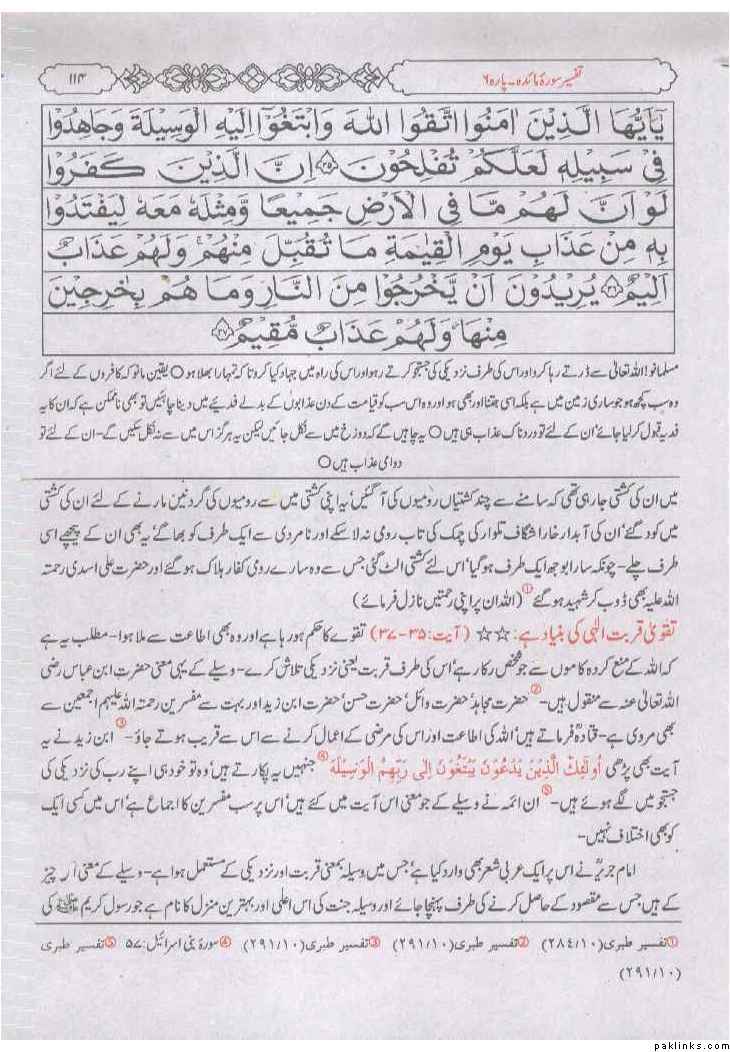
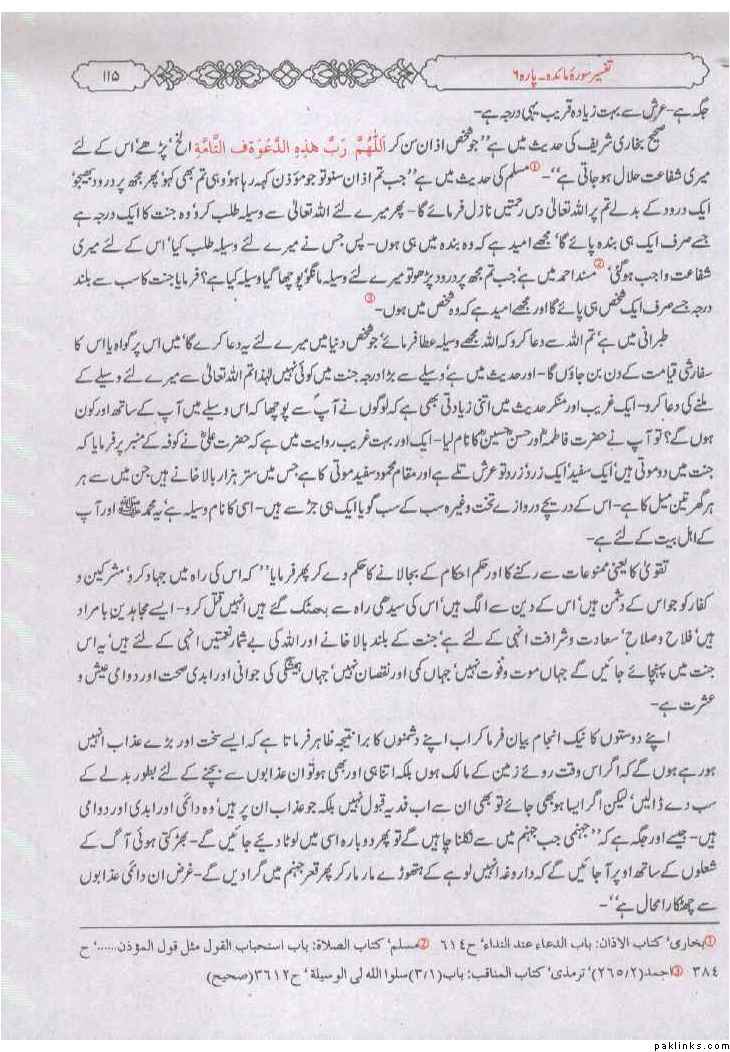
]ALLAH bless you,your post has a reference to Al-Maida, Ayath # 35. which contain the word"Waseela" . on the basis of this word, people argue about importance of waseela which is quite surprising. i have study the different explanations, no one support this ayath in this regard to which you reffered it.hazrat Mododi explain this Ayath as seek the " Qurb" by Taqwa not by something else.the most elaboration is in the Ibne Kaseer which i am attatching
**Al-Maid, Ayath35O ye who believe! do your duty to Allah seek the means of approach unto Him and strive with might and main in His cause: that ye may prosper.
taqwa here too might be translated “fear of Allah”, but the very next clause shows that “fear of Allah” does not mean “fear” in the ordinary sense, which would make you avoid the object of fear. On the contrary the “fear of Allah” is the intense desire to avoid everything that is against His Will and Law. It is in fact duty to Allah, for we are told to seek ardently the means by which we may approach Him, and that can only be done by striving with might and main for His cause.
see some Hateeth which shows the real method of Dua
Hadith Qudsi 35
Our Lord (glorified and exalted be He) descends each night to the earth’s sky when there remains the final third of the night, and He says: Who is saying a prayer to Me that I may answer it? Who is asking something of Me that I may give it him? Who is asking forgiveness of Me that I may forgive him? And thus He continues till [the light of] dawn shines.
Sahih Al-Bukhari Hadith
Hadith 8.350 Narrated by Anas
Allah’s Apostle said, "When anyone of you appeal to Allah for something, he should ask with determination and should not say, ‘O Allah, if You wish, give me,’ for nobody can force Allah to do something against His Will.
regards