Re: roadrunner:kindly differentiate vedism and hinduism
A good discussion can be done without calling names. Even though ssingh does not care, I care because one (rr) does not have to be disrespectful in order to push his/her point through. It's nto a big deal anyways.
Re: roadrunner:kindly differentiate vedism and hinduism
Hinduism is word coined in the last few hundred years.
Previously is used to be Vedic Religions based on Vedanta Philosophy aka Sanatan Dharma.
The Whole World is One Family
By Stephen Knapp
        The title may sound like some fantasy, or a overly utopian idea, but actually this is the premise of the Vedic teachings. That is why there is the saying in Sanskrit, Vasudhaiv Kutumbikam, “the world is one family”. Certainly we can see that the whole world is populated by people who are working to attain the same things: happiness, peace, security, resources like food and shelter, and a hopeful future. How much easier it could be if we focused on our similarities instead of our differences. And with that, how much easier it would be to find the necessary cooperation that would pave the way for global assistance in helping everyone acquire what they need.

        Yes, we are all born in certain parts of the world and may have different physical or cultural characteristics. You may be born a Caucasian in America, or a black person in Africa, or an Arabian, or German, or in an Islamic family or Christian, etc. But did you make a decision that this was what you were going to be? Or did you just sort of find yourself in this situation? Did you just happen to have a family that taught you what you should accept yourself to be? Or did you really make a deliberate decision that this was the identity you wanted to accept? Or, on the other hand, would you really like to see more deeply than this identity and discover what you are above and beyond the temporary and changing body? The fact of the matter is that we are all hoping and struggling to find the same basic needs as everyone else. So this means that whatever the appearances of the body may be, we all have many of the same aspirations. And we share the planet similar to the way a family of brothers and sisters share the same home.

        Why the Vedic texts teach how we are all one family can be explained. The Vedic literature, the oldest spiritual and philosophical texts in the world, do not preach the superiority of one religion over another, but espouse the doctrine of santana-dharma, which is the eternal path for all living beings based on the nature of the soul. These ancient Vedic scriptures only recommend the highest level of dharma that a person can follow, depending on what he or she would like to accomplish in this life. Otherwise, we can consider a variety of thoughts and philosophies that may assist in our progress. This is also why he Rig Veda explains: aano bhadrah kritawo yantu vishwataha, which means, “Let noble thoughts come to us from everywhere.”

        The premise is that we are all spiritual beings who are not these bodies but only inside them. Our real identity is not whether we belong to a certain ethnic group or culture. Yes, we may follow a certain path or religion, but these can be changed and the soul is above all such temporary designations. And the nature of the soul is to love and be loved. Everyone is working and wishing for that, because happiness is found in relations, and no happiness is higher than a deep loving relationship. But the highest relationship is that which we, as spiritual beings, share when it is based on devotion to the Supreme Being, the ultimate lovable object. That is the eternal spiritual path, or santana-dharma.

        By having a solid understanding of such spiritual knowledge, there is automatically a respect for all others regardless of race, sex, or species. This brings a moral and peaceful social behavior in everybody toward everyone. By having respect for everyone’s spiritual identity, parts and parcels of the Lord, this also brings an innate happiness in us all. We can understand that we are only visiting this planet for a short time, and that we are all in this together. In other words, my contribution to your well-being, especially spiritual well-being, will be an automatic contribution to my own existence. In this way, society at large is in a state of constant improvement. That is the goal of the Vedic way of life.

        Therefore, the Vedic system means a way of life that aims at the elevation of everyone in society to a higher level of consciousness. It means to assist ourselves through a disciplined and godly life to understand the purpose of our existence as well as to become a spiritually realized person. It also means that we help every other individual soul because by helping others we help ourselves. That itself is a natural state of being when we can perceive God as the Supersoul, Paramatma, within everyone. All of this is encouraged by, and increases, a natural faith in an all-pervading Supreme Being. Such faith and focus on the Supreme Being, when systematically developed, can elevate us to return to our real spiritual home after death, which is one of the most important goals of the Vedic lifestyle.

        This Vedic premise is one of the reasons why India has always welcomed so many other religions into the country. India is the homeland of some of the oldest religions in the world. In the Vedic system, there is room for both dissent and digression and freedom of choice. The basic principle is that the freedom of the individual is all important. It is not that the beliefs of one must be imposed on another. Thus, different communities following different ways can live together in amity. Spiritual Truth itself can manifest in different ways, depending on the lessons that an individual needs to learn, and the ways that he or she may need to grow in this particular lifetime. Therefore, because of different levels of consciousness within people, it should not be expected that only one religion or philosophy has everything that can fulfill everyone everywhere.

        The trouble we see so much of in the world today is not so much a clash of religions, but a clash of individual egos of people who associate their bodily identity and cause with their religion. It is the tendency of the human mind to cling to those people who are similar, and claim superiority over those who are different. This itself leads to the divisions of religion, caste, ethnic group, or race. Thus, the tendency becomes to defend one’s own weakness, inferiority or insecurity by unnecessarily criticizing and hurting others to establish one’s own sense of position and superiority. However, in these days this is often done in the egotistical guise of defending one’s own religion. But this ignores the very love, compassion and tolerance that most religions claim to represent or teach. And certainly it ignores the very love, mutual respect and cooperation that we seek, and that the world depends on if we and this planet are to survive. Why not take the noble path of being more willing to live up to your religion rather than to simply fight or die for it? This alone would settle many of our differences and world problems. We have to decide whether we want to live with each other or fight with one another. The answer should be obvious.

        As it is concluded in the Atharva Veda: “We are birds of the same nest. Wearing different skins, speaking different languages, believing in different religions, and belonging to different cultures – yet we share the same home, our earth. Born on the same planet, covered by the same skies, gazing at the same stars, breathing the same air, we must learn to progress happily together or miserably perish together. For humans can live individually but can survive only collectively
Re: roadrunner:kindly differentiate vedism and hinduism
Previously is used to be Vedic Religions based on Vedanta Philosophy aka Sanatan Dharma.
The Whole World is One Family
By Stephen Knapp
The title may sound like some fantasy, or a overly utopian idea, but actually this is the premise of the Vedic teachings. That is why there is the saying in Sanskrit, Vasudhaiv Kutumbikam, “the world is one family”. Certainly we can see that the whole world is populated by people who are working to attain the same things: happiness, peace, security, resources like food and shelter, and a hopeful future. How much easier it could be if we focused on our similarities instead of our differences. And with that, how much easier it would be to find the necessary cooperation that would pave the way for global assistance in helping everyone acquire what they need.
Yes, we are all born in certain parts of the world and may have different physical or cultural characteristics. You may be born a Caucasian in America, or a black person in Africa, or an Arabian, or German, or in an Islamic family or Christian, etc. But did you make a decision that this was what you were going to be? Or did you just sort of find yourself in this situation? Did you just happen to have a family that taught you what you should accept yourself to be? Or did you really make a deliberate decision that this was the identity you wanted to accept? Or, on the other hand, would you really like to see more deeply than this identity and discover what you are above and beyond the temporary and changing body? The fact of the matter is that we are all hoping and struggling to find the same basic needs as everyone else. So this means that whatever the appearances of the body may be, we all have many of the same aspirations. And we share the planet similar to the way a family of brothers and sisters share the same home.
I'm not reading throught this nonsense by "Stephen Knapp" now, just tell me how this article, or you disagrees with my three points above..
Vedic society believed in different Gods, different colour-skinned Gods in fact,
Vedic society had no castes, whereas casteism is central to Hindu belief.
*]Vedic society ate beef, whereas the slaughtering of the cow has been made illegal within the Hindu framewor of belief through latter books.
Re: roadrunner:kindly differentiate vedism and hinduism
Roadrunner I will clarify:
There is no such things as different coloured Gods. Idols, paintings etc. are based on the imagination of the artist (Camera was invented in 1857 only!!) . Lord krishna is portrayed differently in different parts of India and so is Lord Hanuman and other deities.
Main deities have always been three Brahma-Vishnu-Mahesh synonymous with philosophy of creation-preservation-destruction. One deity is known with several names and is portrayed differently in different parts of the country.
What is casteism..it is classification of people according to the work they do. This concept has existed in human mind since time immemorial but a science was made out it by Ancient Hindus...i.e. they started fitting people into four broad classifications. It is the most misunderstood and most misrepresented concept. When such classification was introduced there was no such thing that one class is superior to another. But subsequently two anomalies creeped into this concept, First..it got associated with inheritance and Second.. one class started exercising supremacy over another. This was the start of downfall and fragmentation of society.
Sanatan Dharmis...many of them were meat eaters. Beef was consumed. The practice of beef eating was stopped because cow was considered as resource (milk, dung for fuel/fertiliser etc.). So killing a cow meant eliminating a resource which has availability for many years. Moreover it was also noted that meat eating was also leading to diseases. Hence consumption of beef got prohibited. These sanatan dharmis also used to cosume alcohol (Sura, Amritsaar, Somras)
Now tell me why consumption of pork is prohibited in Islam?
There is a scientifc explanation for instead of relgious one. It is an animal which likes frolicking in mud & muck and consuming its meat is an invitation to disease (who likes tape worms)..so a story has to be woven around the concept and if it has religious colour in it, it becomes more convincing like the holy cow concept.
There is no such thing as Vedism. Ancient religion was Sanatan Dharma which got rechristened as Hinduism.
Re: roadrunner:kindly differentiate vedism and hinduism
I’m not 100% sure on this, but I’ll look up the references for it. I don’t think you’re right here, the camera is irrelevant, and paintings are most definitely irrelevant. The basis of colour of the Gods of the Veda and the Gods of Gangetic Hinduism is the texts themselves. But even colour isnt the most important thing here. We’re talking about who were the Gods of the Rig Veda, and who the later and present Gods of Hinduism. The Rig Vedic Gods were Indra, Agni mainly, these were all powerful and the most talked about ones of Vedic society. Later books describe these two as being defeated and surrendering to the Gods of the later non Rig Vedic books. This is the point. The Gods were different and the Vedic Gods were all powerful in Vedic mysticism, but were secondary Gods in the non Rig Vedic books. That to me is a completely different philosophy between the two religions of Vedism and Hinduism.
Now this is 100% wrong, in fact you have contradicted yourself here by mentioning that the classifications have been introduced , and that castes have become superior to one another. This is Hinduism. In Vedic society, all the people were equal, as mentioned in the Veda. It is when the latter Puranas came about that you start hearing about Hindu castes, supremacy and inheritance. Here’s a quote from the Rig Veda as an example for the lack of caste system
"All men are brothers; no one is big; no one is small. All are equal."
Now that quote was from the Rig Veda.
The following quotes are from the Laws of Manu (Bharati Hindu religion, not Paki Vedic religion)
Evidence of caste and inherited caste "87. But in order to protect this universe He, the most resplendent one, assignedseparate (duties and) occupations to those who sprang from his mouth, arms, thighs, and feet.
Evidence of superiority 96. Of created beings the most excellent are said to be those which are animated; of the animated, those which subsist by intelligence; of the intelligent, mankind; and of men, the Brahmanas;"
*The Laws of Manu I | Sacred Texts Archive *
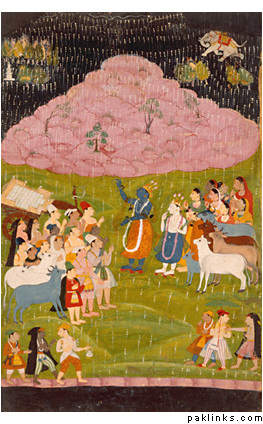
And this is where you’re going wrong! I’ve tried explaining this to you. Let me try, this time with an example. This uses the Krishna Govardan conversation from the Bhahadgavita. I would have thought you know that Indra is a Rig Vedic God, in fact the main Rig Vedic God of the Vedic (ancient Paki) people. In this scene from the Gita, Indra (who’s the God of Storms) is angry with a group of cow herders for preventing sacrifices to him so to punish them he reign torrents of rain on them for a week. Krishna though came to the rescue of them and raised a mountain above the herders and herd with his finger to protect them. The elephant in the background is Indra descending from the skies to admit defeat before Krishna (a Dravidian God). Now, tell me, would the Vedic Pakis have accepted a writing of their main God Indra defeated by a Dravidian foreign God, Krishna and then have him grovelling before Krishna? No way is the answer.
You must acknowledge that there is something deeply contradictory in Hinduism’s claim of following the Bhahadgavita and the Rig Veda. The two books are poles apart. Simply poles apart. The story that I’ve quoted above is one example of the way in which Hindu Scripture worships the Cow (note, not the scripture of the Rig Vedic Aryans). You should try reading TR Sesha Iyengar’s book “Dravidian India”. Here’s parts of it..
All these things like Brahminism, Casteism, ban on beef eating, are all Hindu forms of worship. Even Krishna is supposedly the 8th avatar of the Dravidian Vishnu God.
“Of course, mainstream scholarship has now come around to the view that Shiva, Vishnu and his incarnations, are of Dravidian origin.” - Taken from the link above.
It’s mentioned in the Qu’ran not to eat pork. It is similarly mentioned in the more recent Hindu scriptures that the cow is a sacred animal and must be protected just like Krishna did in the Gita. These are scripture based laws. However the Rig Veda places no such ban on cow eating. It in fact encourages cow eating in the name of sacrifice to Indra and the other Rig Vedic Gods.
Vedism is well known to everyone. It has it’s name usually as Vedic civilization, or Vedic society, or Vedic Aryans, and this was an ancient Paki civilization.
Re: roadrunner:kindly differentiate vedism and hinduism
Nescio, please ask roadrunner to summarize his findings with proof in one post. I am completely confused with his vedism, hinduism, pakistani, indian, race, colour etc. After he is done..
Give us then a opportunity to summarise our response.
thank you.
“In this wide-ranging work, Iyengar has distilled years of his research in Dravidology. In many respects, he was decades ahead of scholarship. He elucidates the Dravidian origin of Sumerians and Australoids. A large part of his work is of course devoted to the Dravidians and the Indus Valley Civilization. The Dravidian nature of the Indus Valley is of course well-accepted now:D , but we must remember that Mr. Iyengar wrote these things when the identity of the Harappans was not so well-accepted”.
Besides, roadrunner…bhagavad geetha is called cream of vedas or gist of vedas. there is nothing poles apart in its philosophy. and stop acting as though you have read gita or vedas. Irrespective of what ever it is, we are followers of vedas. end of discussion.
Re: roadrunner:kindly differentiate vedism and hinduism
It seems, whatever you say, that is the truth and we should accept it:D ...that's how you discuss. whatever it is, you cannot escape from the shadow of india on your culture:D ....if you want to, go back to from where your ancestors came from. and can look for you people of your color.
Re: roadrunner:kindly differentiate vedism and hinduism
Now this is 100% wrong, in fact you have contradicted yourself here by mentioning that the classifications have been introduced , and that castes have become superior to one another. This is Hinduism. In Vedic society, all the people were equal, as mentioned in the Veda. It is when the latter Puranas came about that you start hearing about Hindu castes, supremacy and inheritance. Here's a quote from the Rig Veda as an example for the lack of caste system
"All men are brothers; no one is big; no one is small. All are equal."
Now that quote was from the Rig Veda.
No...it is you who are contradicting yourself. If vedas say that all men are brothers and equals....then it must also say all people of all color must be same. isn't it?:D if it doesn't, then it is corrupted. that's it.
and manusmriti was composed much later than your aryan invasion. the very basis of aryan invasion is, caste system came and was established by aryans in the subcontinent. then manusmriti must also have been established by aryans. is it not??:D...one more contradiction from you. given an oppurtunity, you will leave no stone unturned to twist facts and make it suit to your ego. and yes, i am a follower of vedic religion/hinduism.
Re: roadrunner:kindly differentiate vedism and hinduism
This just goes to show it was a Dravidian that wrote that piece and he accepts Vedism and Hinduism as different. Even your own websites admit this. And I have proof that Harrappa was a mix of Aryans and Dravidians..the skeletal remains have been found and point to a mix of people making up Harrapa, much like modern day Pakistan.
I havent read the entire Veda, and do not need to read it to know it is the complete opposite of modern day Hinduism. I’ve just provided some points to show it is.
Re: roadrunner:kindly differentiate vedism and hinduism
You opened the thread, found out your case is weaker than mine, then want it closed! you asked for it, and it's an informative thread that should remain informative.
Re: roadrunner:kindly differentiate vedism and hinduism
Besides, your website which you gave also says this. He is not a dravidian if you club brahmins in india as aryans, which you said earlier. His name is iyengar, he is a brahmin infact of top order. besides he also says this:
Iyengar, moreover, notes the profound influence which Dravidian has effected upon Sanskrit:
"The Aryans on their arrival at the north-west frontier found the Dravidians in flourishing communities. It can be asserted that the subsequent development of the uncultured Vedic tongue, which resulted in Sanskrit, was owing to the influence of the highly civilized Dravidian, when the former came into contact with the latter. Prof. Rapson (ftn. p.50, Cambridge History of India Vol.I) bears testimony to the fact that the aboriginal languages in the south of India were associated with a high degree of culture, and hence it is not surprising to note the presence of the Dravidian element in Sanskrit.
Re: roadrunner:kindly differentiate vedism and hinduism
It's called cream of vedas by modern hindus. Do you honestly think Vedic people would have want anything to do with modern day Hinduism when it's completely different to what they practised in their own society? You have merely gone and adopted their culture and added some extra things.
Re: roadrunner:kindly differentiate vedism and hinduism
that i know that my case is weaker:D ....informative,yes...it should be. provided if one side doesn't end up saying that proof brought by other side as wrong each every time when the authors of those scriptures themselves can be attested as biggest proofs.
Re: roadrunner:kindly differentiate vedism and hinduism
Brahmanical Hinduism originated from India, and in South India, Brahmins are Dravidian.
[QUOTE]
Iyengar, moreover, notes the profound influence which Dravidian has effected upon Sanskrit:
"The Aryans on their arrival at the north-west frontier found the Dravidians in flourishing communities. It can be asserted that the subsequent development of the uncultured Vedic tongue, which resulted in Sanskrit, was owing to the influence of the highly civilized Dravidian, when the former came into contact with the latter. Prof. Rapson (ftn. p.50, Cambridge History of India Vol.I) bears testimony to the fact that the aboriginal languages in the south of India were associated with a high degree of culture, and hence it is not surprising to note the presence of the Dravidian element in Sanskrit.
[/quote]
We know Sanskrit is not a Dravidian language genius. Look up its classification anywhere. It's a pan Dravidian Hindu website that admits Vedism and Hinduism are different. At least some people can.
Re: roadrunner:kindly differentiate vedism and hinduism
We know Sanskrit is not a Dravidian language genius. Look up its classification anywhere. It's a pan Dravidian Hindu website that admits Vedism and Hinduism are different. At least some people can.
you didn't bring any evidence for this genius. when dravidians dominated indus valley and sanscrit developed in indus valley, then who contributed to it genius?....and it is south indians who are more proficient in sanscrit than north indians genius:D
Re: roadrunner:kindly differentiate vedism and hinduism
^^Singh, I'll reply later. But when Sanskrit developed the Vedic Aryans had come to the Indus Valley..Indo European should ring a bell in your head here. And also Dravidians did not dominate the Indus Valley when the Indus Valley flourished. We know this from fossil records.