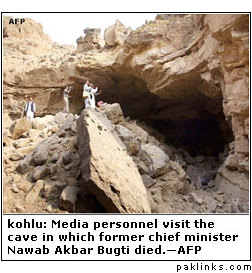
Re: Nawab Akbar Bugti Killed (MERGED)
Another excellent article on the issue
Rover’s diary: Akbar Bugti phenomenon, in a historical perspective
BABAR AYAZ
ARTICLE (September 04 2006): Many years back I had called on Nawab Akbar Bugti at his Quetta residence; he was a bitter man, although his son Salim was a senior Minister in the Balochistan government. During the discussion on harnessing Balochistan’s oil and gas resources, he said that no fresh exploration should be allowed in the province.
Knowing the reasons of his reaction, I suggested that the Balochistan government or the people living on each concession should establish their respective holding companies, which should partner with the prospective exploration companies.
“For instance,” I explained, “You can have, say, 15 to 20% equity in the company so that when oil and gas is discovered you can share the profit.” Nawab Bugti laughed at my suggestion cynically and said: “Babar, you are naïve, the government (Federal) is not willing to give us control over our resources so how can we negotiate with others?” In a way, he was right; the constitution of Pakistan does not give the common people any right over oil and gas reserves.
He was not the only one in Balochistan who felt that the natural resources should not be developed till the province got control over them. “Let them be under the ground as this is the asset of our people, we don’t want to lose them like Sui gas reserves.” This has been the common stand of most Balochis. And that of other nationalists in Sindh and NWFP.
Now every government in Islamabad believes that natural resources are national assets and not that of the nationalities that live there. It is this unresolved provincial autonomy issue which is haunting Pakistan from its inception. Provinces have been denied their right to control their economic resources although we have lost half the country because of this stupidity of the establishment. Their fiscal powers have also been clipped.
Let’s briefly look at the Balochistan issue, as it is one of the worst examples of centre-province relationship in what remains as Pakistan.
First the understanding was reached with the Khan of Kalat on August 4, 1947 that Kalat would be independent on August 15, 1947, enjoying the same status as it originally held in 1863, having friendly relations with its neighbours. Another agreement was signed with Pakistan on the same date which said that: The government of Pakistan agrees that Kalat is an independent state, being quite different in status from other states of India, and commits to its relations with the British Government as manifested in several agreements.
It was agreed that in the meantime a standstill agreement be made between Pakistan and Kalat by which Pakistan shall stand committed to all responsibilities and agreements signed by Kalat and the British government from 1839 to 1947 and by this Pakistan shall be legal, constitutional and political successor of the British. (The British had only control over Quetta and some other areas). A few weeks later Kharan and Lasbella states and Marri and Bugti tribal areas were returned to the Kalat fold. The Kalat Government made a formal independence declaration on August 15, 1947 and a delegation came down to Karachi to discuss the future relationship with Pakistan.
While Khan of Kalat seemed inclined to merge his state with Pakistan, the Baloch Sardars of his jirga were not inclined to do anything in haste without settling the provincial autonomy issues. The Khan was under considerable influence of Quaid-e-Azam and had promised to work out the merger details in three months, but as Quaid was sick this issue was handed over to his cabinet.
They mishandled the whole issue and used the British tactics to place the Balochis against each other by carving out three states of Kalat - Kharan, Lasbella and Makran. This resulted in the first uprising against Pakistan in 1948. The unilateral decision to break the Kalat State by Pakistan was contrary to the earlier understanding that in case the relations of Kalat with any government got strained, Kalat will exercise its right of self-determination.
That was the beginning of the people of Balochistan’s revolt against the centre. They have been to the hills many times since then, the last (before the present armed revolt) being the one against the dissolution of their elected government by Bhutto in 1972. It was just after a few days of the signing of the constitution. Khair Baksh Marri had refused to sign it as it did not recognise the rights of the provinces over their economic resources.
Although the gas was found in Sui in 1952 the province was not given any share from its profits. The province’s right over 12.5% royalty on oil and gas was accepted as late as in 1995.
And what does Balochistan get on the gas produced by it, which meets almost 21% energy needs of the country, is pittance. This royalty goes into the provincial kitty but not much trickles down to the people of the area who actually own this precious natural resource. Imagine how rich the Bugtis would have been if they were in the US, where people became billionaires when oil was found in their land. The government always tried to pacify Akbar Bugti by giving him some money through PPL, but in all fairness what he got and what the province got in the last 54 years was peanuts.
True Akbar Bugti was a brutal tribal Sardar who had a stake in maintaining the status quo which is primitive socially, politically and economically. All in the name of Baloch traditions. But he was not much different in this from a number of other tribal chiefs on the side of the government.
All governments had worked towards preserving this system, even though sometimes they talked about breaking the sardari system. Social systems are not changed through decrees not worth the paper they are written on. This change can only be brought in by changing the economic relations in that society. Not selectively only in the areas of the hostile Sardars, but across the board. What is needed is to empower the people of the area and not the Sardars. This objective can be achieved by giving substantial percentage of the earnings from natural resources to the local governments in that area. As a matter of fact they should be allowed to collect it directly from the exploration and production companies. They should decide what development projects they want and it should not come from above.
The issue of areas which are not blessed with natural resources can be dealt with through federal and provincial grants. The Federal and provincial governments then should ensure that the information about the funds collected is widely publicised. The rest would be done by the people themselves.
The prosperity and high income level of the people living in resource-rich areas would encourage others to seek investment in their areas.
They would also be benefited from a rise in consumption in rich districts and would find some thing to sell to their rich cousins. If Bugtis were given their due share from Sui earnings, Marris would not have stalled the exploration in their areas. They would have rather competed to get the investors to explore what lies in their land.
In the interest of the country, the constitution has to be amended accepting that provinces have a right over their economic resources. The centre can brow-beat the people who stand for this right, but cannot extort. Remember what Habib Jalib said when General Yahya launched a military operation in the then East Pakistan - “Mohabbat golion sey bow rahey ho/Gumaan tumko kay rasta kat raha hey/Yaqeen mujhko kay manzil kho rahay ho.” (Sowing love with bullets/You are presuming it’s a way forward/I am sure you are losing the way).