All things Hezbollah vs Israel (merged threads)

Re: ~! Difference between the two groups fighting

Nearly everyone? Pray tell where did you get this statistic? FOX or CNN or maybe both? Since when is a government which only represents the minority and cares about certain sectors of a nation considered legitimate?

[QUOTE]
If support for Hezbollah is high now, what will it be like when everything is "over"?
[/QUOTE]

Pretty high. Just like it has always been before and after the fighting.

[QUOTE]

work on gaining power legitimately. When are elections in Lebanon anyway

[/QUOTE]

They are already gaining power through votes, but since seats in Lebanon are allocated by religion and not by number, they only have a few seats. They would be the majority if a FREE and FAIR election was held in Lebanon. The current government in Lebanon is a joke, a farce and does not represent the majority of the Lebanese.

Re: ~! Difference between the two groups fighting

AMEEN

Re: ~! Difference between the two groups fighting

Firing missles indiscrimately into cities and then apologizing for killing children. What do they expect to happen? Are we supposed to be impressed by this apology?

Re: ~! Difference between the two groups fighting

Has Israel ever apologized for its massacres of civilians?

All things Hezbollah vs Israel

**TYRE, Lebanon (CNN) – The last time I sat down to write something, it was about the cost of war. As I looked ahead to the coming days, the last words I wrote were: Who will die?

**Today, I found out.

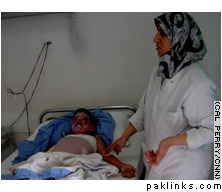
Standing in front of this 8-year-old boy lying in a hospital bed, the “conflict in the Middle East” and the “cost of war” seem endless and suffocating. His pain cannot possibly be imagined as he shakes uncontrollably in and out of shock. He has blood coming from his eyes.

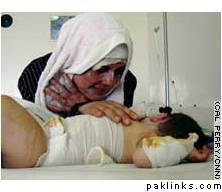
His name is Mahmood Monsoor and he is horribly burned. In the hospital bed next to him is his 8-month-old sister, Maria – also burned. Screaming at the top of her lungs is the children’s mother, Nuhader Monsoor. She is standing over her baby, looking at her son – and probably thinking of her dead husband. The smell of burned flesh is overwhelming.

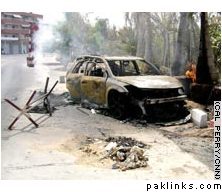
Mahmood Monsoor is badly burned from the strike on the car.

This story, for the Monsoor family, started out as a typical one, probably one that most of us have experienced. They had simply gone on a family vacation to some lovely sunny beaches, but these beaches were in southern Lebanon.

The six of them, like thousands of others, were fleeing the fighting – trying to get north, waving white flags, when an Israeli bomb or missile slammed into their car.

The father, Mohammed Monsoor, was killed instantly. His children all were wounded. His wife, who is now crying over two of the wounded children, was in the best physical condition. But as would be the case for any mother and wife, her life, in many ways, ended the minute the car exploded into flames.

The other two Monsoor children, Ahmed, 15, and Ali, 13, are in surgery. Doctors can’t tell me if they will make it. They walk away, their heads shaking. Optimism is not a word that breathes truth in this place.

There are more than enough stories like this, in hospitals across southern Lebanon. This hospital, on this day, seems to be a microcosm of the region. Less than 100 meters from the front door of the hospital, a car is on fire. Less than 30 minutes earlier, the car exploded as an Israeli jet circled overhead. The fog of war has crept into the hospital, and no one knows where the casualties of that strike are being treated.

Just days earlier, staff at this hospital were moving bodies out to make room for more. Like an assembly line of the dead, unless the bombings stop, they will be doing the same tomorrow.

The city of Tyre has been enduring stories like this for more than a week. Buildings are crumpled; those who have not left are hiding in basements. Those who dare to pack into cars run the risk of ending up like the Monsoor family. Some who move north die on the road. Some stay in basements, and die there. Others hope against hope that the bombs will fall elsewhere – missing them.

Politics creeps into the ward like the blood that runs on the floors. “Clearly he is Hezbollah,” says one of the doctors outside the room – sarcastically referring to 8-year-old Mahmood, whose screams can be heard from the hallway. His screams now blend with the wails of his mother, matching the baby’s cries.

The hospital ward begins to teem with members of the international press. They all have blue flak jackets that say “press” on the front. They carry microphones, cameras, radios and satellite phones, and have local guides to translate.

Today, as I finish I am sitting in the same spot and the shells are still falling. Hezbollah rockets are firing toward northern Israel. I can imagine another reporter, in another flak jacket, standing over an 8-year old Israeli boy.

I’ll finish by asking another question: Are any of us making a difference?

Tomorrow, I’ll let you know.

Nuhader Monsoor cries over her wounded baby, Maria.

The Monsoor family’s car was hit as they tried to flee to the north.

Re: Four children and the cost of war

i saw her story on tv today, distressing in a way words cannot begin to illustrate.

Allah rehem karai.

Re: ~! Difference between the two groups fighting

You should consider the possibility that the Israeli attacks, Iraq, Afghanistan, Chechnya etc… are actually the wrath of Allah.

Allah works in mysterious ways.

Re: All things Hezbollah vs Israel

I have no idea why American, Israeli and “the intellectuals” think they can eliminate Hezbollah. The “goal” they want to accomplish keeps changing day to day, which indicates that they are already running out of excuses for legitimizing this mass murder. Second, even if they come close to it, they will not succeed. Almost every Shiite family in the South Lebanon contains Hezbollah members or sympathizers, which is hardly surprising when you have a harsh eighteen years of Israeli military hostilities. Now, when the Lebanese will see their current leader shaking hands with Condi, the majority will go and support Hezbollah. Lebanese have defeated Israelis before and they will do it again.

Long Live Lebanon.

Re: All things Hezbollah vs Israel

Lebanon...What I pity
By Samah Idriss
Online Journal Guest Writer

Jul 24, 2006, 00:56

To the indignation remaining in Suheil Idriss’ eyes.
I write these words as the Israeli aggression against Lebanon enters its seventh day, following military operation by the Islamic Resistance which resulted in the capture of two Israeli soldiers and the killing of seven more. I flip through the television channels and the newspaper pages. It all makes me say, “What a pity, Lebanon.”
Yet, I do not say this because I see Lebanon “stuck in a war created by the machinations of the Syrian-Iranian axis.” Such is the claim made by those who either neutralize Lebanon from the Israeli-Arab conflict, among them the February 14th bloc, or make its participation in that conflict contingent on the participation of all other Arab countries. Nor do I say it because I am skeptical about HizbAllah’s success in achieving its declared aims, i.e. the release from Israeli prisons of Lebanese prisoners, and perhaps Arab prisoners, too. Nor again do I say it because I bemoan (though truly I do) the destruction of the airport, bridges, and the rest of the infrastructure whose construction cost we Lebanese are paying from our own pockets and will continue to pay from our children’s and grandchildren’s pockets for tens of years to come.
Yes, Lebanon, I pity you. And yet . . .
What I pity about you, Lebanon, is that you should be afflicted by a leadership that did not take advantage of the liberation in 2000 to fortify the South and other areas against future Israeli aggressions. (And anyone who took into consideration Israel’s history and ambitions in this region could have seen that more aggression was not long in the waiting.) The successive Lebanese cabinets failed to build shelters, pave roads, or invest in the institutions that contribute to a populace’s steadfastness (such as hospitals, schools, universities, etc), despite the millions of dollars that were received from Arab regimes after each Israeli attack and were passed on to the Council for the South.
What I pity about you, Lebanon, is that you should suffer a leadership that does not provide its people with the means for self-defense, though most of its governments, including the current one, have been “on friendly terms” with the sponsors of the Cedar Revolution, the United States and France, both of which provide Israel with whatever arms it desires. No wonder, of course, when we consider that Lebanese authorities have consistently held for decades that “Lebanon’s strength . . . is in its weakness.”
What I pity about you, Lebanon, is that you should be governed—these days in particular—by a cabinet that does not “adopt” the capture of Israeli soldiers for the sake of liberating Lebanese prisoners, thereby officially orphaning the Resistance before the world, and indeed, providing a cover for the Israeli aggression. It is pitiful, Lebanon, that you should be stricken with a Prime Minister who condemns the Israeli aggression for its being “disproportionate” to the HizbAllah’s operation. Does that mean that he would have supported the former had it matched the latter, even though it is Israel, as belligerent and occupier, who provoked that operation (and all past, current, and perhaps future ones)?
How pitiful, Lebanon, that you should not be so lucky as to have a leadership that incessantly pressures “the international community” (whose praises it always sings) to compel Israel to pay reparations for its acts of aggression over the course of more than four decades. Indeed, how odd it is to hear principal members of the successive Lebanese governments praising the “shrewdness” of the Zionist lobby in the US, forgetting (or rather ignoring) all the while the fact that that lobby had succeeded, by 1998, in extorting $1.25 billion from Switzerland and $60 billion from Germany as “reparations” whose payment was forced on Europe “due to its rampant anti-semitism” both before and after World War 2. (See Norman G. Finkelstein, Holocaust Industry, Verso, 2000).
What I pity about you, Lebanon, is that you should endure a class of politicians and “analysts” who try to overwhelm us these days with two slogans: “bad timing” and “providing a pretext to the enemy.” The first has been the main concern of the February 14th bloc politicians, and the media that support them—as if they would have whistled and clapped for the operation had it occurred some other day. (Whatever day that might be, they noticeably do not specify.) The second has told us over and over that the operation presented a pretext needed by Israelis to carry out their aggression. This absurd logic completely ignores history: not once has the Israeli enemy sought a pretext to expand its aggression, occupation, and vengeance against Arab opposition. On the contrary, Shabak and the Mossad take any time they choose for aggression, even when operations against it have ceased. Moreover, this logic swiftly leads Arabs to submission and reliance on the same old pretenses: “realism” and “the eye cannot fight the chisel,” (though it did fight and triumph, in fact, on May 25, 2000).
What is pitiful too about you, Lebanon, is that your principal media outlets have been transformed into messenger boys for the American and French embassies as these call upon their citizens to leave a Lebanon that is no longer safe—though it has become so precisely because of US weaponry and American and French political support for Israel. And with their call to flee, these embassies facilitate the deployment of that weaponry against Lebanon, and probably against Beirut in particular. Speaking of the media, how pitiful for Lebanon too that no well-equipped television station such as Future TV has produced a video clip in support of the steadfastness of the Lebanese people while that television station produced more than one hundred songs and video clips (most of them exceedingly silly) in the weeks after the killing of Prime Minister al-Hariri. Or do the victims of Israeli aggression (as I write these lines there are over 210 Lebanese civilians dead) count for less than one Prime Minister Hariri?
What I pity about you, Lebanon, is your class of phony leftists (specifically the “Democratic Left”) who have no other concern but to suspect everything redolent of dignity and to seek out anything with which they can denounce the Syrian and the Iranian regimes, HizbAllah, Hamas, the Islamic Jihad, and the PFLP-General Command—anything, even that which might result in the ultimate release of heroes who paid the price of their freedom to attain ours. Indeed, some Hariri Leftists went as far as to claim that NasrAllah is the one who destroyed the Lebanese economy with his daring military operation, thus deliberately failing to remember how the policies of Prime Minister Hariri abetted debt, squander, and corruption (in coordination with some of his allies as well as leading figures in the Syrian regime).
This is not to say that those the February 14th Bloc likes to criticize are blameless. Least of all the Syrian regime, whose “strategizing” intellectuals (such as Dr. Imad Fawzi Al-Shuaybi) disgust me with their pouring praise on the Lebanese Resistance without once, for example, wondering aloud about the absence of official Syrian resistance in the Golan. Such praise strikes me as the other face of the position taken by the likes of MP Elias ‘Atallah (of the Décor-atic Left) who criticizes both the acquiescence of the Syrian regime in the Golan and also HizbAllah’s non-acquiescence and resistance in Lebanon! Would Mr. ‘Atallah like us to follow the Syrian suit in this case or not? Along those lines too, criticism of the Lebanese leadership, its political right and “left,” should not keep one quiet about the twisted logic of the Iranian regime which fights imperialism in Lebanon but collaborates with it in Iraq.
All the same, it is truly shameful that the February 14th bloc, along with its “theorists” and media figures, denounces the Lebanese Resistance‘s coordination with Syria and Iran, as if it were possible to stop American-Israeli war (or at least put a limit to it) without regional alliances. Rather, one would expect that if that bloc sincerely cared about the persistence of Lebanon, its dignity, and the security of its lands, it would immediately call upon the Lebanese government (of which it is the majority) to request military support from Syria and Iran, regardless of its alleged antagonism to religious or one-party rule. Or do the advocates of “sovereignty, liberty, and independence” believe that it is possible to confront American-Israeli violence with a vanguard led by tabbouleh, kibbe nayyeh, and home-brewed araq; a rear-guard composed of dabkeh, the “Libinese” poems of Said `Aql, and the conservative credo that rejects “the war of others on our land” (referring specifically to Syria, Iran, and the Palestinians); and a banner flapping in the wind above them, decorated with those symbols of co-existence, crosses and crescents?


Whenever anyone says, “I pity you, Lebanon,” solely to disparage HizbAllah, the Resistance, and all who raise their voices against America and Israel, they should be asked these questions:
Is there any way other than capturing Israeli soldiers to bring home Samir al-Qantar, Yahya Skaf, Nasim Nisr, and Ahmad Farran, not to mention—and as long as we are Arab nationalists and leftists, we must mention—thousands of prisoners of Palestinian, Arab, and other nationalities? Yes, one other way is for the prisoners to declare their repentance, and to swear to be decent, cooperative people. A possible second way is for the leadership of the Islamic Resistance to follow Oslo’s suit, vow to “renounce and denounce” armed resistance, and resort to the Security Council to request the return of its prisoners (as well as the liberation of its territories, the cessation of Israeli theft of Lebanese water, . . . ). I have no doubt the Lebanese state may realize these demands after the repatriation of Palestinian refugees (in accordance with Resolution 194, and scores of other UN resolutions)! There may be yet a third way: if Sheikh Hasan NasrAllah changes his identity at the nearest notary public and takes the name “Mr. Hasan Karzai” or “General Hasan Lahd,” or “General Hasan Rajjoub.”
Other than arms, is there any way to intimidate Israel, if only a bit, before it thinks of strolling anew in Lebanon’s lands, waters, and skies, or expelling more refugees and committing more massacres in Al-Houleh, Kfar Kila, Al-Mansuriyyah, Qana, Marwahin, and ‘Aytaroun?
It feels banal to remind hip liberalists that history (Arab at least) has not witnessed genuine victories without bloodshed, arrests, torture, or death. Even non-violent struggle, such as strikes, boycotts, and divestment campaigns (in South Africa during Apartheid, in the Indian movement against the British led by Gandhi, and in Palestine during the first Intifada) does not escape bloodshed. Not that I think that those who oppose Lebanese armed resistance call, for instance, for the boycott of companies that support Israel, such as Nestle, Estée Lauder, Caterpillar, Coca-Cola. It is well-known that ministers in the former Hariri cabinet (such as Basil Fulayhan) ignored complaints submitted by local civil groups regarding the opening in Lebanon of Estée Lauder, a company headed by Ronald Lauder, president of the Jewish National Fund (the primary source of funding for new settlers in Israel). What is more, Mrs. Nazik al-Hariri (the wife of the ex-Prime Minister), in spite of vigorous public protest demonstrations, presided several years ago over the opening ceremony of the Aishti store in downtown Beirut that markets exclusively that company’s products.
Furthermore it will be extremely trite to remind those who spurn HizbAllah’s operation (and armed resistance generally) in favor of reliance upon the “international community” and “UN resolutions,” that United States (and occasionally Western Europe) have consistently refused to implement international resolutions against Israel. Quite the opposite, they recently decided to starve the entire Palestinian people because it had elected, through completely democratic procedures, the route of resistance to Israel.
If there remains no means to bring back Lebanese prisoners beyond that of capturing Israeli soldiers (a tactic whose success was confirmed in the recent past through operations carried out by PFLP-GC and HizbAllah among other groups), why condemn it? And why limit its application to Lebanese territory as long as Israel itself continues to detain hundreds of prisoners taken from outside Occupied Palestine? And what is all the more comical is that some politicians and the commentators in their pay (especially Future TV and LBC) when pressed aver that they are not against HizbAllah’s operation or armed resistance per se, but rather against undertaking resistance activities in the absence of a prior national consensus.
What national consensus are they talking about? Resistance needs neither national consensus nor national unity. That is a preposterous fib that is not supported by any historical instances, to the best of my knowledge. For example the French Resistance in World War II—a particularly important example as the February 14th bloc adores France, its civilization, and especially Jacques Chirac—did not by any means represent the majority in France when it was launched. Historian Elizabeth Thompson (Colonial Citizens, Columbia U. Press, 2000, p.196) shows that one-third of the bureaucrats in the Vichy administration in Lebanon refused to serve Charles De Gaulle and returned to France to serve the Vichy proxy government for the Nazis. Likewise the entire French military forces in Lebanon abandoned De Gaulle, except for a mere 3000.
Or take an example closer to home: in 1982, most Lebanese were terrified of the Israeli occupiers, and many tossed their weapons in public trash for fear of being caught “red-handed.” The nationalist resistance to the Israeli occupation of Beirut began with just a handful of fighters motivated by their self-respect. They stood up to the occupiers in the neighborhoods of Hamra, Concorde, and ‘Aisha Bakkar, . . . etc. They were hunted down, arrested, and killed by Amin Gemayel’s regime, the Israeli proxy. As days passed, however, that handful became a tide that freed Beirut and major sections of Lebanon from occupation. Still the resistance was far from enjoying any national Lebanese consensus (official or popular), despite its conjoining people from diverse sects by virtue of its secular and leftist character. Later, for a long list of reasons, HizbAllah came to the helm of the resistance and liberated most of what had remained under Israeli control, yet again without the resistance attaining any national consensus, despite its having become a roaring popular wave. Indeed, it remained basically confined to a single (albeit huge) sect. So why should the Resistance today seek a national consensus about its national, legal, and religious right? And from whom?
From the “Lebanese Forces” who collaborated with the Israelis for many years on the excuse of protecting the Christians?
From parties with ambiguous identities—sectarian and socialist and conservative—and whose leadership coordinated with Israeli occupation (as elaborated by Faris Abi Sa’b in an article published a month or so ago in Al-Diyar newspaper)?
From parliamentary “representatives” who would not have received one hundred votes in the last parliamentary elections if not for the funding of Sheikh Sa’d al-Hariri and for the exploitation of popular sympathy for his family following the assassination of his father?
From other MPs who confessed that they were forced to vote for President Emile Lahhoud’s unconstitutional extension in office, out of fear of the Syrian regime’s retribution lest they vote against it? Can people who betrayed the trust of their constituency represent a national consensus?
Indeed, did not Hasan NasrAllah, who already had in his possession Ra`ad, Zilzal, and Shihab missiles, show great patience in conferring hours upon hours with various Lebanese leaders (Michel ‘Awn, Sa’d al-Hariri, etc . . . ) to attain their recognition of the Lebanese identity of the Shab’a Farms and Kafar Shuba, and the right to bring back Lebanese prisoners? Was that not enough before HizbAllah could undertake concrete action to obtain the prisoners’ release? After the “National Dialogue” and the slew of coordination meetings, was “national consensus” still necessary? What if a public referendum (not of the MPs, not of the party leaders, but of the people themselves) was held about the resistance? Would it result in anything less than a declaration by the majority of Lebanese (not all, since that would be impossible for any cause) in support for the armed Lebanese Resistance?


Lastly, what I pity about you, Lebanon is that, after your victory in 2000, you should be reduced once again by those who criticize Resistance to a site for mere business, tourism, and shrewdness (shatara). Business and tourist industry were hit by Israel and the US (which provides it with arms) not by HizbAllah’s exercising its right to free Lebanese prisoners. Beirut airport (which, incidentally, was recently renamed Rafiq al-Hariri International Airport without any national consensus, despite the fact that it is the entire national populace that is paying for its construction) was hit by Israel and the US, not by HizbAllah in 2006, nor by the Palestinian Resistance in 1968. (By the way, does not the destruction of the airport indicate Hariri’s gross mis-estimation of national priorities? Should the priority not be Lebanon’s image, as a “civilized” and “advanced” nation in the eyes of tourists, Orientalists, Gulf visitors, and the “international community,” but rather security vis-à-vis Israel’s belligerence?)
What I pity is that it should be said, “Lebanon paid enough for Palestine” so it no longer has to act in solidarity with the subjugated Palestinian people, not even through an operation whose prime aim is to liberate Lebanese prisoners but whose timing might coincide with the Israeli military machine’s pressuring the elected Hamas government. Is it too much to ask of you, Lebanon, that your quest to free your prisoners also relieves some of the horrific weight of the Israeli military from the shoulders of the Palestinian people simply by virtue of its timing? Have we forgotten already our bitterness, we Lebanese, when “the Arabs” were cheering for the Algerian team against the Polish at the 1982 World Cup but were utterly silent about the Israeli invasion of Lebanon? Do intellectuals and analysts who are so tired of Palestine want, today, to be like those “Arabs” they condemned?
Likewise, how pitiful for Lebanon that some of its residents of Palestinian origin, who came as refugees decades ago, acquired citizenship (contrary to hundreds of thousands of other Palestinians), attained wealth, today stress the importance of separating the fates of Lebanon and Palestine. Now that they have become Lebanese they even reject that the “timing” of HizbAllah’s operation should come to Hamas’ aid. This, in fact, is not so much a case of renouncing one’s origin, or neglecting one’s tortured people, as it is a case of forgetting an obvious historical fact: this entire region was one common territory for its residents before it got ripped apart by mandates and empires that separated Lebanese from Palestinians.
What would a Lebanon that is not pitiful look like? A dignified Lebanon would be the ally of a venerable Palestine. Indeed, it would not hurt Lebanon, but honor it, to help the Palestinian people and their democratically elected government to prevail, whenever possible, and especially when the principle aim is directly in Lebanon’s favor (as in the case of the Lebanese prisoners in Occupied Palestine). Regardless, the victory of the Islamic Resistance is “near, very near, truly near,” as swore the symbol today of Arab dignity (yes, dignity, dear liberals), Sayyid Hasan NasrAllah. That victory will also be a victory for Palestine. All that is necessary at this moment is a tenacious hold on principles, unswerving support for the Resistance, and serene patience.
It is the fate of Lebanon to be neighbor to a vicious enemy, Israel. But it is Lebanon’s ennobling choice to stand by the side of its heroic freedom-fighters, and by the side of Palestine.
All things Hezbollah vs Israel (merged threads)

Hezbollah’s impressive resistance to the Israeli onslaught is now being widely recognized by many.

Hezbollah impressive in battle, Israeli soldiers say

The boys of war - Ohad, 22, Yakov 19, Yair, 21, and Yaron, 19 - stood shy and dust-grimed in front of their massive tank and said the Hezbollah militants they faced in the bitter battle for the village of Maroun al-Ras in Lebanon were tough and skilled. **The commander of the Merkava tank, Lieutenant Ohad - only first names were allowed for security reasons - said, with a distinct lack of swagger, “they were very good.” As his tank entered the village just before sunrise last Thursday in the fiercest battle to date, it was hit by an anti-tank missile. The tank’s gunner was wounded. Fire was coming from every direction. “When the fighting started the opposition was very strong,” he said. **Gradually, in street to street fighting the Israelis gained the upper hand, but not before five of its soldiers were killed there. Since Israel began its incursions last week, it has found Hezbollah in south Lebanon well dug in, tactically deployed and highly committed. Although the Israeli Defense Force denies it, some military affairs experts say, it has been a harder, slower-moving slog than originally anticipated. But Uri Bar Joseph, a professor at Haifa University, who studies Israel’s conventional and nonconventional military doctrine, reminds that nothing in war goes according to plan. “And one of the great advantages of the Israeli army is its ability to adapt,” he said. “What we saw the first day of fighting was relatively high causalities. I think for that reason they are moving slower and more carefully now.”

In addition to special forces, the IDF has started using bulldozers, tanks and demolitions to clear paths for troops in an effort to minimize casualties. But deploying these tools slows the offensive. Perhaps for that reason, Maroun al-Ras is the only town the IDF controls in Lebanon, and its grasp there still appears fragile. The IDF has now set its sights on two other towns, one of which, Bint Jbail, the Israelis have dubbed as Hezbollah’s “terror capital” of southern Lebanon. The IDF believes it is full of rockets. It is hard to determine how many Israeli troops are currently in Lebanon; government voices have been contradictory. On Sunday Israeli politicians said there were thousands of troops across the border. But later, Brig. Gen. Shukki Shachar, the chief of staff for the IDF’s Northern Command, said there were “many hundreds” with thousands in reserve. Shachar, standing in the shade of tall fir trees at the mountaintop headquarters of Northern Command, with sprinklers watering nearby lawns, refused to be specific about troop deployment, except to say, “we have enough units to do our mission.” He said that some of the deployments were just a few kilometers deep, while others are what he described as “in depth.”

When Shachar was challenged by reporters over his use of the word “great” to describe progress in Lebanon on the ground, he backed off and said, “I am not saying it is going great, we are making progress.” Professor Bar Joseph said he believes the IDF was caught flat-footed and without a plan for a ground deployment. It had assumed there would be an international outcry if Israel entered a sovereign country. Instead, from unexpected quarters in Europe and the Arab world, at various degrees of volume, the word was “keep hitting Hezbollah. And now Israel has to do something” to take advantage of the relative support it is now enjoying. At the armored tank base up in the mountains of northern Israel, Lieutenant Ohad said that before he headed into battle Thursday he called his new bride who he has seen for only two days since their June 11th wedding, to wish her good night. As Ohad and his crewmembers - a gunner, loader and driver - maneuvered towards the village, Ohad said he felt nervous. It was going to be his first big combat experience. “It’s a war, obviously you are scared. You have this feeling of uncertainty,” he said through a translator. In the background as he spoke there was the continuous dull thud of artillery fire. Twice, during a visit by reporters to the base that the IDF asked not be disclosed, Hezbollah rockets screamed nearby, headed towards Israeli villages a mile or two away. When they hit, plumes of dust blossomed slowly upwards and blended with the haze. Ohad, recalling the night of the battle, said that no sooner had his tank entered the village than there was a thunderous bang and afterwards a ringing echo. “We didn’t understand what had happened. There was a lot of smoke and sparks. The gunner was down. What you do is touch your hands and legs, to make sure they are there. At first we were afraid we had loaded our shell in backwards.” Then he said he scrambled to the back and saw where the missile had punched a hole through the metal. They got the gunner out and into a first aide station, and went back into the fight. Ohad declined to identify the gunner’s injuries, except that they were not serious. He has been released from the hospital but has not rejoined his crew. Despite how close together the battleground and the home front are in Israel - troops in other conflicts have been known to order pizza from the battlefield - Ohad says he turns off his cell phone when he goes into action. When the battle for the village was over, he turned it back on and called his wife in Lod to let her know he was fine.

http://www.sanluisobispo.com/mld/sanluisobispo/news/world/15112197.htm

Re: Hezbollah impressive in battle, Israeli soldiers say

Well if Hizbiz were that strong, we would have seen them in person right in Haifa downtown. We may still see them in Haifa but probably in Murgha (rooster) position making lines in the sand with their noses.

It is sad to see how those Southern Lebanon villages will be destroyed and then occupied by Israelis. Then the same people who sing the songs of Hizbi power, will be begging and pleading for Israel to go back to the borders of 1967.

Smart people protect their land.
Not-so-smart ones lose it in war, and then beg for its return.

Hezbollah Pictures Presents…

Our very strange day with Hezbollah

Hezbollah invited us to come see them again; it’s the second time in as many days. Yesterday, Anderson, photographer Neil Hallsworth and I drove to the southern suburbs of Beirut and waited at a predetermined meeting spot.

A few minutes passed, then an old, American-made sedan pulled up behind us. Two men jumped out of the car. Our fixer approached them and after an animated conversation, one of the Hezbollah men stuck his head in our car window and said in passable English, “We’re very sorry to inconvenience you but there will be no tour today. There are Israeli drones overhead and it’s not safe to be here. Please leave now.” Those were easy orders to follow.

Today, we were told Hezbollah was again willing to take our team into their neighborhood. Meet them at the same spot, they said, at 11 a.m. and don’t be late. We weren’t. We waited. Then waited some more, and what follows is a log of a very strange day with Hezbollah.

10:40 a.m.: Our team of Anderson, Neil, producer Tommy Evans and I arrive at the site of a bridge that’s been blown to pieces by Israeli bombs. It’s the same spot we met our Hezbollah men yesterday. Next to the bridge there are two high-rise apartment buildings under construction. This is a poor neighborhood and new construction clearly doesn’t come here often. The buildings are heavily damaged, though, and it seems unlikely they’ll ever be completed.

10:50 a.m.: Our translator, Mira, is making a call to Hezbollah’s office, making sure they know we’ve arrived. You don’t have to spend much time in these neighborhoods to realize that you’re an outsider … and you’re being watched. They tell us they know we’re here.

11:05 a.m.: Hezbollah is late for our meeting. We’re sitting still for 25 minutes in an area recently hit hard by Israeli jets, so it’s no surprise the mood is tense. We’re not talking much. A young couple passes by – the boy is wearing jeans and short sleeves, the girl a head-scarf and a dress covering her body ankle to wrist. They nod politely and continue past us. They’re holding hands. We’re still waiting.

11:22 a.m.: A crowd of journalists is passing 200 yards behind us and we quickly realize we’ve been given bad information and that Hezbollah’s tour has started without us. We turn our car around and try to catch up.

11:26 a.m.: It’s not hard to spot 40 western journalists walking through a bombed-out area, and we’ve just now found the group. We also find out we missed some ground rules. We’re pulling into a side street and two men dressed in black step out of a doorway with AK-47s. Neil has the camera on his shoulder and they immediately assume he’s rolling. He’s not, but they want to check the tape anyway. We show it to them and they let us pass. Hezbollah tour ground rule #1: Don’t show the faces of anyone we don’t want you to see or pictures of places you’re not supposed to be. Now we know. We catch up to the group.

11:35 a.m.: We’re standing on what used to be a residential street. It’s now a mess of wires and rubble. Smoke is still rising off the debris. Bombs have smashed nearly a quarter mile of this area and there’s virtually nothing left. There’s a twisted tire from a children’s bike here, some compact disks from someone’s collection there. Anderson is doing a few stand-ups, but the Hezbollah representative leading the tour is telling us it’s time to move on. We tell him we want to talk to some people who lived here, who witnessed what happened. “Not here,” he says. “Maybe at our next stop.”

12:05 p.m.: Our car is being led through back streets to a broken-down building with five ambulances parked in front. “These are the emergency workers who respond to casualty calls when Israel drops their bombs,” the Hezbollah man says. “Take your pictures and talk to some of them if you’d like.” We’re growing tired of what is now obviously a dog-and-pony show, but we decide to play along, and approach one driver with a few questions. Anderson asks him what kind of casualties he’s seeing, but before he can answer, the ambulance beside us turns on his siren and screeches out, followed by the next ambulance, then the next. It’s a well coordinated and not-so-subtle piece of propaganda that might as well come with a soundtrack titled “Hezbollah Cares.”

12:16 p.m.: We again ask the Hezbollah guy (he won’t give us his name) when we can talk to some residents, but he brushes us off and tells us maybe at our next stop. He’s now on his cell phone and it’s not hard to imagine he’s making sure all the props are in place before we move on. I wish I spoke Arabic. He opens our car door, slides in, and says he’s riding with us. We’re fine with it and offer him a bottle of water. “No thank you,” he says in English. While we have his attention, Anderson asks him if we can talk to someone in Hezbollah’s leadership. His answer is short: “Not while we’re at war.” He gets out of our car and onto the back of someone’s motor scooter.

12:30 p.m.: We’re now driving through a neighborhood that hasn’t seen any bombing, but it’s here we’re told we can talk to some residents. Hezbollah guy takes us down to what amounts to a crude bomb shelter and tells us the people here live on this street but are afraid to sleep in their apartment. The concrete room is dimly lit and dank. Two people on plastic chairs are watching an Arabic news channel. One sits in the corner yelling angry epithets about Israel for the reporters. We wait for the media gaggle to leave, then introduce ourselves. They tell us they’re a mother, her son and his wife. There’s no way to know if it’s true. The conversation follows a familiar pattern:

“Are you scared?”

“No!”

“Will you fight?”

“To the death!”

“Do you hate Israel?”

“Of course, and its mother America!”

We thank them for their insights and move back up to the street.

12:44 p.m.: We’re back on the street and on cue, a Hezbollah resistance song is now blaring from an apartment. A young man on the porch dressed in black is giving us the victory sign. I look behind me and there’s our Hezbollah guide encouraging the young man to lift his hands higher so our camera can see.

12:50 p.m.: Anderson is doing a few more stand-ups about our story that’s quickly become less about Hezbollah and more about their crude propaganda machine when the “family” emerges from the bunker behind us and joins their friends in the street. They’re laughing, talking loudly, and gesturing with their hands, mocking anger. I really should learn Arabic. Anderson does another stand-up about the group now standing behind us.

12:55 p.m.: We pile into our van and are now driving out of the Hezbollah-controlled neighborhood. It feels like we’ve just left a haunted house: Slightly frightening at first, but ridiculous by the end.

http://edition.cnn.com/CNN/Programs/anderson.cooper.360/blog/

Hezbollah digging tunnels into Israel

Hezbollah decided today to dig tunnels to israel. Big meeting was held..

Re: Hezbollah digging tunnels into Israel

in related news...shipments of moles, rabbits and other such digging critters were blocked by IDF on a vessel coming from Iran masquerading as a pet supplies company.

Re: Hezbollah digging tunnels into Israel


Next time you want to discuss rumours please don't open a separate thread.

Re: All things Hezbollah vs Israel (merged threads)

.

Re: Hezbollah digging tunnels into Israel

Did they strip search the moles at least?

Re: Hezbollah impressive in battle, Israeli soldiers say

First, clarify see them where? On American TV, News Papers? We all know that American media is an Israeli information vacuum: Defacing information about Israel is always control but not propaganda films. You will see those pictures of prisoner in murgha position because its great for moral support. And if not a prisoner then it’ll be some poor local chap made to submit!

Hezbullah, in my opinion, despite its history of fighting violence with violence has the support of the people. Hence, its win during the elections. For many years they have proved their might along with their rag tag milita of soldiers who probably were never trained in military tactics are capable of facing and stopping, if only for the time being, one of the best military machines in the world! In the article above you must read between the lines: abviously the Israelis took these rag tag men with second hand guns and home made rockets to be less than just a handful. Hezbullah has proved that it takes more than sophisticated guns and top of the line military armament to win a battle; human will is stronger! (Read: Art of War)

Last thing: we wouldn’t have a war if land wasn’t stolen in 1948! (SEE MY SIGNATURE)

Re: All things Hezbollah vs Israel (merged threads)

A new Middle East, or Rice's fantasy ride?By Rami G. Khouri
Daily Star staff

American officials are very good at vernacular descriptions, but lousy at history and political reality in the Middle East. As US Secretary of State Condoleezza Rice sets off Sunday on her short trip to a Middle East that is increasingly engulfed in violent confrontations and political turmoil, she has described the massive destruction, dislocation and human suffering in Lebanon as an inevitable part of the "birth pangs of a new Middle East."
From my perspective here in Beirut, watching American-supplied Israeli jets smash this country to smithereens, what she describes as "birth pangs" look much more like a wicked hangover from a decades-old American orgy of diplomatic intoxication with the enticements of pro-Israeli politics.
We shall find out in the coming years if indeed a new Middle Easy is being born, or - as I suspect - we are witnessing the initial dying gasps of the Western-made political order that has defined this region and focused primarily on Israeli national dictates for most of the past half-century. The way to a truly new and stable Middle East is to apply policies that deliver equal rights to all concerned, not to favor Israel as having greater rights than Arabs.

Rice declared that Israel should ignore calls for a cease-fire, saying: "This is a different Middle East. It's a new Middle East. It's hard, We're going through a very violent time."
Behind the American position to support Israel's massive attacks against Lebanon's civilian infrastructure and Hizbullah positions is a sense - widely reported from Washington in recent days - that the Bush-Rice team wants to use this conflict to achieve short-term tactical aims and long-term strategic goals that serve the interests of America, Israel and their few allies in the region.
Short-term, the US would like Israel to wipe out Hizbullah, allow the Lebanese government to send its troops to the South of the country, ensure the safety of northern Israel, cut Syria's influence down to size, and apply greater pressure on Hizbullah supporter Iran. The US opposes a cease-fire, therefore, because, "a cease-fire would be a false promise if it simply returns us to the status quo," Rice said.
This diplomatic position to support Israel's attacks on Lebanon, coupled with rushing sophisticated precision-guided bombs to Israel from the US arsenal, indicates that Washington seriously aims to fundamentally redraw the political and ideological map of the Middle East in the longer term. If this means yet another Arab land goes up in flames and war, so be it, Washington seems to be saying. So we now have three Arab countries where American policies and arms have played a major role in promoting chaos, disintegration and mass death and suffering: Iraq, Palestine and Lebanon. You can watch them burn, live on your television sets.
Ironically, these were the three countries that Bush-Rice & Co. have held up as models and pioneers of the American policy to promote freedom and democracy as antidotes to Arab despotism and terrorism.
Washington's desire to change the face of the Arab world requires removing the last vestiges of anti-American defiance and anti-Israel resistance. The problem for Bush-Rice is that such sentiments probably comprise a majority of Arab people. Most of them flock to Islamist parties and resistance groups like Hamas, Hizbullah, the Muslim Brotherhood and assorted Shiite groups in the Iraqi government.
Syria and Iran are the most problematic governments for Washington in this respect. So there is further irony and much incoherence in the latest American official desire for Arab governments to pressure Syria to reduce its support for Hizbullah and other groups who defy the US and Israel. The numbing fact that Bush-Rice fail to acknowledge - perhaps understandably, given the alcoholic's tendency to evade reality - is that Washington now can only speak to a few Arab governments (in Saudi Arabia, Egypt and elsewhere) who are in almost no position to impact on anyone other than their immediate families and many guards.
Washington is engaged almost exclusively with Arab governments whose influence with Syria is virtually nonexistent, whose credibility with Arab public opinion is zero, whose own legitimacy at home is increasingly challenged, and whose pro-US policies tend to promote the growth of those militant Islamist movements that now lead the battle against American and Israeli policies. Is Rice traveling to a new Middle East, or to a diplomatic Disneyland of her own imagination?
If Rice pursues contacts in the coming five days that increase Washington's bias toward Israel, tighten its links with isolated, increasingly impotent Arab governments, and further alienate the masses of Arab public opinion, she will exacerbate the very problem she claims she wants to fix: the spread of violence and terror, practiced simultaneously by the armies of states like the US and Israel, by police-state governments in the Middle East who live by violence as a rule, and by non-state actors like Hizbullah and others like it. On her long flight from Washington to Palestine-Israel Sunday night, someone should give Condoleezza Rice a modern history book of the Middle East, so that she can cut through the haze of her long political drunken stupor, and finally see more clearly from where the problems of this region emanate, where the solutions come from, and how her country can become a constructive rather than a destructive force.

Re: Hezbollah impressive in battle, Israeli soldiers say

where are your signatures?

You know Arabs are very much like Bharatis in this area. Here is how.

Arabs make up their own history about 1948.
Bharatis make up their own history about 1947.

Arabs say Israel "stole" their land in 1948.
Bharatis say Pakistan "stole" their land in 1947.

Arabs never accepted the reality.
Bharatis never accepted the reality.

Arabs created official terrorism against Israel.
Bharatis created official terrorism agains Pakistan.

Ultimately that hateful existance will destroy Arabs
Ultimately that same hateful existance will destroy Bharat.