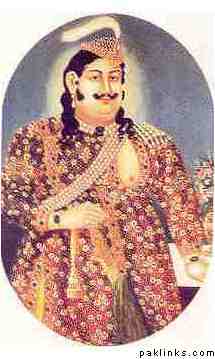
Wajid Ali Shah was most unfortunate to have ascended the throne of Awadh at a time when the East India Company was determined to grab the coveted throne of prosperous Awadh (Oudh), which was “the garden, granary, and queen-province of India.”
In different circumstances perhaps, be might have succeeded as a ruler because he had many qualities that make a good administrator. He was generous, kind and compassionate towards his subjects, besides being one of the most magnan- imous and passionate patrons of the Fine Arts. **But the British Agent, and some of the treacherous elements in the court of Awadh availed of his lavish and luxurious style of living, brand- ed him as “a monster of debauchery, profligacy and vice”, and succeeded in banishing him from his beloved Lucknow.
**
In recent times, one finds a turn of the tide in his favour. Attempts are being made to remove Wajid Ali Shah’s tarnished image and to repaint him as a benevolent and gifted monarch who was more sinned against than sinning. Valuable books have been published recently giving a full and just assessment of his virtues as well as his vices.
When he ascended the throne, he took keen interest in the administration of justice, introduced reforms, and reorganised the military department. But gradually, he sank into a life of pleasures surrounded by courtesans, singers, dancers, and eunuchs. In his book “Awadh Under Wajid Ali Shah”, Dr. G.D. Bhatnagar gives the following assessment of this ill-starred prince:- "Cast by providence for the role of an accomplished dilettante, he found himself a misfit for the high office to which he was elevated by chance.
Wajid Ali Shah’s character was complex. Though he was a man of pleasure, he was neither an unscrupulous knave nor a brainless libertine. He was a lovable and generous gentleman, he was a voluptuary,** still he never touched wine, and though sunk in pleasure, he never missed his 5 daily prayers**. It was the literary and artistic attainments of Wajid Ali Shah which distinguished him from his contemporaries."
When Wajid Ali Shah was a young boy, some astrologers warned his parents that he would become a Yogi, and advised them that the boy should be dressed up as a Yogi on each birthday of his so as to counteract the effect of the evil stars. **When he ascended the throne in 1847 at the age of 24, he had a fabulous annual income of more then fifteen lakhs of rupees, most of which he squandered on music, dance and drama. **
First of all, he established his famous Parikhaana (abode of fairies) in which hundreds of beautiful and talented girls were taught music and dancing by expert-teachers engaged by the royal patron. These girls were known as Parees or fairies with fancy- names such as Sultan pari, Mahrukh pari and so on. On each birthday of his, the Nawab would dress up as a Yogi with saffron robes, ash of pearls smeared on his face and body, necklaces of pearls around his neck, and a rosary in his hand, and walk pompously into the court with two of his Parees dressed up as Jogans. Gradually he made it into a spectacular pageant or Mela known as Jogia Jashan, in which all citizens of Lucknow could participate, dressed as Yogis, irrespective of caste and creed.
**In the opinion of Mr. Ranbir Singh it was this Jogia Jashan on his birthdays that “took the curtain up on the Hindustani Theatre”. **Later on, when his favourite venue, the Kaisarbagh Baradari was built, he began to stage his magnificant Rahas, obviously a Persianised name for Rasleela, full of sensuous poetry, his own lyrical compositions under the pen-name “Akhtarpiya” and glamorous Kathak dances.
Ranbir Singh gives details of Wajid Ali Shah’s book entitled “Bani” in which the author mentions 36 types of Rahas all set in Kathak style (with colourful names like “Mor-Chchatri”, “Ghunghat”, “Salami”, “Mor Pankhi” and “Mujra”), and gives exhaustive notes about the costumes, jewellery, and stage- craft. Rahas, prepared at a fabulous cost of saveral lakhs of rupees, became very popular, and was performed at the Kaisarbagh-Rahas Manzil, most probably, “the first Hindustani Theatre Hall”.
Many have regarded Wajid Ali Shah as "the first playwright of the Hindustani theatre", because his “Radha Kanhaiya Ka Kissa” staged in the Rahas Manzil was the first play of its kind. It featured Radha, Krishna, several sakhis, and a vidushaka-like character called “Ramchera”. Songs, dances, mime, and drama were all delightfully synthesised in these Rahas performances. He dramatised many other poems such as Darya-i-Tashsq, Afsane-i-Isbaq, and Bhahar-i-Ulfat. It is said that Amanat’s “Inder Sabha” was inspired by these dance-dramas, written, produced and staged by Nawab Wajid Ali Shah.
Today, however, his pioneer contributions in this field are seldom remembered. Kathak dance attained new heights of popularity and glory under his expert guidance and lavish patronage. Thakur Prasadji was his Kathak guru, and the unforgettable Kalka-Binda brothers performed in his court. What with the grand pageantry of the Rahas, Jogiya Jashan, Dance dramas, and Kathak performances, Lucknow became the magnetic cultural centre where the most reputed musi- cians, dancers and poets of the time flourished. The greatest musicians, dancers and instrumentalists of the time enjoyed his munificent patronage and hospitality.
**But all this pomp and splendour were wiped out in less than eight years. In February 1854, Wajid Ali Shah was deposed by the British Resident and exiled into far-off Matiaburj near Calcutta. Even when the shocking ultimatum was given to him, Wajid Ali Shah appealed to his beloved subjects not to offer any resistance, and to maintain peace. **The touching des- cription of the bewailing citizens of Lucknow given in the Urdu “Asrar-i-Wajid” has been translated into English by Dr. G.D. Bhatnagar in his book as follows.
“The condition of this town, without exaggeration, was such that on the departure of Jan-i-Alam, the life became extinct and the body of the town was left soulless. Grief rained down from every door and wall. There was no lane, bazar, or dwelling which did not wail out in full agony of separation from Jan-i-Alam. All sorts of agonies were produced in the Hindi musical tunes and notes.”
**Historians describe how much the people of Lucknow lammted the exile of their kind and popular ruler. Many of the poets of the time have depicted their grief in touching verses like the following :
Lucknow bekas huwa Hazrat jo-gaye, *
*Fazle gul kab ayegi, kab honge aakar naghma sanjh, *
Ek muddat ho gayi murgaane gulshan ko gaye
The royal caravan “of about 1000 persons started from Lucknow on March 13, 1854 towards Calcutta via Kanpur. The parting scenes were pathetic, the whole city being thrown into gloom. Everybody wept and bewailed while bidding farewell to the unfortunate king. Everywhere there was sorrow. Poor and rich, young and old, all were bewailing for the King. The citizens looked helpless and recited mournful nauha (dirges) in bewilderment”.
As for Wajid Ali Shah, nothing caused him more agony than being forcibly parted forever from his beloved Lucknow.** It was at this tragic moment of being torn away from the city and people he loved that the following lines burst out from his sorrow-laden heart:-**
*
“Babul mora naihar chchooto jaay-*
Chaar kahaar mil, mori doliya uthaye
*Mora apna begaana chchooto Jaay”
*
“Our sweetest songs are those that tell of saddest thoughts.”
One can very well visualise that sad moment of parting through these touching lines. In fact this song has now come to be associated with the inevitable bidaayi of every bride from her parental home - that poignant moment when she is seated in a doli and is about to be wrenched away from her dear “babul” into the distant land of her groom.

 Hehehe Dolly Bindra Missing Link Of Wajid Shah Hehe !!
 Jaan e Alam ke baare main aap aur kia kahenge? Whats your personal take on his focusing his attention just to promote arts and leaving other things unattended?


