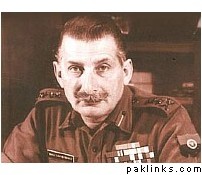
A brilliant man, a grand personality, a legendary solider, a celebrated military commander, a decorated war hero, a very personable, open minded and casual human being with a highly celebrated image,
Field Marshal Sam Hormusji Framji “Sam Bahadur” Jamshedji Manekshaw MC
passed away after a long illness on 27 June 2008 at age 94.
Though being the architect of Pakistan’s most humiliating moment in 1971, FM Sam has been admired in Pakistan for his straight forward and honest stand. He has been on record calling a spade a spade and commending the efforts of his nation’s arch-rival Pakistan’s military and its supreme efforts in trying to fight a losing battle when the odds were totally against them due to natural circumstances and course of events in 1971 against a much larger and better prepared offensive Indian Army. He has also been recorded as commending individual acts of valour at company and platoon level and has even praised the bravery of some officers of Pakistan Army. In true spirit of the profession of arms and the associated chivalry.
The Indian general who commanded the military campaign that led to the creation of Bangladesh has died at the age of 94.
Sam Manekshaw, whose career spanned four decades, was one of India’s best known and well-respected soldiers.
Under the British, he was decorated for gallantry in World War II for his part fighting the Japanese army in Burma.
After India gained independence, he became chief of the army in 1969 and in 1973 was made field marshal. ‘The brave’
Under his command, India went to war with Pakistan in 1971, supporting Bengali nationalists in what was then East Pakistan.
Pakistan surrendered within 14 days and Bangladesh was born.
In 1973, only a fortnight before he retired, he was promoted to the rank of field marshal, one of only two Indian army generals to rise to the post.
Sam Manekshaw otherwise known as Sam Bahadur - or “Sam the Brave” - was born in the northern Indian town of Amritsar in 1914 and was among the first batch of recruits at the Indian Military Academy set up by the British in 1932.
Serving under the British, he was decorated for his part in a battle with the Japanese army in Burma.
He made the transition to working for independent India with ease and became chief of the Indian army in 1969.
He played a decisive role in some of India’s most significant wars, including the war with China in 1962 and the victory over Pakistan in 1971, which made him a national hero.
A documentary film made about him in 2003 captured some of his much admired sense of humour.
In one sequence Field Marshal Manekshaw recalls how, following the 1971 war against Pakistan, Prime Minister Indira Gandhi confronted him about rumours that he was planning a coup against her.
“Don’t you think I would not be a worthy replacement for you Madam prime minister? You have a long nose, so have I. I don’t poke my nose in other people’s affairs,” he joked.
In the film, Field Marshal Manekshaw also said that India lost a golden opportunity to solve the Kashmir issue once and for all at the Shimla summit with Pakistan which was held soon after the 1971 war. ‘Thorough gentleman’
The BBC’s Charu Shahane says that he will be remembered as being handsome and witty with a handlebar moustache - every inch a victorious soldier.
Our correspondent says that he captured the public imagination and became a hero in the eyes of India’s people.
In retirement, the field marshal remained reticent and eager to keep a low profile despite being much adored by his countrymen.
He recently refused to comment on the war in Iraq despite a huge gathering of journalists bombarding him with questions.
Tributes have been pouring into the websites of Indian newspapers, calling him “a great soldier and a very thorough gentleman”.
Sam Manekshaw, who had been battling a series of illnesses, died at a military hospital in Wellington in the southern state of Tamil Nadu, where he had lived since retiring.
Indian Defence Minister AK Antony said the nation “had lost a great soldier, a true patriot and a noble son”.
Yes he was a truly a professional soldier imbibed with the ultimate sense of duty and honor.
Sure most will love him or hate him for his role in the 1971 destruction of the then East Pakistan. However that should not cloud our view of this straight shooter, who (sadly) was among the last surviving soldiers of the grand old British Indian Army.
I remember seeing his TV interviews. He was honest and candid. He was an unwilling commander of Indian Army that was pushed into attacking a sovereign country called East Pakistan.
At the end, he obeyed orders like a loyal soldier. He did confess that Indians trained and equipped 60,000 Bengali insurgents. These insurgents were then pushed into East Pakistan to conduct a campaign of murder and mayhem. This was not too unlike the modern day Iraqi insurgents being trained by the neighboring countries.
We can argue about who-dun-it for East Pakistan until the Kingdom comes, and perhaps write 100's of posts filled with arguments and counter arguments.
It was Generals like him who treated Pakistani POWs with utter respect and dignity. Almost all of our POW soldiers came home a bit famished but alive. He knew that Pakistan soldiers were simply caught in the evil designs of politicians like Indira, Mujeeb, and Bhutto.
We must not forget how our Islamists are treating our soldiers these days. We must remember Haroon ul Islam and others who were so mercilessly killed by Arab inspired maulvis.
However this is the day to mourn the loss of a great soldier. Let's pray for his soul that God may forgive his sins.
Good bye dear General, Good bye a great soldier. May your soul rest in peace.
Last time i checked, it was Paklinks, not Indian Links, you wanna praise a stupid genaral like him, go open a thread there! cant take the criticism, change the Forum!
I doubt any moral on gs can ever decide who goes to hell. so calm down please. That was just a bad statement.
... He already did that once in the hell that Pakistanis had created for the Bengalis in Dacca. ...
We can blame each others until the kingdom comes.
The reality is somewhere in the middle. Mankeshaw was deadly honest (much more than ordinary Indians) when he confessed that India sent in 60,000 insurgents into East Pakistan.
The result of these 60,000 criminals was obvious. 30,000 bengalis died in East Bengal and millions more died in the West Bengali camps.
QUOTE=Get smart;5909064]... ....Salute Sam! Light your cigar ...
[/QUOTE]
Amen to that.
Just learn to be a honest and candid from the great general. That's all!
didnt know anything about him till his death and more that i learn about the man more i admire him....A Brave solider is like a good athlete....you have to admire them regardless of what religion/country they belong to.