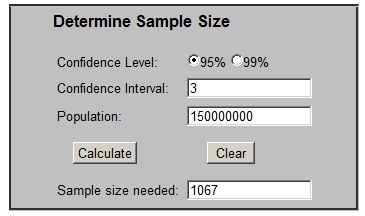
All i’ll tell you is to read up on the central limit theorem, see how sample sizeswork with respect to confidence levels and margins of error. 1000-2000 is a perfectly reasonable sample size, given the confidence level and margin of error they are aiming for. See this online calculator of sample size (which uses a relatively unsophisticated random sampling model, as opposed to the stratified sampling used by Pew)
Let me read that and answer back. Add anything else in the meantime. I still do not buy your answer.
Added:
OK. The sites you posted are merely what the meaning/understanding of population size concept is and a calculator.
Both sites you posted are not the answer by themselves.
So what is your take on it (based on the sites you posted) to prove the ‘study’ you mentioned above has valid results??
If you say 1000 and 2000 sample size is enough to draw valid conclusion on about 180 million total population, then think again, or provide clear answer.
Oh bhai, please do refute based on my own links. Like I said, sample size is perfectly reasonable. 2000 people are a standard sample size, there is nothing dodgy going on here. I posted a random calculator, input the parameters most studies aim for (95% confidence, ±3 margin of error), and with the population of Pakistan you get a sample size of around 1000. Just saying oh I dont believe this is no argument.
You might have an issue with basic statistics, but these are basic tenets of statistics/hypothesis testing. If you disagree with the sample size of this poll, then you disagree with polling in general, because this is how its done. Go through the page below, it’ll tell you about why the central limit theorem is relevant, what that implies for the distribution of sample means and how we can estimate margins of error based on that.
You could find problems with methodology etc, but trust me, just saying 2000 people cant represent 180 million goes against standard practice based on sound statistics. Look at this for instance. Its a listing of Obama’s job approval numbers from a number of different organizations. The column you should look at is the sample size.. typical values are around 1000-1200. America has a much larger population than Pakistan!
You are sounding shah Se Barh Ke Shah Ke Wafadaar now.
Here is why.
The article itself says.**
"About the Spring 2010 Pew Global Attitudes Survey
Results for the survey are based face-to-face interviews conducted under the direction of
Princeton Survey Research Associates International. All surveys are based on national
samples except Pakistan, where the sample was disproportionately urban.
The descriptions below show the margin of sampling error based on all interviews
conducted in that country.
For results based on the full sample in a given country, one can say with 95% confidence that the error attributable to sampling and other random effects is plus or minus the margin of error. In addition to sampling error, one should bear in mind that question wording and practical difficulties in conducting surveys can introduce error or bias into the findings of opinion polls."
This is exactly I had in mind before even read this portion.
**There is such thing in statistics which is called “Sampling error” . This has to do with the selection of wrong sample of population from a large population. Kinda like this below what you posted earlier:
** Factors that Affect Confidence Intervals
There are three factors that determine the size of the confidence interval for a given confidence level:
Sample size
Percentage
Population size
Sample Size
The larger your sample size, the more sure you can be that their answers truly reflect the population. This indicates that for a given confidence level, the larger your sample size, the smaller your confidence interval. However, the relationship is not linear (i.e., doubling the sample size does not halve the confidence interval).
Percentage
Your accuracy also depends on the percentage of your sample that picks a particular answer. If 99% of your sample said “Yes” and 1% said “No,” the chances of error are remote, irrespective of sample size. However, if the percentages are 51% and 49% the chances of error are much greater. It is easier to be sure of extreme answers than of middle-of-the-road ones.
When determining the sample size needed for a given level of accuracy you must use the worst case percentage (50%). You should also use this percentage if you want to determine a general level of accuracy for a sample you already have. To determine the confidence interval for a specific answer your sample has given, you can use the percentage picking that answer and get a smaller interval.
So, here we have total sample size of 2000. If we assume ALL gave a particular answer, then the percentage would be 100% for the whole sample size.
We do not know how many actually answered a particular one.
**Plus, the ratio of sample size to whole population is too low (2000/180,000,000= 0.0000015) just as a common sense.
**
Population Size
How many people are there in the group your sample represents?
This may be the number of people in a city you are studying, the number of people who buy new cars, etc.
**Often you may not know the exact population size. **This is not a problem. The mathematics of probability proves the size of the population is irrelevant unless the size of the sample exceeds a few percent of the total population you are examining.
This means that a sample of 500 people is equally useful in examining the opinions of a state of 15,000,000 as it would a city of 100,000.
(This does not apply here, since we know the population and margin of error of +/- 3 is too high for sample size of 2000 only in such high poplulation which is being blamed of representing merely ‘some’ of 2000 sample size. Remember, not all of 2000 must have answered the same way)
For this reason, The Survey System ignores the population size when it is “large” or unknown. Population size is only likely to be a factor when you work with a relatively small and known group of people (e.g., the members of an association).
The confidence interval calculations assume you have a genuine random sample of the relevant population. If your sample is not truly random, you cannot rely on the intervals. Non-random samples usually result from some flaw in the sampling procedure. An example of such a flaw is to only call people during the day and miss almost everyone who works. For most purposes, the non-working population cannot be assumed to accurately represent the entire (working and non-working) population.**
We do know, that sample was not randomly selected as in Pakistan.**
You have three different colouring schemes going on here. Could you summarize exactly what your issue is. Do you still think that the sample size is too small? If so can you provide the specific basis? Or is it some other issue now?
Heres what you need to do: I think the sample size is too small because _______ .
You have not given answer how this sample size of skewed and non random urban population of merely 2000 out of 180 million is enough. All you have posted is links after links.
Why not for now focus on red?
Any comment on article itself acknowledging the shortcomings of the ‘study’?
Yar. My position IS the default position. It IS the standard, this IS how polls are done. I’ve given you a link that calculates sample size, given confidence intervals. I’ve given you a list of fifty national US polls, with sample sizes averaging around 1200-1500 (for a country of > 300 million). This IS how its done. Lets settle the issue of ‘merely’ 2000 before we come to urban population bias. Do you have ANY mathematical reason for why 2000 is too small a sample size for a population of 180 million. Please confine your answer to this specific point. We will come to urban and skewing in due course. Lets just settle sample size for now.
Remember, you are arguing against an established science. Extraordinary claims require extraordinary evidence. Im happy if you want to prove statistics wrong, but for God’s sake, come up with something remotely mathematical.
For example: If one reduces the CI to 1.0, the sample size wil automatically be over 9000 (9640). And then again in order to get ‘close’ to validity of results, one still has to deal with other possible statistical biases.
What do you understand a margin of error to be? Also please provide your distinction between ‘valid’ and ‘statistically significant’ with respect to polling.
Accepet one thing though. The study like this should not draw any final conclusion and… with so called mathematical mumbo jumbo, one cannot make big headings or be adamant on people to accept the results!
You have not come up with any reason whatsoever why you agree with results as written on stone!
Even the study conductors have given caution and possible sources of error.
Great job believing anything published in the name of poll or study!
haha. i thought so. Its fine if you dont WANT to accept the results and dont think they’re written on STONE. you TRIED to make a mathematical argument based on sample size, you come up with absolute nonsense in terms of a refutation.
to answer the question I asked you, a margin of error would mean that there is a 95% likelihood that the true beliefs of the population in question (Pakistan) is between 85±3 re support of segregated workplaces, assuming 2000 samples and otherwise good methodological accuracy. That is to say, there is a 95% likelihood that between 82 and 88% of Pakistanies support segregated workplaces. You said that if you decrease the margin of error to 1 the number of samples required goes upto 9000. Ofcourse! Thats a confusion between precision and accuracy. If you want a precise answer on the exact opinion, you will have to sample more people. If you wanted to say the true mean is between 86 and 84, you’d need more people. If you wanted to say that the true mean is between 85.5 and 85 you’d need a lot more people. If you wanted to say that the true mean is exactly 85 you’d need to survey everyone. But 3% is not a bad range, if I said 82% or 88% that wouldnt be substantially different from 85% in terms of what we take away from the poll. Therefore we dont NEED to aim for a more precise estimate! Remember, lack of precision does NOT make the poll automatically inaccurate.
You have gone from saying the survey is nonsense to saying the results are not set in stone. they are NOT. nobody claimed they were. nobody is adamant that you accept results. just dont make objections you cannot defend when you talk to me, please dont come up with half assed claims about sample size, especially when you clearly dont grasp basic concepts of statistics, which you call mathematical mumbo jumbo. This is the problem with a lot of us, we make confident claims against established science, and when probed about what we know we’ll go ‘oh well you cant prove it without a shadow of a doubt look you yourself are saying its an estimate’. It is an estimate, and the acknowledgement of it as such is a requirement for good, solid science.
The percentage of male/female subjects would be very informative. I think there’s a large majority of women in Pakistan who would prefer segregated workplaces.
An urban population but in which region of Pakistan? It might just be me but I’ve noticed that every city has its own set of perceptions. So I’m sure what could be an opinion in Islamabad wouldn’t be an opinion in Lahore. So I’m sure there’s vast variations in our culture when compared with Jordan, Indonesia and Turkey.
To be fair, they do say an urban population sample but again, like I said there’s differences in perception I’m sure. And I’ve got a feeling that just numbers wouldn’t really tell us much in this case. It might be true for countries that have a relatively uniform level of values, perceptions and competencies (Places in almost all developed nations and more).
No need to tell me what margin of error means and what it means to be a statistically significant poll or study. This is NOT statistics class.
You have been told that the fumdamental problem I have is when conducting this kind of poll, the methods completely ignores the total population.
In order to offset this big flaw in conducting any poll or study, one has to be sure to reduce the margin of error to get more precision. The statement you made about the 85+/-3 with sample size of 2000 and think that by drawing otherwise statistically good result you CAN apply the results on 180 million people then I have no reason to waste my time on you.
That is why as much as possible the larger sample (hence more precise result) is needed when one wants to make others believe the results as being ‘valid’.
I do not think I can get you out of the mindset which you have in believing anything which is claimed as ''solid science".
Buddy! **there is no solid sceince in statistics. **
Statistcs like this is based on a lot of assumptions and what one is willing to accept as margin of error/P-value/sample size etc.
Let me ask you there.
**If someone conducts any study or poll like this (on 2000 people) with questions asked on general preferance of using one product ‘A’ by those people. **
Would you be willing to make a headline saying in this world (of over 6.5 billion people), the preferred product IS A, given the results be exactly same? (Such as 85% people said they do. And margin of error was set as +/- 3.)
Answer that without asking me question and making any assumptions.
P.S. No if and or but will be accepted. A simple yes and no would do fine.
Just a question, can you clarify what ‘valid’ means, and why it is necessary to be ‘precise’ to be valid? I dont believe you have any clarity on these concepts, and dont want to waste my time teaching you basic statistics from scratch. I have told you specifically what the implications of ±3 imprecision are, and they do NOT make the poll less accurate (or valid) merely by virtue of being imprecise.
Re your question of 6.5 billion people, theres a simple answer. When a population belongs to a number of different categories as the population of the whole world does, then you use stratified sampling (as used in this poll). Other than that, sure, a random sample of 2000 is fine for the whole world. Might seem counter-intuitive but so is the world being round :). What will happen is, when you sample the world with 2000 samples, you’ll get a high enough variance that your results wont mean much unless you ask “is the sky blue?”.
As for there being no solid science in statistics and all that nonsense.. sure. If you want to deny statistics in general, I dont really wish to get into that. Lets just leave it at this: your reasons for discrediting this poll apply to disbelieving in a branch of mathematics in general. Im fine with that.
I never denied statistics. I merely said do not believe all what is presented in the name of study or poll. Have a critical mind and read before accepting results.
And the red part of your sentence means you cannot make claim that the preferred product is ‘A’ based on the results of a ‘seemingly’ well conducted poll or study.
And that is why the article you brought has same exact problem of ignoring the large total populaton. And too little sample size to draw any conclusion. I rest my case. Thanks and nice discussing with you.
A critical mind without any substance. You have been revolving around sample size yet cannot produce ANY evidence for saying that the total population should mean that the sample size should be bigger except for making the results more precise (while 82-88% doesnt change how we would interpret the results AT ALL, therefore no value in being more precise). Meanwhile I have given you the following:
a) An online calculator that given the quality aimed for in the study (a quality generally seen as acceptable in the statistics community) gives a sample size smaller than what was used in the study
b) An exhaustive list of national US polls, where the sample size was usually smaller than what was used in the Pew study despite the US population being about twice that of Pakistan
c) Extensive quotes from standard statistics books that explicitly reject the idea that total population influences statistics interpreted from the sample beyond a certain point already overcome by the relatively large sample size.
All of these demonstrate that this is a standard poll, completely in keeping with both mathematical soundness and the standards in the polling community worldwide. You have meanwhile given me “I dont believe it because look the population is so big”. Total bollocks.
No, your reading of the red part of my sentence illustrates your struggles with the english language.
Oh so the article has the same exact problem of ignoring the large total population. The article in question ofcourse quoting from statistics textbooks. So I return to the fact that you basically are struggling with a branch of mathematics, as opposed to with this specific poll.
I thought we were done when you said “your results won’t mean much”.
180 million or over 6.5 billion population, the results should be accepted or questioned by same analogy, right? Why do you not think the result of study should not have same ‘high enough variance’ in 180 million population? Any ‘mathematical’ answer?
Just do me a favor, place this ‘study’ you qouted and the one I asked you on world population side by side.
Then give me ONE mathematical reason why you would refute world population based study and not the one you posted;
and why would you say the "results won’t mean much" or “high variance” in one and not the other?
Yep!I am struggling with YOUR English there my friend.
I asked you to give me answer yes and no. Remember?
You just don’t want to give up and say you are trying to impose result of a flawed study by design. It won’t do any good but to make you look like someone accpeting ANYHING in the name of mathematical gimmick!
Big claims like headlines or news need better studies.
“Mathematical gimmick”. Do you regard statistics as a valid branch of science or not?
YES the results WOULD be valid. My comment on high variance were simply because I was at that point being generous, and saying you probably wont get results of 85% in random samples of world opinion, given how polarized I expect it to be. It had nothing to do with the sample size itself, I was commenting on what I expect the resulting percentage to be, unless its a question such as “Is the sky blue”. Regardless, the result of the poll WOULD be valid.
To return to your question. YES. The results would be valid.