Re: Retirement account and buying car
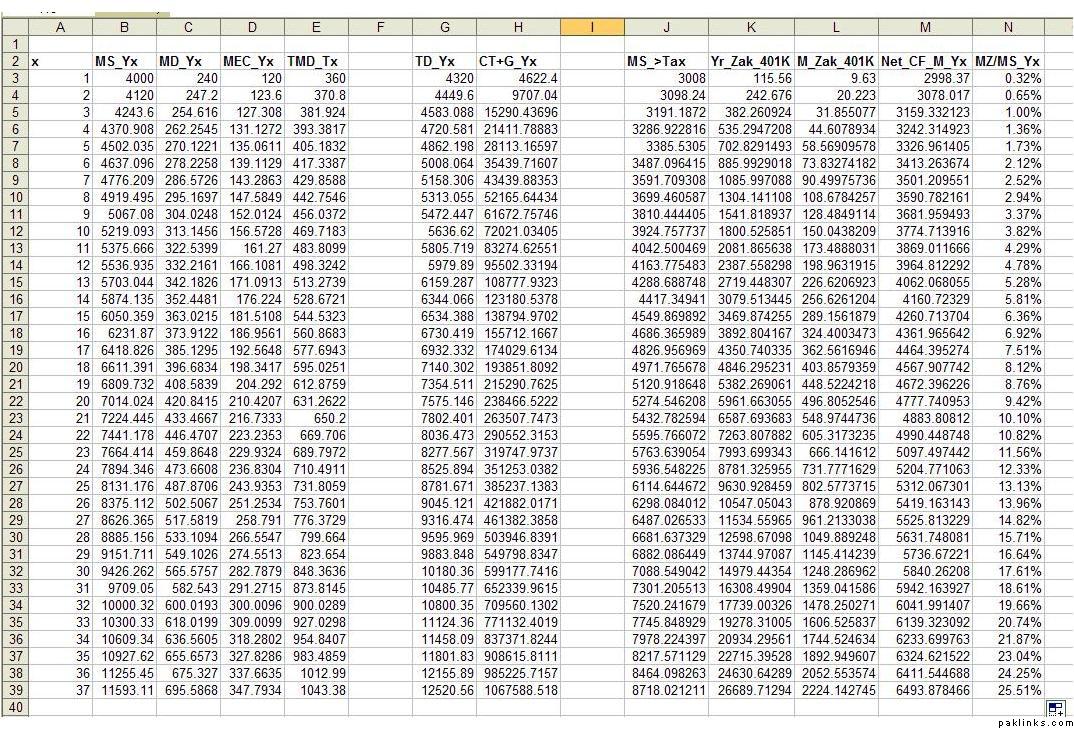
So what does the salary come out to be after 37 years when he started off with $4000 per month? Wouldn't that mean that when he saved that $1 million his salary is not $4000 anymore? So the calculation showed by brother Psyah is invalid then.
However, it would be interesting to see the savings growth compared with salary growth to see how it affects the 'net-cash-flow' per month.
Peace Captain1
To answer your question please see the spreadsheet in the previous post.
x= year x, MS_Yx = Monthly gross at Year x, MD_Yx = Monthly deposit pre-tax Year x, MEC_Yx = Monthly Employer contributions Year x, TMD_Tx = Total Monthly Depoist Year x.
TD_Yx = Total accumulated deposit pre-gains in year x.
CT+G_Yx = Cumulative Total + gains by end of Year x.
MS_>Tax = Monthly salary after tax based on (Column B - Column C) x 0.8 [assumed 20% Tax]
Yr_Zak_401K = Yearly zakat on the account
M_Zak_401K = Yearly zakat amount split evenly on a monthly basis
Net_CF_M_Yx = Net cash-flow monthly Year x,
MZ/MS_Yx = Ratio between Monthly zakat and monthly pre-zakat after tax salary expressed as a percentage.
As you can see for the first few years the zakat is quite insignificant but the proportion of zakat increases rapidly as the account gathers momentum.
After 25 years the salary has doubled, but the zakat proportion has increased over 40 fold.
Let's assume that salaries don't increase by 3% every year, then it is obvious that the maximum saving will be reached quite early due to zakat becoming harder and harder to pay out. Which proves my point that zakat does control and cap maximum savings, or encourages wealth to be dynamic rather than static.