can someone explain this passage to me from holy quran in right context. thanks
.
can someone explain this passage to me from holy quran in right context. thanks
.
Re: Request for explaination
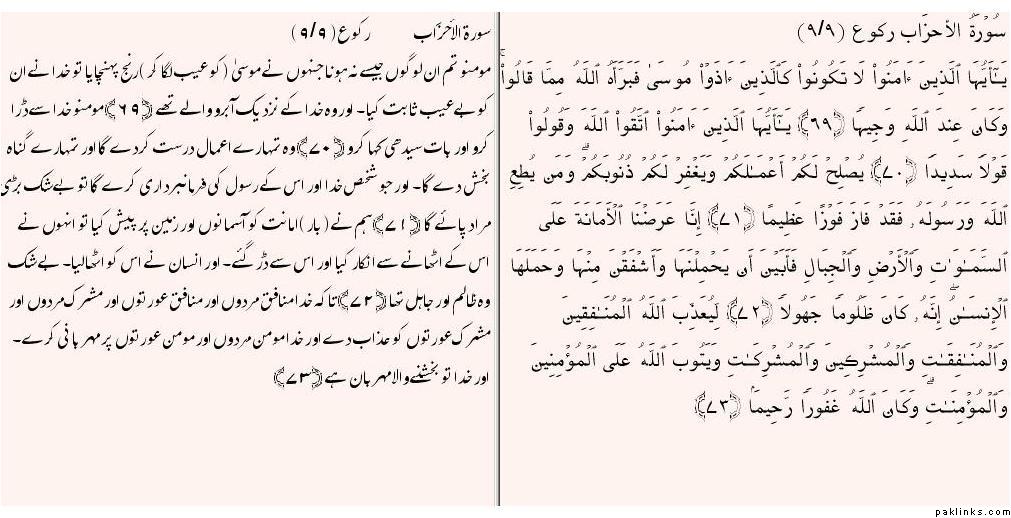
** Surah 33:69.** O you who believe! Be not like those who annoyed Musa, but Allah cleared him of that which they alleged, and he was honorable before Allah.)
Al-Bukhari recorded in the Book of Hadiths about the Prophets, that Abu Hurayrah said that the Messenger of Allah said:
(Musa, peace be upon him, was a shy and modest man who would never show anything of his skin because of his shyness. Some of the Children of Israel annoyed him by saying: "He only keeps himself covered because of some defect in his skin, either leprosy or scrotal hernia or some other defect.'' Allah, may He be glorified, wanted to clear Musa, peace be upon him, of what they were saying. One day Musa was alone, so he took off his garment and put it on a rock, then he took a bath. When he had finished, he turned back to pick up his garment, but the rock moved away, taking his garment with it. Musa picked up his stick and chased the rock, saying, "My garment, O rock! My garment, O rock!'' Until he reached a group of the Children of Israel, who saw him naked and found that he was the best of those whom Allah had created. Thus he was cleared of what they had said about him. Then the rock stood still, so he took his garment and put it on. He started hitting the rock with his stick, and by Allah, the marks of that beating were left on the rock, three or four or five. This is what is referred to in the Ayah: (O you who believe! Be not like those who annoyed Musa, but Allah cleared him of that which they alleged, and he was honorable before Allah.)) This Hadith is one of those which were recorded by Al-Bukhari but not Muslim. Imam Ahmad recorded that Abdullah (bin Masud) said: "One day, the Messenger of Allah distributed some booty and a man among the Ansar said, This division was not done for the sake of Allah.' I said,O enemy of Allah! I am going to tell the Messenger of Allah what you have said.' So, I told the Prophet about it. His face reddened and he said,
(May Allah have mercy on Musa. He was annoyed with worse than this, yet he remained patient.)'' This was recorded in the Two Sahihs.
(and he was honorable before Allah. ) means, he had a position of status and honor before his Lord, may He be exalted and glorified. Al-Hasan Al-Basri said: "His supplications would be answered by Allah.'' Some of them said that part of his great standing before Allah was that he interceded for his brother Harun, asking Allah to send him with him as a Messenger, and Allah granted his request and said:
And We granted him his brother Harun, (also) a Prophet, out of Our mercy.) (19:53)
Re: Request for explaination
Surah 33
(70. O you who believe! Have Taqwa of Allah and speak (always) the truth.) (71. He will direct you to do righteous good deeds and will forgive you your sins. And whosoever obeys Allah and His Messenger, he has indeed achieved a great victory.)
Here Allah commands His servants to have Taqwa of Him, worshipping Him as if they can see Him, and to
(speak (always) the truth.) meaning, to speak in a straightforward manner, with no crookedness or distortion. He promises them that if they do that, He will reward them by making their deeds righteous, i.e., enabling them to do righteous deeds, and He will forgive them their past sins. With regard to whatever sins they may commit in the future, He will inspire them to repent from them. Then He says:
(And whosoever obeys Allah and His Messenger, he has indeed achieved a great victory.) meaning, he will be saved from the fire of Hell and will enjoy everlasting delights (in Paradise).
72. Truly, We did offer the Amanah to the heavens and the earth, and the mountains, but they declined to bear it and were afraid of it. But man bore it. Verily, he was unjust and ignorant.)
** (73.** So that Allah will punish the hypocrites, men and women, and the men and women who are idolators. And Allah will pardon the believers, men and women. And Allah is Ever Oft-Forgiving, Most Merciful.)
Al-Awfi reported that IbnAbbas said, "Al-Amanah means obedience. This was offered to them before it was offered to Adam, and they could not bear it. Then Allah said to Adam: I have offered the Amanah to the heavens and the earth and the mountains, and they could not bear it. Will you take it on' He said,O Lord, what does it involve' He said, `If you do good, you will be rewarded, and if you do evil, you will be punished.' So Adam took the Amanah and bore it, and this is what is referred to in the Ayah:
But man bore it. Verily, he was unjust and ignorant.)'' Ali bin Abi Talhah reported that IbnAbbas said, "Al-Amanah means Al-Fara'id (the obligatory duties). Allah offered them to the heavens and the earth and the mountains, (on the grounds that) if they fulfilled them, He would reward them; and if they failed, He would punish them. But they did not want to do that, and they were afraid of it, not because their intention was sinful, but because of their respect for the religion of Allah, in case they could not fulfill the obligations involved. Then Allah offered it to Adam, and he accepted it with all that it entailed. This is what is referred to in the Ayah:
But man bore it. Verily, he was unjust and ignorant. ) meaning, he underestimated the command of Allah.'' This was also the view of Mujahid, Said bin Jubayr, Ad-Dahhak, Al-Hasan Al-Basri and others that Al-Amanah means Al-Fara'id. Others said that it meant obedience. Al-Amash narrated from Abu Ad-Duha from Masruq that Ubayy bin Ka`b said: "Part of Al-Amanah means that woman was entrusted with her own chastity.'' Qatadah said: "Al-Amanah means religion, obligatory duties and prescribed punishments.'' Malik narrated that Zayd bin Aslam said: "Al-Amanah means three things: prayer, fasting and performing Ghusl to cleanse oneself from sexual impurity.'' There is no contradiction between all of these views; they are all in agreement and all refer to responsibility and the acceptance of commands and prohibitions with their attendant conditions, which is that the one who fulfills this responsibility, will be rewarded; while the one who neglects it, will be punished. Man accepted this despite the fact that he is weak, ignorant and unjust -- except for those whom Allah helps, and Allah is the One Whose help we seek. One of the reports which deal with Al-Amanah is the Hadith recorded by Imam Ahmad from Hudhayfah, may Allah be pleased with him, who said: "The Messenger of Allah told us two Hadiths, one of which I have seen and the other I am still waiting to see. He told us that Al-Amanah is deeply rooted in the heart of man, then the Qur'an was revealed and they know it from the Qur'an and from the Sunnah. Then he told us that Al-Amanah will be taken away. He said
(A man may sleep and Al-Amanah will be taken from his heart, leaving nothing but a trace like a blister left by a coal if you were to roll it over your leg -- you will see it protruding but there is nothing inside.) Then he took a pebble and rolled it over his leg, then he said:
(Then the people will start buying and selling, and hardly anyone will be paying attention to Al-Amanah, until it will be said that among the tribe of so-and-so there is a trustworthy man, and it will said of a man, how strong he is, how nice and how wise,' and there is not even a mustard seed of faith in his heart.) No doubt, there came upon me a time when I did not mind dealing (bargaining) with anyone of you, for if he was a Muslim, his Islam would compel him to pay me what is due to me, and if he was a Christian, or Jew, the Muslim official would compel him to pay me what is due to me, but today, I do not deal except with such and such person among you.'' It was also recorded in the Two Sahihs from the Hadith of Al-Amash. Imam Ahmad recorded that Abdullah binAmr, may Allah be pleased with him, said that the Messenger of Allah said:
(There are four things, if you attain them, then whatever you miss in this world will not matter: preserving trust, speaking the truth, being of good character and moderation in eating.)
(So that Allah will punish the hypocrites, men and women, and the men and women who are idolators.) means, because the sons of Adam have undertaken to fulfill the Amanah, which means duties, Allah will punish the men and women among them who are hypocrites, who are those who make an outward display of faith because they fear the believers, but in their hearts they conceal disbelief and in fact are followers of the disbelievers.
(and the men and women who are idolators.) these are the ones who both outwardly and inwardly associate others in worship with Allah and go against His Messengers.
(And Allah will pardon the believers, men and women.) means, He will show mercy to the believers among mankind, who believe in Allah and in His angels, Books and Messengers, and who obey Him.
(And Allah is Ever Oft-Forgiving, Most Merciful.)
Taken from Tafsir Ibn Kathir
Re: Request for explaination
Thankyou for the quoted explaination. I understand the part about musa but verse 72 still does not make sense in light of explaination you provided.
If the amanah is something noble then why Allah admonish man so severely for undertaking it ? 
We did indeed offer the Trust to the Heavens and the Earth and the Mountains; but they refused to undertake it, being afraid thereof: but man undertook it;- He was indeed unjust and foolish;- {72}
**Why mountains ? **
The former and later part of this verse are like northpole and southpole.
If the man is foolish and unjust then it implies that the ‘Amanah’ (trust) is reference to something bad ??? no ?
Re: Request for explaination
^Amanah isn't a bad thing but a big responsibility......rest I leave on psyah to answer, I'm busy for rest of the day.
Re: Request for explaination
Haan grocery list main ye bhi likh ker unki jaib mian dal dena. ‘Apkey wo’ kabhi kabhi ansswer karna bhool bhi jatey hian 
Re: Request for explaination
^Amanah isn't a bad thing but a big responsibility......rest I leave on psyah to answer, I'm busy for rest of the day.
Lagta hai "aapkay woh" bhool gaye.
Re: Request for explaination
Re: Request for explaination
Peace Bro. Code_Red
It's really quite simple. Ammanah of any kind is a trust. A trust is when something of value is given to another for a time for safe keeping, later to be returned in the same manner that it was given.
Humans are said to have accepted a Divine Trust with no clean intention to return that trust in tact. This verse does not refer to all humans, but rather the generality of mankind. We are more likely to be tempted by the benefit in something than be repelled by it's potential harm. The following verse clarifies this position that from mankind the hypocrits and idolators will be punished.
It stems from the supposition that many people make that this life is theirs, and they can do as they wish, or they say well I didn't ask to be born ... The correct answer is we did ask to be made and put in the world. Jinn and Mankind were the greedy ones. All other souls that will not have a testimony have escaped punishment and judgement, but not you and I.
The deeper truth is that we probably cannot maintain our side of the bargain, we are told that the odds are stacked against us. However, with His Mercy as it states in verse 73 we inshaAllah will enter Jannah. Just so long as we try to avoid even 1 second in Hell, by trying to uphold this Ammanah.
My Dad always used to give money for our expenses to my cousin in Pakistan when we would visit, because he could trust her more than any other. This was seen as an honour by all in the family. However, one time she refused and said that she could not uphold the task on that occasion because her times were hard and that she may betray the trust by resorting to drastic measures. Such is the condition of man. We are utterly poor and utterly prone to betray His trust, but still we accepted it ... Do you see the analogy?
Re: Request for explaination
Yes, I see the analogy, which is fine but some points you made are not clear
**
Please elaborate  from where did you deduce that ?
You might be positive about yourself, but i did not ask anything like that 
Sorry but i am quite slow  cant grasp it.
My point is that if the trust is something noble then undertaking it should be laudable effort … Instead man is severely admonished for doing so ? why ?
btw, thanku for your time and explaination
Re: Request for explaination
Assalamu’alaikum once again bro
There is no severe admonishing in the verse. Allah (SWT) calls mankind unjust and ignorant. The trust from Allah (SWT) comes with a price … a price that we cannot possibly afford, but in haste we took it up. Our unjustness is our nature and our ignorance too. We took the task of taking the Trust when all others respectfully declined, because they were not looking for glory, but we were. They could see the potential in the harm outweighed the potential in gaining the glory. We were the ones who run with the risk. We are merely being called risky. Of course later Allah (SWT) states that in His Mercy He will deal with us accordingly; we were the only few ignorants to take up the challenge of accepting the Trust. Undertaking the Trust itself is not a laudable deed but undertaking it and doing the task justice is a laudable effort and reward comes in the form of Jannah.
Jannah is better than being expunged from existence, but being expunged from existence is better than being condemned to an eternal punishment. Those who refused saw the latter scenario as the prominent one, and correctly so too, we and even in our current state see a slim chance of success but treat it like as if it most likely to occur. Allah (SWT) tells us the odds are heavily against us. The refusal was the more sensible option, but the taking up of it has given us a chance to receive a reward. But merely agreeing to taking the Trust is neither laudable nor is it sensible especially if it can be seen that the odds are against us.
Think of jumping over a gap between two cliffs. The chances of making the jump are slim, potential is a deathly fall. However, there is a prize for anyone who makes the jump. Simply opting to jump is not laudable it is considered foolish. Only if the jump is completed safely then can the reward come. Allah (SWT) is simply saying in the following verse that if we jump with the correct techniques then He will make sure that He gives us an extra boost to make the jump, but if we jump in a sloppy style then He will let us continue in our trajectory which will probably not make the jump.
Re: Request for explaination
http://www.alislam.org/quran/tafseer/?page=2137®ion=E1&CR=
Re: Request for explaination
Assalamu'alaikum once again bro
**There is no severe admonishing in the verse. Allah (SWT) calls mankind unjust and ignorant. **The trust from Allah (SWT) comes with a price ... a price that we cannot possibly afford, but in haste we took it up. Our unjustness is our nature and our ignorance too. We took the task of taking the Trust when all others respectfully declined, because they were not looking for glory, but we were. They could see the potential in the harm outweighed the potential in gaining the glory. We were the ones who run with the risk. We are merely being called risky. Of course later Allah (SWT) states that in His Mercy He will deal with us accordingly; we were the only few ignorants to take up the challenge of accepting the Trust. Undertaking the Trust itself is not a laudable deed but undertaking it and doing the task justice is a laudable effort and reward comes in the form of Jannah.
walikum salam
You are needlessly trying to tone down the harsh tone with which Allah Adressed the man. 'Unjust and ignorant' ... Just try this !
call anyone "Zalim" & "Jahil" and see how much offence he takes.
Of course he is creator and absolute authority So he can address man whatever way he desires.
To me this verse is still a mystery. Somehow i feel that there is somethign more to context, which is sadly not available.
One remote explaination i would suggest while looking at 'past tense' ... I think God is speaking from experience rather than offering any prophecy. Like every few billions years, God creates a universe and an intelligent creature resembling 'man model' and gives him free will. The tone of address, i assume was evolved form a periodic disappointment.
^ this might sound silly but there is something more to the verse which i can not fathom.
Re: Request for explaination
and please I asked for elaboration . May be you offered explaination but i am quite slow. Please highlight that portion. thanks
Humans are said to have accepted a Divine Trust with no clean intention to return that trust in tact...
Re: Request for explaination
Respectable Code Red
Assalam-o-Alaikum
I have come to this forum after a long time. Read your mail and tried to find out out some plausible explanations. Admitting my ignorance, I offer my sincere applogies in advance if I fall short of it.
For you kind perusal, I have translated each Ayat in Urdu, with a specific colour for each word or phrase.
Re: Request for explaination
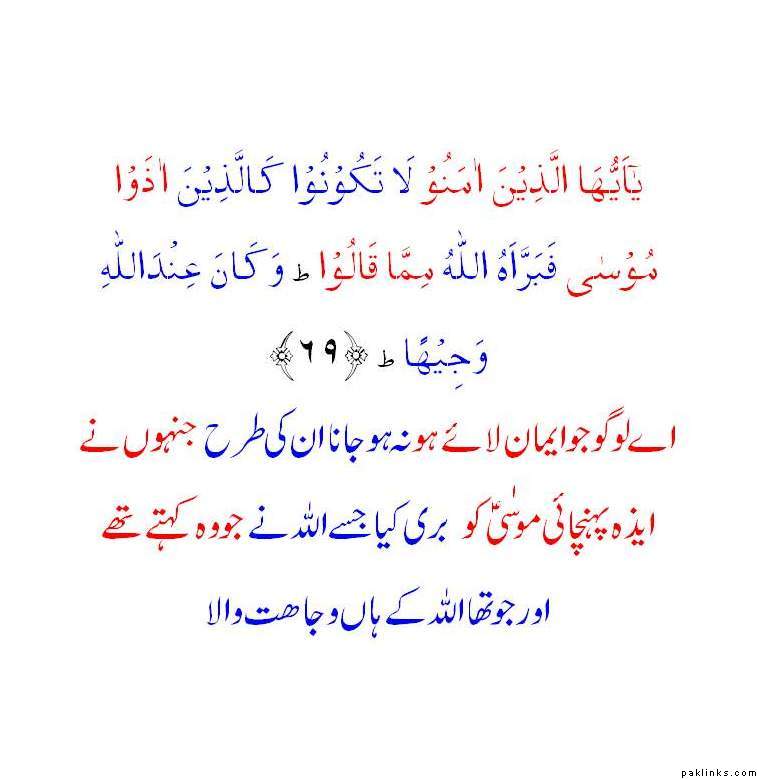
In my humble opinion, this Ayat does not refer to a specific incident as quoted above. Infact it relates to the general attitude of Jews, who used to hurt Hazrat Musa (AS), by showing him disrespect, even after proclaiming him as a Messanger of Allah. Allah clearly is telling the Muslims that they should not behave like Jews who hurt their Prophet Hazrat Musa (AS) by uttering the words not worthy of the his honour and respect. May be some of them had objected on his ability to speak to Allah? or had certain unbecoming utterances on his personality? But since he had a lot of respect, honour and dignity before Allah Almighty, therefore, Allah cleared and exonerated him of their gossip.
Re: Request for explaination
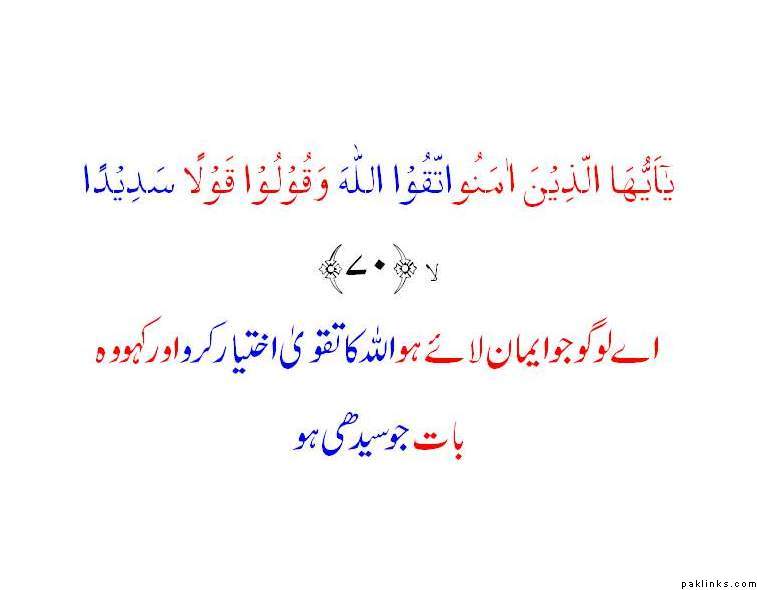
As a sequel to the previous Ayat, Allah Almighty is advising the Muslims that they should fear Allah Almighty, avoid gossip, loose and vain talk and should use simple, straight-forward and decent language.
Re: Request for explaination
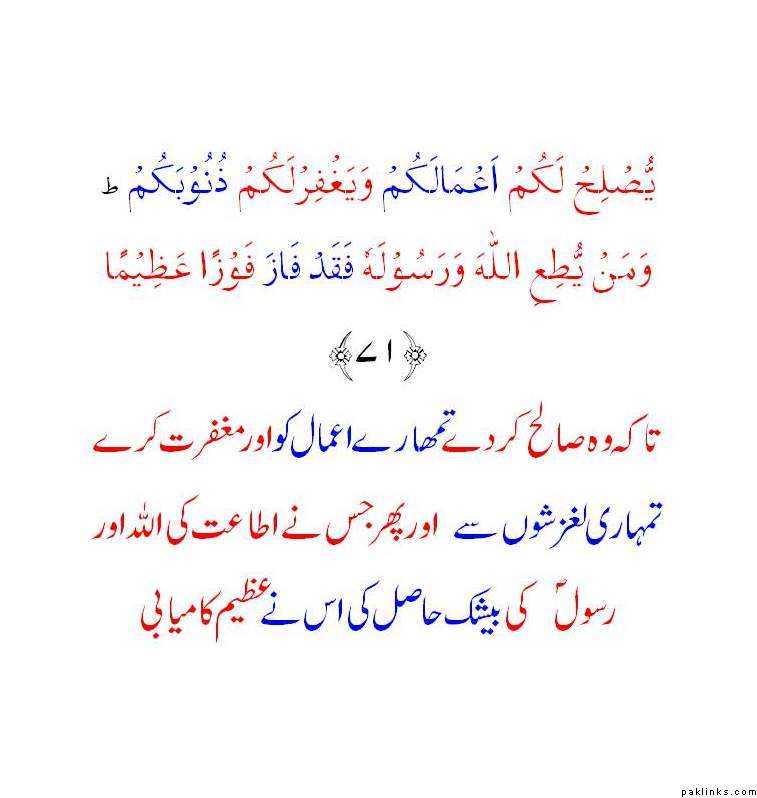
And if they would act upon the advice in previous Ayat, then Allah Almighty will lead them to acts of piety, and will forgive their misdeeds. If anyone would act on this prescribed way, it would be as if one is obeying Allah Almighty and His Holy Prophet Hazrat Muhammad (SAW). This would surely be a magnificent achievement leading to success (may be in this world and/or atleast in the hereafter).
Re: Request for explaination
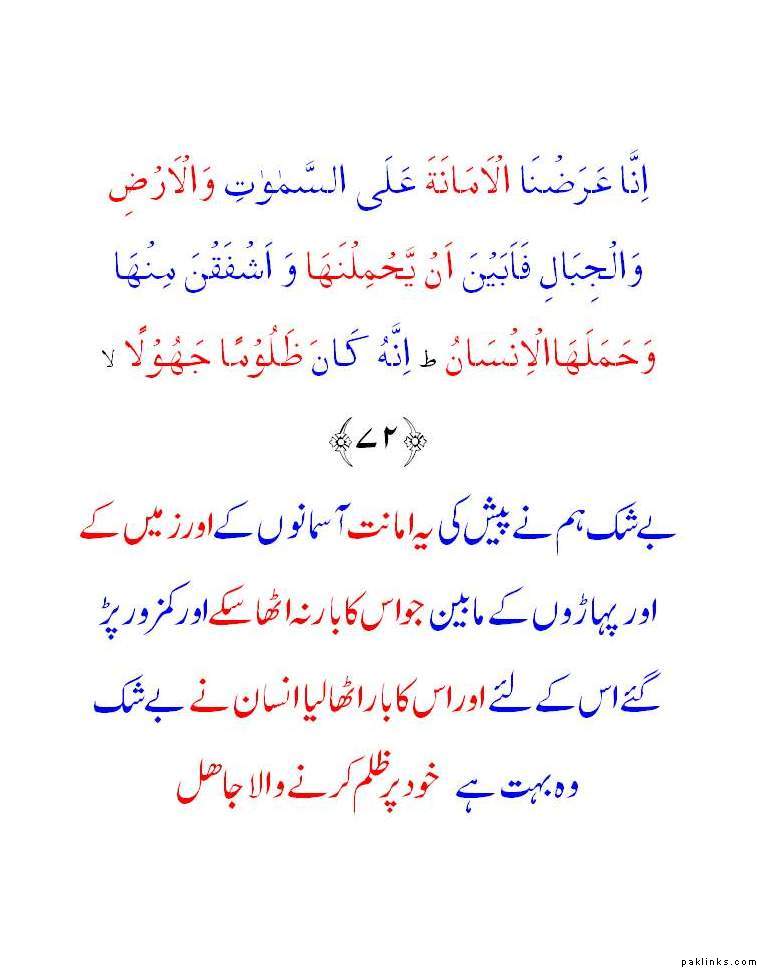
Surely, to act or otherwise on an advice, whether divine or not requires wisdom. This wisdom is the only thing which makes human beings Ashraf-ul-makhlookat i.e., best of all the creations. It is the only thing which is bestowed upon human beings and not to earth, heavens and mountains etc. May be at the time of Yaum-i-alast i.e., the day when Allah Almighty asked "Am I not your Sustainer (Alast-o-be-rabe-kum) the same trust of Wisdom was offered to Earth, Skies and Mountains? Since it was being offered by Allaah Almighty, they might have realised the difficulty in fulfilling its obligations to avoid everything evil and to do everthing good. Consequently, they declined, but man NOT KNOWING THE OBLIGATIONS OF THE TRUST volunteered to bear that trust. This Ayat is probably referring to that occasion when MAN IN HIS IGNORANCE COMMITTED AN EXCESS ON HIMSLEF.
Re: Request for explaination
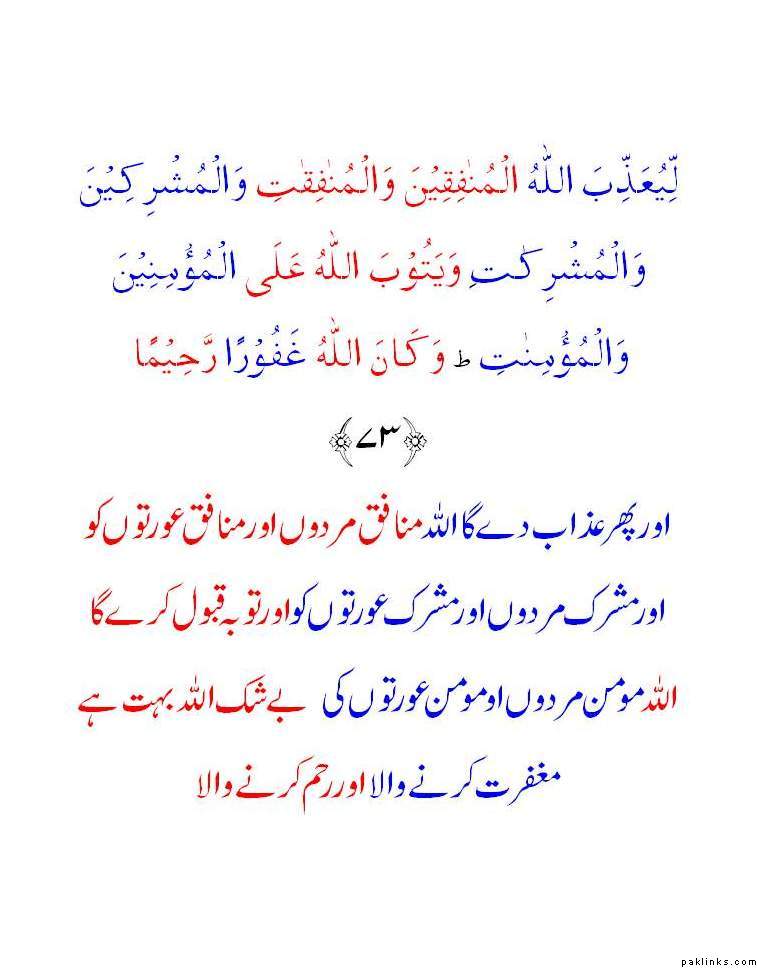
And hypocrite men/women plus polythiest men/women i.e., those who fail to honour this trust will be severely dealt with by Allah Almighty who will punish them. On the contrary, those who try to honour this trust will be blessed by Allah Almighty who is very forgiving.