Religion - Logic or Faith

:wsalam:

Good post bro.

If one has not witnessed something that is ‘blinded’ faith and yes logic is not the only tool to ascertain truth or fact. But the definition of truth or fact is loose also.

Logic can even make someone go stray. Mind/brain and logic are very weak tools.

**In our zeal of proving islam or religion true we start using arguments of logic and science and fall on our face on the ground.

**Either one believes in something or not depends on willingness to believe and not on coercion by logical proof.

**The prophets had to use miracles to prove they were right, why?

In order to combat any logical tool anyone would try to use against them.**

I have lot of Sudanese friends and they tell me that Sudan has developed the best infrastructure quietly. Plus, Khartoum boasts of best living standards. Sudan has lot of oil and its one of the places in Africa where the established is pro-people. In Darfur they have given befitting reply to non-muslims insulting the Arabs.

Re: Religion - Logic or Faith

Ahem. I am in Sudan. And what you have stated above is far from truth.

First let me go to your Darfur comment. Darfur is not a religious issue at all. There are a bunch of Darfurian Muslims who as per your comments are getting a befitting reply. The main Darfurian rebel groups against the Sudanese governement are all Muslims. Darfur is an ethinic and tribal issue exasperated by the discovery of oil in this region. People from the Darfur region and South Sudan are extremely concerned that all the oil money is going to the North Sudan and from where the oil is being produced, the region does not get any benefit at all. If some person is giving you wrong information, be warned that he is either ignorant or purposefully trying to misguide your sentiments.

Indeed, there has been development in infrastructure in Khartoum, BUT not in Sudan. Governement has spent money to develop Khartoum but once you drive out of Khartoum, you see the true picture. People don't have money to wear clothes. Though, present government proclaims itself to be Islamic, corruption is rampant from top to bottom. Ask your Sudanese friends about corruption. Sudanese are nice people; probably, the best arabs in the Middle East and they all tell stories about corruption, nepotism, favouritism, high infliation, high cost of living, double standards for the powerful and commoners.

Indeed, Khartoum boast the best living standards in Sudan but it does not even compare to the standards you have in Faisalabad. Medical facilities are very poor. Electricity and Water are a major problem. Food and living are extremely expensive. You are rasically discriminated if you are from North or from South.

Picture is not rosy. While foreigners see development of infrastructure in Khartoum, the locals are getting more desperate and hopeless day by day.

Successful gulf countries: Apart from Saudi Arabia, all the other gulf countries have not adopted Islamic laws. If you are able to look, you should see that they are all secular nations.

Saudi Arabia: Religion has become the means (same as in Iran) to control the masses. The rich can do whatever they want but the poor must accept their fate as the will of God.

Malaysia: Again, I don't believe religion has played a major role in the development of the country. Malaysians are generally better Muslims than you find elsewhere but the major success of their economy is because of the large hard working Chinese and Indian communities.

Indonesia: Again, religion has played no role in their development.

Note: I have lived and worked in all of these countries.

Re: Religion - Logic or Faith

:wasalam: USResident and diwana
I’m having to do this the hard way, so I am preparing this response with a bit more thought this time.
I acknowledge your apathy in this matter, but this is the one area that I think is important for us to get to grips with. I apologise for the semantics, but it is in the semantics that people can misunderstand one another and it is based on semantics that we develop our more sophisticated understandings. I see though you have not entirely disagreed with me you have however lessened the importance of what I am saying. I have done my homework in this matter and I say this with utmost humility and because this matter is an area that I wish to KNOW about (mind the pun) I want to engage in rhetoric so this matter can be effectively expounded upon, and if necessary for me to adjust my stance when I am happy that I need to do so. Likewise I want to be able to explain my stance without being perceived as one who is pushing this matter for others to accept.
There is a creed based reason for my concerns in this matter and also a ray of hope for those who may have to face the tribulations of Dajjal. My concerns are as you might now become aware of is the premise in language that defines for us how we should think. This is a kin to how we should operate based on what we know (or what we think we know) – or simply what we believe.
First let me present the said definition and compare it with what the dictionaries state:
USResident definition of belief

Merriam-Webster - belief

Oxford - belief

As can be seen the three definitions are varied. USResident claims that belief is acceptance when there is no witnessing. Number 3 of M-W definition states evidence strengthens a conviction but the conviction can exist without that evidence, Oxford states that belief is merely a feeling that something is true and moreover when there is no proof. The observation that I am making is that belief can be both conviction of something to be true when it has both evidence and no evidence. The USResident definition is what I call the common definition and this is what people imply in everyday speak, but if we rule out the notion that belief can also be trust in something to be true when there IS evidence such as in the case of Merriam-Webster it therefore covers all bases. If we assume that USResident is correct about the definition of belief, then we have an equation that all belief is blind. It supports the orientation of the Oxford dictionary whose basis is secular however you can see the subtle difference in the M-W definition whose basis is religious. Either way both dictionaries acknowledge that belief encompasses all of what we ‘know’ and particularly refers to what we accept without evidence. Furthermore there is another danger in accepting the complementary definition of ‘knowledge’ or rather ‘to know’ let’s look at the definitions below:
USResident - Knowledge

Merriam-Webster - Knowledge

Oxford – knowledge

Merriam-Webster – Know

Oxford – know

You see here USResident has inserted a real gem of a statement. Knowledge is direct cognition and at this stage it has not reached intimation that we should form an opinion regarding it, it is simply knowledge whether it is true or not. I think diwana you may have missed this distinction that he made.
Brother diwana the problem in using common definitions is that creates incomplete concepts. Such as the statement you have made:
‘If one has not witnessed something that is ‘blinded’ faith’
Yet Muslims declare and bear witness that there is One God. How can that be? Because we both bear witness that God is One and this statement is considered one of faith not of logical fact. Are you saying that we are lying that we should not say ‘witness’ or have you really stumbled across a breakdown in the assumed meanings of words?
The fact is we do bear witness … we witness it with our conviction we do not have to necessarily see something to affirm its truth we can have a number of experiences that may be subjective and not objective, as you seem to have accepted by default.
Moving over to the dictionary definitions of ‘know’ it is analogous to conviction and to be sure, but furthermore it involves being absolutely sure. I mean I can say that I know something, but I could be wrong. I can say that I saw something but my eyes can deceive me. Can I really be sure?
This is the danger in attempting to separate the terms ‘know’ and ‘believe’ because the faculty of belief is what both overrides ‘knowledge’ and at the same time ‘drives’ what we ‘know to be true’, because without belief what we have is just ‘information’ … when intimate with that information and accept it after privately agreeing with it, it becomes something that we say we ‘know’, but what we know can be subject to ‘error’ just as much as what we ‘believe’. When we know something we really only believe we know and it may be that it is only our take on it. We know how we have understood it, but do not know its ‘universality’. We cannot ever know anything much with absoluteness. Perhaps the most fundamental concept that we have is the concept of identity and that is ‘one’ and that is ‘Oneness’ … it appears interesting that the only thing that we can be fairly sure about is the presiding Attribute of how our Lord wants us to acknowledge Him by. This adds reason as to why we say that we bare witness.
There is an opinion that we already know everything, taken from the story of Adam (AS) who was taught the names of things, and it is embedded in our natures, but what we do is draw it out from within through inspiration and guidance and echo this against what information we have to our disposal. When we agree with that information from what we have drawn out we can either do so erroneously, self-deceivingly or with guidance from whatever mechanism; we call it affirmation and that affirmation is a private affair, when we affirm in public it is a different matter. This private affirmation is the same function drawn from our faculty to believe.
To believe something therefore is no different to knowing something except that linguistically to know something infers that we can objectively demonstrate it, but it should not mean that what we believe defies reason. We should not be beings who defy reason. We of course can defy reason and we do it all the time, but we should not do it and our Islamic belief is distinct from other beliefs because it is grounded in reason. Logic is only one form of reasoning. Which brings me to USResidents’ statement, which is in agreement to the essence of what I have been saying:

And it seems that diwana has accepted this. But you have not accepted the argument of reasoned belief as a middle condition. As I said it is the only condition we are allowed to have as Muslims. I think you do have reasoned belief, but I think in my humble opinion you are mistakenly equating it with blind belief and furthermore you are also mistaking any form of reasoning to be that of logic, which I think you are not really saying anymore.
So what is logic?
Logic necessitates conclusions based on premises. Logic can lead to false conclusions and it can also lead to inconclusive answers. I am not talking here about false arguments, which are something else entirely. False arguments are when the logical process has been compromised. This will happen when the premise presented is wrong or when the conclusion drawn is wrong and also when both the premise and conclusions are partially correct but infer totality.
Example of false premise in line 1:

  1. All Fungi are deadly
  2. Mushrooms are fungi
  3. Therefore, Mushrooms are deadly
    All fungi are not deadly and hence not all mushrooms are deadly
    Example of false conclusions in line 3:
  4. A man and woman have intercourse
  5. Intercourse is the precursor to having babies
  6. The man and woman will have a baby
    There is missing information which causes the line of argumentation to mandate the conclusion which is not true; at best it CAN be true.
    Example of false inference:
  7. Some fungi are deadly
  8. Death-caps are fungi
  9. Death-caps are deadly
    Here the conclusion is true, and both the premises also, but the construction of the logic assumes that death-caps are part of the group of some deadly fungi.
    The limitations of logic therefore are in the premises which are context specific. We cannot set upon ourselves conditions in the premise that are unreasonable, nor can we allow logic to dictate what is or is not an all encompassing set of premises.
    The correct logical answer in the above third example is that death-caps MAY be deadly, which makes us none the wiser. So the logical construct has been a waste of time.
    This is where reason comes in. If something could be deadly then it is better not to eat it, we could test it against an animal and if that animal dies it could mean we would die too, we start to use fuzzy inferences to help us make our decisions we use analogies and they are not logic in themselves.
    It is also called reason to base a belief on a previously established belief. This should answer the question posed by brother diwana:

It is true that is what I have said, but to believe that the Qur’an cannot be faulted is itself subject to reason. The reason I use is that for 1400 years no one has achieved a successful challenge against the Qur’an. Therefore I can base it as my premise to form beliefs upon that. This strictly is not logical, because logic tells us that even if it has not been successfully challenged it does not mean that in the future it will not be successfully challenged. I have used reason and not logic to deduce that up until now for 1400 years there has been no successful challenge so I am confident that there will not be any challenge that will succeed ever.
However, even to believe in something first and then to obtain wisdoms for it is still better than not finding anything and not pondering.
Now USResident states:

Agreed! To note that it does not mean non-logical arguments cannot achieve some sort of objectivity. We have made binary what is in fact a spectrum of evidences. Some evidence is clearer than others, but earlier it has been argued that even the clearest evidence can be wrong and as I now state even the most illogical evidence can be perceivable to many people; such as the feeling of love for example.

Brother diwana writes:

That may be the case for some people, but we are encouraged where capability allows to see through our bases for forming opinions. I believe that ‘Iman is strengthened when we ponder over creation. Now we are told that the Qur’an is authentic we can choose to accept that or we can try to prove it wrong. To prove something right we need evidence upon evidence and it may never be enough, but to prove something wrong we only need one statement provided it is in the right context. If we cannot prove the Qur’an to be inauthentic then we must deduce that it should be trusted as though it is authentic.
Here is where the topic shifts a bit, diwana you say:

First of all I am not saying that logic is the only way to obtain belief, but what I am saying is that logic should not be defied its place. Where it can be used it must be used. Where it cannot be used then other evidences will suffice. And the whole ensemble of evidence should be used for how we make our decision, not to make the decision on impulse alone.
It is true that people who know our scriptures better than us are still not Muslim, but this is testified in the Qur’an, by His Signs Allah (SWT) can cause people to be guided and to go astray. It is a matter not of logical reasoning, but rather a matter of choosing ones own desires over what they can see to be true.
When logic is used honestly then it will provide evidence to make a decision whether or not to believe in something, but when it is used dishonestly then such people as you mention will ‘hide’ this fact. This is another aspect of the miracle of the Qur’anic Arabic is that it calls the disbeliever the ‘hider’ … a person who simply does not believe is ‘astray’ or ‘misguided’ but the person who sees the truth be it through logical deduction or otherwise and still does not openly accept the truth even when in his heart he has seen it, then this is called ‘kufr’.
I spent a long time introspecting over this matter and have come to the conclusion that when a matter has reached intimation with us, we then employ a sub-cognition to evaluate where it needs to be privately classified. This is strewn from our Fitrah and is not in our control. Where it settles is based purely on tawfiq we then assess this classification against our cognitive and irascible functions which lets us know whether we privately agree with this private classification or whether we do not. There are five possibilities, when:
A matter is classified as true and we offer it private acceptance – true to self
A matter is classified as false and we offer it private acceptance – true to self
A matter is classified as true and we offer it private rejection – untrue to self
A matter is classified as false and we offer it private rejection – untrue to self
A matter is classified as either false or true, but we prevent ourselves from assessing it.
Then when we are required to cognitively assess these states if we are privately truthful to ourselves on a matter but in the open we reject its truth, this is called kufr. But there is a form of honesty here.
However, if privately we deny ourselves the truth and claim otherwise this is both being dishonest to ourselves and to others and renders a greater illness … this to me gives reason why the hypocrites ‘munafiq’ are worse than the kafir.
Please interject at any stage …
The fifth condition is what I define as ‘blind faith’ … it is when a matter is open to our private assessment but we choose to accept it based on our public deciding faculties only. This is blind faith and blind faith will have the fruits of prayer without khushu and rituals without meaning or understanding. The mechanism of Blind belief is similar to kufr because in kufr we disobey our private conclusions and in blind belief we disallow our private conclusions to form.

Diwana you go on to say:

But where it is possible it should be used

I agree logic should not be used in isolation, and it should be noted that there are more fundamental forms of premises than logical constructs. Senses such as sight and smell are two of these. Feeling of wellbeing is another.

brother diwana your last points:

That actually did happen to a friend of mine about 15 years ago he tried to do a session in the debating society that there is 100% proof of God, he was not successful at convincing people. When to use logic and knowing its limitations is important for Muslims.

But this can be seen another way, the miracles they used was to show that reason to believe can go beyond mere logic. Miracles are a form of evidence to believe that person is from God. But the fundamental thing that tests a true prophet is his truth. And when it came to arguments the people could not defeat the prophets in matters of reason.
This brings me nicely on to the point I want to make about the Dajjal. We are going to face times that are really hard to know truth from falsehood. I pray often that Allah (SWT) gives me clarity of thought and perception and to show me truth and to guide me. This is because I have had some bad times in the past.
I believe that we are systematically through trends in society being made to ‘believe’ things that are false and nothing is stronger than the ‘eyes’ in making us do this. If we are ‘blind’ to this or accept things in a blind manner then if the time should come upon us when the Dajjal arrives it will become increasingly difficult to discern the reality of the situation.
The Ummah will fall prostrate to him because he will show us things, but it will be reason alone from the worldly gifts and tawfiq and guidance that will protect us from the fitnah of Dajjal. Our reason that dictates that ‘Lam yalid wa lam you lad’ needs to be put before what we think we ‘know’ from our eyes.

lol

Islam supports Logic and Philosophy fully! If the Qur'an would have no logic and the sayings, where is then the need of any God? What is logic? A logical explanation is required to act religiously, you don't jump for the brige, if I tell you jump, it will happen nothing!

It is truly very logically when a Maulvi tells me to recite a Sura without understanding what I read! I can read Arabic, but I do not understand what I read! That is very logic!

Logic is required to understand Religion and Doctrines. If Logic was not required, Religions and all this World would have no sense!

Welcome in the 21 century. I thoug Islam belongs to the Middle Ages!

Peace Numb

Your capacity to communicate accurately has been affected. What are you saying?

Are you trying to be sarcastic, if you are then please construct your sentences correctly.

So logic is required to understand religion ... are you still being sarcastic? I presume not. And what has the 21st century got to do with logic? We went back in the Dark Ages the Greek philosophers were the pioneers of logic and it was taken further by the early Islamic scientists, then it was taken back in to Europe. The middle ages are more encrusted with wisdom than this day and age, which is overflowing with information and not enough minds to understand and even fewer minds to analyse the ethical impacts.

And if I have mistaken what you are saying ... I apologise I can only guess wht you are saying because it doesn't make entire sense to me.

Re: Religion - Logic or Faith

**I **can hardly add anything better to what brother Psyah is coming up with, however since this thread is all about “logic” and since I have seen posts with some what inappropriate interpretation of logic, I felt I can add my two pennies just by defining a few terms.

All rational knowledge is either material or formal: the material knowledge considers some object; the latter is concerned only with the form of the understanding and of the reason itself, and with the universal laws of thought in general without distinction of its objects.

Formal philosophy is called logic. Material philosophy, however, has to do with determinate objects and the laws to which they are subject, is again twofold; for these laws are either laws of nature or of freedom. The science of the former is physics, that of the latter, ethics; they are also called natural philosophy and moral philosophy respectively.

Logic cannot have any empirical part; that is, a part in which the universal and necessary laws of thought should rest on grounds taken from experience; otherwise it would not be logic, i.e., a canon for the understanding or the reason, valid for all thought, and capable of demonstration.

Natural and moral philosophy, on the contrary, can each have their empirical part, since the former has to determine the laws of nature as an object of experience; the latter the laws of the human will, so far as it is affected by nature: the former, however, being laws according to which everything does happen; the latter, laws according to which everything ought to happen. Ethics, however, must also consider the conditions under which what ought to happen frequently does not.

We may call all philosophy empirical, so far as it is based on grounds of experience: on the other band, that which delivers its doctrines from a priori principles alone we may call pure philosophy. When the latter is merely formal it is logic; if it is restricted to definite objects of the understanding it is metaphysic.

Since “logic” draws its strength, primarily, from the use of language, and language as it stands today is incapable of defining and elaborating all parts of “faith” in its entirety, there will be a time when language supported by relative empirical part would be in a position to find“logic” behind faith in its entirety.

Religion stems out form a belief on the existence a supreme being, visibly unimaginable, materially unintelligible, eternal in its existence, omnipotent and omniscient. One who believes in that Supreme Being can not establish a belief based on material “logic”, it is only certitude, which infuses logic to believe all that “faith or religion” comes with.

Re: Religion - Logic or Faith

^ Peace IntelliPhant

I was waiting to see when you would join and assist us in understanding this topic.

Arey psyah bhai ! AApka to jawab nahee…Aapney to choooselee, I give up and surrender…and am waving white flags in both hands…I agree, your religion and faith is the most logical of all, now where do I sign up ? BTW…Can you tell me if you are a full time moderator for this forum or you moderate full time for this forum ?..Hmmmmmm tough question

Peace Psyah,

I have witnessed many inconsistencies in your statements throughout this thread and it seems you have again done the same mistakes in your last post I would say unknowingly.

First your point was that logic is the mainstay for us to believe on religion.
Then you brought the term of 'reasoned believe' but gave an example of blind belief. We have spent so much time on defining the terms and I am glad you did make few statements which i have been saying thrroughout.

You have tried to defend the blind belief on Quran based on 1400 years of non-challenge in your understanding. Its true that many non-muslims have accepted Quran to be the authentic book or something from superior self.
But Quran has been disputed by many others to be the word of God. We in the enthusiasm choose to ignore them or belittle them. Interstingl enough you blamed others who do not belive on Quran as the people who choose not to follow.

Come one Psyah, I expected something better. Don't we not do the same?

We choose to not follow other scriptures or someone puts a gun on our head not to follow them?

We use our logic and they do theirs. Why blame them of doing something wrong?

The answer will continue in next post sine I have other good things to discuss out of your post. Its just that something came up.

Peace again.

The examples of inconsistencies: I can dissect your point of view more and your posts ...But I will limit for now to this below. i am sure yoo will try to make it as if I misunderstood all along just like you thought I misunderstood the statement by bro usresident)

Belief on religion is based on logic.
Belief on religion is 'resoned believe' (Wrong example given though)
Logic is not the only way to achieve belief..................(hey isn't it the same thing I was saying all along????)

My position has not changed a bit:

There are certain things in religion which are not based on logic and they are based even on 'blinded' faith or believe or whatever you call. I think this should put an end on trying to bring definition from dictionaries.

You used the word Iman in your post which I am glad you did.

Iman is a firm believe on something. Thats all. A firm bleive to the point that one thinks the belief is true and factual.

Re: Religion - Logic or Faith

^ Peace diwana

I have been consistent throughout the thread, you can but only check through it … it is there for you to do so. However, I think my previous post is all I want to say in this matter. JazakAllah khair. I shall read through all my posts again, just so I can see where I failed to communicate my points. Perhaps it was me who didn’t understand you.

Below is my first post on this thread …

http://www.paklinks.com/gs/religion-scripture/306716-religion-logic-faith.html#post6234556

P.S. To add I am only human I can make errors

Peace

I do apologise ... but this post is both off topic and loaded with insinuation.

:wsalam: Bro Psyah

I hate asking you this but could you reply to just my post and not mix your response to Diwana in it, it will be easier for me understand what you are addressing to me and why.

Peace Psyah;

I am not saying I have not thought the same way as you have. It was very hard for me also to get myself look beyond what I was taught and preached.

Its like one is told** " you are not our child and we actually adopted you. We do not know who your parents were but now that you are an adult and mature, go on and you are free to find your parents and family"
**
OR

it maybe similar to when a spaceship goes on an endeavor by itself after detaching from mother ship.

This bereavement period is crucial and painful and stressful.

But it eventually teaches that

**1-one should not belittle others beliefs and be too sure about own beliefs.

2- Even though one thinks the belief one carries might be the best, there are people who have similar way of thinking.

3- Our job is to provide information and Hidayat and ultimate agreement is upon their heart and not from their minds.

4- We are muslims (majority) because we were ‘blessed’ to be born in muslim families. If we were born in christian family no one can be sure if we actually were not practicing and believing Christianity.**

Its a painful process for anyone of us to accept that many of us believe on one or the other religion purely based on no logic and brain power or any reasoned belief.

And we cannot make anyone believe on any particular religion or its teachings by using any ‘logic’.

Just one thing: Preaching religion is not a joke.

About thinking and logic in religious matter:
I have mentioned Iqbal Sheyr before in another thread:

**Bay Khatar Kood Para Aatishe Namrood Main Ishq
Aql hai Mahve Tamashaae Labe baam Abhi

** It makes me humble and careful that I am believing something because of my limited knowledge, brain power, logic and learnings; and I wish and sincerely hope that what I believe in, is not something wrong and I keep my heart and mind open to anything which may come along later as better than what I think as today.

:wsalam: USResident

Many apologies … okay here you go …

This is not the meaning of belief as a concept it is merely the meaning of belief when used in laymans English. The meaning of belief is to accept something as true. There is no condition attached. Due to a fairly recent trend society has gradually equated the meaning of blind belief with belief per se. This is because gradually society is being affected by the strong arm of secular science. Science is now dictating together with sophisticated contract law that something that is ‘objective’ is the only thing that is true. And that it does not matter what a person may regard it as, but it is not useful for us to determine the argument of faith to such people. The argument I use against them is that it may be that ‘knowledge’ or ‘facts’ are objective, but there are some very clear and logical things that people will reject and at the same time there will be very ambiguous things that people will accept. This suggests that the faculty of belief overrides the faculty of logical deduction or even eye witnessing. On the other side of the coin we can also see that people will think they are ‘sure’ of something but in fact they have been deceived. Personal truth depends on the vantage point. It is therefore more correct to class ‘what we know’ as really ‘what we think we know’ and then to class that in to the superset of ‘belief’ … Belief hence contains all acceptance matters.
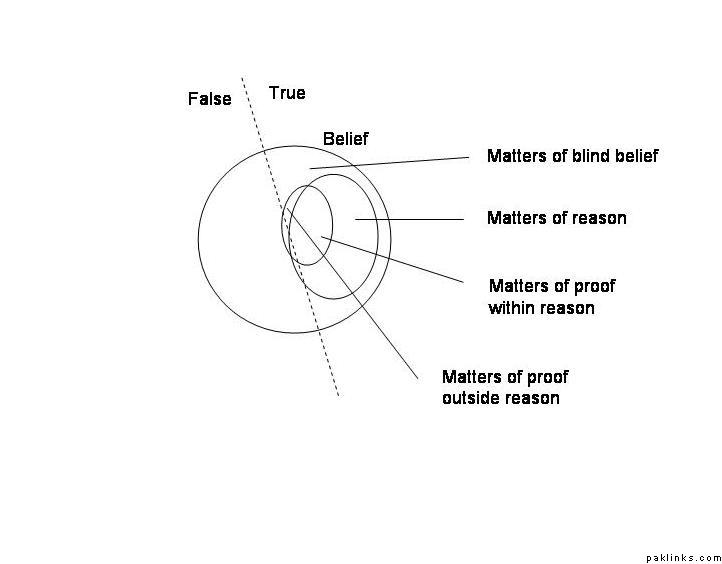
To explain my point the following Venn diagram has eight possible positions of belief. True blind belief, false blind belief, true belief in matters of reason, false belief in matters of reason, true belief in matters of proof within reason, false belief in matters of proof within reason, true belief in matter of proof outside reason and finally false belief in matters of proof outside reason.

The belief in matters of the proof circle, be it within reason or not or be it true or false is what is commonly called ‘know’ or ‘the stance on knowledge’. However, Islam requires us to make distinction of true matters of proof and false matters of proof, both of which an honest person will say he ‘knows’. However, he will need to reject some matters of proof and some matters of reason based on other proofs, reasons and beliefs in general. A magician may deceive us but according to eye witness testimony it is proof but our eyes can deceive us. By the way logic resides within the circle of reason, inside the section of matters of proof within reason. It is still subject to being false by the way.
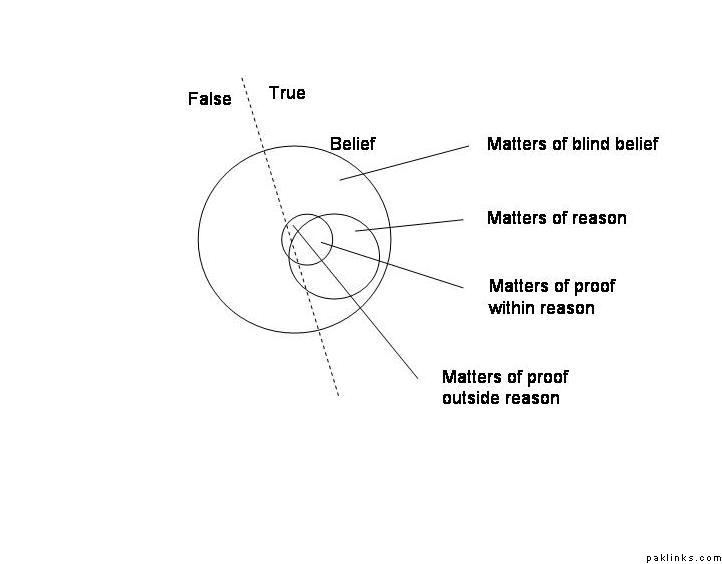
The Qur’an tells us that we are in disadvantage in this matter; it would be difficult to discern truth from falsehood if we were not guided. When we are truly stumped then we should meditate on matters to access our fitrah, which is a form of reasoning outside logic. The way we access our fitrah regularly is do much dzikr and requests for guidance and performance of istikhara. It may be true that some beliefs require us to first accept but should not leave them like that. We should investigate and ponder over those points. This means that the matter becomes reasoned after the acceptance. For example a Muslim tells another about so and so … The Qur’an in the story of Solomon (AS) teaches that the Hoopoe bird was late gave an excuse and the matter was checked up. This proves that blind belief is not acceptable in Islam. Whether we first accept and then get evidence or first get evidence and then accept we are not allowed to establish a belief and leave it in the blind category. Hence we are required to grow our circle of reason, please refer to the new Venn diagram.

When Muhammad (SAW) got a visit from the Angel Gabriel (AS) he initially rejected its truth, but with the reasoning from his wife Khadijah (RA) he accepted it.

Agreed

Hence, Belief and Knowledge are not exclusive from one another nor is there a like for like comparison. Knowledge is extracted truth, be it from the world around us or from within our souls, but we can choose to deny ourselves the knowledge we have and that called kufr and we choose to accept that knowledge and that called belief – ‘iman.
But this is the Islamic definition of knowledge, the worldly definition of knowledge is only extracted information from the world and does not include the inner sources and furthermore it is only that information from the world that can be objectively demonstrated.

:o

**Dear diwana,

before you make any opinions on religions, make an opinion about yourself and your logic. If there was no logic in Religion, Muhammad (saw) and all other Prophets would have not given their life for Religion. I used to believe blindly and this is a wrong attitude. I wanted to believe what I see, not what I have heard or read or whatever. I have seen God and Allah tells me to believe in logic, not in farytales. I was born blind to the ways of mankind, but I was not born blind towards God and my destination.

I don’t have a blind belief and Islam also doesn’t require blind belief. What would be the sense then. That would mean, there is something, the books and the Prophets told me it’s like that, ok I do that, but I’m not sure.

If Islam or Religions in general would require blind belief then there would be compulsory in belief. Islam for example, it could not stand up for it’s claim to be a peaceful religion. It would be a contradiction

What does Islam mean? find peace by bowing down infront of your Lord. When you don’t, you won’t have peace. Do we have peace? Watch for example the muslim states! Pakistan is fighting since 50 years for Kashmir. Did Allah tell them to fight for Kashmir, for materalism? Allah said fight for me and you will be blessed. Is Pakistan blessed? Is it logic to fight for land and kill innocent lives?

It is logic to have sex before marriage, it is logic to steal, hurt, kill, rape…
If it is logic to have war, please, the Bush errr the Obama Administration is waiting for you!

The Holy Qur’an talks of people like you (don’t be offended) and this strenghtens my belief more and more.

Since the Middle Ages, the West and the Popes have misused their Might and led a hate campaign against the Islam. They are still leading it today. This is another hate campaign, fueled by the Western Media blaming Islam for the social problems.

Someone who looks for problems, he will get 'em. Don’t make Islam or Religions responsible for that. It is easy to judge others, but impossible to jude about yourself.

Don’t you admit that Peace is logical desire?

The mission of Muhammad (saw) was to establish Peace in the entire world. Isn’t that logic that when I smile instead of crying I feel good? This is logical, right? How come that you say Religions have no logic?

When I hear the Ulema of our time speaking or any other Mullah or the Pope I ask myself “Have they read too much Lord of the Rings, Harry Potter…”

These scientist you have read about and you believe (you must be a victim of Siegmund Freud, Darwin and all the other great Men who have achieved so much, but still so less) in were and are in first line Atheist. They have no belief. They believe in strange mathematical figures and claim to have solved the code of life…
**

^ Thank you numb for sharing your thoughts. I urge you to please read the thread again. Make your thoughts a bit consolidated. There are so many thoughts and many are not even consistent with the topic at hand. I do not know where to begin and what to respond to.

Please feel free to write again and I will be more than glad to respond. I do see your emotions and admire.

Just two questions:

1- What does Quran say about people like me? And who are people like me anyway?

2- Why do you think I might be victim of Sigmund Freud or whoever?

Peace. :)

Please consider the following rule:

[quote]

  1. Refrain from quoting LONG posts, as it causes distraction to the eye. It takes up unnecessary space and makes reading difficult. It can disrupt the flow of a thread, because posters have to scroll through large amounts of text that they may not wish to read. Better quote the part in a post that you are directly referring to...otherwise delete some paras or use @ to directly address the poster whom you want to reply. [/quote]

would you like to know some other Einsteinian quotes? likec

"I am a deeply religious non believer. that is a somewhat new kind of religion".

so his definition of religion was probably not the one that you use.