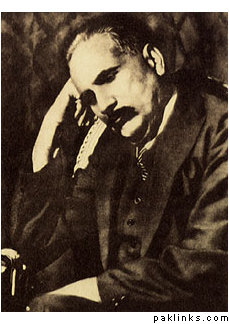
Hakeem-ul-Ummat, Muffakkir-e-Pakistan, Shaair-e-Mashriq, Dr. Sir Allama Muhammad Iqbal - a person considered to be the GREATEST and the BIGGEST poet of 20th century by a majority of Critics needs no introduction on his name for he is commonly well known to everyone who is related to Pakistan in someway or other and to muslims especially Arabs who have read his translated work…
The following information about him is taken from Wikipedia and is accurate as per my own knowledge about him.
Sir Muhammad Iqbal (Urdu:** محمد اقبال**) born (November 9, 1877 – April 21, 1938) was a Muslim poet, philosopher and politician born in Sialkot, British India (now in Pakistan), whose poetry in Urdu and Persian is among the greatest of the modern era, and whose vision of an independent state for the Muslims of British India was to inspire the creation of Pakistan. He is commonly referred to as Allama Iqbal (علامہ اقبال, Allama lit. Scholar.)
After studying in England and Germany, Iqbal established a law practice, but concentrated primarily on writing scholarly works on politics, economics, history, philosophy and religion. He is best known for his poetic works, including Asrar-e-Khudi—which brought a knighthood— Rumuz-e-Bekhudi, and the Bang-e-Dara, with its enduring patriotic song Tarana-e-Hind. In Afghanistan and Iran, where he is known as Iqbāl-e Lāhorī (اقبال لاهوری Iqbal of Lahore), he is highly regarded for his Persian works.
Iqbal was a strong proponent of the political and spiritual revival of Islamic civilisation across the world, but specifically in India; a series of famous lectures he delivered to this effect were published as The Reconstruction of Religious Thought in Islam. One of the most prominent leaders of the All India Muslim League, Iqbal encouraged the creation of a “state in northwestern India for Indian Muslims” in his 1930 presidential address. Iqbal encouraged and worked closely with Muhammad Ali Jinnah, and he is known as Muffakir-e-Pakistan (“The Thinker of Pakistan”), Shair-e-Mashriq (“The Poet of the East”), and Hakeem-ul-Ummat (“The Sage of Ummah”). He is officially recognised as the “national poet” in Pakistan. The anniversary of his birth (یوم ولادت محمد اقبال - Yōm-e Welādat-e Muhammad Iqbāl) on November 9 is a holiday in Pakistan.
Iqbal Died on April 21st, 1938 in Lahore.
His works in urdu includes the following books in his name:
-
Baang-e-Dara (1924)
-
Baal-e-Jibreel (1935)
-
Zarb-e-Kaleem (1936)
-
Armaghan-e-Hijaaz (1938)
His works in Persian includes the following books in his name: -
Asrar-e-Khudi (1915)
-
Rumuz-e-Bekhudi (1918)
-
Payaam-e-Mashriq (1923)
-
Zaboor-e-A’jam (1927)
-
Javaidnaama (1932)
-
Pas Chah Bayaad Kard (1936)
-
Armaghan-e-Hijaaz (1938) - also in the list of urdu poetry

