NYT: Pakistan to Talk With Militants, New Leaders Say

Both Asif Ali Zardari and Nawaz Sharif are in favour of using military force only as a last resort. They have likened the current Taliban militant problem to the Irish Republican Army (IRA) guerilla war (1969-1997) which was aimed at overthrowing British rule in Northern Ireland to create a united Ireland

FYI:

Britain = England + Wales + Scotland

UK = Britain + Northern Ireland

A typical IRA operation involved sniping at British patrols and engaging them in fire-fights in urban areas of Belfast (capital of Northern Ireland) and Derry. They also killed local police and soldiers when off-duty. These tactics produced many casualties for both sides and for civilian by-standers. Another element of their campaign was the bombing of commercial targets such as shops and businesses. The most effective tactic the IRA developed for its bombing campaign was the car bomb. IRA bombers often made a point of telling the British government a few minutes in advance where they had planted their bombs in order to minimise loss of life. The Taliban suicide bombers and murderers on the otherhand are killing civilians and security personnel indiscriminately

http://www.nytimes.com/2008/03/22/world/asia/22pstan.html?pagewanted=1&ei=5087&em&en=71cac932cc0327b1&ex=1206244800

By JANE PERLEZ
Published: March 22, 2008

ISLAMABAD, Pakistan — Faced with a sharp escalation of suicide bombings in urban areas, the leaders of Pakistan’s new coalition government say they will negotiate with the militants believed to be orchestrating the attacks, and will use military force only as a last resort.

That talk has alarmed American officials, who fear it reflects a softening stance toward the militants just as President Pervez Musharraf has given the Bush administration a freer hand to strike at militants using pilotless Predator drones.
Many Pakistanis, however, are convinced that the surge in suicide bombings — 17 in the first 10 weeks of 2008 — is retaliation for three Predator strikes since the beginning of the year. The spike in attacks, combined with the crushing defeat of Mr. Musharraf’s party in February parliamentary elections, has brought demands for change in his American-backed policies.
Speaking in separate interviews, the leaders of Pakistan’s new government coalition — Asif Ali Zardari of the Pakistan Peoples Party and Nawaz Sharif, head of the Pakistan Muslim League-N — tried to strike a more independent stance from Washington and repackage the conflict in a more palatable way for Pakistanis.
They said they were determined to set a different course from that of President Musharraf, who has received generous military financial help of more than $10 billion from Washington for his support.
**“We are dealing with our own people,” said Mr. Sharif, who was twice prime minister in the 1990s. “We will deal with them very sensibly. And when you have a problem in your own family, you don’t kill your own family. You sit and talk. After all, Britain also got the solution of the problem of Ireland. So what’s the harm in conducting negotiations?” **
**Mr. Zardari said: “Obviously what they have been doing for the last eight years has not been working. Even a fool knows that.” **
The war against the insurgents has to be redefined, he said, as “Pakistan’s war” for a public that has come to resent the conflict as being pushed on the country as part of an American agenda. It should be dealt with by talks and the use of a beefed-up police force rather than the army, he said.
Washington opposed past negotiations because in its view short-term peace deals between the militants and the Pakistani military were a sign of weakness and resulted in the militants’ winning time to fortify themselves.
The chairman of the Joint Chiefs of Staff, Adm. Mike Mullen, said on a visit to Islamabad last month that talks with the militants were not helpful in the “short term.”
In general terms, according to a retired senior Pakistani general who remains close to the current military leadership, new negotiations would be likely to involve a ban on non-Pakistani militants — like Afghans, Uzbeks and Chechens — coming from southern Afghanistan into Pakistan, in return for reduced operations by the Pakistani Army in the tribal areas.
But precisely how those talks would be different from the negotiations that led to failed peace deals under Mr. Musharraf is not entirely clear, except that negotiators would represent the newly elected government rather than the military government of the past eight years.
Neither Mr. Zardari nor Mr. Sharif was specific about whom among the militant groups in Pakistan’s tribal areas they favored talking to. Nor was it clear what kind of formula or quid pro quo the two political leaders had in mind for the talks.
Mr. Sharif, whose Islamic religious background is conservative, refused to say whether he would negotiate with Baitullah Mehsud, the Pakistani Taliban leader whom the government blames for many if not most of the recent suicide bomb attacks in Pakistan.
American and Pakistani terrorism experts have said they believe that Mr. Mehsud was behind the assassination of the opposition leader Benazir Bhutto in December, and that he works in tandem with Al Qaeda. “Nobody gave me any presentation on this subject,” Mr. Sharif said.
Asked whom the negotiations would be held with, Mr. Sharif replied: “With all the concerned elements. I don’t think guns and bullets have so far produced any positive results.”
Any result that smacks of Pakistan’s ceding further control over the tribal areas is not one likely to be welcomed in Washington. The Bush administration views the tribal areas as a sanctuary for Taliban forces who cross the border into Afghanistan to fight American and NATO forces, as well as a base for Al Qaeda to plot new terrorist attacks in the United States and Europe.
Pakistanis, however, have come to see the tribal areas as something entirely different: a once peaceful region where a group of militants have turned their wrath on the rest of the country as punishment for the American alliance.
Many civilians were among the 274 people killed since the beginning of the year, but the dead also included young soldiers and policemen, according to a tally by the Pakistani newspaper Dawn. A bomb explosion last Saturday at an Italian restaurant favored by foreigners in Islamabad wounded four F.B.I. agents and underscored for Pakistanis yet again the American involvement here.
Washington may have little choice but to adjust to the new policies, said a retired Pakistani Army brigadier, Mehmood Shah, who was in charge of security in the tribal areas.
Of the new Pakistani government, Mr. Shah said: “They will not like to be seen as dictated to by the United States. They would like it to be seen as ‘our war.’ ”
Mr. Shah, who met with Admiral Mullen in Islamabad, said there was a popular sense in Pakistan — prevalent on television talk shows as well as in the halls of Parliament — that it was time to “keep a distance from the United States.”
As Pakistan’s new leaders fashion their strategy, however, they will unavoidably be dealing with programs devised by Washington to help Pakistan regain control of the lawless tribal areas. In some places, the approaches may yet dovetail.
For instance, one element of the stepped-up American aid effort is a $400 million plan to train the Frontier Corps, an underfinanced paramilitary force that is used to patrol the border with Afghanistan.
Mr. Sharif said he had heard about the plan, expected to begin in October, but had no details.
Mr. Zardari favored employing such a force over relying on the army, which he said was the “wrong instrument” to use against the militants. “We need to use the police force,” he said. “They had few guns, made in 1952. You have to upgrade them. You have got to give them modern technology, and they will stand better than anybody else.”
**Mr. Sharif, who is regarded as a nationalist — he gave the go-ahead for the explosion of Pakistan’s nuclear bomb in 1998 — said he was not in favor of foreign aid. “I think frankly we should rely less on aid,” he said. “It makes us, you see, lazy. We should generate our own resources.” **
Both men stressed that the new Parliament, which held its first session this week, would be consulted on the strategy toward the insurgency, a sharp distinction from the go-it-alone behavior of Mr. Musharraf, who until last year served as both head of the army and president.
Mr. Sharif and Mr. Zardari have made much of the fact that they received a broad mandate in the elections last month. To that end, they said, they would revive the role of Parliament.
As an example of the docile legislature, a recent report of Parliament’s committee on defense for the last four years consisted of 67 pages. The panel was apparently so short of funds, the report was published with financing from the United States Agency for International Development, whose logo appears on the last page.
The only mention in the report of the fight against terrorism was about a resolution by the committee in 2007 criticizing the United States for threatening to link the amount of aid to Pakistan to the performance of the army.
Another important distinction from the past is that **the new government would not use “the same tainted network of agencies and the army who have created this” situation, said one of Mr. Sharif’s senior aides, Nisar Ali Khan, who has relatives in prominent positions in the army. **
**“The new start won’t be with them,” he said. “It has to be a multifaceted operation with the tribal chiefs who are operating in the area.” **
Both parties have long accused Pakistan’s intelligence agencies of backing militant groups, even as the government has been forced to negotiate with them. Many of the groups were used to pressure India and Afghanistan, but have more recently turned their fury back on Pakistan as they have become more radicalized.
Those intelligence agencies will almost certainly have new leadership chosen by a new prime minister.
Ijaz Shah, the head of the powerful Intelligence Bureau and a confidant of Mr. Musharraf, resigned this week. His replacement will be named by the new prime minister, who is expected to be announced on Monday by Mr. Zardari.
Mr. Zardari is not immediately eligible to become prime minister because he did not run for Parliament. But he is likely to do so in the coming months and then assume the mantle of prime minister.
Re: NYT: Pakistan to Talk With Militants, New Leaders Say

10% compounded annually…Should buy off all the War Lords…even the those from the West…way to go Pakistan…:k:

Re: NYT: Pakistan to Talk With Militants, New Leaders Say

Despite the fact that I am a pro- Musharraff individual, I hope to god that Nawaz and Asif are successful in negotiating some sort of lasting treaty with the extremist elements. Bullets and bombs are most definatly not working, and nor will they ever. Musharraff tried to negotiate with the Taliban before, but the talks failed. Asif and Nawaz must now prove that they are better than Musharraff by making the negotiations a lasting success. If Nawaz and Asif somehow create a lasting peace agreement, reduce American influence, and stand united on a Pro-Pakistan policy...they will most certainly earn the respects of many Pakistanis.

Re: NYT: Pakistan to Talk With Militants, New Leaders Say

Buying warlords is a failed method. Why? Because warlords can sell their loyalties, give away their women, and rent their homes to the highest bidder at the drop of shuttlecock burqa.

In corporate world too, one can find similar "transitions", but the problem with warlords is that they create anarchy in their own area.

It is time that we abolished the now-100%-obsolete FCR or Frontier crime regulations or Jirga system.

The next and immediate step should be to abolish FATA itself and merge it with the Frontier province.

If however FATA resists to be merged with Frontier, it should be changed to separate provinces by adding surrounding Punjab areas.

I.."Keeping distance from USA" is the common thread that joins Islamists and leftist intellectuals. Anyone following leftists liberals in Pakistan is doomed to wreck the economy from where it is right now. Once the economy goes down people will kick the government out.

It is time that we moved away from leftist liberal NYT-ish holier-than-though stance.

II..Mr. Z the new Co-Maharaja from Sindh is delusional at best unless he is just paying lip service to the leftist media. The problem is that the police force cannot face the warlords. The only way to beat the diddians out of warlords is to use flying gunships, or combat airplanes. And guess what! those weapons are usually not given to the police force.

III..Mr. Sharif is correct that "foreign Aid" is not good as it makes the country "lazy". However if you abadon the Western policies, you will not only lose Aid, but the trade as well.

Just see the examples of Singapore, Malaysia, S. Korea, China, India, Japan over the last 60 years. They all combined "Aid & Trade" with the USA. Overtime percentage of "Aid" goes down, while "Trade" picks up.

Mr. Sharif has the credentials to help Pakistan significantly boost its "Trade", but he won't be able to do that until the Western markets remain open for Pakistan for the foreseeable future.

IV..Broad mandate can fizzle overnight if the newly elected parties do not deliver on economic front. Both ML-A-B-C-Q-R-N-T and PPP-PPPPP-PPPP etc. should know that they had big mandate in the past as well. Once the law and order situation + economy went down, the whole mandate thingy disappeared overnight.

V..People who accuse Pakistani Army for supporting anti-Pakistani elements are living in Alice's wonderland. Or simply are so dumb to just mouth the leftist liberal and Islamist propaganda.

VI..See V above.,

Re: NYT: Pakistan to Talk With Militants, New Leaders Say

You guys talk as if Pakistan 'chose' to keep near USA in the past and so they can now 'elect' to put distance.

Facts are what:

  • in the past Pakistan needed USA to counter India and USA needed Pakistan to counter Russia

  • now USA needs not just cooperation of Pakistan but actual control - because from their point of view there are two Pakistans. a) the government, the leaders and the power brokers; b)the jihadis, the al qaeda supporters and the radical islams.

The characters themselves switch side between a & b as local needs warrant. Depending upon where a person is on a given day, they either justify additional US control or berate US control

Re: NYT: Pakistan to Talk With Militants, New Leaders Say

I think that is correct analogy by Zardari and Nawaz. Pakistan has to change strategy as Mush's formula of killing jehadis for the last eight years has created more jehadis and hatred among brothers.

Instead of using derogatory terms as 10% or buying out Islamic fundamentalists on this most important and crucial problem now faced by Pakistan, indicates lack of self-respect, self-esteem and moral bankruptcy. Using these derogatory terms should now be avoided for leaders/political parties, who have been given mendate by people of Pakistan. Do not insult peoples' mendate.

aasman par thuka mun per hi aata hay.

Re: NYT: Pakistan to Talk With Militants, New Leaders Say

question is, is hunting the jihadis mush's formula or is it bush's formula that mush is forced to execute?

if it is the latter, and I do think it is the latter, then wouldn't the same thing happen with anyone else in mush's position? remember mush 'talked' to the jihadis too but it didn't bear fruit

Re: NYT: Pakistan to Talk With Militants, New Leaders Say

Typical Indian perception and twists on this very complicated affair.

Just like the Pakistan's Islamo-leftists, you are spouting the hate against USA by making it Bush's war.

What's with the Indian-nationalists, who want to suck every $$ from the USA, but heaven's forbid, if Pakistan ends up on the US side?

Hello, Indians wilingly were the leading voice in the leftist movements fully funded by the Soviet Union.

Now that Soviet Union is dead, you guys make a U-turn by dumping Ruskies and then promptly making Uncle Sam as your 100th deity?

FYI! America is fighting its war in Afghanistan. Jihadis want to use Pakistani areas for their nefarious missions. When they are stopped from doing so, the same Arab Jihadis want to turn Pakistan into their battle ground.

By declaring war on Pakistan, Jihadis cast the first stone against Pakistan. And you still think this Bush's war?

I hope you passed your logic 101.

Re: NYT: Pakistan to Talk With Militants, New Leaders Say

stop ranting inanley about India. my question was very simply this -

can anybody leading pakistan behave any differently than musharaf, given the circumstance where US is running the show.

Re: NYT: Pakistan to Talk With Militants, New Leaders Say

suicide bombers similar to IRA? ridiculous concept.
what the two munnay forgot to realise was that IRA was not using northern Ireland to launch attacks on lets say soviet union.

This is not just Pakistan's problem, and the big issue militants have with Pakistan is that it is trying to stop their attacks on NATO forces in Afghanistan, and sheltering al qaeda types in the tribal area.

Nawaz and Asif and do whatever they want, can they convince Al Qaeda of not launching any attacks in US or Europe or elsewhere? or will they convince Pakistani Taleban to stop crossing the border into Afghanistan and attacking NATO forces?

If they can do it, then..like wow. But I have my doubts.

btw guess what happens if there is one major attack on US soil and it is tracked back to FATA.

lets just say it will not be asif or nawaz's call. but Bush, Mccain, Clinton or Obama's call.

2 Likes

Re: NYT: Pakistan to Talk With Militants, New Leaders Say

Very Good point.

Re: NYT: Pakistan to Talk With Militants, New Leaders Say

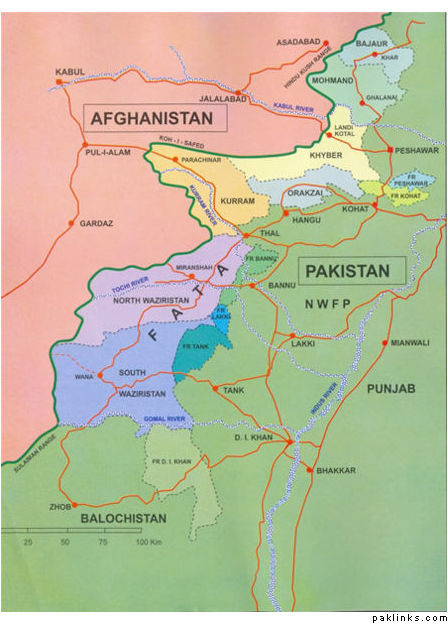
Which parts of Punjab touch FATA areas? I thought NWFP is a buffer between Punjab and FATA areas.

Re: NYT: Pakistan to Talk With Militants, New Leaders Say

A possibility of success as a result of ‘negotiations’ and ‘deals’ would mean a big blow to someone’s long war i.e. terrorists can be overcome only by missiles/bombs.

Its a slap in some faces. But slight correction its been less than 7 years.

Re: NYT: Pakistan to Talk With Militants, New Leaders Say

^ Mianwali is close enough

Re: NYT: Pakistan to Talk With Militants, New Leaders Say

Which area of FATA is Mianwali touching, sorry I can't see it clearly :D

Re: NYT: Pakistan to Talk With Militants, New Leaders Say

If you double click on it you get a larger image. Yes Mianwali is not exactly touching FATA but most of it’s inhabitants (Niazis) have their roots in FATA.

Did you know that pre-1901 there was no such thing as NWFP. In November 1901, North West Frontier Province was carved out of Punjab and present day towns of Mianwali, Isa Khel, Kalabagh, and Kundian were separated from Bannu District (NWFP) and a new district was made with the headquarters in Mianwali city and placed in Punjab.

FATA
Federally Administered Tribal Areas - Wikipedia](Federally Administered Tribal Areas - Wikipedia)

Niazi
Niazi - Wikipedia](Niazi - Wikipedia)

Re: NYT: Pakistan to Talk With Militants, New Leaders Say

Well we have seen the result of using bombs and gunship helicopters. Let see what these guys will do. the start is good...

Military should be called back immediately, and local Police ( if they are from tribal areas) should awarded with the task of cleaning their territory, This Police will be composed of their own people and will have support of them as well.

Re: NYT: Pakistan to Talk With Militants, New Leaders Say

Lets see where discussion can get us. It is better to have a peaceful resolution, but it must be with the big stick in the background.

Re: NYT: Pakistan to Talk With Militants, New Leaders Say

Local police doesn't exist. As per Frontier Crimes Regulations, tribals are supposed to police themselves. And they have miserably failed in breaking the stranglehold of Arabs and other sundry terrorists.

That's why it is of utmost importance to get rid of FCR, and replace with the Pakistani penal code (a variation of British-era Indian penal code).

As soon as we get rid of FCR, we must change the status of FATA as the Lawless-Gun-toting Wild Wild West. This type of concepts belong to the life that existed 2 centuries ago. In the modern world, you are either part of a country, or you don't exist.

p.s. A force called Khasa dras do exist in FATA but they are toothless tigers or more accurately pawless cats. .

Re: NYT: Pakistan to Talk With Militants, New Leaders Say

and where exactly is economy.? i have my brother in law and cousin in textile business... i mean to say actually owning the textile factories... and i can tell that economy is in far worse condition than ever... People are literally closing the factor*ies..* Officially pakistan textile is doing pretty badly in export...

economy is definitely not the number of mobile phone subscriber..

I wander the intelligence of people who believe that economy is doing gr8... when there is 8 - 14 hours of load shedding... really dia salaee and mom-batee economy is booming in Pakistan... i don't know any other industry which can work without electricity.. and if you have a little bit of common sense you know that no factory can work on petrol power generation as it will not be feasible production...

Pakistan need to get rid of Musharraf and all its chamchas... if it has to survive. and Alhamdulillah Pakistani common man has realised this reality... and insallah we will get rid of them soon.