Muslims' role in fighting Nazis: WW2 highlighted

‘Untold’ story of WW2 stirs Muslim youth pride
** Muslim role in Second World War, fighting and dying alongside Britons against Nazis, being used to wean young men away from extremism and alienation*

BIRMINGHAM: Taunted by racists as a “Paki” and “terrorist”, Haroon Bin Khaled spent his teenaged years feeling rejected by mainstream Britain and increasingly drawn to Al Qaeda extremism.

But the young Muslim of Pakistani descent found an unexpected answer to his alienation the day he heard the story of how Muslim soldiers, many from what is now Pakistan, fought and died alongside Britons against the Nazis in World War Two.

Almost at a stroke, the jobless young man with an unpromising future felt a sense of belonging. As he examined the facts, he began to shed beliefs that Britain despised him or that fighting alongside the Taliban in Afghanistan was a worthwhile idea.

“Truthfully, it touched me,” said the former gang member, now 21 and with a prison stretch for fraud behind him.

“If that could be shown to other youths it could make a big difference.”

That ‘difference’ could be better community relations, hurt in the years after the September 11, 2001 attacks on the United States and especially after four young British extremists carried out suicide bombings in London in July 2005, killing 52 people.

It could also help security by dissuading Muslim men from joining the Taliban war against Western forces in Afghanistan, or from taking part in attacks at home such as the London bombings or attacks in Madrid in 2004 that killed 191 people.

Bin Khaled is one of dozens of youths of Pakistani descent in Birmingham to have attended a workshop by academic Jahan Mahmood that uses the Muslim role in the Second World War to wean young men away from extremism and alienation.

Jahan says his presentation is intended to counter the notion of perennial confrontation between Christians and Muslims that Al Qaeda seeks to present as an immutable fact of history.

Another attendee was Sabeel Saddique, 19, who used to watch videos of Al Qaeda beheadings on his mobile phone for kicks and still feels Britain does not fully accept him.

“I’ve always thought that we were on our own,” the burly former gang member said in an interview in the largely immigrant Sparkbrook district, a drab district renowned for drug dealing.

“We used to think, ‘Taliban - yeah!’ We admired them, we just wanted to be like them because everyone was always on about ‘Muslims are terrorists’ and it just used to make us angry.”

Saddique said when New York’s World Trade Centre was attacked “we all thought it was cool … But now I see it in a different way. That’s all just wrong. It’s killing innocents”.

He still opposes Western armed action in Muslim countries. But he says his sense of belonging to Britain and his distaste for Al Qaeda is real and stems from Jahan’s lecture, which showed “what our grandparents have done for the country”.

He just wishes white Britons knew that history as well.

“We are part of this country no matter what, because we did fight. You just don’t feel like it, because the people don’t know about it, and they don’t treat us like we’re part of it," he added.

Basharat Najib, a youth counsellor in the nearby town of West Bromwich, said Jahan’s workshop got a “very, very positive” reaction among the alienated young men he works with, many of whom are of Pakistani or Bangladeshi origin. Many often ask why they weren’t taught this information about the war at school.

“The vision they had from school was Germany on one side, Britain on the other, and the Americans coming in at the end,” he said.

“They have no affinity with Britain though they may be born here. But the soldiers’ story gives them a sense of belonging. It gives the missing ingredient of affection for the country.”

The workshop tells how soldiers volunteered in the army of Britain’s then Indian colony and fought in north Africa and Italy.

India’s army grew from 200,000 in 1939 to 2.5 million in 1945, with Muslims making up about a third of the numbers at any one time. Most Muslim recruits came from what is now Pakistan.

In all, 87,000 Indian army soldiers were killed in the war, according to the Commonwealth War Graves Commission.

Jahan’s study, which focuses on 5,500 Indian army deaths in Italy, fascinates its audiences because it breaks down Muslim casualties according to recruitment areas within British India, and then traces links between today’s British Pakistani communities and the areas where recruitment took place.

Young Muslims specially identify with Jahan’s finding that of the 122 deaths of soldiers under 18 in Italy, 90 were Muslim. Among them were three 15-year-olds – Amir Khan from Attock, Gulab Khan from Rawalpindi, and Mian Khan from Kohat.

In a lecture at Oxford University in April, Jahan spoke of a “a pressing need to restore a sense of identity and self esteem for young British Muslims today”.

“If more was known about the contribution of so many Muslim soldiers of the British Indian Army, it would help to restore a sense of pride, cement the social bonds of different communities in British society, and turn the idea of a shared heritage into a meaningful weapon against prejudice,” he said.

The workshop was funded by a state programme called “Positive Futures” which supports local initiatives to help disengaged and vulnerable young people. reuters

Daily Times - Leading News Resource of Pakistan

Muslims have always played an important and pivotal role to shape the world for better. From the best educational institutions of Baghdad and Spain, to the industrial innovations, one worth mentioning Damascus Steel, the refined medical procedures of Islamic arab world, and so much more all this while Europe laid wasted in the “Dark Ages”…it was the muslim world that gave sanctuary to those yearning to escape the ruthless control of Church which prohibited so much as even the study of Sciences, which were readily taught in Spain under Muslim rule.

But history is witness to the fact that despite all the contribution muslims have made to better the world, fought side by side against evil ideologies that posed a threat to the peace-loving world, the sacrifices of muslims are often overlooked, if not totally ignored. The minimal lipservice in the form of “Allowed immigration” is a tiny fraction of the gratitude that is owed to the muslims across the world for their positive role. The negatives associated with some nutcases who happen to be muslims are in a tiny fraction, but often magnified to shadow the entire community.
Re: Muslims’ role in fighting Nazis: WW2 highlighted

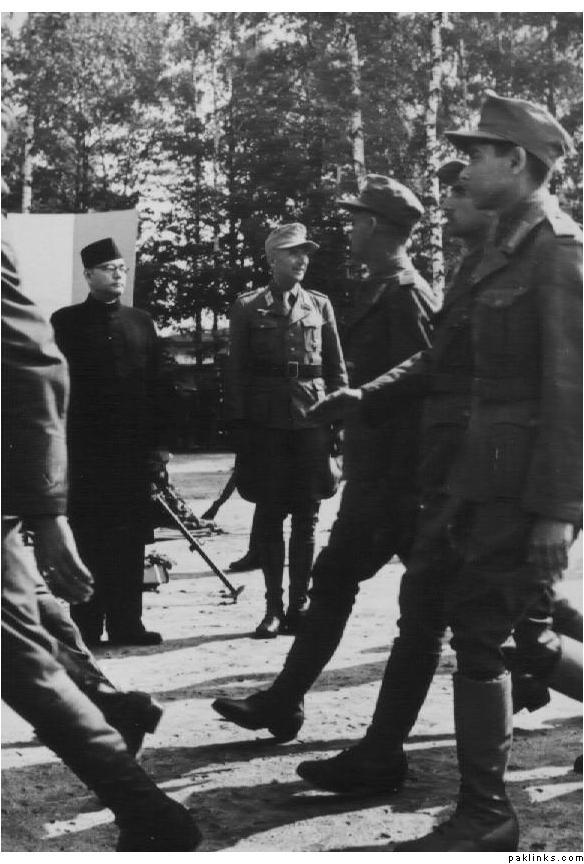
Then what to make of this footage

Re: Muslims' role in fighting Nazis: WW2 highlighted

The French also recruited about 350,000 North African Muslim soldiers to fight against the Germans during WW2. When the Nazis occupied Paris, local Muslims arranged to have nearly 2,000 Jews hidden in the city's Grand Mosque to avoid deportation to the death camps...some were given fake birth certificates with Muslim names, others were smuggled out to Algeria and Spain. Turkish diplomats saved tens of thousands of Turkish-origin Jews by having them repatriated to Turkey.

Muslim role? Naah.

**
Islam never faired well in the anti-nazi fight.

Because most of the so called "true" Muslims or 100% pakka Muslims are from Arab lands. And majority of those Muslims supported Nazis and Hitler.
**

In fact the Grand-Mufti of Palestine was the Grand-chamcha of Hitler.

Most of the sacrifices in the anti-Nazi fight were made by the UK and US Christian young soldiers.

If the credit has to be given to non-UK or non-US soldiers then we must talk about qurater to half-million soldiers mostly from Pakistani areas of today.

Additionally a much smaller number of non-Euro soldiers also came from French-colonies in Africa. However many French and Africans also supported Hitler.

Do your study yara before spreading the untruths.

p.s. HUGE number of British-Indian troops included Hindus, Sikhs and Muslims from Punjab (both Indian and Pakistani Punjab) and Frontier province.

Thus the dominating numbers of non-Anglo Saxon soldiers were Punjabis and Pashtuns secular troops. Indian-Mullahs were cheering for Hitler.

Congress told the Indian people that WW2 wasn't their fight, and the Muslim League told the Muslims of India that it was their fight.

Muslims in total accounted for over 25% of the British Indian army by 1945, at over 650,000

The majority of the Free French army were Muslims from Africa too- that added in another 200,000 at least.

That gives you a grand total of nearly 850,000 in total between British India and France alone. I haven't even counted Dutch colonial forces from what is now Indonesia, nor have I counted Muslim Africans in British service.

In German service, you by contrast had about 13,000 Muslims from Bosnia and 427,000 Ostruppen, mainly Russian Muslim prisoners who had been persuaded to fight against Communism and communism's allies.

In total, over twice as many Muslims fought against the Germans as fought for them.


In the end, particularly in India, and to a lesser extend in Africa, those Muslims who sided with the Allies were proven to be right as most Muslim countries were able to peacefully secure their independence after the war.

However, going into the war, this was no sure thing. And siding with the Germans had one attractive lure for Muslims of all races and nationalities, be they Soviet, Indian, or Arab: The Germans were the only people in the world who were managing to fight against the governments that were denying political rights to the majority of the world's Muslims.

That made for an easy propaganda argument. The Germans could, with a fair degree of factual accuracy, argue to Muslims that their victory would deliver the world's Muslims from the oppression they were experiencing under the Allies.

For example, in 1944, Japan promised full Indonesian independence. The Allies, on the other hand, not only refused to tolerate the idea of Indonesian independence, but even financed the Dutch reoccupation and provided troops for it. In the end, Indonesia had to fight a bloody revolution to obtained the independence from the victorious Allies that it had been promised by the Axis.

Other instances during the war strengthened Germany's argument that Muslims should fight for Germany. In 1944 Russia ethnically cleansed Crimea of its entire Muslim population. Germany had never carried out any similar activity against Muslim populations it occupied, and spun this to recruit Muslims from amongst its Russian prisoners.

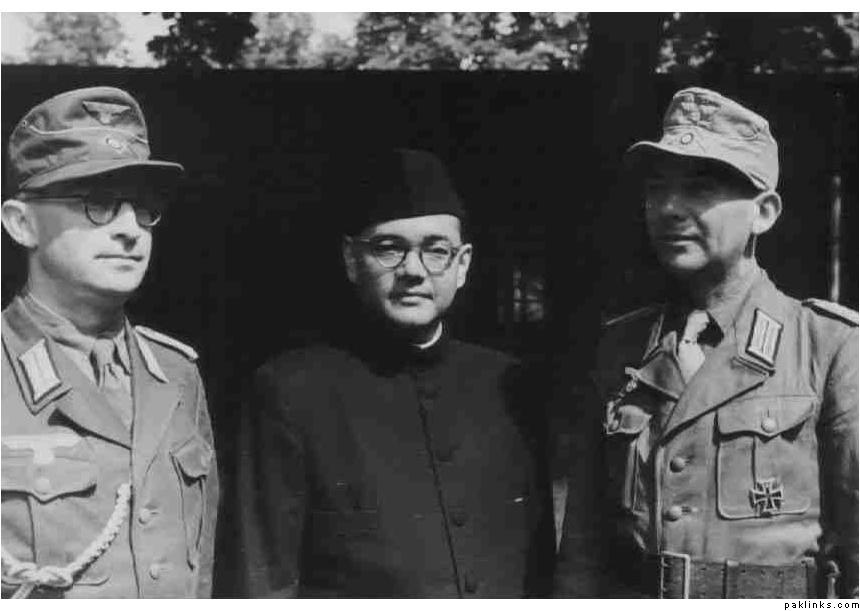
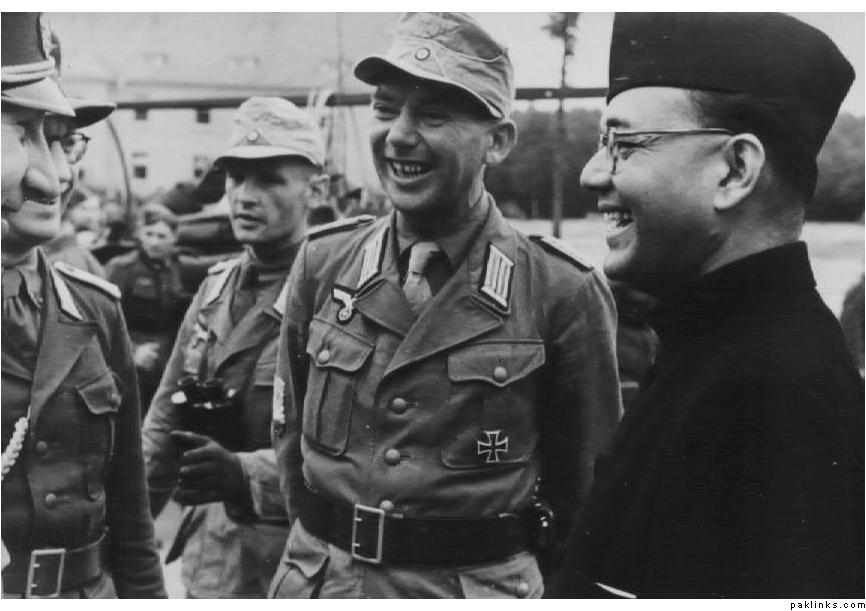
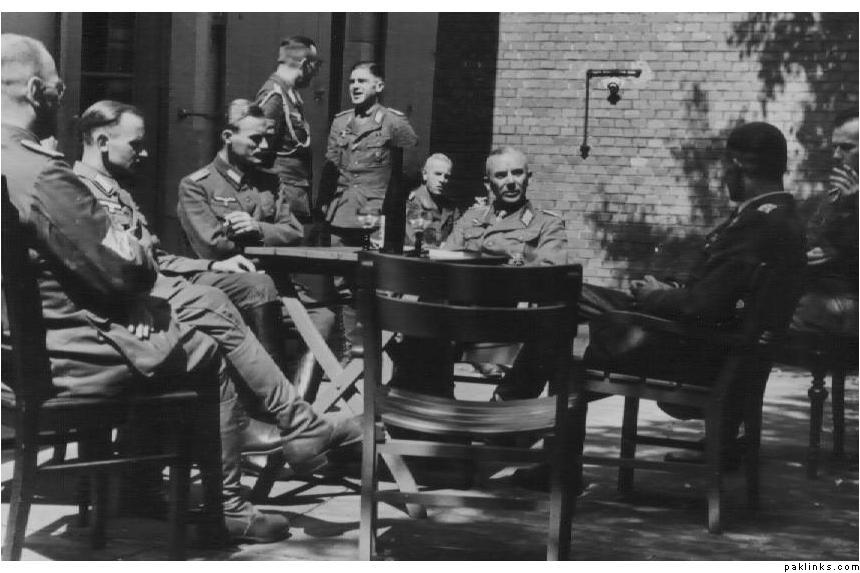
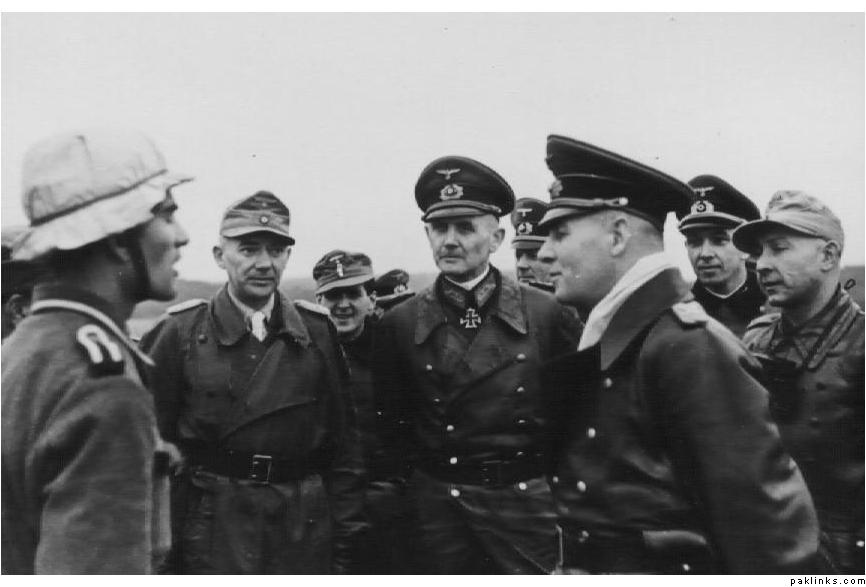
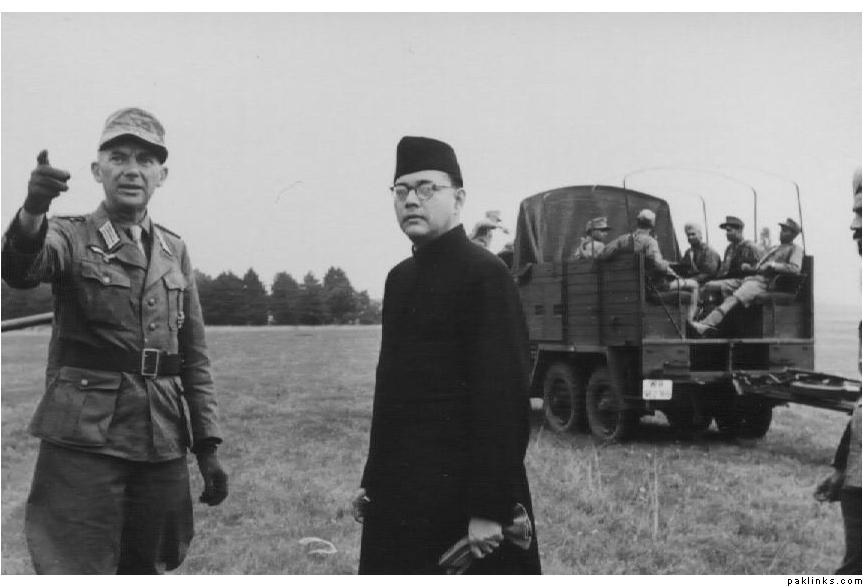
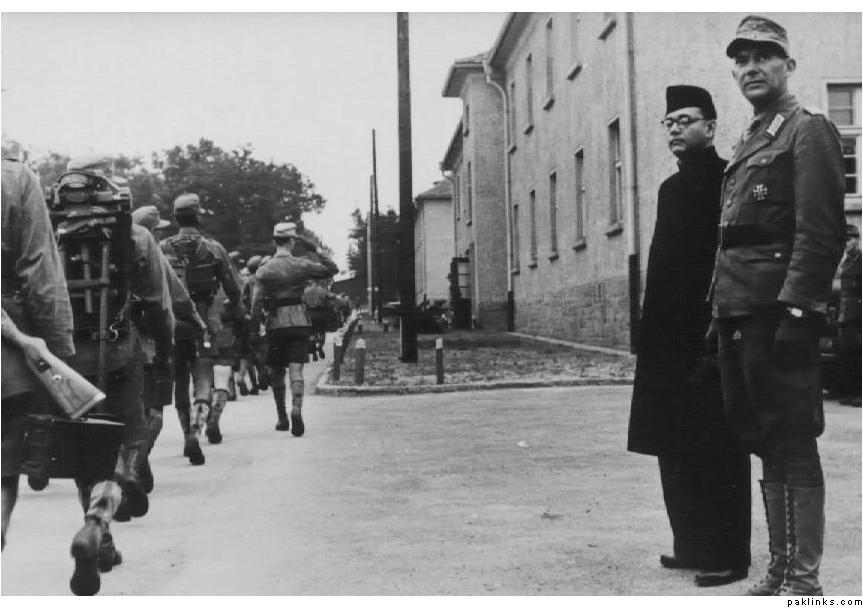
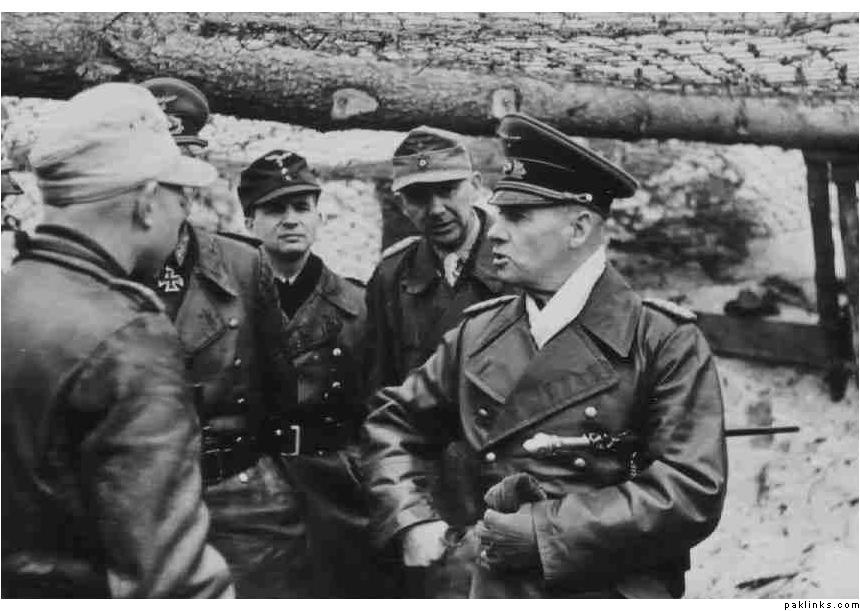
Guess who is with Field Martial Erwin Rommel in this picture?


Fascists stand with fascists. So what's new in the land of revolving revolutionaries!

That's half truth and you know it. Congress was in bed with British through and through. Gandhi ji himself was an official recruiting boy for the British.

Both Congress and ML played their cards and with poker faces. News-rag stories aside, the reality was that both supported the British raj.

In fact Congress was such a brown-nose that they picked the last viceroy as their GG. There goes the Fareedoom movement of India. Heck if you were dying to be free, then why on earth you pick your occupier as the big boss of your so-called freed country.

So please save us from the ana-book ishtyle history.

That's True.

That's half truth and half ....... (you know what I mean).

So what?

the Middle Eastern Arabs the 100% genuine pakka Muslims supported Nazis.

Nothing against you maddy. The thread starter is wrong to attribute British-Indian troops' role as some how "religio-Islamists" role.

No matter how he twists it, it still is a wrong statement. Those Muslims, Sikhs, and Hindus fought together and they were serving their government as professional soldiers.

Islam at no point was a driver for these armymen. Just remember that!

p.s. Oh BTW, thread starter is also wrong to say it is an "untold" story. hahah. Even the basic history books and heck even wiki gives all the major details of British-Indian troops.

Re: Muslims' role in fighting Nazis: WW2 highlighted

Vigo, this young man seems to be in exactly the same situation what British subjects of Indian subcontinent were a century ago. Being "subjects", they did not know what to do. They did not know what was their fight and what was not. If you read the history of british indian troops they changed stance many times.

1- Many soldiers defected and joined Japanese and Nazis, only to find out they were being used and were treated worse by japanese than by allies.
2- British indian troops at one time refused to serve anywher outside India, only to be convinced later to join in.
3- The opposition or favour of Congress or Muslim League depended upon what they could gain in return for their services in war.
4- Gandhi initially opposed Nazism later in mid -forties they felt that opposing a stretched british force will lead to early independence and Congressi-inclined troops defected. Later one Gandhi took a neutral stance.
5- Gandhi was always wary that if he opposed indian troop participation in war, ML will favour it to gain favours which they did.

British indian troops indeed had a major part in establishing and prolonging british rule in many parts of the world specially middle-east. This is what James Lawrence writes in his book "Raj: Making of British India"

*For over a 100 years Inia had underpinned British status as a global power and provided it with markets, prestige and muscle. Ever since sepoys had been sent to egypt in 1800 to evict the detritus of Napoleon's army, Indian manpower had upheld British pretensions in Middle East, East Africa and the Far East....India's own liberation signalled the end of Britain as a world power. *

Re: Muslims’ role in fighting Nazis: WW2 highlighted

The same crap. Muslim haters always bring Al-Husseini when seeking to “prove” Muslims helped nazis. One lone mufti is used as an evidence than ALL (!) Muslim arabs helped nazis! That works with your average Muslim / Arab hater moron, but that stops there, sadly.

For example, if the ME Arabs fully supported nazis, what to make of this!?

ZNet - Palestine Regiment

If you say it, I guess it’s the truth. :smiley:

Learning history without making false Islamic praise, does not mean “hating Muslims”.

Why do you fail to understand that Arabs had practically no role in fighting Nazis.

You bring up this Fiski-Fisk’s article to show a lone “Regiment” from Palestine. Did you read it first?

Do you even know how many soldiers are in a typical regiment?

Do you know how puny a regiment is compared to the typical WWII armies’ size?

Few hunderd to a thousand men supplied in the war of millions, is simply

“lahoo laga ker shahidon main shamil hona”

OK.

You want to know who among Arabs really contributed in WWII and in LARGE numbers?

These were Egyptian women employed as dancers and waitresses in Cairo night clubs.

Most of the British and British-Indian soldiers fighting on ME front, were sent to Cairo for R&R. Many of them “availed themselves” to the wonderful Egyptian SERVICES.

Read brother before shouting “Muslim hater” slogans. Shabash.

Re: Muslims' role in fighting Nazis: WW2 highlighted

My Grandad fought against Japanese in Burma and Singapore in WW2 in British Army.

That’s awesome. If you don’t mind, you should share your story in Military sub-forum, it’ll be interesting to hear coming from a personal account. :k:

If I were you i would seek refund from my history teacher.. I don;t knwo eher to start because your knowldge and argument resemble swiss cheese.. holes everywhere

Mr. Bose was seeking freedom of India he was nto there to endorse jews butchery.. it makes me laugh when people who roamed around the world with Sword i hand teachg others meanign of peace..

Hasan Nisar puts it brilliantly.. “Ham rote hain ki spain hath se chala gaya, are speain kya hamre baap ka tha ham sword se jite the jabsword kamjor huaa hath se gaya..”

at least someone is truthful..
We idnian never attcked any country in 10000 years of history we have never had expansionist tendencies unlike islamic armies ..

[QUOTE]
Learning history without making false Islamic praise, does not mean "hating Muslims".
[/QUOTE]

No, but affirming things such as "Muslims who fought against nazis didn't do it because of Islam" when obviously you have no proof to back it up, is.

[QUOTE]
Why do you fail to understand that Arabs had practically no role in fighting Nazis.
[/QUOTE]

And they had an even less one in fighting alongside them. lol

[QUOTE]
Do you even know how many soldiers are in a typical regiment?
[/QUOTE]

More than one lone mufti, that's for sure.

[QUOTE]
These were Egyptian women employed as dancers and waitresses in Cairo night clubs.
[/QUOTE]

What exactly was that about?

What, you believe that just because you say it's false, anyone gonna believe you? lol

Related to the topic:

[QUOTE]

Islam Attracting Many Survivors of Rwanda Genocide

Jihad Is Taught as 'Struggle to Heal'

Washington Foreign Post Service
Monday, September 23, 2002; Page A10

RUHENGERI, Rwanda -- The villagers with their forest green head wraps and forest green Korans arrived at the mosque on a rainy Sunday afternoon for a lecture for new converts. There was one main topic: jihad.

They found their seats and flipped to the right page. Hands flew in the air. People read passages aloud. And the word jihad -- holy struggle -- echoed again and again through the dark, leaky room.

It wasn't the kind of jihad that has been in the news since Sept. 11, 2001. There were no references to Osama bin Laden, the World Trade Center or suicide bombers. Instead there was only talk of April 6, 1994, the first day of the state-sponsored genocide in which ethnic Hutu extremists killed 800,000 minority Tutsis and Hutu moderates.

"We have our own jihad, and that is our war against ignorance between Hutu and Tutsi. It is our struggle to heal," said Saleh Habimana, the head mufti of Rwanda. "Our jihad is to start respecting each other and living as Rwandans and as Muslims."

Since the genocide, Rwandans have converted to Islam in huge numbers. Muslims now make up 14 percent of the 8.2 million people here in Africa's most Catholic nation, twice as many as before the killings began.

Many converts say they chose Islam because of the role that some Catholic and Protestant leaders played in the genocide. Human rights groups have documented several incidents in which Christian clerics allowed Tutsis to seek refuge in churches, then surrendered them to Hutu death squads, as well as instances of Hutu priests and ministers encouraging their congregations to kill Tutsis. Today some churches serve as memorials to the many people slaughtered among their pews.

Four clergymen are facing genocide charges at the U.N.-created International Criminal Tribunal for Rwanda, and last year in Belgium, the former colonial power, two Rwandan nuns were convicted of murder for their roles in the massacre of 7,000 Tutsis who sought protection at a Benedictine convent.
In contrast, many Muslim leaders and families are being honored for protecting and hiding those who were fleeing.

Some say Muslims did this because of the religion's strong dictates against murder, though Christian doctrine proscribes it as well. Others say Muslims, always considered an ostracized minority, were not swept up in the Hutus' campaign of bloodshed and were unafraid of supporting a cause they felt was honorable.

"I know people in America think Muslims are terrorists, but for Rwandans they were our freedom fighters during the genocide," said Jean Pierre Sagahutu, 37, a Tutsi who converted to Islam from Catholicism after his father and nine other members of his family were slaughtered. "I wanted to hide in a church, but that was the worst place to go. Instead, a Muslim family took me. They saved my life."

Sagahutu said his father had worked at a hospital where he was friendly with a Muslim family. They took Sagahutu in, even though they were Hutus. "I watched them pray five times a day. I ate with them and I saw how they lived," he said. "When they pray, Hutu and Tutsi are in the same mosque. There is no difference. I needed to see that."

Islam has long been a religion of the downtrodden. In the Middle East and South Asia, the religion has had a strong focus on outreach to the poor and tackling social ills by banning alcohol and encouraging sexual modesty. In the United States, Malcolm X used a form of Islam to encourage economic and racial empowerment among blacks.

Muslim leaders say they have a natural constituency in Rwanda, where AIDS and poverty have replaced genocide as the most daunting problems. "Islam fits into the fabric of our society. It helps those who are in poverty. It preaches against behaviors that create AIDS. It offers education in the Koran and Arabic when there is not a lot of education being offered," said Habimana, the chief mufti. "I think people can relate to Islam. They are converting as a sign of appreciation to the Muslim community who sheltered them during the genocide."

While Western governments worry that the growth of Islam carries with it the danger of militancy, there are few signs of militant Islam in Rwanda.

Nevertheless, some government officials quietly express concern that some of the mosques receive funding from Saudi Arabia, whose dominant Wahhabi sect has been embraced by militant groups in other parts of the world. They also worry that high poverty rates and a traumatized population make Rwanda the perfect breeding ground for Islamic extremism.

But Nish Imiyimana, an imam here in Ruhengeri, about 45 miles northwest of Kigali, the capital, contends: "We have enough of our own problems. We don't want a bomb dropped on us by America. We want American NGOs [nongovernmental organizations] to come and build us hospitals instead."

Imams across the country held meetings after Sept. 11, 2001, to clarify what it means to be a Muslim. "I told everyone, 'Islam means peace,' " said Imiyimana, recalling that the mosque was packed that day. "Considering our track record, it wasn't hard to convince them."

That fact worries the Catholic church. Priests here said they have asked for advice from church leaders in Rome about how to react to the number of converts to Islam.

"The Catholic church has a problem after genocide," said the Rev. Jean Bosco Ntagugire, who works at Kigali churches. "The trust has been broken. We can't say, 'Christians come back.' We have to hope that happens when faith builds again."

To help make that happen, the Catholic church has started to offer youth sports programs and camping trips, Ntagugire said. But Muslims are also reaching out, even forming women's groups that provide classes on child care and being a mother.

At a recent class here, hundreds of women dressed in red, orange and purple head coverings gathered in a dark clay building. They talked about their personal struggle, or jihad, to raise their children well. And afterward, during a lunch of beans and chicken legs, they ate heartily and shared stories about how Muslims saved them during the genocide.

"If it weren't for the Muslims, my whole family would be dead," said Aisha Uwimbabazi, 27, a convert and mother of two children. "I was very, very thankful for Muslim people during the genocide. I thought about it and I really felt it was right to change."

[/QUOTE]

Re: Muslims' role in fighting Nazis: WW2 highlighted

messed up kid trying to find justification for traitors in our history .... he shud see a shrink and needs lithium