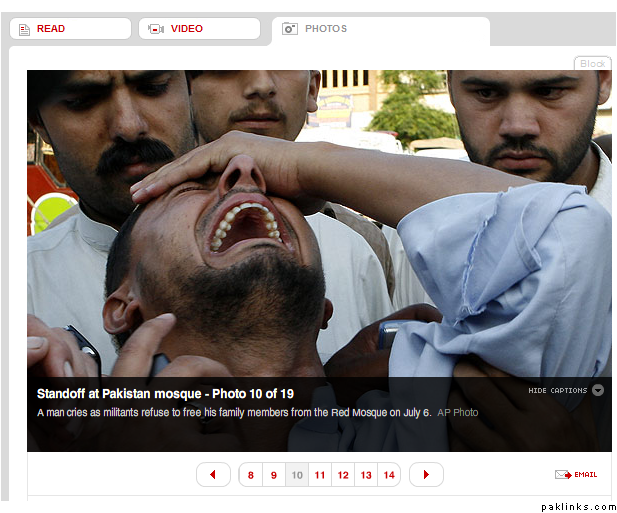
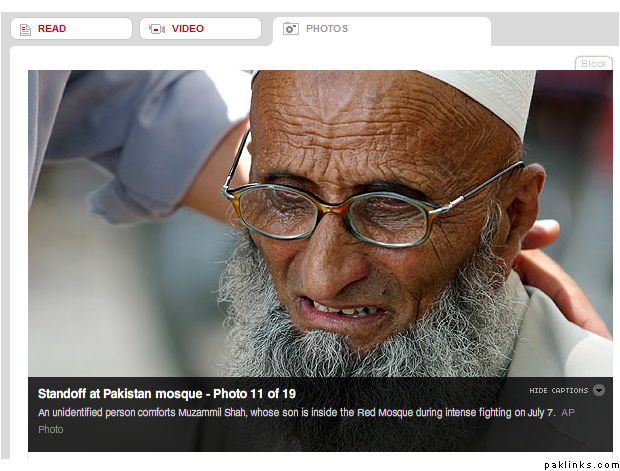
Re: Lal Masjid Siege Thread - Operation Silence (merged)
Lets hope its not true. If the govt. goes that way, tries to be opaque about the no. of causalities and operational details, it will lead to speculation and people will end up believing what they want to believe. Recipe for disaster this.
Meanwhile, here r the editorials from all leading english dailies. Majority of them support the govt. for the operation. This support however will evaporate very quickly if the news about going ons of burials in the shadows is correct.
Complete support from Dawn:
A gruesome end](http://www.dawn.com/2007/07/11/ed.htm#1)
“EIGHTY per cent of the operation,” to quote an army spokesman, had been completed to expel the terrorists from the Lal Masjid when these lines were written, and Abdul Rashid Ghazi had been killed, though resistance from hard-core militants was still going on, with the death toll in the vicinity of 150. While no tears will be shed over the death of the well-armed militants gathered around him by Ghazi, our hearts go out to the families of those innocent men, women and children who were killed during Tuesday’s operation or in the fighting earlier. The responsibility for the death of the innocents and the trauma of those who have survived rests with the extremists who held hostage those whom they had lured into the mosque for giving them lessons in Islam. Instead, in a most perfidious way and in a way that behoves perhaps hardened criminals, they used men and women as a human shield to save themselves. That was the reason why the late-night talks which had aroused hopes for a peaceful solution failed. The government’s mistakes in the entire drama notwithstanding, one has to admit that it exercised the utmost restraint. It kept talking to the Aziz-Rashid brothers for months and used a variety of channels to free the hostages and disarm the militants.
On the Lal Masjid mafia’s directives, its militants had raided a home, attacked shops, and kidnapped not only police officials but also seven Chinese nationals. Instead of reciprocating the security forces’ restraint, the militants burnt a nearby building, leaving the government with no option but to retaliate, though the security forces’ response on July 3 was in low key. Finally, after the fighting escalated and the elder brother was caught and over 1,200 hostages were released, Abdul Rashid Ghazi refused to show any flexibility. Even Maulana Fazlur Rahman accused Ghazi of intransigence. Those who went to negotiate with him included Maulana Abdul Sattar and Bilqees Edhi and some of the country’s respected ulema, but Ghazi remained obdurate. He and his militants fired on parents who had gone to the mosque to meet their children. The Ghazi band’s isolation from the nation was total, for no madressah leaders anywhere in the country came to their support, and the little bit of support they received came from the politically motivated ulema and those pro-Taliban elements in Fata who are already in a virtual state of war with Pakistan’s security forces.
There is no room for complacency, and the government must relentlessly pursue terrorists and criminals masquerading as ‘soldiers of Islam’. They are in a position to keep creating trouble for the government every now and then, but as Abdul Aziz’s escape bid and the outcome of the Lal Masjid stand-off show, they are cowards because they know their stand lacks a moral basis. The nation’s support for the authorities on the crackdown against the Lal Masjid brigade should strengthen the government’s position. The episode also shows that self-proclaimed mujahids committing crime after crime cannot fool the Pakistani people by taking cover under religious slogans. Those arrested should be tried and given every chance to defend themselves in an open trial. The government must also order an inquiry into why and how the intelligence agencies failed to get wind of the goings-on in the Lal Masjid and the stockpiling of arms and ammunition in such large quantities. Talibanism has destroyed Afghanistan. Let it not harm Pakistan.
A bloody end](The News International: Latest News Breaking, World, Entertainment, Royal News)
Could the end have been any different? Could the lives of those who died have been saved if things had turned out differently – if the maulana had agreed to surrender (the word itself was apparently anathema to him)? What of the reputation of the federal capital and the image of the country, with a pitched battle fought a stone’s throw from many foreign embassies? And also, what will be the fallout of this bloody and violent end to the week-long siege of the Lal Masjid complex? Should the country brace itself for retaliatory attacks against government installations and security forces?
By his actions, Maulana Abdul Rashid Ghazi proved to be a very difficult customer. He kept changing his demands and conditions and used the media to further what now seem to be very selfish ends. In the run-up to Tuesday morning’s assault by army commandos on the Lal Masjid complex, PML-Q chief Chaudhry Shujaat Hussain was leading efforts to broker a peaceful settlement, to save the lives of the women and children inside the compound. At around 3 pm, several television channels started carrying tickers saying that a deal had been more or less reached, that the government had read out a draft agreement to the maulana over the phone, quoting ‘sources’ that said that he would be sent to his village along with the rest of his family. At that point in time, this seemed a dramatic turnaround in the crisis, not least because of the potential for controversy, had the deal gone through – given that the Lal Masjid brothers had been in large part responsible for what has happened to the federal capital in recent months. However, very soon, in a matter of minutes, the ministers accompanying the PML-Q chief began singing a different tune denying any forward movement and in effect saying that this attempt to broker a deal had failed. It then transpired that the maulana wanted safe passage for himself and others inside and with no conditions attached. The government at that point took the only option it had – not to allow the maulana such concessions. Had the maulana and his family been allowed to shift to their native village, the government would have been accused of caving in and appeasing the extremists and public opinion would have sharply disapproved of any such agreement. Hence, the decision to launch the final assault was not an easy one but given the circumstances there was nothing else that the government could really do.
Once ‘Operation Silence’ is over, the firing stops, the dust settles down and the bodies are counted, there are bound to be many questions raised. Why didn’t the government take action earlier against the clerics because had that been the case so many lives would not have been lost? Why were the Lal Masjid elements allowed so much leeway that the complex became almost like a state within a state, complete with a moral policing force which acted with impunity enforcing a rigid interpretation of Islam on the city’s residents? How did so many hardened militants, reportedly some foreigners among them, make their way inside the compound situated in the heart of Islamabad? (Surely this is a disturbing indictment of the failure of the law-enforcement and intelligence agencies to keep track of the movement of such elements). Incidentally, one well known television journalist has recently written in a newspaper column that he was told by a senior government official that Lal Masjid’s arms suppliers had been arrested by the police some time back but they were released after intervention from higher authorities. If this claim is true, answers need to be given as to why this was done. As for those who survive the assault, particularly Maulana Ghazi, they will have to be held accountable for all their misdeeds. There is a danger that some of these may become rallying points for the cause of the extremists in the country but this is a route that the government now needs to pursue to its logical end. After all, tackling extremists head on is never an easy task anywhere, more so in Pakistan.
Whatever has happened at Lal Masjid should also give some much-needed warning to the state to permanently disentangle and disengage itself from some of its affiliations and relationships of the past. It offers many lessons to the government and it would be good if some of these were learnt – foremost among them is that militancy and extremism is best nipped in the bud and allowing it to fester actually ends up damaging the national interest. Also, the government needs to ask itself why it usually exhibits much less patience for moderate and progressive sections of society, especially when they can help in the fight against extremism. As for Pakistanis generally, Lal Masjid should make some of them think about where their nation is heading and whether the route is that intended by the founding fathers.
Lessons of Lal Masjid](http://www.dailytimes.com.pk/default.asp?page=2007\07\11\story_11-7-2007_pg3_1)
As the Lal Masjid saga moved to its endgame on Monday, the clergy represented by Wifaqul Madaris of the Deobandi school of thought decided to split from the Musharraf government. The delegation of clerics led by the old Taliban admirer Maulana Rafi Usmani of Darul Ulum Karachi announced that it was disappointed by the way the government had reacted to their efforts to “resolve” the Lal Masjid standoff. They kept the “agreed plan” secret but the federal state minister of information Mr Tariq Azim disclosed that the government could not accept the clerical position that the abandoned seminaries of Lal Masjid be handed over to the Wifaq instead of the law.
As the troops finally broke into the seminary held by Maulana Abdur Rashid Ghazi and his foreign terrorists, the nation was agonised over what should have been done. The foremost thought, naturally, was for the women and children kept hostage by the terrorists. The media talked about it all the time; one TV channel hyped it up unfairly through old school hymns from Allama Iqbal. This had the effect of watering down the universally accepted state principle of not negotiating with terrorists in a “siege-and-hostage” situation.
A justifiable lack of trust affected all efforts at talking to the terrorists inside Jamia Hafsa. As some of the ulema and the country’s top philanthropist Abdus Sattar Edhi offered to go inside the seminary to talk to Mr Ghazi, it was realised that even a single well-known personage taken hostage by the terrorists would immediately mean defeat of the government. For instance, had Mr Edhi been taken hostage by the terrorists during negotiations, the demand for safe passage would have had to be conceded. Once safe passage was allowed, the terrorists would have gone on to commit more acts of revenge in areas where the writ of the state is already weak.
The gap between the politico-religious minded and expert opinion has been evident during the siege and will continue to dog the government in the coming days. The inmates of Lal Masjid will be lionised by some while the collateral damage in the shape of women and children killed will be pinned on the government as “criminal neglect of the life of the common man”. Other “ungoverned spaces” inside the country will step up their “revenge” actions. Already, the killing of Chinese mechanics in Peshawar — providing repairs backup to Chinese rickshaws — was a crude retaliation for what happened after the Lal Masjid vigilantes abducted some Chinese nationals in Islamabad.
The situation confronted by the government has been compared to what happened in India after the hijack of an Indian passenger airliner from Nepal in 1999. The hijackers brought the plane to Kandahar and asked for the release of three Al Qaeda terrorists from an Indian jail in return for the Indian passengers. As days rolled by with the Indian government refusing to negotiate with the hijackers, the Indian public reaction to the killing of one passenger and the unspeakable suffering of the women and children on board the plane began to inflict its toll. The Vajpayee government gave in finally and released the terrorists, not least since the plane was on foreign territory sympathetic to the hijackers (the Taliban) and an effective operation could not have been carried out. In the event, the Indian government has not forgiven itself for its mistake. The terrorists released by India went on to perpetrate history’s worst crimes. Maulana Masood Azhar headed straight for Jamia Banuria in Karachi and announced his new jihadi outfit called Jaish Muhammad. In 2001 it attacked the Indian parliament and unleashed a military standoff between India and Pakistan lasting for nearly one year. The same year Umar Sheikh took part in the planning of the 9/11 terrorist acts in the United States, acting as the funnel for the funds that went from Al Qaeda to the hijackers in the United States. He was caught after he was instrumental in the kidnapping and beheading of the American journalist Daniel Pearl. Jaish, under different names, has since tried to kill President Musharraf a number of times.
The fact is that Lal Masjid was feeding ideologically into the anarchic order of Talibanisation in the Frontier and Tribal Areas. Eighty percent of the acolytes in its residential seminaries were from FATA and from the provincially administered tribal region of Malakand, Swat and Dir. Messrs Ghazi and Aziz regularly applauded the “state within the state” of the “FM radio mullah” Fazlullah of Malakand enjoying direct connections with Al Qaeda. No one paid heed to this. No one registered the trend of increased Al Qaeda “appearances” in the country. Over the last six months, many Al Qaeda terrorists were caught in the country and Lal Masjid remained an ally of Al Qaeda. Significantly, the “free media” knew about it but didn’t take it to task!
Law enforcement and intelligence agencies arrested 32 Al-Qaeda activists in Pakistan from January 2007 onwards. Nasir Suleman Zakaria, an Arab and Al Qaeda member, was arrested while travelling to Balochistan from Wana (South Waziristan). Two of the 32 arrested men were German, 3 were Turkish, 2 Kyrgyz, and 5 Uzbek, all attached to the different jihadi organisations of the country. Those who advocated “safe passage” for Mr Ghazi and his terrorists wrongly believe, together with Imran Khan, that General Musharraf has “unleashed an artificial war in Pakistan to please the Americans”.
Let us be clear. No government can violate the universal principle of “no negotiation with terrorists” and live to be praised. This time around, the “free media” didn’t play its cards fairly. It was allowed to carry on its own “negotiations” with the terrorists, tacitly bending public opinion in favour of “safe passage” — one FM radio in Lahore actually recommended it — and was not able to comment objectively on the vested interest of the Wifaq clerics negotiating with the ulterior motive of grabbing the madrassa property in a city already home to 88 seminaries bristling with rejectionism. *
Now that it’s over…](http://www.nation.com.pk/daily/july-2007/12/editorials1.php)
REFLECTION on the Lal Masjid crisis centres around two themes; one looking forward, the other a bit more retrospective. The first is an expression of concern about any possible fallout in the future, the second is an evaluation of how the government handled the issue.
A day into the action against the Lal Masjid, voices from within the renegade mosque threatened of suicide attacks conducted by associates all over the country if the operation was not stopped immediately. The government called the bluff. Sure enough, the attacks never took place. With growing casualties, however, the sympathies of the militant right kept growing. These sympathies have sustained spoiler episodes like the Khateeb’s attempted escape in a burqa and reports of students being held inside the mosque against their will. The soft corner seems to have been nurtured by the rather large number of casualties and injured in the final operation and by the notion, unfounded perhaps, that the Naib Khateeb, Ghazi Abdur Rasheed, was killed despite the possibility of an agreement that would have entailed his vacating the compound peacefully. Whatever the cause, however, tensions are at a high. The Federal Government has declared a state of red alert. There are signs of possible reprisals by militants. As many as nine policemen were injured seriously as a result of two high intensity explosions in Khal area of Lower Dir on Tuesday. A violent protesting mob attacked the offices of the French Red Cross and Care International and later set them on fire. Security has been beefed up throughout the country and a crackdown is expected in Swat, where there has been considerable resentment over the Lal Masjid issue, against the Tehreek Nifaz-e-Shariah Muhammadi.
There is also considerable resentment from other quarters as well; specifically over the inefficiency and mismanagement of the army and paramilitary forces during the crackdown. And the set of rather imposing restrictions on the media, ones that continue even after the operation, preventing them to ascertain the exact number of casualties. The action against the Lal Masjid was needlessly long drawn out. All arguments from the government about how a swift operation would have yielded a large collateral damage fall like flies when one considers the 100 plus (by fairly conservative estimates) casualties during the supposedly well-thought out plan. Granted, the presence of hostages complicated the situation, but this was, after all, a crackdown against a gang of students holed up in a mosque inside the Federal Capital. The nation’s intelligence apparatus and security agencies are supposed to be ready for far more formidable adversaries in far more hostile environs.
The drop scene](http://thepost.com.pk/EditorialNews.aspx?dtlid=106737&catid=10)
After the final operation against Lal Masjid and Jamia Hafsa, which culminated in the death of Maulana Abdul Rashid Ghazi, it has become inconsequential to know who subverted the draft agreement between the Wafaqul Madaris ulema and the Lal Masjid maulana. Only a thorough and across-the-board probe would reveal the many secrets enveloping the Lal Masjid saga. What is a matter of grief is the loss of scores of lives, both of the military commandos and Jamia students, in the final operation against the militants. Started after the failure of the last-ditch efforts by the ulema and the duo of Chaudhry Shujaat Hussain and Ijazul Haq to reach some sort of agreement with Maulana Rashid Ghazi to avoid the final action, the operation took long hours to meet its targets because of tough resistance from the militants that the government dubbed as well-trained jihadis. Working under strict restrictions, it was very difficult for the media to give the exact death toll and the precise details of the operation. From the official accounts of the operation, it is clear that scores of militants, including Maulana Rashid Ghazi, and military commandos, including an officer, lost their lives. Children and women, who were the major concern for the government and caused delays in the start of the operation, were mostly rescued.
The Lal Masjid operation and subsequent killings of course is a tragic day in Pakistan’s history and most people had hoped that it would be forestalled by some miracle. This did not happen. With the government promising to place every fact before the shell-shocked nation, it would be too early to jump to any conclusion with regard to the causes, factors and failings both on the part of the government and Lal Masjid clerics. One point that must be emphasised here is that the unfortunate denouement of the nerve wracking standoff between the government and the clerics could have negative ramifications. Already, tidings from NWFP and the tribal areas are not good. There have been attacks on security personnel and NGO offices. Some militants blocked the Karakoram Highway. Fearing more backlash, the government has elevated the threat level throughout the country. Security measures taken by the government are justified in the backdrop of religious passions that the ‘last stand’ taken by Maulana Abdul Rashid and the Lal Masjid and Jamia Hafsa militants might provoke. The link of the Lal Masjid cleric and militants with jihadis was well established when Maulana Abdul Rashid asked the government to induct Maulana Fazlur Rahman Khalil of formerly Harkatul Ansar as a mediator on his behalf. So, a swift and strong reaction from the religious militants and jihadi outfits cannot be ruled out.
Mufti Raheem Usmani, a renowned religious scholar and a member of the delegation that held talks with Maulana Abdul Rashid; has declared that all those Lal Masjid and Jamia Hafsa militants who lost their lives while harbouring the belief that they were engaged in jihad are ‘shaheeds’. This is going to ratchet up religious sentiments, and could lead to increased polarisation between the moderates and extremists in the country, the former including General Musharraf under the banner of ‘enlightened moderation’. Mufti Sahib’s fatwa could be a precursor to brewing tensions between the clerics heading madrassas and the government in the coming days. President General Musharraf, on the other hand, while expressing his satisfaction over the operation against Maulana Abdul Rashid, has declared that he will continue his war against terrorism. The tragedy of Lal Masjid therefore has many dangerous dimensions, which will leave deep scars on the national psyche.
A repulsive doubletalk](http://www.thefrontierpost.com/News.aspx?ncat=ed&nid=62)
If you are listening to the incessant chant of the holy men ruling this province of the NWFP, you are just left aghast at the amount of volubility they churn out every day against the “interference” of the army in politics and in civilian affairs. Their two head priests are presently on a pilgrimage in London, huddling up with the steelmaker of Lahore in pursuit of this sacred “mission”. The other day, they teamed up with the steelmaker to hammer out a declaration for the return of true democracy and civilian rule to the people back home. The two saints were indeed in the forefront of the composers who plugged in that bombastic declaration a pledge for ending the army’s intervention in civilian affairs of the state and for its withdrawal to the barracks to keep confined to its constitutional duty of guarding the country’s frontiers. Yet at the time they were frantically chasing this saintly avocation in London, their holy flocks back home in the NWFP were plumping for inviting the army to deal with the troublemakers in Swat. Could there be a greater duplicity then this? Isn’t handling the mischievous elements a job of the provincial civilian law-enforcement agencies, not of the army? Or is it that this holy clan debunks the army’s role when it considers it politically beneficial and expedient, and goes for it when it finds that the going is rough and tough? What else could it be? Yet, this tribe can look a bit real and respectable if it puts an end to its detestable habit of running with the hare and hunting with the hounds and instead do the job it is in the government for and which it is falteringly failing to do so far. Whatever construct it may put on it, the fact is that the provincial cabinet’s decision to call the army even as a last resort to quell the troubles in Swat is an open confession of the holy clan of its incompetence, its ineptitude and its ineffectualness. And for this, none but it itself has squarely to blame. It may not have had an adequate civilian security apparatus at its command for combating lawlessness and for maintaining law and order on its domain. Yet, it was not all paupers either. The apparatus at its beck and call was not that inadequate, after all. And if it had been compunctious and dutiful enough in utilising that uniformed force purely for the protection of the people’s safety of lives and security of their properties, it would have done it to a great measure, if not to the fullest extent. But it was not. It has had shelled out the bulk of its police force on the guard duties of its battalions of ministers, aides, advisors, its favourite nazims and political, public and religious figures. And that, too, when quite a chunk of its paramilitaries were deployed outside in other provinces, which had not been returned to it, in spite of its persistent representations to Islamabad. In order to make up on the deficiency of the police force, it did launch into a recruitment drive of sorts. But here, too, the clan was lesser than saintly in recruitment, the ghastly shows of which have left the residents of Peshawar and Abbottabad dazzled with the dishonesty of the recruiters. All the nominees of the privileged were taken in; all the deserving sons of the commoners were left out. Now wonder, the province throughout is in such a frightening state of crime, lawlessness and violence. It is not just the settled districts adjoining the tribal areas that are in the vicious grip of a burgeoning Talibanisation. The rest of the province is no paradise of peace, calm and tranquility, either. Criminality of all sorts is virtually in a binge everywhere. Nowhere now people feel safe for their lives or their properties. Fear of the criminal stalks all over the province. And extremism is raising its head all over dreadfully. Will then the holy clan call the army everywhere to check the crime and lawlessness for it, while it itself will keep munching on juicy fruits and sampling on spicy foods. There is a limit even to hypocrisy and doubletalk. Perhaps, in its intoxication of power this holy clan has forgotten this. For once for a change, can this holy tribe become a bit upright and straight? It would do it no harm; but it may bring some comfort and some ease to the harried people of this province. So why should this clan of the holy men grudge even this little mercy to these tormented souls?