Re: History of Baloch and Balochistan
Ameer E Balochistan Khan E Baloch Mir Abdullah Khan Ahmedzai Baloch (1715 -1730) Ba Laqabe Shabaz E Koohi
**
http://oi58.tinypic.com/aetn9s.jpg
**
Re: History of Baloch and Balochistan
Ameer E Balochistan Khan E Baloch Mir Abdullah Khan Ahmedzai Baloch (1715 -1730) Ba Laqabe Shabaz E Koohi
**
http://oi58.tinypic.com/aetn9s.jpg
**
Re: History of Baloch and Balochistan
**Ameer E Balochistan Khan of Kalat (Shaheed) Mir Mehrab khan Ahmedzai Baloch and his adjutant generals swords
http://oi57.tinypic.com/2w2erzm.jpg
**
Re: History of Baloch and Balochistan
Khan of Kalat Mir Khudadad Khan Ahmedzai Baloch in 1901 Pishin Balochistan After being Deposed by the British Here Khan Sahab is in prison(in a house) in Pishin, still his moselium is there with a dom and being taken care by a Baloch family…Still Baloch people go to Pishin to offer their respect to their King..because Khan Khudadad Khan Baloch resisted British policies staunchly.
Re: History of Baloch and Balochistan
**Khan of Kalat, Jam of Lasbela with other Baloch Chiefs 1880-1900s
http://oi60.tinypic.com/33nexb8.jpg
**
Re: History of Baloch and Balochistan
**Quetta District is an integral part of the Baloch Country Which was given on Lease to the The British Government of India By Ameer E Balochistan Mir Khudadad Khan Ahmedzai Baloch in 1883 AD
http://oi61.tinypic.com/oqcf4l.jpg
http://oi62.tinypic.com/2r72an9.jpg
**
Re: History of Baloch and Balochistan
Baloch of Sibi, Sibi Balochistan 1917
Re: History of Baloch and Balochistan
Sardar Khan Bahadur Sohbat Khan Gola Baloch in Sibi Balochistan
Re: History of Baloch and Balochistan
THE BALOCH AND KURDS
**
**
The Kurds and The Baloch have always been referred by the ancient chroniclers with Koch who appear to be the original inhabitants of Balochistan before the Baloch arrival and also with Kurds. Many ethnologists believe that the Kurds belong to the Median branch of Aryan tribes who were mixed up with many people of indigenous origin and later invaders including Semites, Armenians and Turkomans.
**
The Kurds have been living in Kurdish region and Zagros area since the Semitic conquest of Assyria. They are said to have posed a permanent nuisance for the weak rulers of Assyria by organizing raids on Tigris mainland. In a Sumerian inscription dated 2000 B.C. a country known as Kardala is mentioned; and afterwards the Assyrian King, Tiglath Pileser, (circa 745-724 B.C.) appears to have fought a tribe referred as Kur-ti-e. Xenophon (circa 434-355 B.C.) also speaks of Kardukai, a mountain-folk who harassed his march towards the sea. Some archaeological evidences tend to show a Kurdish kingdom which flourished in the second millennium B.C. on the borders of the Semitic empire in Babylonia. In a later period, the Kurds cavalry served as the vanguard of Cyrus army in capturing Babylonia in 539 B.C.**
**
The Kurds are from the same origin as that of Baloch. The period of their migration from the Caspian region may be a few centuries earlier than the Baloch who followed at a later period; but instead of going to their people in Zagros mountainous region, outskirts of Mesopotamia, they headed towards east. Linguistically and culturally they must have been from the same stock." Janmahmad; The Baloch Cultural Heritage, 1982,]
**
**
References**
** Note: population statistics for Baloch (including those without a notation) in foreign countries were derived from various census counts, the UN, the CIA World Factbook and Ethnologue.
Eastern Baloch, Ethnologue.com (retrieved 7 July 1998)
Population by Mother Tongue, Population Census Organization, Government of Pakistan (retrieved 7 June 2006)
Census of Afghans in Pakistan, UNHCR Statistical Summary Report (retrieved 10 October 2006)
Languages of Iran, Ethnologue.com (retrieved 7 June 2006)
Western Baloch, Ethnologue.com (retrieved 7 June 2006)
Western Baloch in Turkmenistan, Ethnologue.com(retrieved 7 June 2006)
People in Kuwait, Ethnologue.com (retrieved 7 June 2006)
Pakistan - Library of Congress Country Studies
Library of Congress Country Studies
Baluch - U.S. Library of Congress
Baloch - Britannica Online**
** Similarity in languages**
** Balochi kurdi english**
**
1 wush wush happy**
** 2 sur sur red**
** 3 brath bra brother**
** 4 duzshmn Duzshmn enemy**
** 5 tuni tuni thristy**
** The days names in Balochi and in kurdish r also same
**The langage,culture,customs,habits, and way of fight of kurd&baloch are similar. There are many baloch clans which from parts of kurd nation and vice versa. 4Xample: baloch/kurd bugti/boghti marri/dola marri mamashai/mamash kalpur/kalpur baazdani/barazani keerd/kurd brahoi/barhushi
Re: History of Baloch and Balochistan
**Writer of lots of books on history of Baloch and Balochistan Agha Mir Naseer Khan Ahmadzai Baloch 1940
http://oi61.tinypic.com/2d0cqi8.jpg
**
History Of Baloch , Balochistan & Other Books Written By Agha Mir Naseer Khan Ahmedzai Baloch .
http://oi60.tinypic.com/9kxf5t.jpg
Re: History of Baloch and Balochistan
Map Of Asia In Which Migration Of Baloch Is Shown In 3800 BC
Re: History of Baloch and Balochistan
Ameer E Balochistan Khan of Kalat Mir Mehrab Khan Ahmadzai Baloch hokom nama to Raisani Baloch
حکم نامہ خان آف قلات میر محراب خان
Re: History of Baloch and Balochistan
the Poet Sufi Saint Shah Abdul Latif Bhittai (1689 -1752) poetry on Kech Balochistan and on the Balochi Prince of Kech and Lover Mir Punno Khan Baloch
Re: History of Baloch and Balochistan
**Alexander 3rd King Of Macedonia Empire In 323 BC
http://oi59.tinypic.com/sm9gcy.jpg
Alexander 3rd King Of Macedonia Conquered Median Empire In 323 BC
**
http://oi58.tinypic.com/2z70qjo.jpg
**
Median Kurds Empire 853 BC To 550 BC
http://oi58.tinypic.com/macnqt.jpg
After The Fall Of Median Empir Baloch History Begins .In This Map It’s Shown The Old Map Of Balochistan. South Eastren States Of Median Empire .
Turan (Kalat) , Makran And Zabulistan (Chagai.Sistan.Helmand**)
Re: History of Baloch and Balochistan
listen what British Col Sir Robert Groves Sandeman said about Baloch
Click me to listen to what British Col Sir Robert Groves Sandeman Said About Baloch
https://c1.staticflickr.com/9/8375/8375371837_96d7e44647_z.jpg
Re: History of Baloch and Balochistan
King of Turan (now Balochistan) King Brakhoi Kurd Baloch 638 BC To 594 BC
Re: History of Baloch and Balochistan
**King of Makran King Organi Kurd Baloch **** 638 BC To 594 BC **
**
http://oi61.tinypic.com/w2k4me.jpg
**
Re: History of Baloch and Balochistan
**Baloch and Kurd Origin and Medes Empire
Great Medes are Off-Spring of Yafas (یافث) son of Hazrat Nooh (AS) .Baloch and Kurds are Off-Springs of Great Medes. Before 667 AD Baloch were Known as Kurds .Kurds of Balochistan were given the name Balose by Sassanid Empire in 667 AD and later it Became Baloch. Baloch and Kurds Lived in South Eastren areas of Medes Empire Turan ( Kalat ) , Makran And Zabulistan ( Chagai, Sistan, Helmand) . After Fall of Medes Empire they Created there own Empire Later it became Balochistan .
http://oi62.tinypic.com/wkpmaf.jpg
****Complete Baloch Shujra Ancestry which Starts from Hazrat Nooh (AS)

**
Re: History of Baloch and Balochistan
**the First Mughal Emperor Babur Mentions The Baloch in his Memoirs sending an expedition against them in Punjab and later Baloch joined the Army of Mughal Emperor Babur against Ibrahim Lodhi and received gratuities after the defeat of ibrahim Lodhi in 1526
http://oi62.tinypic.com/okn0cj.jpg
http://oi58.tinypic.com/2czx3j9.jpg
**
Re: History of Baloch and Balochistan
Baloch Sufi Saint Poet Hazrat Baba Jawansal Bugti Baloch
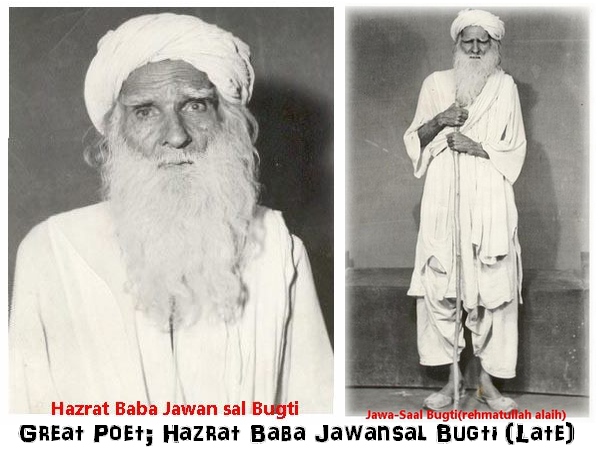
Re: History of Baloch and Balochistan
**Baloch Sufi Saint Poet Mast Taukali Marri Baloch
Taukali was born in 1825 in Mandek Band area near Kahan. He belonged to Loharani (Shirani) branch of Mari tribe. His father’s name was Lal Han (Lal Khan). Taukali’s mother died in his infancy, his father passed away when he was just 13/14 years old. He had a brother named Peeruk. The original name of Taukali was Sohrab Khan, which was changed to Takali due to namesake with a family member of the tribal chief. After his father’s death, Taukali came to Maawand where he was fostered by a man named Balochaan.
In a fateful day Takali met his destiny and became Mast (frantic); roaming in Rastarani area with his intimate friend Bahar Khan, caught in a storm, they searched a shelter to take cover and ended up reaching Sammo’s haven-tent. They were welcome. Sammo was alone. The catastrophic weather was persistent to unearth the tent. The newly-wed Sammo was running one end fastening her tent and to other shielding her household belongings. The errant wind blew away the covering chador of rain-soaked Sammo and the ingenuous Taukali was thunderstruck glimpsing the heavenly drenched body. Lightning kept on flashing, thunder rumbling and the shocked Taukali staring the beauteous icon. Sammo’s family gathered at night. They entertained their guests as per traditions. But Taukali did not eat nor did he sleep at entire night. His friend Bahar Khan wondered what’s wrong with Taukali, he asked him but Taukali was bewildered and speechless. At morning Bahar Khan marked his serious situation and again asked him “have you been bitten by any snake?” Mast replied spontaneously “The housewife has captured my heart; I am of no use anymore”. This was a calamitous day of 1858. It is said that Taukali was on a war expedition when this happened, but it is not true. Though Taukali did have some sort of weaponry with him on the occasion and he wanted to keep it away from rain. As he says it in a Ballad stanza “Bro Hamoda Ke Hayma ey Hairi; Hathyaar Hondi Bant Mani Meeri” (go there where is a blessed tent; so that your worthy weapons are safe). He portrays the whole episode in detail in his poem; how he sealed his fate.
Sammo was from Kalowani clan of Marri tribe. Sammo’s father’s name was Bashkia and one of her brothers’ name was Dilmurad. Sammo was married to a man named Biwargh (Bibargh) who was from Rahmkani branch of Marri tribe. Sammo had one son, who died in early childhood, and two daughters. Sammo died in 1880 in the month of Ramadan and she was buried in Makhmaar area. Sammo was not a typical gorgeous woman. But love has no bounds; Taukali fell in love with the simple married woman. As it is said regarding true love “to love to love, not to love to be loved”, Taukali never tried to approach his beloved Sammo or expected to earn her love.
As saying goes ‘the first sight of love is the last of wisdom’ the naïve Taukali was no longer Taukali; he became Mast. And people began calling him Mast Taukali or Mast en Taukali (frantic Taukali). He lived a vagabond’s life, wandering here and there. His days were passing in company of Sufis, poets and saints. Shrines were his dwellings.
As Plato says “at the touch of love everyone becomes a poet”, soon Mast’s poetry started traversing heart to heart and people to people. He was always seen in shrines. Some allegedly marvelous workings and phenomenal deeds earned Mast the fame of a saint in populace, who pursued Mast seeking his favour and prayers. There were several miraculous events attributed to Mast. Once, Sardar Jamal Khan Leghari intending for hajj, took Mast along for the voyage. Mr. Leghari was in a habit of testing Mast’s saint-like miracles. In the middle of journey Mast was thrown in the sea as ordered by the Sardar. When they reached Mecca they found Mast there alive. Mast foretold the tribal chief that he would die seeing the trees of his village on return. Though Sardar blindfolded himself to avoid sighting the trees and Mast’s curse, but died reaching his village consequently.
Mast never rode horses. He said that he was forbidden by Sammo and she would be worried losing my footprints on earth owing to horse riding. In a cave at Jandaran Mountain Mast made a tent-like house and said that it was now Sammo’s home; it still exists there, whenever its any wood-stuff is dismantled people replace it with a new one. In Dera Bugti city there is an old and big stone, called Mast’s stone. Once Mast was going to Dera Bugti, he pointed at the stone and said “O Sammo’s stone, come with me” and the stone followed him drag-rolling. Nawb Akbar Khan Bughti had a shirt (Kurta) and a stick believed to belong to Mast. Taukali was a man with medium build or of short height and he always called himself Sammo Beli (Sammo’s companion).
Mast Taukali died in 1896 (though 1892, 1895 and 1895 are also maintained as his death year). Mast fell ill while he was travelling in Pazha area, his family and friends were intimated. They came, stretched Mast off on a charpoy, when they reached Tambo area he died. Mast Taukali was to be buried on Tekil Mountain as per his will, but the camel taking his corpse was reluctant to go anywhere else other than Maidangri area, where he was buried. The tomb of Mast Taukali is now a popular shrine and all traditional festivals and rituals are performed there.
Mast Taukali was not only an eminent poet of Balochi but also a great Sufi of the era. As Sufis believe that by purifying their hearts they get close to God. For Mast, Sammo’s love was the pathway to get there. Sufis say that they see the divine presence in everything, Mast found it in Sammo. He says in a stanza:
“Nindo’n Kahan a Bitago’n Kohaani Marri; Wa Raza Beet o Bahaanag Sammo e Kuth ey” (I am an ordinary Marri of Kahan, not to speak of my status; it was Allah and His acceptance I earned, Sammo was a mere means
**
http://static.panoramio.com/photos/large/63663516.jpg
http://mw2.google.com/mw-panoramio/photos/medium/63664178.jpg