Re: Gaza Under attack
Re “if something similar was going on in Kashmir” why pose that hypothetical question? Especially when peace appears to have gained a foothold there.
Re: Gaza Under attack
Re “if something similar was going on in Kashmir” why pose that hypothetical question? Especially when peace appears to have gained a foothold there.
Re: Gaza Under attack
It really makes no sense. There is no comparison between the level of widespread, mass scale and almost unstoppable violence you see in Palestine and Kashmir, and that’s the crux of the matter. And of course there was all sorts of outrage, protests and campaigning by Pakistanis when Kashmir went through its some of its most bloodiest phases in its history. Maybe internet wasn’t a big deal back in the day, but let’s not pretend that Kashmir was never a matter of concern and appealed to the emotions for its neighbours. What’s the next, where was the outrage when USA bombed Afghanistan?
There was a massive thread discussing Syria, huge fundraising movements, protests and charity appeals focused on Syria. But Syria was viewed as a civil war, and initially there’s was a lot confusion over who’s fighting who and which side is on the right, all sides were equally evil as each other. But that’s the point, when there was Lebanon, the focus was on Lebanon, then came Egypt, then came Libya, then came Syria, and now Palestine, and I’m pretty sure sure once the ceasefire is achieved, everyone will go back to talking about Iraq. It’s a never ending cycle.
I’m absolutely disgusted by House of Saud. I cannot curse that treacherous family enough. Where is there condemnation? Where is there aid? Where is their concern for Ummah? Where are there God cursed fighters?
Re: Gaza Under attack
Waiting for their ‘hoors’ by killing Muslims in Syria, Pakistan, Afghanistan, Yemen, Iraq and so on…
Re: Gaza Under attack
Below is a very good read if anybody is interested to know why US has been madly in luv with Israel. It just saddens me and i wonder when would it be possible to change this US strategy. I think never!
Why the US has the most pro-Israel foreign policy in the world - Vox
Why the US has the most pro-Israel foreign policy in the world
Updated by Zack Beauchamp on July 24, 2014, 9:00 a.m. ET @zackbeauchamp](http://twitter.com/zackbeauchamp) [EMAIL=“[email protected]”][email protected]

Obama and Netanyahu walk.[RIGHT]Lior Mizrahi/Getty Images[/RIGHT]
Everyone knows the United States is Israel’s best friend. The US gives Israel billions of dollars in aid annually, consistently blocks UN Security Council resolutions condemning Israel, and backs its military offensives publicly. But why? What’s the thinking behind America going above-and-beyond for Israel?
The short version: it’s complicated. The long version is that It’s a tight interplay of America’s long-running Middle East strategy, US public opinion/electoral politics, and a pro-Israel lobbying campaign that is effective, but maybe not as effective as you’ve heard. Here’s a guide to the different factors shaping America’s Israel policy — and how they relate to each other.
Since the Cold War, Israel has been the linchpin of American Middle East strategy
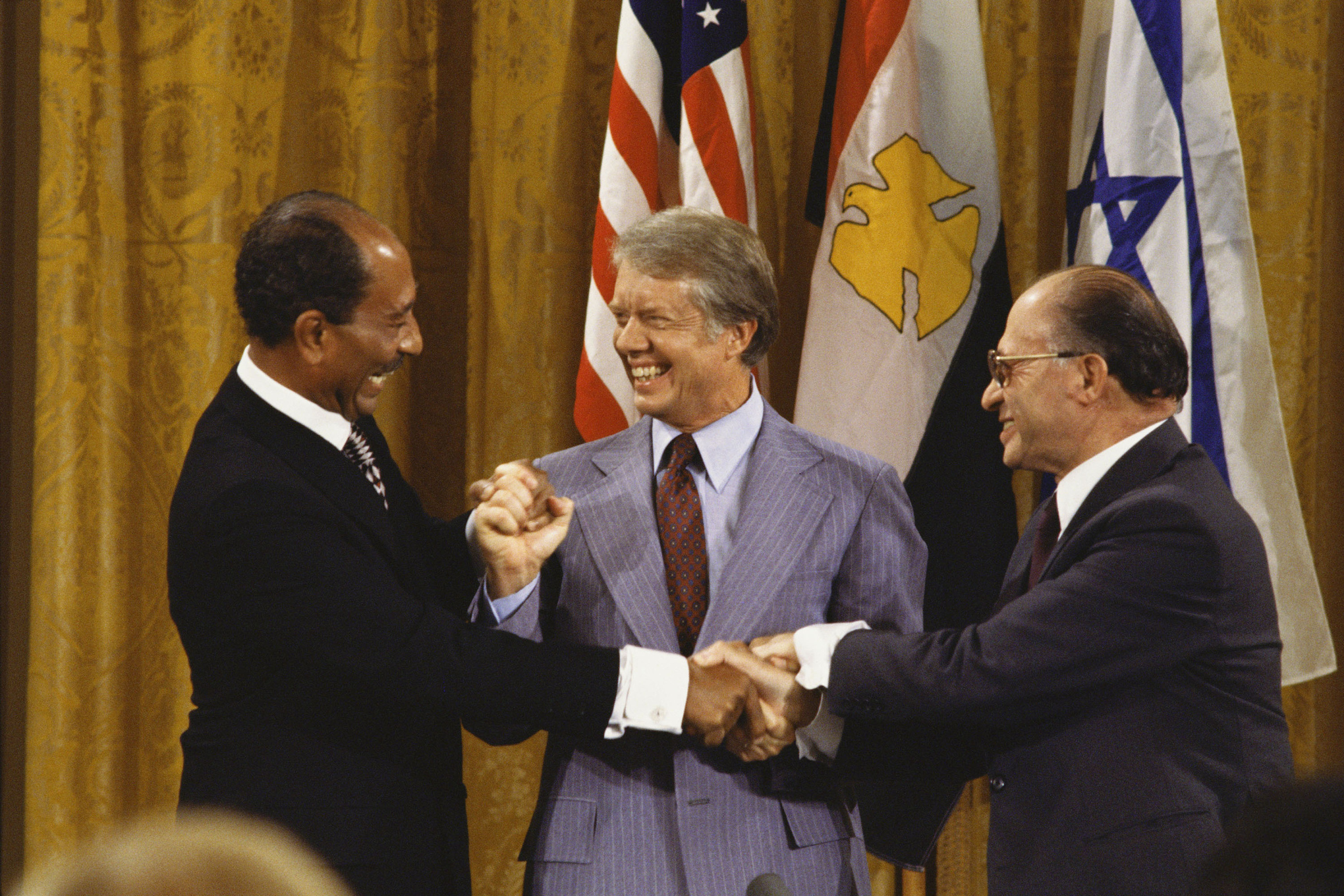
US President Jimmy Carter, Egyptian President Anwar Sadat, and Israeli Prime Minister Menachem Begin shake hands at the Camp David accords that led to an Israeli-Egyptian peace treaty. David Hume Kennerly/Getty Images
The US wasn’t always so close with Israel. For instance, when Israel (along with France and Britain) invaded Egypt in 1956, the United States sided against Israel, pushing the invaders to leave. And the US for years opposed, and worked actively against, Israel’s clandestine nuclear program. “Stated commitments to [Israel from American policymakers] cannot erase a legacy of US policies that often represented more of a threat than a support to Israeli security,” Michael Barnett, George Washington University political scientist, writes.
Even when the US did come to support Israel, it was more about cold strategic calculation than the domestic political support you see today. The US-Israel relationship grew “by leaps and bounds” after 1967, according to Barnett, owing largely to “a changing US containment and strategic posture.” American presidents and strategists came to see Israel as a useful tool for containing Soviet influence in the Middle East, which was significant among Arab states, and used diplomatic and military support to weave Israel firmly into the anti-Soviet bloc.
This strategic justification came down with the Berlin Wall. Yet the US aid to Israel kept flowing after the Cold War, as did diplomatic support. What kept it going?
THE US APPROACH TO THE MIDDLE EAST DIDN’T CHANGE THAT MUCH AFTER THE COLD WAR
For one thing, the US approach to the Middle East didn’t change that much after the Cold War. The US became increasingly involved in managing disputes and problems inside the Middle East during the Cold War, and it maintained that role as the world’s sole super-power in the 90s. Stability in the Middle East continued to be a major American interest, for a number of reasons that included the global oil market, and the US took on the role as guarantor of regional stability.
That meant the US saw it as strategically worthwhile to support states like Egypt, Saudi Arabia, and Israel, which saw themselves as benefitting from an essentially conservative US approach to Middle Eastern regional politics. Unlike, say, Iran, Syria, and Saddam’s Iraq, these countries were basically OK with the status quo in the Middle East. The US also supported the status quo, so it supported them accordingly.
This view of Israel as a “force for stability” helps maintain US support, according to Brent Sasley, a political scientist at the University of Texas, “in the sense that Israel can stabilize what’s going on in the Middle East. If there’s fear of Jordan being undermined by an internal or external enemy, the United States sometimes turns to Israel to pose a threat to that threat.”
America’s self-appointed role as manager of the Middle East also landed it the job of Israeli-Palestinian peace broker.
“The parties need a third party,” Hussein Ibish, a Senior Fellow at the American Task Force on Palestine, says. “I think there is no other candidate than the United States. There’s no other party that’s capable, and no other party that’s interested.”
American policymakers have seen US support for Israel as a way of showing Israel that the US is still taking its interests into account during negotiations, and thus convincing Israel that they can safely engage in peace talks. It’s meant to draw the Israelis to the negotiating table, and keep them there.
Together, these strategic factors explain why America’s approach to Israel has been broadly consistent for at least the past three administrations. Despite the vast disagreements between the George W. Bush administration versus the Clinton and Obama administrations on foreign policy, they’ve both supported military and political aid to Israel. And they’ve both crossed Israel when it wasn’t in the US’ strategic interests: Bushrefused to support an Israeli strike on Iran, and Obama repeatedly clashed with Israeli leaders on West Bank settlements.
All of this isn’t to say that American presidents and foreign policy principals are necessarily right to believe these things. It’s within the realm of possibility, as some argue, that US support for Israel undermines regional stability and compromises America’s status as neutral broker during peace negotiations. The point here isn’t to endorse the official US view, but describe the line of thinking that’s been so influential in driving the American foreign policy establishment’s approach to Israel.
Supporting Israel is good politics in the US
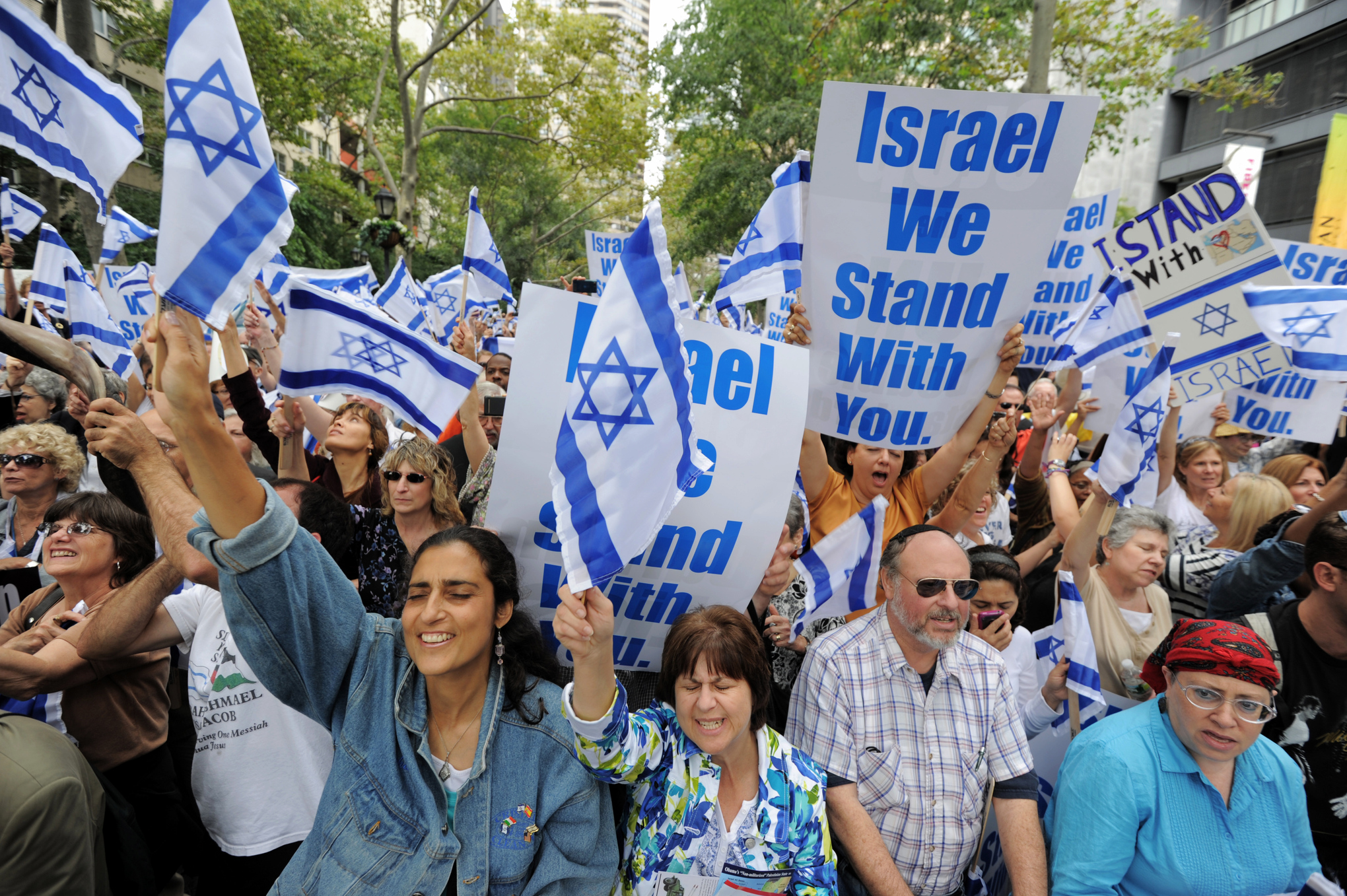
Jewish and Christian groups rally for Israel in New York. Stan Honda/AFP/Getty Images
US support for Israel isn’t just about strategic calculation and foreign policy interests, or at least not anymore. For a long time, at the very least since the 1980s, it’s also been about domestic politics and the way American politicians read American voters.
Congressional votes on issues relating to Israel are famously lopsided. The Senate resolution supporting Israel’s recent offensives in Gaza passed unanimously, as many “pro-Israel” bills and resolutions do.
The simplest explanation for these lopsided votes is that supporting Israel is really, really popular among voters. “The single factor most driving the U.S.-Israel relationship appears to be the broad and deep support for Israel among the American public,” Israel Institute program director Michael Koplow writes. “The average gap between those holding favorable and unfavorable views of Israel over [the past four administrations] is 31 points.”
Indeed, Gallup data since 1988 consistently shows a much higher percentage of Americans sympathizing with Israelis than with Palestinians in the conflict:
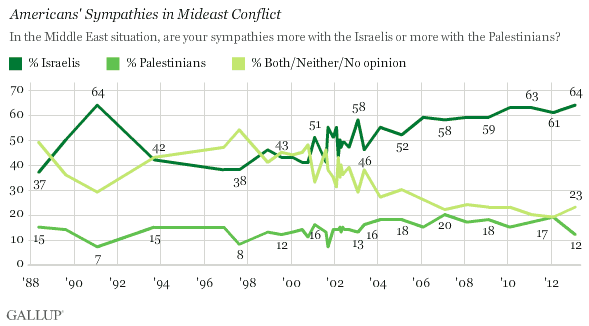
So it makes sense that Congresspeople would take pretty hard-core pro-Israel stances: it’s reasonably popular.
But why is Israel so popular among Americans in the first place? One big reason is a perceived sense of “shared values.” According to Barnett, the American moral image of Israel — “the only democracy in the Middle East,” for example — is the “foundation of US-Israeli relations.” Of course, as Barnett hastens to add, this leaves Israel vulnerable if Americans comes to believe that Israel has strayed from those shared values (more on that in the last section).
Religious groups are two other critically important factors. American Jews and evangelical Christians are two of the most politically engaged groups in the United States. They’re major constituencies, respectively, in the Democratic and Republican parties. And both are overwhelmingly pro-Israel.
There are nuances here: evangelical support for Israel tends to be more uncritical than Jewish support. For instance, a majority of reform and secular Jews — 65 percent of the American Jewish population — disapprove of Israel’s expansion of West Bank settlements. And Jews under the age of 35 are the least likely to identify as Zionist (though a majority still do). On the other hand, the older and more conservative Jews who aren’t entirely representative of the more liberal body of Jewish-American public opinion toward Israel, have a lot of clout with national politicians. They express strong desire to vote based on the Israel issue and are clustered in Florida and Pennsylvania, large swing states in presidential elections.
All that said, Pew data shows overall consistency in American Jewish views on the US-Israel relationship. 54 percent of American Jews think the US supports Israel the right amount — and 31 percent say it doesn’t go far enough. By contrast, 31 percent of white evangelicals think the US has reached the right level of support, while 46 percent want the US to support Israel more.
Add evangelicals, Jews, and broad public support together, and you get consistent, bipartisan support for Israel.
There’s also a huge pro-Israel lobby — but how effective are they really?

Obama walks up to speak at an AIPAC conference. Mandel Ngan/AFP/Getty Images.
No account of US-Israel relations can ignore the American Israel Public Affairs Committee — AIPAC for short. AIPAC is America’s largest pro-Israel lobby. Surveys of Capitol Hill insiders conducted by Fortune (1997) and National Journal (2005) ranked it the second-most powerful lobbying shop in Washington, after (respectively) the AARP and National Federation of Independent Business. Neither survey isparticularly statistically rigorous, so don’t take the specific rankings too seriously. And AIPAC loses on plenty of issues. However, the surveys do suggest that AIPAC is perceived as hugely powerful within Washington.
Saying that AIPAC pushes US foreign policy in a more pro-Israel direction isn’t controversial. The big, and extremely contentious, question is just how much AIPAC actually matters. Is the group actually steering US politics and foreign policy in a direction it wouldn’t go on its own?
AIPAC IS AN EXTREMELY INFLUENTIAL LOBBYING GROUP, BUT ITS POWER IS LINKED TO THE OTHER SOURCES OF US SUPPORT FOR ISRAEL
The major flashpoint here is John Mearsheimer and Stephen Walt’s The Israel Lobby and American Foreign Policy, which began as an 2006 essay and evolved into a book. The two eminent international relations scholars argued that there’s no way to explain the US-Israel relationship, from an IR perspective, other than as AIPAC and its allies pushing the US to act counter to its own interests. They reject that either strategy or shared values fully explain the US support for Israel, so lobbying must. “The unmatched power of the Israel Lobby,” Walt and Mearsheimer write, is “the” explanation for America’s continued strong support for Israel.
This argument is hugely controversial, including among international relations theorists. Some argued that The Israel Lobby creepily invoked classic anti-Semitic tropes of Jews secretly controlling the government. Others dismissed it as, in one particularly memorable phrase, “piss-poor, monocausal social science.”
One of the main criticisms of Walt and Mearsheimer’s thesis is that they don’t present very much direct evidence that AIPAC lobbying influenced specific votes. Another criticism is that Walt and Mearsheimer premise their thesis on the argument that Israel is neither strategically nor morally worthy of American support, and so policymakers must be supporting Israel because they’ve been coerced into it by AIPAC, whereas a number of policymakers will tell you they earnestly believe the alliance is worthwhile absent lobbying. Critics also argue that the definition of “Israel Lobby” beyond AIPAC used in the book is so large as to encompass basically the entire American foreign policy establishment.
Whatever you think of this debate, it can be easy to get lost in a binary between “the Israel lobby is all that matters” and “the Israel lobby is irrelevant.” What’s clearly true is that AIPAC is highly influential, but also that its power is linked to the other sources of US support for Israel; it does well on whipping up support for bills that are already in line with public opinion.
**AIPAC doesn’t always win. For instance, it lost a major fight in Congress when it pushed for more sanctions on Iran in February 2014; the sanctions were likely designed to kill the ongoing US-Iran nuclear negotiations. AIPAC’s influence is a product of financial resources and power, sure, but also of choosing to push for policies that have public support and are consonant with American grand strategy in the Middle East.
**
Could US support for Israel change?
**

**
A rally against the Gaza offensive in New York. Bilgin S. Sasmaz/Anadolu Agency/Getty Images
**
It’s hard to know where one driver of America’s Israel policy ends and another begins. For instance: early in his administration, President Obama pushed Israeli Prime Minister Benjamin Netanyahu to halt settlement growth in the West Bank; Netanyahu resisted this in part by rallying his allies in Congress. Netanyahu’s allies in both parties, who are always eager to appear pro-Israel, pressured Obama to drop his anti-settlements push, which he did.**
The question here is whether, in this case and others, US foreign policy interests or US domestic politics was ultimately more consequential to driving the US-Israel relationship. For example, would Obama have pushed harder against settlements had Netanyahu not been able to call up so many allies in Congress? Were those members of Congress primarily driven by pure domestic politics, which do favor pro-Israel policies, by an earnest concern that Obama’s approach was bad for Israelis, or by a belief that Obama was hurting US foreign policy interests?
In thinking about the future of US-Israel relations, it’s much more helpful to examine what might cause these broad-bush factors to change. In simpler terms: is there a scenario under which the US and Israel drift apart?
“US-ISRAELI RELATIONS ARE DEPENDENT UPON ISRAEL’S HAVING A PARTICULAR IDENTITY”
Barnett, the George Washington University scholar, sees Israel’s continued occupation of the West Bank as the greatest threat to the relationship. He notes that, in the early '90s, Congress made a $10 billion loan guarantee conditional on the fact that Israel didn’t use any of the money for West Bank settlements. Israel’s prime minister, Yitzhak Shamir, tried to fight it, but the Bush administration stood firm. Shamir lost, both in Congress and with the executive, because the Israeli position wasn’t consistent with the US vision of a Western, democratic Israel.
“US-Israeli relations,” Barnett writes, “are dependent upon Israel’s having a particular identity.” That may even be true among American Jews, as journalist Peter Beinart argued in an essay almost as controversialas Walt and Mearsheimer’s. Beinart argues that Israel’s ongoing occupation of the West Bank is already alienating younger and more secular Jews, and that AIPAC and other mainstream Jewish organizations risk losing their broad base of support unless they become more willing to criticize Israel on these points.
Barnett’s conclusion only follows if you think “shared values” are the linchpin of US-Israel relations. Maybe the US would still think it’s strategically useful to support Israel. Maybe Israel remains popular among certain Christians and the broader public regardless of its Palestinian policy. Maybe AIPAC remains strong enough to keep Congress in line. Maybe Israel comes to an agreement with the Palestinians and Barnett’s point becomes moot.
For now, though, there’s little evidence that American support for Israel is fundamentally breaking down — whether you think that’s a good or bad thing.
Re: Gaza Under attack
Its interesting. I wana know more abt that and in particular Zia’s role. do you hv any source/link?
Re: Gaza Under attack
Re: Gaza Under attack
wow. so he was leading their army division?!! I wonder if the two countries still have this close ties. Probably not. But he did what he was supposed to do as he was supporting Jordanians.
I doubt if anybody saw at that time how much they’d need PLO to deal with Israel. As its said Israel itself had to create Hamas to deal with PLO. not sure if its true.
Re: Gaza Under attack
Gaza episode made it Clear that US and Israel both are our enemies. Full stop. I am sure these guys will have to pay for their atrocities
Re: Gaza Under attack
The Vox article promises in the beginning to shed light on non-lobby factors, but contradicts its own stance later down the article by stating how the AIPAC was able to over rule the US President and the whole Government on Multple Occasions.
Re: Gaza Under attack
Perhaps it would have been better if Jordan had been a democracy, but palestinians not only wanted to take over jordan but they also were attacking Israel. I think the later (attacking israel) that Jordan wasn’t keen on happening probably was one of the reasons Fatah wanted to rule Jordan to be free to strike israel however they want.
It is sort of analogous to the afpak taliban situation, though in Pakistan’s case, the taliban don’t form the majority of Pakistanis or even pashtuns. Otherwise, we would have been taken for a worser ride by TTP.
Re: Gaza Under attack
There have been threads about issues in Syria, Iraq etc., these issues have been going for so long now that the threads get buried by other threads.
Hamas simply wants the blockades to be lifted by Israel and Egypt, too bad to ask for?
They are tards, they only want to eliminate existing (even if so called) Muslim govt, they are either direct or indirect enemies/agents.
Re: Gaza Under attack
I think this was the context in which Arafat started saying that India is his second home. Viz a viz Jordan I think PLO was wrong. Would we allow afghans to take over Pakistan?
Re: Gaza Under attack
I agree. We really dont know wut exactly were the circumstances but it was a big massacre. Infact I read quite a bit today about that whole thing especially “black september” cuz thats when Zia and company killed 20-30K palestinians as per PLO and one quote that Israel’s PM once said Jordan killed as many Palestinians as we cant kill in 20 yrs.
Not that PLO was doing anything right. And things like h!jacking etc were pure t3rrorism.
And there’s one other picture of that too. All the weapons that PLO was using was actually given by soviet union and since it was right in the mid of cold war, US had to make sure their coup gets failed.
As per a book: “Charlie Wilson’s War" by George Crile during the so-called Afghan Jihad following things did happen;
“He told Zia about his experience the previous year when the Israelis had shown him the vast stores of Soviet weapons they had captured from the PLO in Lebanon. The weapons were perfect for the Mujahideen, he told Zia. If Wilson could convince the CIA to buy them, would Zia have any problems passing them on to the Afghans? Zia, ever the pragmatist, smiled on the proposal, adding, “Just don’t put any Stars of David on the boxes” {Page 131-132}.
Re: Gaza Under attack
We are living in the fall out of the Cold War era. All this crap is because of the plans that were hatched back then, and no one realized that creating terrorists would cause problems later.
I wish people would realize that terrorism is NOT Islam, it’s a warfare tactic that doesn’t work for anyone, but it’s a warfare tactic that didn’t come from Islam, Muhammad, Allah, or us muslims. It came from secret services wanting to get even with the Soviet Union.
Re: Gaza Under attack
wah wwah kaya baat aap kee…kaya simple logic hai…my company is going through a huge simplification initiative..you should lead that effort!
will then hamas stop military struggle against israel?
and will hamas change its official slogan death to all Israelis and destroy israel?
will hamas then destroy booby-trapped tunnels underneath civilian population and long-range rocket launchers.
What are Hamas’ objectives?
What is Hamas wishing for when this campaign is over?
How can you account for the conduct of the hamas’s leaders who, with eyes wide open, reject a muslim-country sponsored ceasefire again and again and get involve in a large-scale military confrontation with Israel, when all the residents of the Gaza Strip know full well who has the upper military hand and in mean process let thousands of poor Palestinians get killed
hamas prefers to be regarded as a martyr than being one that tried to run a civilian rule and failed miserably. Alas it is a movement that rose from amid the refugee camps with a slogan to care for the welfare of the needy residents but never built one single schools and has changed its spots and is willing to sacrifice many of its followers for its radical objectives.
hamas is a cancer that is destroying gaza strip and is allowing Zionists and fascists IDF to attack Palestine again and again.
Re: Gaza Under attack
Agreed, Hamas is acting in an inhumane fashion. Ceasefires have been offered, it is Ramadan, and they aren’t taking them. Who’s really muslim here?
Re: Gaza Under attack
The deafening silence around the Hamas proposal for a 10-year truce | Mondoweiss
Hamas is offering Israel a 10-year truce if it accepts 10 conditions…
Withdrawal of Israeli tanks from the Gaza border.
Freeing all the prisoners that were arrested after the killing of the three youths.
Lifting the siege and opening the border crossings to commerce and people.
Establishing an international seaport and airport which would be under U.N. supervision.
Increasing the permitted fishing zone to 10 kilometers.
Internationalizing the Rafah Crossing and placing it under the supervision of the U.N. and some Arab nations.
International forces on the borders.
Easing conditions for permits to pray at the Al Aqsa Mosque.
Prohibition on Israeli interference in the reconciliation agreement.
Reestablishing an industrial zone and improvements in further economic development in the Gaza Strip.
Re: Gaza Under attack
I would agree. But then, if not Hamas, then it would be something else giving them an excuse to assert themselves.
Isn’t it interesting that everytime this happens, amid all the chaos there are hardly any news of any Hamas leaders getting killed in these attacks?
Re: Gaza Under attack
Groups like Hamas are bound to emerge from war torn or occupied territories. Not expecting such group from Palestine is extremely unrealistic. It is more like you are expecting Palestinians to be the absolutely moral and calm while their land is being occupied.
Re: Gaza Under attack
The logic followed by groups like Hamas is that the 22 years of peaceful negotiation by the PLO since the Oslo Accords have failed to produce any tangible results other than Israel taking over more and more land in the West Bank for settlements.
By contrast, from their perspective, continued armed resistance and terrorism have led to mass prisoner releases and the Israeli withdrawal from Gaza.
By their logic, therefore, Israel only reacts to military pressure and will do nothing to improve the lot of the Palestinians during times of peace.
That’s why they are refusing the accept a peace on a status quo basis, because they believe then all the deaths and struggle will have been for nothing - the situation will revert to Israel continuing to maintain a stranglehold on Gaza and the Palestinians.
Not to mention that even the left-wing Israeli press is noticing that Gazans and West Bankers increasingly blame Israel and not Hamas for the hundreds of deaths.
The conflict is increasing support for Hamas amongst the Palestinians- it is a political move to extend the war, it secures their power base in Gaza as well as boosting their West Bank presence, which will help them in the next Palestinian election.
The worst thing for peace in the Middle East was Yitzhak Rabin’s assassination, because he was the only Israeli leader willing to make 100% concessions for a lasting, just peace.
The second worst thing was Ariel Sharon’s stroke and coma, because though the man had been a butcher he was the last Israeli leaders to have the balls to eventually stand up to the Settler lobby and remove settlers to try and make conditions for peace.