Fatima Bhutto's new book: The Shadow of the Crescent Moon

I havent read the 231 pages book but man this young lady is becoming a worldwide popular figure on her own without contributing directly into the politics. She has read many books by now including some of poetry.
I dont agree with her many opinions but its interesting to know that she still keeps Pakistanis in the perspective and try to highlight them on international scale.

Interview: Fatima Bhutto, Author Of ‘The Shadow Of The Crescent Moon’ : NPR

In Bhutto’s ‘Crescent Moon,’ Pakistan ‘Demands A Sacrifice From Its People’

APRIL 02, 2015 4:00 AM ET
NPR STAFF

Listen to the Story

Morning Edition
7 min 2 sec
*(Interview: Fatima Bhutto, Author Of 'The Shadow Of The Crescent Moon' : NPR)
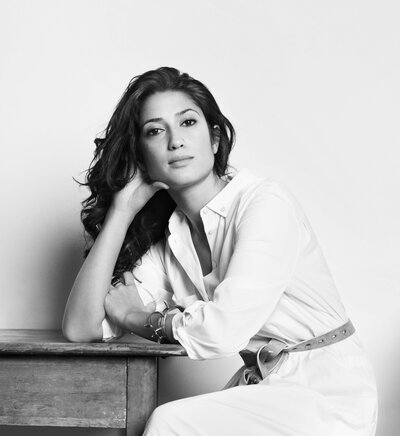
Fatima Bhutto is also the author of Whispers of the Desert, Songs of Blood and Sword and 8.50 a.m. 8 October 2005.

Paul Wetherell/Courtesy of Penguin Press

Fatima Bhutto is a member of one of the most famous families in Pakistan — a family that produced two prime ministers, her aunt Benazir Bhutto and her grandfather Zulfikar Ali Bhutto. And yet her latest book explores the lives of people who feel alienated from her country.
*
The Shadow of the Crescent Moon* is about Pakistan’s remote tribal regions. The country’s national flag includes a white crescent moon against a green background.

“It refers to the Pakistani flag that flies over this part of the country,” she tells NPR’s Steve Inskeep. It’s a part of the country “that has always felt separate from the nation, that has always felt separate from the center. And how the shadow of that moon never wanes, how it always remains no matter what you do to try to free yourself from it.”
**
Bhutto has had her own personal reasons to feel alienated. Her father, a Pakistani politician, was murdered years ago. Bhutto has long suspected members of her own powerful family played a role in the killing.**

In her early 30s, she remains a member of Pakistan’s elite, a journalist and writer. But in this novel, she explores the lives of three brothers far from any elite. They’re in a real city called Mir Ali, in the mountainous area near Afghanistan. It’s a rebellious region mainly known to Americans for sheltering extremist groups. Bhutto writes of people driven less by radical Islam than by a desire for independence. In fact, they never fully accepted being part of their country to begin with.
“It’s a part of the country that has always been removed …” Bhutto says. “And they have suffered especially over the last 15 years since the war on terror … because this is where the drone wars have been focused. This is where Pakistani military strikes have been focused. An entire region no longer exists except in the news. It no longer has the ability to live freely and as they would wish because they have become the epicenter of something dangerous.”
[HR][/HR]
Interview Highlights

http://media.npr.org/assets/bakertaylor/covers/t/the-shadow-of-the-crescent-moon/9781594205606_custom-6b221c739421f09546215455e27a22554d4a340e-s400-c85.jpg

The Shadow of the Crescent Moon

by Fatima Bhutto
Hardcover, 231 pagespurchase

On Pakistan’s effort to develop a national identity

You see that across Pakistan, actually. If you come to Sindh, the province that I live in, where I’m from, people identify very strongly as Sindhis with their own language and their own history. If you go to the Punjab, people identify very strongly as Punjabis. And this has been a question for Pakistan: What does it mean to be Pakistani? Are you Pakistani first? Or are you a Pakistani second? Or even third, now that people are identifying along religious lines as well.
**
On whether the community she describes in the book — with tanks, troops and military presence everywhere — is “normal”**

It didn’t used to be normal but unfortunately it is becoming normal in more and more places. If you go to Balochistan, for example, that’s something you would see. If you go to certain parts in the tribal areas, again, that’s something you would see. And what we’ve been noticing, those of us who live in other parts of the country, is that violence has become so ordinary now that you just learn to live around it whether you’re in Karachi or, in fact, Mir Ali.
This is a country of divided loyalties, and it’s also a country of sacrifices. Pakistan is a country that demands a sacrifice from its people. … And I don’t know if that’s specific to Pakistan. I think any violent place demands a certain amount of sacrifice from its people.

- Fatima Bhutto

On the three brothers in the novel who must balance loyalties to their community, to their state, and to their family
This is a country of divided loyalties, and it’s also a country of sacrifices. Pakistan is a country that demands a sacrifice from its people. The question is just: Where will the sacrifice come from? Will you sacrifice yourself, your own life, or your comfort? Or do you sacrifice a fidelity to an idea or to a people in order to survive? And I don’t know if that’s specific to Pakistan. I think any violent place demands a certain amount of sacrifice from its people.
On whether Pakistan is on an upward trajectory
Sadly, no. If you’re looking at Pakistan recently, you will know that we’ve executed almost — I think it’s 50 people at last count — through hangings since the death penalty was reinstated. The government has just recently banned [the blogging site] WordPress, so that joins YouTube — something like 20,000 other websites that are now banned from the country. …
http://media.npr.org/assets/img/2015/03/24/shadow-of-the-crescent-moon_sq-3a61fc4e7a2d97be0a747c1c16f1ae536481264e-s100.jpg

Re: Fatima Bhutto’s new book: The Shadow of the Crescent Moon

I like her as a writer…she is extremely intelligent, but “Songs of Blood and Sword” was just a hero worship tome to her father lol, and was as expected a one sided view of events.

I’ll still pick this up and read it though, because like I said, I enjoy her works.

Re: Fatima Bhutto’s new book: The Shadow of the Crescent Moon

See thats wut i dont like exactly, i mean her father can be a hero to her with huge respect but not for most of us. But in the end of the day if she associates rest of her writes with the people of Pakistan whether minorities or others, it still is a service to the country. Atleast she isnt bringing any shame to the country rather highlighting wut can be done better in many ways.

Plz do share your views once you read this book.

Re: Fatima Bhutto’s new book: The Shadow of the Crescent Moon

This did save me from looking more into fatima’s work

"

                   68 of 86 people found the following review helpful

Interesting Baqwas (Garbage), June 6, 2010
By
Zico “Zico”](http://www.amazon.com/gp/pdp/profile/A3545EKQ5H46RK/ref=cm_cr_rdp_pdp)

            **This review is from: Songs of Blood and Sword (Kindle Edition)**       

I approached this book with both interest (I am a Pakistani and from Karachi, and attended the same high school as Ms. Bhutto) and an open mind. I have heard that Fatima Bhutto is a smart, outspoken, and young Pakistani woman. For this reason, I was curious about the content of this book. Neverthless, coming from a family as cursed and controversial as the Bhuttos, I had reservations initially, about whether she would indeed provide truth, clarity, and candor into the crazy world of the Bhutto clan. As I had expected, the book is a huge and utter disappointment.

It is impossible for a Bhutto to be balanced and objective regarding all that the Bhutto ruling clan have contributed to Pakistan both positively and (overwhelmingly) negatively. Despite a Western liberal education, formative years outside of the larger Bhutto yoke, and slights received by various members of the Bhuttocracy, Ms. Bhutto has not been able to shed her Bhutto-ness, especially when approaching the subject of her grandfather, and her father. Her views regarding her aunt Benazir were already well known to me, thru her various comments in the media in the past. That Benazir and her husband have left our country in tatters is apparent to anyone who lives in the real world (not the PPP stalwarts who are deluded beyond comprehension). This book did not provide any analysis or information that any realistic and interested party into the world of Paksitani politics, would have known anyway. Her comments about the Benazir-Zaradari Axis was not enlightening in the least, except for her personal remarks about them, which makes for interesting tabloid-esque material.

The real problem with this book is the lack of adequate critical analysis of her grandfather and her father. It is understandable on a personal level, that the author would hero-worship her father and grandfather. Those are natural instincts, especially among women in our part of the world, with respect to paternal figures in their lives. But if she was setting out to write an honest book about the controversial Bhutto clan, then her father and grandfather, who are the main players in the ‘Songs of Blood and Sword’, deserved and merited to be analyzed very critically and very thoroughly.

Although she tries hard to claim otherwise (‘I’m not my grandfather’s keeper’ in one quote from the book), the analysis of her grandfather was pitiful. Zulfikar Ali Bhutto was a nefarious, vindictive and megalomaniacal leader. Undoubtedly gifted with a brilliant mind, mesmerizing presence, and an orator par excellence, he was nonetheless, the archetypal Third World megalomaniac. Coming myself from a strata of society, in which family members and family friends were involved either personally with Mr. Bhutto or in a governmental capacity, I have never heard one kind word about this man. None of these people I allude to, had anything to gain from or lose, by commenting negatively on Mr. Bhutto as a man and as a leader. Yet their remarks about him are vitriolic to say the least.

That Ms. Bhutto only briefly mentions this vindictiveness and any of his other shortcomings, is ample proof of the lack of objectivity and honesty in the assessment of her grandfather. His horrendous role in the splitting of Pakistan, his declaring Ahmedi’s non-Muslims for his political gain, his paranoia leading him to kill countless political foes, are not given any discussion or analysis. I agree with the analysis of his early years as a Foreign Minister, but what the hell happened to the analysis once he became leader? Utter garbage. Cursory mention of his controversies (nationalization of industries, declaring Ahmedi’s non-Muslims, his role in cleaving Pakistan, his ordering the murder of Ahmed Raza Kasuri). The same can be said regarding her father. Very nice to read tender comments and statements of Murtaza Bhutto the father, but nothing of his infamous temper, his arrogance and sense of entitlement, and his vindictiveness.

Overall, my feeling after reading this book was that it was an interesting read, with some interesting insights into the twisted Bhutto clan. But it really lacked any semblance of balance and objectivity. It’s is hard for one to be critical of one’s own family. It is also hard to be an apologist for their shortcomings. But my feeling is that this book shouldn’t have been written in the first place, if there was no true objective analysis given. It is basically a subjective account into the world of Pakistan’s curse, the Bhuttos. And an attempt to angelicize (word?) her father and grandfather.

"

Re: Fatima Bhutto’s new book: The Shadow of the Crescent Moon

More about this book including the Excerpt:

The Shadow Of The Crescent Moon

by FATIMA BHUTTO

Hardcover, 231 pages, Penguin Group USA, List Price: $25.95|NPR Summary](http://www.npr.org/books/titles/395063677/the-shadow-of-the-crescent-moon?tab=excerpt#)

Keeping his deathbed promise to his father — to free the small town of Mir Ali in Pakistan’s Tribal Areas from oppressors — Hayat is forced to make terrible choices during a single morning when his brother, Sikander, and his troubled wife, Mina, are taken hostage by members of the Taliban.

Note: Book excerpts are provided by the publisher and may contain language some find offensive.
**

Excerpt: ‘The Shadow Of The Crescent Moon’**

Prologue

In a white house on Sher Hakimullah road eight thirty on Friday morning has come too early.
The bazaar is opening slowly, rearranging its schedule to accommodate Eid’s last-minute shoppers. Light drizzle hits the dusty footpaths, carefully, so as not to disturb the shopkeepers pulling up their shutters. The clouds dip low over Mir Ali and, from a distance, the fog makes it seem as though the tanks aren’t there at all. On the roofs of the town’s buildings, snipers lie in their nests, surrounded by sandbags, their military rain ponchos cold and clammy against their necks, and wait for the day to begin.
Three brothers live under the same roof—a home they share with their widowed mother, who occupies a solitary room on the ground floor, spending her days in the company of a young maid who gives her medicine and homeopathic tonics and twists her long white hair into a single plait every morning.
Two of the brothers are the other occupants of the ground-floor rooms, alongside the family kitchen and a small sitting room. Upstairs, the third brother and his family and their home in disarray as mobile phones beep in lieu of alarm clocks and showers with aged, corroded pipes drip water onto the heads of those who did not remember to fill a bucket the night before. A small cricket bat leans against a bedroom wall, next to a set of plastic cars.
Soggy towels and wet bath mats lie around the bathroom. Socks that stepped in soapy puddles and have to be discarded are strewn on the floor. Muddy footprints of dirty shoes that stomp through the wet-tiled bathroom leave traces of black rings from room to room.
Fridays are always chaotic in the house on Sher Hakimullah road and this morning difficult decisions have been made. The brothers cannot—will not—it is finally decided after some days of deliberation, pray together on Eid.
In Mir Ali, where religion crept into the town’s rocky terrain like the wild flowers that grew quietly where no grass ought to have grown, you chose your mosque carefully. Fridays were no longer about the supplicants; they were about the message delivered to them by faithful translators of the world’s clearest religion. In Mir Ali nowadays you were spoilt for choice.
There were the mellow congregations, whose mullahs invoked harmony and goodness amongst mankind. These were the mosques that did not keep their flock for long, only enough time to remind them of their duties as a promised people. The sermons might proffer some elementary guidance in such endeavours, but it was largely a drive-through service.
There were the *jumma namaz *mosques that specialized in distinctive foreign-policy-based diatribes—lashings of rhetoric against great satans and the little men who did their bidding. These mosques yearned for converts to their cause but they lost them in Mir Ali, where people preferred to go to the houses of God that had taught their fathers and grandfathers about justice. There was no greater cause in Mir Ali than justice.
One by one the brothers filter into the kitchen to drink their morning tea. White onions sizzle in a frying pan, sweating from the heat. The brothers arrive to claim their place at the small table, draped with a sticky plastic tablecloth, where the day’s first meal will be served —sweet parathas and omelettes with diced tomatoes, onions and green chillies. The air smells of the pepper being shaken onto the chopped onions, pungent but sweet. The three brothers take their tea without too much sugar but the aged cook, who brews the tea leaves in a blackened saucepan with fresh goat’s milk, ignores them and heaps in palmfuls of refined white sugar anyway.
On the occasion of the first day of Eid, the brothers at the morning table speak to each other in a toneless, secretive mumble. Heads bent low, they don’t talk as they normally do, with voices that come with secret smiles and banter that falls out of the mouth playfully. This morning there are few teases and no arguments, only the question of how to proceed with the day ahead.
It is too dangerous, too risky, to place all the family together in one mosque that could easily be hit. They no longer know by whom.
‘By drugged-up Saudi pubescents trained in the exact extermination of Shias,’ ventures Aman Erum, the eldest brother.
‘No, it’s not just Saudis,’ protests Sikandar, the middle of the three, as he looks around the kitchen for his wife. ‘Sometimes there’s politics behind it, not God.’ She is nowhere to be seen. He swallows his sugary tea uncomfortably.
‘Yes, yes, sometimes they’re pubescents from Afghanistan. Still Sunnis, though,’ jokes Aman Erum, folding a paratha into his mouth as he stands up to leave.
‘Where are you going?’ Sikandar shouts at him. ‘We’re eating—come back.’ He notices, as he speaks, that Hayat, the youngest brother, hasn’t lifted his eyes from the blue-and-green-
checked pattern of the plastic tablecloth.
He has to go to work, Aman Erum says, to check in before Friday prayers shut the city down for the afternoon. He reminds Sikandar to pass on his business card, newly printed and designed, to a colleague at the hospital.
Kha, kha,’ Sikandar says, tucking the crisp white and red import/export rectangle into his wallet.
‘Wait, which mosque?’ Aman Erum asks, turning round and displaying his mouth, stuffed full of the flaky, buttered bread.
‘You’re going to Hussain Kamal street jumat,’ replies Hayat, looking up. Sikandar looks at his younger brother’s eyes; they are bloodshot. Hayat has decided where each of them will offer his supplications today. He has barely spoken all morning; this is the first time he has broken his silence. ‘You know that,’ he says to Aman Erum abruptly.
Aman Erum doesn’t look at Hayat. ‘Yes, yes,’ he mumbles, turning away from his brother. ‘I know.’ The paratha is chewed and swallowed, a hand raised in farewell, and for a second there is a lull in the siblings’ chatter as they adjust to the prospect of praying alone, without each other, for the first time.
And then the noise picks up again, seamlessly. The remaining two brothers rise to greet their aged mother, Zainab, who looks around the kitchen as she sits down at the table. ‘Where is Mina?’ she asks Sikandar as the brothers shuffle around each other to make space for two more cups of chai before their separate journeys through Mir Ali begin.

From The Shadow of the Crescent Moon by Fatima Bhutto. Reprinted by arrangement with Penguin Press, a member of Penguin Group (USA) LLC, A Penguin Random House Company. Copyright Fatima Bhutto, 2013.

Re: Fatima Bhutto’s new book: The Shadow of the Crescent Moon

Could not have said it any better. She has been ever so critical about Benazir and Asif Ali Zardari (although her stance changed after BB died because of the outpouring western sympathy due to the way BB died). Yet, she finds no fault with her dad who was another corrupt and power hungry person who has a questionable past with terrorist activities including hijacking a commercial plane. I do not doubt her intelligence and intellectual prowess but her selective criticism to me makes her no different from those who she tries to subvert. She was however smart enough to realize (although it took her mother Ghinva’s failed attempts to win a single seat from multiple elections) that just having the Bhutto name tied with her name was not enough to come into the political limelight.

Let’s ask asli nasli watan farosh jiyalas if Fatima deserves this Bhutto last name or its just beep nasal of Bhutto’s who deserve Bhutto last name?

Re: Fatima Bhutto’s new book: The Shadow of the Crescent Moon

well she is gorgeous…and intelligent. deadly combination and hard to find.

thx for sharing Sid. Will read it.