Does the military still control Pakistan?

Quite a thought provoking article on civilians vs army relations. if teh army is becoming more and more popular and there is a surge in popularity of General Raheel it is due to the incompetency of the last and current govt to resolve the issues of the common man and in particular the terrorist threat facing the country.One point in the article mentions the reluctance of both the civilians and army to tackle the murderer Qadri. Now that is a real shame. He should have been hanged a long time ago.

Does the military still control Pakistan?By Owen Bennett-Jones[COLOR=#5A5A5A]BBC News[/COLOR]

[ul]
[li][COLOR=#5A5A5A]28 September 2015[/li]
[li]From the sectionAsia[/li][/ul]
[/COLOR]
[COLOR=inherit]

[COLOR=inherit]Image copyrightAP[/COLOR]Image captionThe army is hugely powerful in PakistanSome call it military rule by stealth. Others prefer to describe it as the generals and the politicians working harmoniously in the national interest. But however you look at it, there’s no denying the Pakistan army’s political power is growing.
It all dates back to the Peshawar school attack of 16 December 2014 when the Pakistani Taliban murdered 132 schoolboys.
Within days the civilian leadership had formulated a 20-point National Action Planto confront the militants, curb their hate speeches, control their religious seminaries and cut their finances.
Aware that the civilian courts are generally reluctant to convict Jihadists, the parliament then passed a constitutional amendment to establish military courts.
The army then announced new “apex committees” that brought together senior politicians, bureaucrats, intelligence officials and military officers.
As many as 50,000 suspected militants have been detained or arrested and in another sign of the state’s resolve, Malik Ishaq, the leader of a formidable sectarian group, Lashkar e Jhangvi, wasshot dead by police in what is widely believed to be an extra-judicial killing.
The crackdown has led to sharply reduced levels of militant violence.
And with media highlighting the role of the army chief General Raheel Sharif, the army is enjoying a surge of public support.
But for all the hopes that the Peshawar School attacks might have marked a significant turning point, some wonder whether the National Action Plan will bring lasting change.
After all, Pakistanis could be forgiven for thinking they have seen it all before.
Tens of thousands of suspected militants were detained by General Musharraf’s regime in 2007, only to be released a few months later.
Since the state lacks the capacity to investigate the detainees the same could well happen again.
When he announced the National Action Plan, Prime Minister Nawaz Sharif stated that Pakistan would no longer distinguish between the “good” Taliban (who fight Pakistan’s enemies) and the “bad” Taliban (who attack targets in Pakistan itself).
Selective targetsBut in reality the state is still being selective about which groups it targets.
Pakistani-based Jihadist groups with a history of fighting Indian forces in the disputed territory of Kashmir are being left alone.
So too are the Afghan Taliban and the Afghan-facing Haqqani Network which stands accused of mounting recent attacks in Kabul.
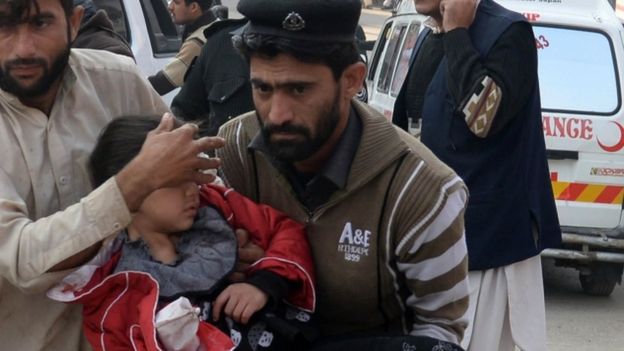
[COLOR=inherit]Image copyrightGetty Images[/COLOR]Image captionPlans were drawn up to combat militants following the Peshawar school attackPerhaps most controversially of all Lashkar e Toiba (or as its renamed itself, Jamaat ud Dawa), the group accused of mounting the 2008 Mumbai attacks, has not been confronted.
The group’s leader Hafeez Saeed is frequently quoted in the Pakistan press.
And no-one is expecting further legal action against, for example, LSE graduate Omar Sheikh who has been convicted of involvement in the 2002 murder of the Wall Street Journal’s Daniel Pearl. His appeal has been pending since 2002.
Nor is there likely to be any resolution of the case of Mumtaz Qadri who in 2011 killed the Governor of Punjab, Salman Taseer.
Qadri, who objected to Taseer’s calls for reform of the blasphemy laws, enjoys hero status in Pakistan.
Neither the army nor the government will want to risk undermining public support for the National Action Plan by including Qadri in its net.
Privately officials say they have to prioritize militants who attack targets within Pakistan.
But even that claim is questionable. Fearing a violent backlash, the state has hesitated to confront militants in their strongholds in Southern Punjab.
The risks are real. Within three weeks of Malik Ishaq’s death, for example, Lashkar e Jhangvi hit back with a suicide bomb attack that killed the Home Minster of Punjab, Shuja Khanzada.
There are also questions about the impact of the National Action Plan on Pakistan’s notoriously volatile civil/military relations.
Elected representatives both in the national parliament and provincial assemblies complain that they have been cut out of decision-making.
Cult of personalitySome also express fears about an emerging cult of personality around Army Chief General Raheel Sharif.
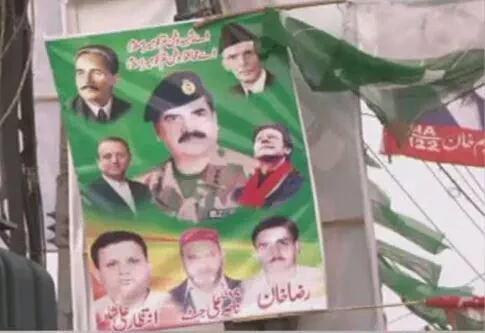
Posters of him have appeared on billboards throughout Pakistan’s biggest city Karachi.
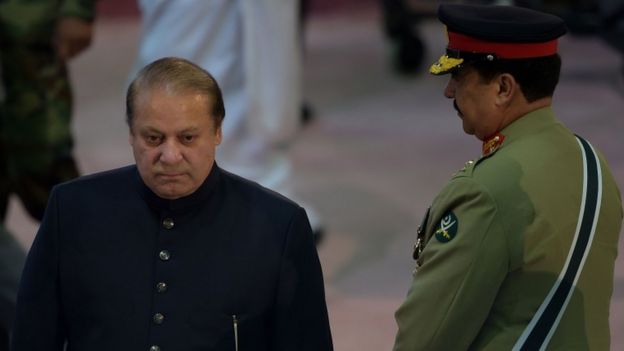
[COLOR=inherit]Image copyrightGetty Images[/COLOR]Image captionThere are tensions between Prime Minister Nawaz Sharif and army chief Raheel SharifMysterious websites, which seem to have access to images sourced from the military, praise him to the skies.
After decades of very poor PR, the army is now producing emotive, patriotic rock songs to bolster support for the anti-Jihadist campaign.
While Pakistani liberals worry about these developments, they simultaneously concede that if the counter narrative to the Jihadists has a militaristic air, its only because the civilians have failed to come up with an effective information strategy of their own.
The contest for public support has had an impact on Pakistan’s previously irrepressible TV news channels.
Many have become so nervous about upsetting the army that they are making use of a 30-second delay on live broadcasts so that the sound can be muted before it’s transmitted.
Originally brought in to stop uncritical interviews of Jihadists, the mechanism is now being used to protect the army’s reputation.
One prime time TV host described how her voice was muted as soon as she used the word “military”.
The person controlling the mute button did not know if she was going to say something supportive or critical of the men in uniform - so decided to play it safe.
The army’s ascendency means that despite his strong electoral mandate Nawaz Sharif is unable to pursue some of his objectives.
His desire to improve relations with India has run up against the army’s insistence that the intractable Kashmir issue should be at the forefront of any talks process.
[HR][/HR]General Raheel Sharif
[ul]
[li]Received his military commission in 1976[/li][/ul]

[ul]
[li]Studied military leadership in Germany, Canada and Britain[/li][/ul]

[ul]
[li]Commanded several infantry units, some on the disputed Line of Control in Kashmir[/li][/ul]

[ul]
[li]His brother, Shabbir Sharif, received two of the country’s highest military awards after he was killed during the 1971 India-Pakistan war[/li][/ul]

[ul]
[li]Previous appointments include inspector-general of training and evaluation at the army headquarters in Rawalpindi, and head of the Pakistan Military Academy at Kakul, Abbottabad.[/li][li]Thought to have played a key role in switching the focus of the army from confronting India to fighting militancy.[/li][/ul]
[HR][/HR]Wary embraceMr Sharif has also been blocked from pursuing legal action against the man who removed him from power last time round, General Musharraf.
The army is unwilling to see a former chief on trial for treason.
For now the government and the army are locked in a wary embrace.
They are working together but in part that is because the civilian politicians fear that if they allow a gap to emerge between them and the military there will be another coup.
Some wonder how long the current situation can last.
“Let me tell you what I have learnt from history,” said Pakistan’s most prominent human rights lawyer, Asma Jahangir.
“Our army doesn’t want power. It wants absolute power.”

[/COLOR]

Re: Does the military still control Pakistan?

All this over the top grumbling and fretting over Army Chief popularity is getting extremely annoying and counter productive. It reeks of insecurity and paranoia. What will be the end result of this whining? ISPR's position had already been upgraded.

It is the same old, same old. All those 'journalists' crying about COAS popularity are the same type who did not raise any hue and cry to improve Pakistan's dastard electoral system.

Re: Does the military still control Pakistan?

By the way, military control or not, but Army Chief's popularity and might public ​praise of leadership style only alludes to one thing and that is that Pakistan is in desperate need of presidential style of democracy. Pakistanis prefer personalised, strong and assertive leadership at the highest level, not lame ducks hiding behind the rotten 'system'.

You can also refer back to Imran Khan's popularity (or even Bhutto's) to support that argument. Are these journalists and 'intellectuals' willing to introduce such debate in Pakistan's politics if they love democracy so much? Nope. Absolutely not. Why would they? They will lose their jobs.

In presidential style democracy, lame ducks, undignified criminals like Nawaz Sharif who have charisma and intelligence of a worn sock will never get the 'popular' vote. Fact. Therefore they use and abuse social evil and system to come to power.

Re: Does the military still control Pakistan?

From where the word still came in the heading...

Re: Does the military still control Pakistan?

[QUOTE]
Let me tell you what I have learnt from history," said Pakistan's most prominent human rights lawyer, Asma Jahangir.
"Our army doesn't want power. It wants absolute power."
[/QUOTE]

This woman needs to shut the hell up before she chokes on her gutka. Yes the so called Human Rights activist who was recently representing MQM in the court? The urban terrorists.

Human Rights activist my foot. Tell her to raise a voice over Baldia Town factory fire or Kasur child sex abuse ring if she has the guts, and a soul!

It doesn't take a genius to figure out why Indians and Western media loves stooges like her. Maybe it's about time to start interviewing real Pakistanis who understand and appreciates the complexities of the situation in Pakistan.

Re: Does the military still control Pakistan?

What she said is 100% right, but I know the truth hurts you.

Brave woman like Asma Jahangir saved thousands of lives, when nobody else would dare.

Re: Does the military still control Pakistan?

Her truth is as irrelevant and mundane as her own measly character in today's Pakistan. Pakistan is a changed country today. The sooner PPP style anti Army haters realise the better. This isn't 80s or 90s anymore. Army had realised this much, so it is time for self proclaimed bloody civilians to get the hint as well.

To expose this phony Human (Politicians) Rights activist a little more, Justice S Khawaja has to be the only judge in recent history to pressurise NAB, and seek an action plan from them which produced the infamous list of 150 mega cases. What does this charlatan Human Rights activist do - she boycotts his farewell ceremony and takes digs at him on twitter. This is how much she works for the interest of corrupt, criminal and traitorous politicians. She would stoop so low to even represent MQM because Altaf said something against the Army.

Good for young new generation of Pakistanis to not give a crap about characters like her.

Re: Does the military still control Pakistan?

Very good article :k:

Well the answer is simply, Yes! And about Quadri we know that he is still well and alive because he killed a politician. Had he killed a man in uniform he would be the first to get hung. So by itself this case says it all.

Right on money!:k:

There is a reason why Military Inc comes in power every single decade and even if we’ve a civilian face we know who is choking from behind. Even that’s gona end very soon and probably sometimes next year it’ll be a complete military govt again.

Re: Does the military still control Pakistan?

[QUOTE]

Height of blind hatred for men in uniform. Have some shame!

What about all those men in uniform killed in Kiyani’s tenure? What about the rangers who were killed in Karachi during PPP-MQM tenure by political target killers? Did a man in uniform hang anyone then? Don’t make baseless stories and spread propaganda.

This lame and pathetic excuses is only to save corrupt politicians who are facing some accountability, pressure to perform, and clear sense of competition. You cannot say a word to politicians, can’t put any pressure on them to fix themselves, so you moan and cry about military’s popularity which they have worked HARD to gain back. Ask your rulers that why that clown Parvez Rasheed is no match for Asim Bajwa’s professionalism.

Army haters had been crying for a coup for good two years. Let them cry some more. Pakistanis are only giving General a credit for what he has achieved. Perceptions are not build in thin air, action speak louder than words.

There is a heroic take behind why Ataturk is immortalised in Turkey, there is also a reason why Pakistanis appreciate Gen Raheel. Doesn’t take a genius to figure out the common link.

Army haters can jump off the cliff in sheer jealousy and misery. Oh how pathetic do they sound that when there had been no coup in last 9 years, they sit there and predict a coup every week, every month, every year. Losers.

Is it really a pain in the ass that Pakistan is actually doing better than ever before in recent history? So bloody what if a General gets some credit? Is he not Pakistani? Ask yourself, has he not turned things around for Pakistan. Were libtards happy with lame duck chief like Kiyani?

Re: Does the military still control Pakistan?

Let's moan and cry why Army hasn't hanged Qadri, but forget the fact that your bloody civil society came on the streets to protect him. Yes this included lawyers.

If Army is supposed to do every thing, then yes might as well hand the government? Why the freaking double standards. You want Army to clean the mess, yet not get credit. You want Army to take bold decisions yet not have any influence.

Bloody hypocrites.

You can cry about Qadri not being hanged when your bloody civilian Punjab government actually refers his case to the Military courts to begin with. Go first educate yourself how Military courts work. The protocol they follow.

Re: Does the military still control Pakistan?

bloody civilians cannot even interfere into medical education being offered by general saab.

Re: Does the military still control Pakistan?

Once a colleague (who remained in UK for several years) used this 'pain in the ass' phrase and I asked him please translate it into Urdu, but he avoided inspite of repeated requests. I think this is a pet dialogue there and not considered weird, but for people like us who translate every English sentence its kinda weird. Though, we should not complaint for such petty things while being in PA. But still.....

Re: Does the military still control Pakistan?

Common phrases, colloquial expressions and idioms are not meant for literal translation, ever. The rule applies for every language on earth I would think? The idea is just to know the general meaning behind, and that's sufficient enough.

Re: Does the military still control Pakistan?

The world is reading wuts written on the wall… Another brilliant article :chai:

Hail to the chief | The Economist

Hail to the chief

Politicians are overshadowed by a publicity-seeking general

Sep 26th 2015 | ISLAMABAD | From the print edition

THE image of a mustachioed man with peaked cap and a chest full of medals is becoming hard to avoid in Pakistan. It is splashed across the posters of a politician competing in a by-election in the eastern city of Lahore. It looms large on giant billboards in the port city of Karachi, apparently paid for by adoring citizens. And it is a rare day when Pakistan’s chief of army staff is not pictured on a newspaper front page. He has even entered the colourful repertoire of artists who decorate the nation’s trucks and rickshaws.

The apotheosis of General Raheel Sharif (pictured, wearing beret) makes it harder than ever for his unrelated namesake, Nawaz Sharif, who is prime minister, to claw back powers from an army that has directly and indirectly controlled Pakistan for most of its history. Nawaz Sharif’s election victory in 2013 resulted in the country’s first transfer of power from one civilian government to another. But the extent of his authority is debatable: the army is reasserting itself.

This marks quite a turnaround for an institution that eight years ago was so unpopular that off-duty soldiers in the most restive areas were advised not to wear their uniforms in public. The long rule of General Pervez Musharraf, a coup-maker, had seriously tarnished the army’s prestige. A particular setback was the violence unleashed in central Islamabad in 2007 when General Musharraf decided to clear out a pro-Taliban mosque in the heart of the city. The army was humiliated in 2011 when the public discovered Osama bin Laden had been hiding next to the country’s officer-training school and that American special forces had been able to penetrate deep into Pakistan to kill him.

Today the army is riding high, buoyed by an improvement in security following a decision in June 2014 to launch an all-out campaign against the Pakistani Taliban. Many credit General Sharif with taking the initiative. Operation Zarb-e-Azb has seen key towns in the former Taliban sanctuary of North Waziristan retaken by the state. Militants have been hunted down elsewhere, particularly in Karachi, which had been a major centre of Taliban activity. All this work has helped cut militant violence by nearly half in the last nine months, according to the Pakistan Institute of Peace Studies, a think-tank in Islamabad.

At the same time the army has been waging a public-relations war, promoting General Sharif as a star. The media dutifully report on his every visit to the front lines and publish photographs of every honour-guard he inspects during his numerous overseas trips.

That General Sharif should receive more than usual publicity is understandable given the country remains mired in a bloody internal conflict. On September 18th 13 Taliban suicide-fighters fought their way into a residential compound of Pakistan’s air force near the city of Peshawar and killed 29 people. Sustaining public support for a war against Islamist militants is tricky given that many on the religious right sympathise with the Taliban’s goal of a strict*sharia *state and often avoid condemning their means of achieving it.

But the constant boosting of the army has come at the price of undermining Pakistan’s civilian rulers, who come across as petty and ineffectual characters compared with the go-getting General Sharif. Aides to the prime minister have been reduced to pleading with journalists at least to mention him when reporting on events dominated by the army chief. Veterans of Mr Sharif’s faction within the Pakistan Muslim League say it is the latest battle in a decades-old fight for supremacy between generals and civilians.

Mr Sharif’s hopes of using his landslide majority to clip the army’s wings and run his own foreign policy have so far come to nothing. A trade deal with India has foundered because of the army’s opposition and the difficulties of dealing with a hardline government in Delhi. The trial on charges of high treason of General Musharraf, who ousted Mr Sharif in a coup in 1999, has been kicked into the long grass.

Few believe the military men are planning another formal takeover. That would likely trigger international sanctions, which the cash-strapped country can ill afford. The army would have little to gain: it already dominates foreign affairs and defence policy, its biggest preoccupations.

There is much speculation, however, that General Sharif will be given an extension of his three-year term in office. He is due to step down in November 2016. Many clamour for him to stay for at least another term. General Musharraf recently echoed these calls. If he does stay on, it would be a setback for civilian government. (There would be a precedent: Ashfaq Kyani, his predecessor, who was credited with rolling back the army’s involvement in politics under General Musharraf, was given an extension in 2010.)

**The aura surrounding the army chief has extinguished what little public scrutiny there was of his institution. Such oversight is badly needed as the army’s power expands. Military courts have started hearing terrorism cases. The army sits on “apex committees” that co-ordinate security matters in each of the four provinces. **Through the paramilitary Rangers force it is largely in charge of policing in Karachi.

No one is calling for a drive against the corruption that pervades the army’s vast commercial empire. Nor have questions been asked by Pakistan’s media about how so many gunmen were able to enter the air force camp near Peshawar. General Sharif rushed to the scene and met injured troops. After the attackers were killed his spokesman pronounced the army’s response “a huge success”—another feather in the cap of Pakistan’s strongman.

From the print edition: Asia

Re: Does the military still control Pakistan?

Your "world" also saw the writing on the wall that Pakistan is a failed state, it is just about to fall apart and Taliban will get its nukes. "Wut" haiippenned dere? Awww.

Who needs nasty Indians and Afghans spitting venom on Pakistan army, when we have plenty of snakes in our own sleeves. Precisely the reason why need a strong Army.

Pakistan Zindabad. Pak Fauj Zindabad. Pkistan Paindabaad.

Now burn!!!

Re: Does the military still control Pakistan?

Just saw a perfect example of this article :smiley:

Re: Does the military still control Pakistan?

Short of being a farangi, but what the heck as NRPs would pretend to be pakistani when they criticize you, what chance do you see of such a system? Even imran doesn't push for it because of his fondness of london.

Re: Does the military still control Pakistan?

^ Imran introduced awareness and a real struggle for free and fair elections, that's more than enough. Already people called him anti system, anti democracy and what not for demanding thorough investigation into rigging. Pushing for presidential style democracy was maybe too much for him.

But this parliamentary system democracy is a farce in Pakistan, too complicated, too deceiving and too open to abuse from a very lower level to all the way to top.

Re: Does the military still control Pakistan?

I see Nawaz Sharif and it makes me ashamed he is the prime minister.

You just have to look at his stature when he meets other leaders he looks like a brain dead retard.

Re: Does the military still control Pakistan?

Yes it does since partition one way or another, except very short period of ZAB’ government after breakup of Pakistan in 1971. ZAB rehabilitated the destroyed military, restored its self esteem and self respect but when it regained its power, it came to old tactics of dislodging legally elected government. ZAB, the elected PM was hanged and his dead body was sent to Garhi Khuda Bux. Even namaze janaza was forbidden for him. N$ in his previous government also tried to control military, but Mush then fired-CAOS, hanged N$ by balls, though N$ claimed he had heaviest mandate by the people to rule the country. Now this Sher-e-punjab is worst than a eunuch before current CAOS.


Restored attachments: