Delhi, the National Urinal

Re: Delhi, the National Urinal

so it doesnt happen in islamabad. Is it.
There are toilets but ofcourse nobody used them because there are never maintained. You might not know what u get when u go into some of them. Its utterly disgusting. Even now people pay only 50 paise to get into some of them, obviuously the qulity of service is as cheap as the money. Somehow sanity is never high in govt agenda.

Re: Delhi, the National Urinal

^ vineshvk: correct, whatever (number/short) visits I have paid to Islamabad I didn't find anyone pissing in public against a wall or something, may be there are areas that I didn't see, but in general the police is very strict in Islamabad.... but as soon as you step out of that jurisdiction its a different world ;)

Re: Delhi, the National Urinal

Mama ji aapko India ke khilaaf aajkal koi news nahi mil rahi kaya jo toilets ki news lekar baith gaye :hehe:

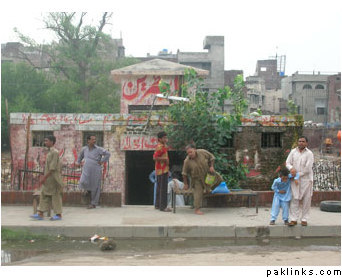
waise hum aapke ghar ke paas ki ek photo khich kar laye hai :naraz:

:woho: Public toilets in Pakistan are filthy.

LAHORE, Pakistan – It’s the 21st century, but 46 percent of Pakistanis still do not have access to acceptable toilet facilities. Many have to go to fields and other abandoned places to relieve themselves, and the sight of men urinating against walls in densely populated areas is not uncommon.

These are the results of a recent study on sanitation facilities in Pakistan, which was conducted by Pakistan’s federal ministry for environment in 2005 and revised in March 2006. **It found out that only 54 percent of this Pakistan’s population has latrine and toilet facilities. **Out of this 54 percent, 70 percent live in urban areas while 30 percent are in rural areas.

The report also revealed that only 44 percent of households in urban areas use underground drainage systems. In rural areas, 68 percent of the households have no such system.

Even in areas that have drainage systems, little care is taken at the government level to maintain them. To make matters worse, many small towns dispose of human excreta using open drains, which poses serious health hazards to the locals. Civic agencies have noted this but little effort is being made to replace these open drains with an underground sewerage system.

source

... Highlights of Delhi Budget 2006-07 ...*](http://delhiplanning.nic.in/Budget%20Speech/2006-07/highlights.pdf)
Please ek baar nazar maar lena mama ji, specially paragraph no. 15 par but apne sir par yeh mat maarna after reading all these >>>>> :smack::hehe:

Re: Delhi, the National Urinal

lolz, nice

Re: Delhi, the National Urinal

Bangladesh Makes Progress in Providing Sanitation, India, Pakistan Lag

In its latest human development report, the United Nations says one of the world’s poorest countries, Bangladesh, has made dramatic progress in providing sanitation to low-income communities, and urges developing countries such as India and Pakistan to follow suit.

Less than one-third of Indians have access to sanitation, according to the recent report prepared by the United Nations Development Program. The situation is even worse in neighboring Pakistan, especially in teeming cities like Lahore and Karachi. The result: more than half-a-million people in these two countries die every year from water-borne diseases like diarrhea.

Arunabha Ghosh, one of the writers of the U.N. report, says the lack of access to sanitation and clean water also creates an enormous drain on the growing economies of the South Asian region.

“Thirty-six-billion dollars is lost due to productivity losses or increased health costs because of the number affected by water-related diseases,” said Ghosh. “So, for a fast growing region like South Asia, there is a huge economic waste that can be countered by addressing this problem.”

But the U.N. says an even poorer country, Bangladesh, has demonstrated that the situation can be dramatically different.

Less than a decade ago, Bangladesh had one of the worst records for sanitation in rural areas. Then more than 600 non-profit groups in the country got together to launch what is known as the “Total Sanitation Campaign.”

Ghosh at the U.N. says the program involves a three-step strategy to make individuals understand the crucial role that sanitation plays in preventing disease.

“The first of it is disgust. Community leaders take other members of the community around the slum to create disgust about human and animal excreta,” said Ghosh. “The second is increasing awareness about what that means for health, so individuals themselves realize how this impacts their life chances.”

“And then the third step is mobilizing both community resources and government resources to provide low-tech sanitation facilities,” continued Ghosh. “Bangladesh has become a world leader in building low-tech toilets, which are cheap and affordable.”

The successful community-based program led to the creation of sanitation facilities across thousands of villages and urban slums. It has now been scaled up into a national project, and aims to achieve nationwide sanitation coverage by 2010.

The U.N. says the same community model is being attempted in parts of India, China and Cambodia, but needs to be broadened to cover larger parts of these countries.

http://www.voanews.com/english/2006-11-12-voa6.cfm

Re: Delhi, the National Urinal

http://www.voanews.com/english/2006-11-12-voa6.cfm

Bangladesh the ‘Golden Boy’ of South Asia

“India may outperform Bangladesh as a high growth globalization success story, but the tables are turned when the benchmark for success shifts to sanitation: despite an average income some 60 percent higher, India has a lower rate of sanitation coverage. Similar gaps between wealth and coverage are observed for water,”

Bangladesh betters India in sanitation

While Bangladesh has 39 percent area covered under sustainable improved sanitation, in India the figure is 33 percent - according to 2004 figures. Since then, Bangladesh has improved vastly upon its sanitation.

‘Two-thirds of Indians don’t have access to improved sanitation. It is not just a question of health but also human dignity, particularly of women,’ said Arunabha Ghosh, one of the authors, at the release of the report here by UNDP Representative Maxime Olson and Union Water Resources Minister Saifuddin Soz.

Re: Delhi, the National Urinal

What I said is true. India is on rank 126 among 177 countries on the Human Development Index, according to a report released by the United Nations on Wednesday.

The Human Development Report by the United Nations places China way ahead of India at 81. China has moved up four ranks compared with its 85 position last year.

India is way behind all other countries.

Re: Delhi, the National Urinal

It is amazing that this entire thread was opened with the intent to spread hate. Mashallah, lage raho, hate away. And then you have the GALL to call yourselves mulsims of the ISLAMIC republic of pakistan.

For shame gents, FOR SHAME!

Re: Delhi, the National Urinal

your posts make alot of sense. also agree with the one u left in the homophobic thread regarding elton john. :slight_smile:

lahore981 u need to stop opening all these hate threads against india! :nono: akhir india gave us kishore kumar na? :wink:

Re: Delhi, the National Urinal

India obviously stinks.

Re: Delhi, the National Urinal

Toilets or bathroom dont play a major role in determining the plan for the houses. This is what I understood. I think its mainly because people consider shelter more important than sanitation. Only when u have a shelter would u worry about sanitation. 15 years ago I was in vizag, andhra. we had a house owner who obviously had decent toilets. (toilets were just enough for one person to get in). But this guy used to go to the nearby railway tracks for his daily stuffs. It was so disgusting. When asked he says that its not possible to change all of a sudden things that he was doing from childhood. 10-12 years ago in our house in kerala we didnt have proper toilets. It was just a slab.And since we had fairly large compound it was easy to have this kacha toilet quite far away from the house. At that time our house was made of thatched roof with hardly any protection against rain or wind. We lived through it and has come a long way in getting a good house with proper toilet attached to everyother room.
The whole point is that the govt should fight the menace in two ways. One to provide and maintain public toilets and to educate the masses of hygeniec practices. New generation of people will obviously taught the importace of good sanitary practices Economic prosperity may go in a long way helping people to have a better life. I think ills that we see around are mainly the cause of poverty.

Re: Delhi, the National Urinal

vinesh

education is critical on hygiene. A few years back I was invlved in some projects which resulted in a major push in rural areas in pakistan through WHO programs.

Additionally, the Human development foundation had initiatives on the topic of hygiene and health targeted to rural women.

Re: Delhi, the National Urinal

This sort of thing happens in Pakistan as well, the only difference is people squat instead of stand.

On the way home as soon as the car gets outside Isb you see people squatting in fields probably taking a dump or a piss. :yukh:

Don’t give them public toilets, they wont know what to do with them, thanks to Ganja there’s lovely service stations all across that new motorway, lovely hotels, food outlets and public toilets but the thick Pakis don’t know what to do with the toilets, you have men going into womens toilets and vice versa, I saw a woman walk into a cubicle which only had a urinal inside (that’s another thing I don’t understand, why put a urinal in a cubicle?).

Re: Delhi, the National Urinal

chalo, fight of “we have more toilets than you”, “they don’t enough toilets” begins :smack:

Re: Delhi, the National Urinal

some ppl have issues whipping out their ding a ling right next to other ppl, i guess thats why. In most places that can be accomplished just by a dividing screen.

Re: Delhi, the National Urinal

Exactly my sentiments

Re: Delhi, the National Urinal

:rotfl: :rotfl: :rotfl:

Re: Delhi, the National Urinal

O yaar this thread is about India, Hindoostan

NOT about pakistan and Bangladesh :grumpy:

Don’t derail this important thread. :slight_smile:

Re: Delhi, the National Urinal

[quote=hollowman]
Mama ji aapko India ke khilaaf aajkal koi news nahi mil rahi kaya jo toilets ki news lekar baith gaye :hehe:

waise hum aapke ghar ke paas ki ek photo khich kar laye hai :naraz:
***Lakin meray Bhai in Pakistan atleast it goes down the drain. we do not recycle urine like they do in India..:frowning: ***

Re: Delhi, the National Urinal

sabse pahle to Bismillah ir-Rahman ir-Rahim as salaam waleekoom (in inzy style) :hehe:

You’ve a point Sindsagar, actually we recycle what you said U??? for our neighbours coz if we will not export to our neighbours so how will they stop begging in front of world bank for mineral water…:frowning: