Re: An educational thread on the differences between Pakistanis and neighbouring popu
Well I am not talking of genocide, but mass invasions, intermingling and settlement spread out across not centuries, but millenia. This will definitely have an effect on the base populations.
Refer to this image for the waves of migrations into the subcontinent : http://ces.iisc.ernet.in/hpg/cesmg/umax25.gif
India is the MOST genetically diverse nation in the world. North-east Indians are Mongoloids, South Indians are Dravidians, hinging towards either Negroid or Aborigine, North and Central Indians are Caucusoid (although darker because of the tropical climate).
From : **Ethnic India: A Genomic View, With Special Reference to Peopling and Structure **
**Analabha Basu1,4, Namita Mukherjee1,4, Sangita Roy2,4, Sanghamitra Sengupta1,4, Sanat Banerjee1, Madan Chakraborty1, Badal Dey1, Monami Roy1, Bidyut Roy1, Nitai P. Bhattacharyya3, Susanta Roychoudhury2 and Partha P. Majumder1,5 **
(6) the Dravidian tribals were possibly widespread throughout India before the arrival of the Indo-European-speaking nomads, but retreated to southern India to avoid dominance; (7) formation of populations by fission that resulted in founder and drift effects have left their imprints on the genetic structures of contemporary populations; (8) the upper castes show closer genetic affinities with Central Asian populations, although those of southern India are more distant than those of northern India; (9) historical gene flow into India has contributed to a considerable obliteration of genetic histories of contemporary populations so that there is at present no clear congruence of genetic and geographical or sociocultural affinities.
I’m afraid your clubbing of such diverse peoples as Orissa and Central India to those of Tamil Nadu itself is grossly incorrect (may I ask if you have been to India, or are you saying this only on the basis of charts and tables you posted before ?)
Again, may I ask if you’ve ever met Parsis from India ? One can easily recognize them 7 out of 10 times.
Dravidian side of Parsis ??!! Well don’t mind but that sure is Lollywood (Pak Film industry) to me.
Parsis are fair bleached skinned and often have light or light brown eyes. I see them in India all the time. And Please do not bring the Dravidian angle in everything Indian.
Its a very well known fact that Parsis fled Persia after being persecuted by the Islamic invaders from Saudi Arabia. 95% of the world’s Parsis reside in India and have no genetic link to Dravidians, aborigines et al.
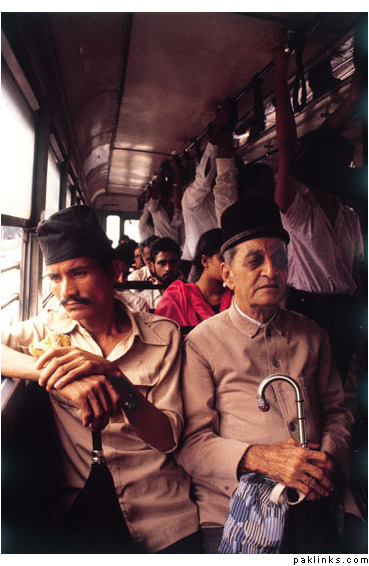
These 2 gentlemen are 2 of India’s top bussinessmen.
Both these are 100% pure descendents of a close-knit humongous Parsi community that dates its lineage to a few hundred years. They don’t intermingle at all.
Now I mean where did you equate Parsis with Dravidians ? Here is a Dravidian :
That’s Laxmipathy Balaji from Tamil Nadu. You go there and 90% of the populace are like him :- charcoal dark, and thick jet-black hair and equally black eyes.
Aha ! Well from that I guess you admit to swamping out of genes atleast. So isn’t it possible that the genes of waves and waves of hordes of hundreds of thousands of Central Asian invaders upto the Moghuls across millenia have altered the genetic makeup in India and Pakistan, and that THAT is no indication of the populace of India and Pakistan being genetically pure Aryans et al.
Whoaa ?? Zoroastrians and Vedic peoples were descendents of a common Indo-Iranian religion called Proto-Indo Iranian religion (you may google it). This is evident from the similarities in the Rig Veda and the Zen Avesta-- in words, rituals, language etc. Yes its true that Zarushsther put it down in one place, but all these ideas predate him by many centuries :- Ahura Mazda, Yasna, Haoma et al.
Forget Parsis. Sanskrit is part of Indo-European language group.
I was talking about Parsis who migrated to India, not modern-day Iranians. There was No Catholic-Islamic style conversion or proletysation in those days. There were tribes and their culture grew and spawned within those tribes. As ideas emerged, there were rituals, and literature was written down in the Avesta.
The inherent similarity in Rig Vedic and Avestan words, rituals etc. indicates that both of them descended from one proto-Indo-Iranian group and split off at some point of time. The split is evident in that ‘S’ in Sanskrit words is replaced by "H’ in Avestan words and have opposite meanins (indicating a serious quarrel or rift).
Case in point : Asura in Sanskrit means Demon, but Ahura in Avestan is worshipped. The sacred Avestan books : Ahunavaiti Gatha ‘Sovereign Lord’, Ushtavaiti Gatha ‘Radiant Happiness’, Spenta Mainyu Gatha sound like Sanskritic. Gatha in Sanskrit means story, which is the same in Avestan.
Re: An educational thread on the differences between Pakistanis and neighbouring popu
It’s simply an ignorant statement. Base populations do not change at all. Only very slight changes of the overall population occur with time. Nothing major, however many invaders have been into the region. This is simply accepted.
North East Indians are a mixture of Mongoloid and Dravidian, but are mainly Dravidian. South Indians are pure Dravidian, not Negroid at all. Central India is caucasoid mixed in with Dravidian, but again are mainly Dravidian. NorthWest India is caucasoid, but compared to Pakistan is more Dravidian. The keyword as you can see is dravidian.
I have posted the map that shows what I say. You can see it again if you like.
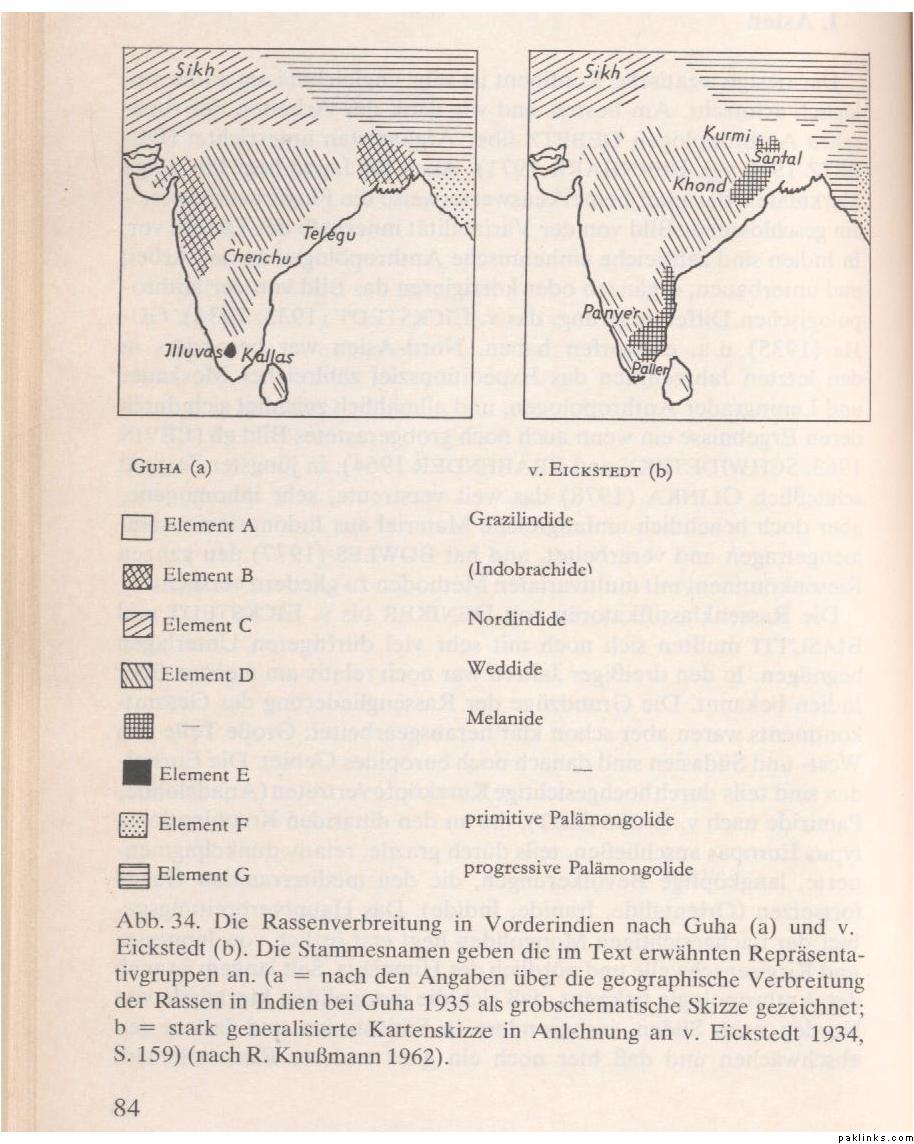
Look closely at the map, and you might be able to grasp this. The regions you claim are all caucasoid with high diversity are in fact the following.. The features described in each especially the statures, facial characteristics and nasal indexes are not typical of Caucasoids at all, but there is undoubted Caucasoid mixing with the people of nw India only.
Grazilindide is defined as a short statured long headed element with high cranial vault but faintly marked supra-orbital ridges and broad, short but ortho-gnathous face, with medium lips. The nose is prominent and long but the alae moderately spread out, giving a mesorrhine index. The colour of the skin varies from light brown in the Telugu Brahmin to a dark tawny brown among the Kalla,but the eye colour is dark brown and colour of the hair is usually black*.** The latter is in general straight but is inclined to waviness and the amount is moderate both on the face and body. It is found in its purest form among the Telugu Brahmins, but the Kallas of Southern Tamil country and the Illuvas of Cochin also furnish good examples. This type forms the predominant element in the greater part of the lower stratum of the population of Northern India, including to some extent the Punjab*
**Weddide is defined as **the aboriginal population of India discloses – (D) a short and moderately high-headed strain with very often strongly marked brow ridges, broad short face, the mouth slightly inclined forwards and small flat nose with the alae extended. The hair varies from wavy to curliness and the skin is of a shade of dark chocolate brown approaching black. This type is predominant among the aboriginal tribes of Central and Southern India, but seems also to have entered in a considerable degree in the lower stratum of the Indian population. This type is closely allied to the Veddas of Ceylon, the Toalas of Celebes, and the Sakais of the Malay Peninsula. A more primitive form of this type is seen among the aborigines of Australia, among whom some of its traits are found in an intensified form. The Bhils of the Vindhya and the Chenchus of the Farhabad Hills may be regarded as representatives of this type.
Now see where it says element C of Pakistan, these are Nordinds.
(C) Another long-headed strain with comparatively lower but longer head and tall stature and possessing a long face and prominent narrow long nose. In its purest form it is found in the North-west Himalayan tribes like the Kaffirs and the Pathan
So it looks that people in NorthWest India are fairly Dravidian, as are people in Central India. The rest would be completely Dravidian with the NE having some Mongol mixed within.
The upper castes of India do show more Caucasoid mixture but they are a small minority of Indians. Something like 10% of India is upper caste, and this includes South India. Nothing in that statement is interesting like you seem to quote it as being. The upper castes of NorthWest India most likely were these Aryans who spilled over from Pakistan, but this is what I’m trying to explain to you..these people have been dravidianized so that they look somwhere in between Pakistan and South India as you would expect. The majority of North India is not upper caste, so it doesnt really matter anyway.
Orissa and Central India are not that diverse. You can see that in the map above.
Parsis tend to be upper caste people in India, they would be easily recognizable.
Parsis do NOT have light eyes. This is one of your John Abraham Bollywood dreams that you try to portray India as. Parsis are almost exclusively brown eyed in India. Their genetics are pretty obvious. They are Iranian paternally and Indian maternally. So would be lighter skinned than the average Indian
Yes, they do have a genetic link with Dravidians. All their MtDNA is Dravidian.
Even so, Parsis are a small minority in India so are irrelevant in describing the basic Indic features which are based around the Dravidian phenotype.
These two are the richest Parsis in India, who would not look like the average Parsi. As you know colourism and castism does exist and the richer people of India all happen to look a certain way. An average Indian Parsi looks like this.
You havent been able to follow a simple argument here. If a very large basal population moves into a region, like say Aryans, in numbers that overwhelm the population (which is what Aryan migration is all about), then the basic genetic structure of the population will change.
When a couple of Parsis move into a country and are surrounded by literally perhaps billions of Dravidians for centuries, it is inevitable that they reproduce with the Dravidian female population. Dont forget, Parsism is a paternal thing, so Parsis are simply people who had Parsi fathers, which explains the genetics quite well.
The Zoroastrians are modern day Iranian ancestors. The Vedic people are the ancestors of modern day Pakistanis. The basal genetic structure of these populations will not have changed over the millenia, unless you are advocating some kind of massive genocide of the people, which is impossible. Since it’s known that the Iranian population, and the Pakistani population of today are not ancestrally related, it must mean that the people who followed Zoroastrianism millenia ago in Pre Islamic persia were not the same as the Vedic ancestors of the Pakistanis. You’re making incorrect conclusions.
Almost all words can be related in most Indo European languages lol. Just like a couple of Aryans could convert the whole of India to Hinduism in the end, it is also easy for the whole of India to convert to Indo-Europeans language groups. A lot of Dravidian groups speak Indo European languages as evidence of this.
Parsis of India are paternally related to modern day Persians, as you’d expect. They are maternally related to Indians/dravidians.
All Indo European groups have related words. You can find related words between Greek or some Tamil vocabularies. But they’re not the same ethnically - or perhaps at base there might be some similarity?
Sanskrit probably was brought to Pakistan and developed there by the Vedic people such as the likes of Pannini. India probably just adopted this Pakistani language and simplified it into Urdu and the other Indo-european languages spoken there.
Re: An educational thread on the differences between Pakistanis and neighbouring populi
That's a 1931 census of India by the British. From the same source :- The earliest occupants of India were probably of the Negrito race but they have left little trace on the mainland of the peninsula. The proto-Australoids who followed them and whose origin must be sought in Palestine (unless the recently found remains of ‘Solo’ man in Java prove to be earlier) may claim to be the true aborigines on the ground that their racial type was ultimately fixed in India. They were followed by an early stock probably of the Mediterranean race, speaking an agglutinative tongue from which the present Austro-asiatic languages are derived, which migrated down the Ganges valley mingling no doubt with the Proto-australoids and in the van at any rate penetrating to the farthest south-east of the Asiatic continent. This early branch of the Mediterranean race may have carried with it the beginnings of culture with a rudimentary knowledge of agriculture. They may also have taken the practice of erecting rude stone monuments and perhaps of primitive navigation. This migration was followed by a later immigration of civilised Mediterraneans from the Persian Gulf, but ultimately from eastern Europe, who brought with them the knowledge of the metals but not of iron and were followed by later waves of immigrants and a generally advanced culture, which maintained a connection with the cities of Mesopotamia and evolved or developed the pre-historic civilisation of the Indus valley and in all probability a similar civilisation in the Ganges valley. All these immigrants were of the dolichocephalic type but mixed with this last race was a brachycephalic element coming ultimately from the Anatolian plateau in the form of the Armenoid branch of the Alpine-race. The civilisation which arose in India under the auspices of these races had developed by the end of the 4th millennium B.C. a high standard of comfort, art and sanitation in city life, and a religion which bears many resemblances to the earlier religions of the eastern Mediterranean. The language in use was probably Dravidian and there was a pictographic script analogous to those in use in prehistoric Mesopotamia. This civilisation was flooded in the west during the third millennium B.C. by an immigration from the Iranian plateau and the Pamirs of a brachy-cephalic race speaking perhaps an Indo-European language of the Pisacha or Dardic family, the main course of which migration went down the west of India and across the Mysore plateau to the south, missing the Malabar coast which has thus preserved much of the ancient civilisation of Dravidian speaking India. Another branch of these, fewer in number, penetrated the Ganges valley but was not strong enough to obliterate the Armenoid-Mediterranean civilisation, though it probably modified it a good deal. Meanwhile in the extreme east of India other movements were going on as there was a widespread race movement of the southern Mongoloids southwards to the Bay of Bengal and into Indonesia, which had some reflex influence on India from the east. Finally about 1,500 B.C. came the Indo-Aryan migration into the Punjab, which first occupied the area between the Indus and the Jamna and later sent colonies into Hindustan. These imposed themselves upon the surviving civilisation there which so reacted to this powerful stimulant as to produce from the combined material the philosophy, religion, art and letters that were the glory of ancient India. (India. 1931. 1. i. p. 460).
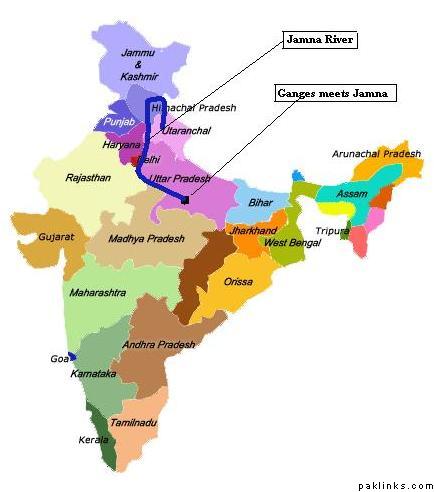
Firstly he too refers to India as modern day India and not the area of the banks of the river Sindhu in the present political map of Pakistan. Secondly by what he says, the Dravidians are the descendents of the Indus Valley civilization that flourished between Pakistan & India. And lastly, he clearly says that the Indo-European language speakers from eastern Europe settled between Indus and Jamna rivers. I hope you know Jamna is in eastern India (in case you say its a river that flows just west of the present political Pakistani border).
Firstly, the Dravidians that you are referring to time & again are not Dravidians of South India who descended from the Indus Valley civ. They are the aborigine populace of India that arrived here far earlier than the Armenoid branch. The Armenoid branch formed the Dravidians of Indus valley and who themselves arrived from Eastern Europe according to the British gent. Those aborigines are older than that.
Secondly, you admit to the theory of swamping of genes. So the present prevalence of aborigine (proto-Australoid and NOT Dravidian as you claim) could have swamped out many of the Aryan-esque genes over time.
Thirdly, its clear that you've never been to India and all that you say (like Parsis are maternally Dravidian) is based solely on those charts and tables that you googled. I invite you to India. Its the most diverse populace in the world. Come to Delhi, Himachal, Garhwal, Agra to Madurai, Thiruvanantapura, and Myrore and see for yourself. Drop in at Mumbai also to see how Parsis look like in general.
Re: An educational thread on the differences between Pakistanis and neighbouring populi
Correct. Remember they didnt have genetic testing in those days, but they did have the power of observation. So the migrational theories arent worth so much, but the observations they made still stand. I used this as an example in order to ridicule your assertions that India was full of these light skinned, light eyed people, when in fact the majority of people in India are Dravidian.
All of these migrational movements are of course theories. These are derived from the observations they made, which are based on their own facts. That the majority of India was and is Dravidian with the majority in the North of India being of the Grazilindid type as well as Wedid, both Dravidian races.
In 1931, India included much of Pakistan which was under the rule of Sikhs.
The quote you seem to have picked on here is this
“about 1,500 B.C. came the Indo-Aryan migration into the Punjab, which first occupied the area between the Indus and the Jamna and later sent colonies into Hindustan.”
First, it would be wise to point out that the British at this time did not have the use of genetic tools to confirm anything. However, you are deliberately (and very cleverly) trying to mislead here.
There are two Jamna Rivers. One is indeed in East India (called Jamuna) , the other one though extends through the Punjab and into Delhi only (Jamna/Yamuna). You can find details about the Jamna/Yamun river here and its course through NorthWest India. http://yap.nic.in/yamuna.asp
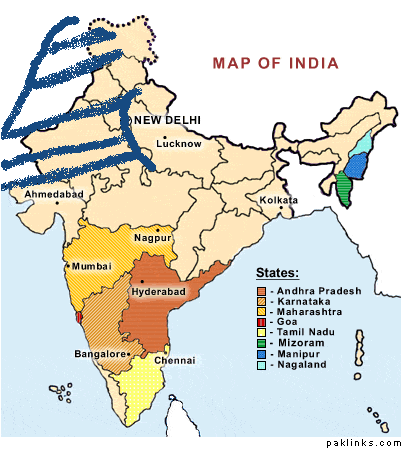
To illustrate my point, I drew this approximation of the area between the Indus and the Jamna Rivers
You can see I think, that this area is only NW India I hope, not NorthEast India, not North Central India, not Central India, notSouth India, only the North West part. However it should be mentioned, that we know through genetics that the central asian markers (probably Aryan) extends far beyond the Indus, in fact throught to Afghanistan where it is in large quantities. The centre of these genes is Pakistan and the areas surrounding the Indus. The NorthWest of India has some similarities with the bulk of Pakistan as you’d expect, but are more Dravidianized as well.
So, no, you’ve tried to mislead by saying that the survey said that the settlers had moved to all over north India when in fact they settled only in Pakistan and the extreme NorthWest regions of modern India’s borders.
I totally agree. The Indus Valley groups are unknown, but it’s thought they were Aryan people mixed with some Dravidians like Pakistan is now.
Oh God, do I need to correct this. Dravidians did not arrive from Eastern Europe! Dravidians are a mixture of the Aboriginal people of India and the earliest settlers into India who perhaps came to the subcontinent along the coastal regions. This is all speculation though, but what is not, is that these people mixed in to produce the Dravidian phenotype.
The proto-Australoids of India might have been swamped out, dont think it’s known. But this swamping has produced the Dravidian phenotype from the mixing most likely.
I have never been to India, but anthropological surveys can’t all be wrong.
Re: An educational thread on the differences between Pakistanis and neighbouring popu
roadrunner, it is indeed astonishing that you have the motivation to prove an Indian’s knowledge of the rivers of his own country wrong. Either you think you can obfuscate my knowledge about the river Yamuna by pasting a map that anyway concludes my view, or you think you can get away by a sleight of words (Yamuna and Jamna). Anyway, you are blatantly lying, and if you aren’t, then you must be severely deluded. Oh, all this definitely proves that you do not know how to read a map. You could have just googled Yamuna.
Yamuna, Jamna, Jamuna are all one and the same. Yes, it is the one which flows from Haryana, New Delhi and goes and merges into the Ganges in Allahabad in UP, which for your info is Eastern India.
Besides, the British were notorious for corrupting local names; so Ganga became Ganges, and Yamuna or Jamuna became Jamna.
Indian r1A1-M-17 populations are of the order of 15.8% and in Pakistan 24.4%. This strain is mostly found in East Europeans.
However, the research paper that I refer to concludes that the Central-Asia/European invaders had only a cultural and linguistic impact on South Asian people but did not have any significant addition to the gene-pool. Infact another astonishing claim that it makes is this :
We found that the influence of Central Asia on the pre-existing gene pool was minor. Therefore, our data do not support models that invoke a pronounced recent genetic input from Central Asia to explain the observed genetic variation in South Asia. R1a1 and R2 haplogroups indicate demographic complexity that is inconsistent with a recent single history. Associated microsatellite analyses of the high-frequency R1a1 haplogroup chromosomes indicate independent recent histories of the Indus Valley and the peninsular Indian region. Our data are also more consistent with a peninsular origin of Dravidian speakers than a source with proximity to the Indus and with significant genetic input resulting from demic diffusion associated with agriculture. Further, the relative position of the Indian tribals (fig. 6), the high microsatellite variance among them (table 12), the estimated age (14 KYA) of microsatellite variation within R1a1 (table 11), and the variance peak in western Eurasia (fig. 4) are entirely inconsistent with a model of recent gene flow from castes to tribes and a large genetic impact of the Indo-Europeans on the autochthonous gene pool of India. Instead, our overall inference is that an early Holocene expansion in northwestern India (including the Indus Valley) contributed R1a1-M17 chromosomes both to the Central Asian and South Asian tribes prior to the arrival of the Indo-Europeans.
http://www.journals.uchicago.edu/AJHG/journal/issues/v78n2/42812/42812.html
So these geneticists have proven scientifically that India has 15.8% R1a1 and Pakistan 24.4%. Besides, when they mention India, or North-West India, they mean present-day India unlike the British who wrote that paper in 1932.
The R1a1-2 strains have originated from north-western India and Pakistan and spread out to Central Asia before their tribes came invading. Thus, the contribution of the Aryans was culture, language and religion only, of which India has inherited, and Pakistan, none.
Re: An educational thread on the differences between Pakistanis and neighbouring populi
Roadie - don't understand your statement about rich parsi looking different from not-rich parsi. how is that possible? unless you're saying the rich went and got plastic surgery.
Also can you check the chronology of the studies you are using? it appears mixed up but you've written so much that it is very confusing. What is your hypothesis?
Re: An educational thread on the differences between Pakistanis and neighbouring popu
What I have quoted above is fact. The Jamna River does not go into East India. The farthest point is goes is Central India (near Lucknow). (click on the map and expand to see the course of the Jamna River - anyone who thinks that the furthest extent of it is Eastern India, explain how?)
The course of the Jamna River is charted here
"This revered river originates from the Champasar Glacier at an altitude of 4421 m in the state of *Uttaranchal](http://www.haryana-online.com/uttranchal.htm). Some say the source of the river is the Saptarishi Kund, a glacial lake. There is a sacred shrine of Yamunotri or Yamnotri, near this source at an altitude of 3235 m. There is a temple dedicated to the Goddess Yamuna, which remains closed from November to May. At Hanumanchatti, the Hanuman Ganga merges with Yamuna river. Yamunotri finds a special mention in the Hindu mythology. According to a legend, this secluded hilly spot was the home of an ancient sage, Asit Muni.
To summarize, the Jamna River goes nowhere near Eastern India, and the farthest point goes as far as Central India. However this is the most extreme interpretation of the extent of the Vedic Civilization. Much more likely, when the Rig Veda describes the Eastern boundary of the Civilization, it is talking about the straight line boundary of the River at the Haryana/Uttar Pradesh boundary. This is simply the most likely extent of the Vedic Civilization, and of course it would have been concentrated in the Indus area.
Re: An educational thread on the differences between Pakistanis and neighbouring popu
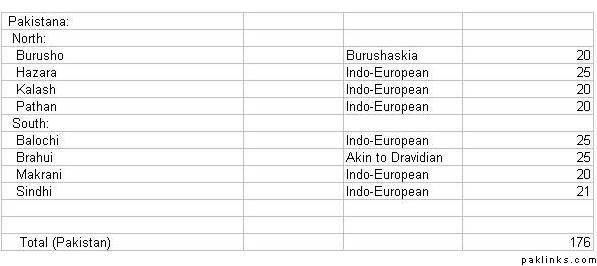
The figures you quote are what the journal quotes, BUT you have made an incorrect comparison. Let me show you why. These are the populations from Pakistan that were sampled and in the quantities shown.
20 of the 176 (12%) Pakistanis sampled were Kalasha!
20 of the 176 (12%) Pakistanis sampled were Makrani!
20 of the 176 (12%) Pakistanis sampled were Burusho!
25 of the 176 (15%) Pakistanis sampled were Hazara!
Already 50% of the samples taken by your paper are from the very small minorities in Pakistan. This lot mentioned actually constitute around 6% of the entire Pakistani population, and are known to lack R1a1 - they are not a good sample of the current Pakistani population, and to take 50% of the sample from these groups is not a good representation of the Pakistani population. Even worse is that they have placed another 25% of the samples from Balochis and Brahuis who constitute around 6% of the Pakistani population. This means that 75% of what they sampled was from the ethnic groups constituting around 10% of the Pakistani population! What you need to do, to compare India and Pakistan for R1a1, is to compare the frequencies of haplogroups in proportion to the population.** This is a misrepresentation by you**. I will try to scale their estimates soon, but your figures are artificial. If you like here is a better representation of the Pakistani haplogroups. We know the major populations in Pakistan are 1) Punjabis (40%) 2) Sindhis (25%) and 3) Pathans (20%). We don’t have Punjabis, we do have Sindhis and Pathans though for Pakistan. These two groups are proven to have very high amounts of R1a1. Even your results show it. 50% of Pathans have R1a1, 50% of Sindhis have R1a1. That means that about half of Pakistan’s population we know for a fact has R1a1.
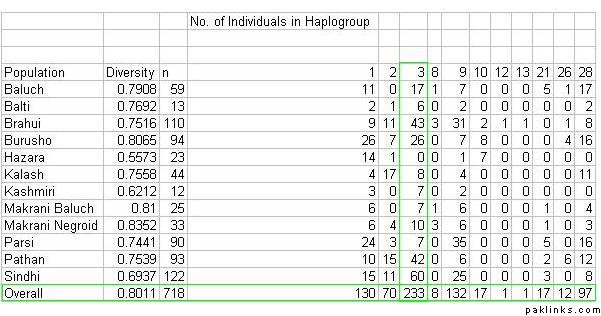
Here is another source that is good..American Journal of Hum Genetics (2002 May; 70(5): 1107–1124 ).
Here is a table you can find from the above journal.
Click it, expand it. Pay careful attention to the green boxes I made. The vertical one is the numbers of people from the sample with Haplogroup 3 identity. Look at the horizontal green box. The overall numbers of Haplogroup 3 is shown for the entire Pakistani sample, and the total number of people that were sampled is shown. Simple percentages show the following.
233 * 100 = 34%
718
Now, scale it up. Pathan, 42/93 = 45%, Sindhi, 60/122 = 49%. So at least 25% (out of 50%) of the Pakistani population we know for a fact is R1a1. This is ignoring 80 million Pakistanis (most of whom are Punjabis, that also contain R1a1 in large quantities).
You quote that the Pakistani figure for R1a1 or haplogroup 3 is 24%. I have proved with an academic reference that this is false information. In reality, this figure is probably 50%, when the populations are sized up. Your Indian figure of 15% is also wrong, and at the very least it is a skewed up guess. The reasons why this is inaccurate and an overestimate and the other points I’ll go into later. But you might be able to see why you cannot compare R1a1 frequencies in the way you did without adjusting for the sizes of each ethnic group.
The main point of all this - the 24% Pakistan figure and 15% Indian figure you quote your article says for the Pakistani and Indian populations, is an incorrect conclusion and comparsion by you. These two figures represent the proportion of R1a1 IN THE SAMPLES THAT STUDY USED. The actual population proportions can and will (as I’ve shown for the Pakistani sample) vary greatly from these two figures for the reasons mentioned.
Re: An educational thread on the differences between Pakistanis and neighbouring populi
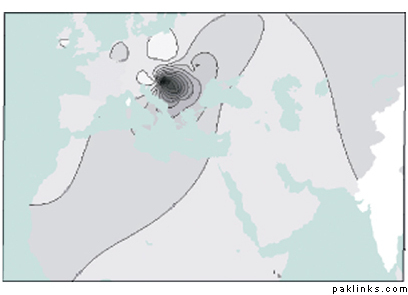
But this is an interesting map. If this is all true, it seems Alexander only settled his people in Pakistan, not Arabia or Iran. Though it could equally have come downwards during the Aryan migration perhaps, but then it would be seen all over Pakistan. Then again, they probably havent done the full investigation of the groups for this.
Re: An educational thread on the differences between Pakistanis and neighbouring populi
Why the hell are some people so damn obsessed with being "aryan"? What the hell is so damn important about ''aryans''? I'm a Pakhtun and us Pakhtuns never say we are aryans etc etc, we say proudly we are Pakhtuns and thats that. Who gives a damn about some people who lived 1500 years ago. its 2007. wake up and smell the green tea.
Re: An educational thread on the differences between Pakistanis and neighbouring popu
Afghanistan is basically mixed up. It's mainly Pashtuns, Hazaras and Tajiks. Pashtuns would be similar to the Paki Pashtuns I would think, Hazaras at least in Pakistan have a Mongolian ancestry, definitely not Aryan derived.
Re: An educational thread on the differences between Pakistanis and neighbouring populi
Whatever, dont post here if you dont care about it. Simple. And the internet Pakhtuns love going on about how Aryan they are, how their country was called Ariana etc, I'd rate Afghani internet Pakhtuns third behind Iranians and Indians on Aryan wannabee status. Only the Pashtuns on Afghanistan have been proven to be of central Asian stock, the Hazaras no way, the Tajiks, the jury is out still, but they dont look it.