Zardari allowed US to boost drone strikes

Not much of a surprise here, but it seems like everyone is playing double game.

RAWALPINDI: Observing that the CIA does not trust the ISI because it has repeatedly demonstrated its untrustworthiness, The Wall Street Journal in an opinion piece said on Friday that Pakistan needs to be a given an ultimatum of the kind it was given immediately after 9/11.

“In the wake of 9/11, the Bush administration famously sent Secretary of State Colin Powell to Islamabad to explain that the US was going to act forcefully to protect itself, and that Pakistan had to choose whose side it was on. It’s time to present Pakistan with the same choice again,” the newspaper said in an opinion piece entitled ‘The Pakistan Ultimatum.’ Importantly, the piece comes within days of a high-profile meeting between the spy chiefs of the United States and Pakistan.

“The government of President Asif Ali Zardari allowed the US to increase the number of drone strikes. Yet it has made a point of complaining about them publicly, playing a particularly cheap form of politics to shore up its waning popularity with a domestic constituency smart enough to see through the hypocrisy,” the paper said.

Noting that relations between Washington and Islamabad have historically never been easy, and seem to have reached something of a watershed now, the Journal said Pakistan’s behaviour has not exactly been exemplary.

“Pakistan’s spy agency, the Inter-Services Intelligence Directorate, has longstanding links to terrorist groups such as Lashkar-e-Taiba and the Haqqani network…The government and military have made no move against the Quetta Shura, the operational nerve centre in Pakistan of Taliban leader Mulla Omar,” the daily said, adding that Islamabad’s US cooperation has also been double-edged.

“The Pakistani army was also happy to cooperate with the US when the targets of the strikes were members of the Pakistani Taliban who had their sights set on Islamabad. But the army has been less cooperative when the targets were the Afghan Taliban based in Pakistan or the ISI’s terrorist partners,” the Journal reported.

“So Pakistan now demands that the United States withdraw hundreds of American intelligence operatives and special-ops trainers from its soil and stop the CIA drone strikes on al-Qaeda, Taliban and affiliated terrorists. Maybe the Obama administration can inform its friends in Islamabad that, when it comes to this particular fight, the US will continue to pursue its enemies wherever they may be, with or without Pakistan’s cooperation,” the daily said.

Re: Zardari allowed US to boost drone strikes

Yes Musharraf as much as I hated him during his tenure 10 or so drone attacks were carried out now 100s are carried out during the present democratic regime

Re: Zardari allowed US to boost drone strikes

This is in fact one of the reasons why USA installed Zardari and PPP in Pakistan. PPP Government has also given scrutiny free visas to hundreds of CIA contractors like Raymond Davis.

Re: Zardari allowed US to boost drone strikes

Challenge of drone attacks

http://www.dawn.com/2011/04/18/challenge-of-drone-attacks.html

THE drones are back. After nearly a month-long break, the attack in Angoor Adda, South Waziristan on April 13 has dashed the hope that Washington was seriously considering racking back its lethal weapons.

However, more than Washington’s persistence, it is Pakistan’s policy of ‘contrived ambiguity’ on drone operations inside its territory that must be blamed for a situation that has left the civilian and military leadership angry and tense.

While it has bleated out protests off and on, the government has tolerated hundreds of attacks with equanimity. There has been much talk of stopping the drones, but no evidence to indicate that the government, or the opposition, is the least bit interested in seriously reviewing this policy.

No attempt has been made to craft a national consensus on the persistent violation of Pakistan’s territorial sovereignty by the unmanned US war-planes. The army too has endorsed this policy by avoiding making the drones a central issue of strategic dialogue with the US administration.

Yet the inherent dangers of this policy of looking the other way while drones struck self-selected targets were always evident: the attacks ran the risk of missing the target and causing massive collateral damage, meaning innocent civilian lives.

The resultant grievance of the locals led some of them to join hands with the Taliban, while others in anger and desperation decided not to cooperate with the law-enforcement agencies, thus depriving them of the necessary support for conducting clean-up operations in these areas.

An even bigger peril that the drone attacks entailed related to Pakistan’s engagement with the US. It was only a matter of time before criticism of these attacks spilled over into the debate about the essence of US policy towards Pakistan, making the lofty talk of strategic ties serving the interests of Washington and Islamabad sound hollow and bogus.

Somehow the Yousuf Raza Gilani government evaded tackling these issues. The drones kept on raining hellfire missiles on the national soil. Even after hundreds of strikes and many more casualties, the pretence in Islamabad was that it did not poison the bilateral equation and that Pakistan and the US were friends whose long-term interests had a natural convergence.

This would have continued except for the sheer force of circumstances the Raymond Davis controversy left in its wake.

Davis’s act of wanton aggression against Pakistan’s citizens and his subsequent release brought to the fore the dark side of US operations in Pakistan. In a way, he personified Washington’s arrogance and Islamabad’s pitiable vulnerability to manipulation. Subsequent events only reinforced this point.
Less than a day after his departure, a drone attack killed nearly 50 Pakistani nationals in North Waziristan. Stung by this audacity and feeling badly let down, the Pakistan Army made one of its strongest protests. ISPR’s March 17 press release quoted army chief Gen Ashfaq Kayani as “strongly condemning the Predator strike”. He called the strike careless and callous and dubbed it “a complete violation of human rights”.

Gen Kayani assured “the brave people of Waziristan” that the army would do its “best and utmost to protect their life, honour and dignity at all costs”. He also gave a thinly veiled warning against future attacks when he said that such aggression against the people of Pakistan was “unjustified and intolerable under any circumstances”.

Foreign Secretary Salman Bashir joined the chorus of condemnation, summoned the US ambassador Cameron Munter and demanded an apology and explanation. Ironically, Mr Munter did not deem it greatly urgent to personally convey Pakistan’s anxiety to the State Department. He stayed put in Islamabad for almost a week before proceeding to Washington.

Realising how lightly the matter was being taken, Gen Kayani worked his special relationship with Adm Michael Mullen, chairman of the joint chiefs of staff, and attempted to get the message across to President Barack Obama.

These were all desperate measures because those seeking the cessation of drone attacks knew that this was not possible. But these were necessary measures as for the first time Pakistani policymakers came face to face with the crisis that the drone attacks had created which went beyond collateral damage.

Suddenly, in full public view Pakistan was shown to be an underling — rather than an equal partner in a strategic equation — who was being punished for daring to hold an American national for over a month. By condemning the post-Raymond Davis release drone attack and seeking to pre-empt another one, Pakistan’s policymakers were trying to show spine. More than that, they were trying to reconstruct the broken myth of being an ally of indispensable importance, one that could not be taken lightly.

But this faith in Washington’s receptivity to Pakistan’s deep sensitivities was shattered again last week when three drone attacks struck Angoor Adda. This attack was particularly perturbing because it came after the gap of almost a month and immediately at the end of DG ISI Gen Shuja Pasha’s talks with his CIA counterpart in which he apparently sought rational grounds for the drone attacks.
Just as the Datta Khel attack was timed with Raymond Davis’s departure, the one in Angoor Adda coincided with the arrival of Gen Pasha back in Pakistan.

So **on the drones the message from Washington is two-fold: one regardless of the costs, the strikes shall continue; two, Pakistan cannot alter even the timing of the strikes, much less their targets or frequency. **This is the hard lesson regarding the subject of engaging with the US. It refreshes the common proverb that Washington’s friendship can be worse than its enmity.

Even more important, it is a reminder that by ignoring drone attacks on its soil for years, Pakistan has lost its voice in Washington. Soverei-gnty conceded negligently cannot be regained easily.
The writer is a senior journalist at DawnNews.

Re: Zardari allowed US to boost drone strikes

Musharraf collected around $5000 per head turned in during the WOT as "terrorist" I am sure per-drone attack someone is collecting a lot more than than $5k.

Re: Zardari allowed US to boost drone strikes

This is PPP, where is Anwer Pasha Sahab now? Jiye Bhutto, jiye Zardari right?

Re: Zardari allowed US to boost drone strikes

Allah khair karay…

US should respect Pakistani resolutions against drones: Malik

Interior Minister Rehman Malik said that the US should respect the demand of Pakistani people and stop the drone attacks. He said malicious designs of enemies against Pakistan would be thwarted.

Talking to media outside the parliament, Malik said that the US should respect the resolutions passed in the Pakistani assemblies. He revealed that talks were being held with the US for transfer of drone technology.

He said that drone technology could only be useful if Pakistan used it against terrorists. Malik assured FATA MP Sajid Toori that Tul Parachanar road would be opened in 48 hours.

Re: Zardari allowed US to boost drone strikes

A good idea by SS, the public should come out by themselves to protest against drones, and then PMLN will support them (or try to hijack the issue)… :slight_smile:

http://www.dawn.com/2011/04/27/public-should-be-out-on-streets-against-drone-attacks-says-cm-punjab.html
**
Public should be out on streets against drone attacks, says CM Punjab**

LAHORE: **Punjab Chief Minister Shahbaz Sharif on Wednesday said the public should come out on the streets in protest against drone attacks by the United States, DawnNews reported.

Speaking at a gathering in Hasilpur, Sharif said the Pakistan Muslim League – Nawaz (PML-N) would fully support the public on the issue.**

He further said that Pakistan would have to rid itself of foreign aid in order to bring an end to drone attacks.

Re: Zardari allowed US to boost drone strikes

kewn? sirf public hee apni ghairat dikhayen? dam hay to khud apni party ki rally nikalo be-ghairto

Re: Zardari allowed US to boost drone strikes

.. Or they can supply those free lunches provided to lawyers in 2007 at a drone special price . :slight_smile:

Re: Zardari allowed US to boost drone strikes

Heading of your thread is completely a lie. "Zardari allowed" or government of "Zardari" are two different things. Your misguided heading and people who codemn PPP and Zardari without going into details of the report trumpetting utter nonsense and stupidity.

Mard ho to comment on above paraghs and condemn Kyani who is actually responsible for this.

Re: Zardari allowed US to boost drone strikes

What is the use of PPP if it can't control anything?

Re: Zardari allowed US to boost drone strikes

Was Kayani not COAS during Mushy era?

Re: Zardari allowed US to boost drone strikes

This is not my topic and I never supported Zardari in person. However I always admire Great leaders of Pakistan who sacrificed their lives for Pakistan.
No comments on this topic however I have copied something for you related to this issue.
Guantánamo Bay files: Anti-extremist author framed and whisked to Cuba

                                  Abdul Badr Mannan was handed over to Americans who later came to believe Pakistani intelligence had set him up

.

  •                                                                                  [James Ball](http://www.guardian.co.uk/profile/jamesball)
    
  •                  [guardian.co.uk](http://www.guardian.co.uk/),                                                                                                                     Monday 25 April 2011                                                                       <li class="history">[Article history](http://www.guardian.co.uk/world/2011/apr/25/guantanamo-files-framed-author-mannan#history-link-box)
    

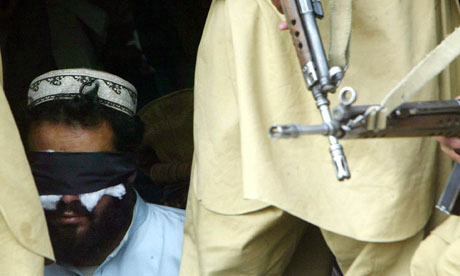
Pakistani soldiers guard a prisoner amid battles with al-Qaida and Taliban forces in this 2004 file picture. Over the years the country’s ISI spy agency handed a number of its prisoners over to US forces who rendered them to Guantánamo Bay. Photograph: David Guttenfelder/AP

               US forces sent an anti-extremist author to [Guantánamo Bay](http://www.guardian.co.uk/world/guantanamo-bay) after being misled by Pakistani authorities.

Abdul Badr Mannan and his brother were arrested in Pakistan and turned over to US forces. In the belief the two were affiliated with al-Qaida, his detention log states, they were transferred on to the Cuban base.
However, four months after assessing Mannan as a high-risk detainee, US forces came to a very different view, recommending his release. “The detainee was also thought to have some affiliation with the Jama’at Ul Dawa AlQurani (JDQ) group,” his file states. “However, it appears the detainee may have been writing a book (detainee and his brother are published authors) concerning Islamic extremism and had merely established contacts to further his research and writing.”
The file then states US suspicions about the reason for his initial arrest, blaming Pakistani intelligence for the error. "Detainee, in his writings, has also been extremely critical of the Pakistani intelligence service and their overt connections to extremism and al-Qaida.
“Detainee and his brother may have been arrested on that pretence and turned over to US authorities, who were misled as to the detainee’s affiliations.”
The report went on to stress that the Pakistani government had provided no evidence to back up its assertions that Mannan was a terrorist, and that the US government had no information about his affiliations.

  • And you can also think on this

                                           [http://online.wsj.com/article/SB10001424052748704729304576287041094035816.html?mod=WSJ_hpp_](http://online.wsj.com/article/SB10001424052748704729304576287041094035816.html?mod=WSJ_hpp_sections_world)
    

Re: Zardari allowed US to boost drone strikes

WikiLeaks shows America’s imperious attitude to Pakistan

The WikiLeaks US embassy cables reveal just how dangerously involved the Americans are in every aspect of Pakistan’s affairs

Pakistan was already under the American hammer before the WikiLeaks crisis blew. But leaked US diplomatic cables published by the Guardian show the extraordinary extent to which Pakistan is in danger of becoming a mere satrapy of imperial Washington.

The US assault on Pakistani sovereignty, which is how these developments are widely viewed in the country, is multipronged. At one end of the spectrum, in the sphere of “hard power”, US special forces are increasingly involved, in one way or another, in covert military operations inside Pakistan.

These troops are being used to help hunt down Taliban and al-Qaida fighters in the tribal areas and co-ordinate drone attacks, as revealed by the Guardian’s Pakistan correspondent, Declan Walsh. Their activities come in addition to previous air and ground cross-border raids; and to the quasi-permanent basing of American technicians and other personnel at the Pakistani air force base from which drone attacks are launched.

The US hand can be seen at work in Pakistan’s complex politics, with the standing and competence of President Asif Ali Zardari seemingly constantly under harsh review. At one point, the military chief, General Ashfaq Kayani, reportedly consults the US ambassador about the possibility of a coup, designed in part to stop the advance of the opposition leader, Nawaz Sharif.

At the same time, Pakistani diplomats are convinced the Americans are somehow trying to commandeer the country’s nuclear deterrent, which they see as its only real defence against India. And all this importunity is underpinned by “soft power”, by a reverse cash tribute from Washington to Islamabad, approaching $2bn a year. In a very real sense, the Americans buy their way in.

This sort of helpful meddling, or shameless intrigue, or outrageous interference – decide yourself what you want to call it – in the internal affairs of a sovereign country is supposed to have gone out of fashion with the retreat of the British empire and the end of the Raj.

But that was never true in reality, of course. All great powers intrude in pursuit of their own interests; it’s what they do – and picking up where the British left off, the US is no different. It is a measure of the Pakistani state’s weakness that the Americans apparently have such scope and leeway to influence and direct its affairs.

What is equally remarkable, however, is how little the Americans appear able, ultimately, to control their satraps. Zardari talks a good game but achieves little. Millions of US taxpayer dollars earmarked for fighting Islamist extremists allegedly disappears into government coffers, never to be seen again. Washington’s staunch Pakistani allies in the “war on terror” play both sides, maintaining their ties to friendly Taliban and the Lashkar-e-Taiba militant group while simultaneously accepting America’s largesse. Being an imperialist is never easy.

So the Americans don’t get what they want. But neither do ordinary Pakistanis. The larger point is that Pakistan is suffering grievously, in terms of lives lost to terrorism; in soldiers and civilians killed and wounded in the campaigns against Pakistani Taliban in the tribal areas; in a ravaged economy, acute poverty and lack of education; and in the all but forgotten but still terrible aftermath of this year’s floods.

Pakistan needs less foreign interference, not more. And that applies to Arab jihadi fanatics as much as it does to imperious Americans. But on current trends the opposite is happening. The clear danger, highlighted by the leaked cables, is that the west’s unwinnable war in Afghanistan is spilling over into its weak, ill-led and much put-upon neighbour – and that Pakistan, too, could become a war zone.

Re: Zardari allowed US to boost drone strikes

true they have nothing in control and quick to blame others for their failures.

Re: Zardari allowed US to boost drone strikes

guys its not Zardari who allowed this .. agree with sachaydino .. the title is quite misleading! ... (and plz im not a zardari fan)

Re: Zardari allowed US to boost drone strikes

The government cannot be completely absolved of whats happening in the country. The statements of Zardari and Gillani regarding drone attacks are on record.

WikiLeaks: Gilani open to drone strikes on ‘right people’
Published: December 1, 2010

More cables released by WikiLeaks reveal that Prime Minister Yousaf Raza Gilani allowed drone strikes in the tribal areas of Pakistan, saying they would protest the attacks in the National Assembly and then ignore them.

When Interior Minister Rehman Malik advised the US to hold off “alleged Predator attacks until after the Bajaur operation”, Gilani brushed off the remarks saying:
“I don’t care if they do it as long as they get the right people. We’ll protest in the National Assembly and then ignore it.”

The statements were reportedly made during meetings with unnamed US officials in August 2008. The cables also show bureaucrats supporting drones viewing them as a viable solution to loosening Taliban’s grip over the Tribal belt.

US forces inside Pakistan
In another shocking revelation, embassy cables reported that small teams of US special forces have been secretly embedded with Pakistani military forces in the tribal belt helping to coordinate drone attacks and to hunt down Taliban and al Qaeda fighters.

One memo quoted by the Times said that 12 US Special Operations soldiers had deployed with Pakistani troops near the Afghan border.

A report in the Guardian quoted the job of the special forces to be “to provide ‘intelligence, surveillance and reconnaissance’ support – ISR in military jargon – ‘general operational advice’ and to help set up a live satellite feed from American drones flying overhead, presumably CIA-operated Predator and Reaper aircraft. The memo said that the forces had been deployed since 2008 but were limited to a training role. It said that the permission for the active combat deployment “almost certainly” came with the personal consent of the army chief General Ashfaq Kayani.

US presence in the country has been a sensitive issue in Pakistan. Earlier, reports of US military presence in areas around Quetta had drawn condemnations from opposition parties and the public. The Pakistani government and the United States embassy however had denied reports about the presence of US forces in Quetta.

Re: Zardari allowed US to boost drone strikes

The article is a little old (two years old) but relevant…

Dangerous double game that mirrors Pakistan’s identity crisis
Jeremy Page: Commentary
The discovery of a secret CIA airbase in southern Pakistan exposes the dangerous double game that Asif Ali Zardari, Pakistan’s President, has to play as he tries to manage relations both with the United States and with a fiercely anti-American public.

While he is criticised in Washington for surrendering to the Taleban by allowing Sharia in the Swat Valley, he will be lambasted at home for allowing the Americans to use a Pakistani base to launch drone attacks on his own territory.

His dilemma mirrors the identity crisis Pakistan has suffered ever since it won independence from Britain in 1947 and especially since it backed the US-led War on Terror in 2001: is it to be an Islamist state, or a secular democracy?

There is no easy answer for the widower of Benazir Bhutto, the former Prime Minister who was assassinated in December 2007.

**Like his predecessor, Pervez Musharraf, Mr Zardari appears to have tacitly allowed the US to carry out the attacks, and use Pakistani bases to launch Predator drones, armed with Hellfire missiles.

Yet he faces a new US Administration that appears determined to strike al-Qaeda and Taleban militants in Pakistan’s tribal areas far harder than had been seen under Mr Musharraf.

As a democratically elected President, Mr Zardari is also under greater pressure to protest publicly about the attacks, especially when there are civilian casualties.

Failing to do so would be political suicide in a country where 97 per cent are Muslim, and many oppose the support for the US campaign. In doing so, however, he risks being embarrassed by revelations like the one about Shamsi, and fuelling anti-American sentiment.**

Lisa Curtis, a former CIA analyst who worked at the US Embassy in Pakistan in the 1990s, said: “He’s in a very difficult position. The US has said, ‘We’re going to do this because the intel is getting better and better. We’ve hit some high-value targets and collateral damage has been very little,’ ” she told The Times. “At the same time, he has to protest publicly because this is Pakistani territory and a lot of Pakistanis are very unhappy.”

The US increased drone attacks and even sent special forces into tribal areas last summer after apparently losing faith in the commitment of the Pakistani Army. President Obama has pledged to review US policy in the region, but made it clear that he would continue with the drone attacks.

US officials say drones have killed several high-value targets in the past year, including Usama al-Kini, the al-Qaeda operations chief in Pakistan, in an attack on January 1. An American dossier leaked last week revealed a list of other prominent victims, including Rashid Rauf, the British chief suspect in the plot in 2006 to blow up a transatlantic airliner.

Some Pakistani officials support the attacks but most see them as a violation of Pakistan’s sovereignty, and even in the US some experts question the efficacy of the tactics.

Re: Zardari allowed US to boost drone strikes

Then give credit to government too, that more the drone attacks, more chances of cleaning of sucidal bombers and terrorist and less the suicidal bombings. Isn't it?