Re: World Cup - Group F
Brazilians Take Carnival on Road
Colorful names and a glorious tradition are part of the defending champions’ mystique
By Grahame L. Jones, Times Staff Writer
June 4, 2006
HAMBURG, Germany — The names just roll off the tongue, each one more exotic than the other, each one conjuring visions of magicians in yellow and blue weaving spells across the bright green soccer fields of Germany.
In this, the summer of the 18th World Cup, Ronaldo, Adriano, Ronaldinho, Kaka, Ze Roberto, Emerson, Cafu, Juan, Lucio, Roberto Carlos and Dida hold center stage.
They are the starting 11 for defending world champion Brazil. They are the players whose dazzling skills are admired by fans as much as they are feared by opponents. They are the ones expected to be standing on the victory podium come July 9 in Berlin.
But it might not be that simple.
Only once in the nine times that the World Cup has been played in Europe has a non-European team triumphed — the Brazilians of 1958, inspired by a teenage prodigy named Pele.
And only twice in the quadrennial tournament’s 76-year history has a country successfully defended its title. Italy won in 1934 and 1938, and Brazil followed its 1958 victory in Sweden by winning in Chile in 1962.
So history, in a sense, is against Brazil.
But who can stop the Brazilians from winning for a sixth time?
While the other 31 teams go to great lengths to hide their lineups and tactics, Brazil does just the opposite. Such is the confidence surrounding the five-time champion that Coach Carlos Alberto Parreira selected his starting lineup six weeks before Brazil’s June 13 opener against Croatia.
It was almost as if Parreira were saying, “This is what we’ve got. What are you going to do about it?”
Truth be told, the Brazilian roster could be split in two and both sides would have a better-than-average chance of making it to the final.
Even Pele said so.
“Brazil has two teams,” the three-time World Cup winner said. “If they have to change a player, it makes no difference.”
And who can argue that point, especially with the likes of Robinho, Cicinho, Juninho Pernambucano, Luisao, Gilberto Silva and half a dozen other stars on the bench?
Parreira, who coached Brazil to its 1994 triumph in the U.S., is well aware that extraordinary talent alone is no guarantee of success.
“The team wins and the team loses,” Parreira told Reuters last month at Brazil’s training camp in Switzerland. "We have the best players in the world, they are all celebrities, but in the end they are integrated into a team.
"We know that having a team of celebrities is not enough to win the World Cup. You have to have humility and play for the team.
“We are trying to create a relaxed and tranquil atmosphere so that the players can play with happiness and freedom, creativity and improvisation.”
In other words, play like Brazil, with a smile like that of Ronaldinho, a two-time world player of the year.
“We play a happy game,” Parreira said.
Toward that end, the players are on very long leashes. When a Swiss photographer spotted Ronaldo, Roberto Carlos and Emerson in a bar late one night last week, Parreira did not blink an eye.
“A day off is a day off,” he said. “They can do what they want as long as they’re back in the hotel at the stipulated time. I have never worried about this before and I am not going to worry about it now, as long as it is within limits.”
Brazil and its entourage have always had a carnival atmosphere surrounding them at international tournaments and this time is no different. Think Mardi Gras with a Portuguese accent. Scantily clad female fans and a drumbeat of music are part and parcel of the experience.
Wine, women, samba and soccer. It’s a heady mix.
And so it will be a colorful and noisy Brazilian contingent that travels to Olympic Stadium in Berlin on June 13 to play Croatia and begin defense of the title it won with a 2-0 victory over Germany at Yokohama, Japan, four years ago.
“Psychologists say it is very important in the dressing room and coming from the hotel to the stadium to do something with your hands, with your mouth,” Parreira recently told Agence France-Presse.
"If you just sit there worrying, clutching your hands, that does not help. If you play something, it helps relax. This is why we give them drums and things.
“Since 1970, we have done this. We buy instruments for them, and they play on the bus — instead of saying, ‘Oh, my God, we are going to play Germany or England in a World Cup game.’ That does not help.”
After Croatia comes Australia on June 18 and Japan on June 22. On paper, the first-round group looks relatively easy, but Brazil did not defeat any of those three teams the last time it played them.
Then there is the fact that goalkeeper Dida has had a shaky season for AC Milan, that outside backs Cafu and Roberto Carlos will be 36 and 33, respectively, by the opener and, therefore, perhaps susceptible to speed, and that Brazil has played no strong opponent since qualifying ended.
Even if it gets through, which is almost certain, the second round is a minefield. Brazil would play either Italy, the Czech Republic or, at an outside shot, the United States.
“I’d be the happiest man alive,” U.S. Coach Bruce Arena said Saturday of the possibility of playing Brazil.
From there on, the road to Berlin only gets more difficult.
That Brazil has the talent to win it all is not in question. Parreira will employ a 4-4-2 system that in reality is a 4-2-4, with what the Brazilian media have dubbed the “magic quartet” of Ronaldo, Adriano, Kaka and Ronaldinho in attack.
Parreira dislikes any mention of magic.
“The word magic is not part of our vocabulary,” he told reporters in Brazil. “We’re not involved in this sort of talk. I want to hear words like efficiency, productivity, winning well, sweat, perspiration and talent.”
Brazilian fans don’t want to hear any of that.
They want their wizards weaving magic runs, improvising moves, trying the outrageous, playing soccer the way the Globetrotters play basketball.
They want Ronaldo — the goat of 1998 when Brazil lost in the final to France and the hero of 2002 when he scored both goals against Germany in the final — to break German Gerd Muller’s record of 14 World Cup goals. Ronaldo has 12.
And they want to win.
Brazil is pretending not to be the favorite, the superstition being that it has failed in previous tournaments when it was labeled the odds-on winner.
“I think Germany and Italy are just as much favorites,” Parreira told the Folha de Sao Paulo newspaper. “In fact, I think Germany are bigger favorites. They have played in seven finals, including three in a row, and they have the fans on their side.”
But Brazil is the reigning world champion and holder of both the Copa America and the Confederations Cup titles. The airplane that carried the team from Brasilia to Switzerland was decorated with five stars, for Brazil’s world titles in 1958, 1962, 1970, 1994 and 2002.
The plane carrying it back might well have six stars.
“There is not a lot to teach these players when they’ve got the ball,” Parreira said. "They are all capable of deciding a match in an instant and they are all players who, when they are in a difficult situation in a match, know how to react and get out of it.
“What we need to do is to organize the team without the ball, so they know what to do when the opposition is in possession.”
That opposition includes history. The brilliant Brazilians of 1970, perhaps the greatest team of all time, succumbed in 1974, coming in as defending champions but finishing only fourth when the World Cup last was played in Germany.
Will history repeat?
Tostao, one of Pele’s 1970 teammates, told England’s FourFourTwo magazine that he believes it is possible.
“I’d say the chance of Brazil not winning is greater than the chance of Brazil winning,” he said.
But that leaves another question. If not Brazil, then who?
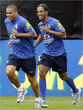
DYNAMIC DUO: Ronaldo, left, and Ronaldinho are stars on a powerful Brazilian team that is seeking a sixth World Cup title.