Seems likely he will go. Not sure when, but may not be around too long which could change the whole dynamics of geo-politics in the Middle East.
                                                                                                                                                                                                                                                                           **The old bear of the Assad regime is falling**

                                  Syria's people no longer fear the state violence machine. The only legitimacy they will accept now is from the ballot box
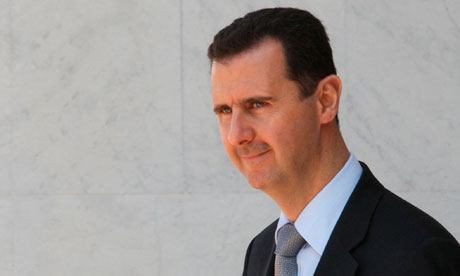
- Syria’s president Bashar al-Assad is coming under increasing pressure to resign. Photograph: Khaled Al-Hariri/Reuters
These days wherever you go on the streets of old Damascus you can hear whispers anticipating the fall of the Assad regime. No one knows how. No one asks how.
This was, for decades, the capital of Syria’s silent republic. When you visit former ministers and businessmen close to the regime, you feel as if you are in a fantasy scene on a famous Syrian TV drama. The theatrics have succeeded in convincing the Arab world that terrorist extremists have infiltrated anti-government protesters, but they have failed to persuade the children of Deraa of that.
The stooges tell you they are against the security forces’ harsh tactics, and criticise the repression of the protesters. Yet at the same time they are convinced that the Syrian regime is based upon a nonnegotiable and fundamental philosophy: that of the iron fist. Political reform would require that the Assad regime unclench that fist, thus weakening itself and accelerating its collapse.
Some of these regime figures have known first-hand how the west thinks. Some have served long years as ambassadors for Hafez al-Assad and his son, Bashar. They will tell you clearly: we know that the west is not merely toying with the regime, its pressure is not without weight, and President Assad is mistaken if he thinks he will survive on this path. Some express regret at the years of effort spent building Syria’s international relations, which have now been laid to waste.
Syria’s people face that most violent and bloodthirsty of Middle Eastern regimes, yet take to the streets every Friday with bare hands and chests, affording tanks and snipers a simple chance to shoot to kill. The people defy all the complex and carefully organised regulations put in place by the Assad regime to prevent demonstrators from reaching squares, and to forestall the emergence of an equivalent to Cairo’s Tahrir Square.
The Syrian people think the time for change has come, and they cannot go back. They do not fear the state violence machine. They will not accept reforms promised by a regime in broad daylight, then disregarded come nightfall. All credibility and legitimacy has been lost.
At last, the only legitimacy acceptable to the people of Syria is that to emerge via the ballot box. When you ask Syrians about the west’s stance, they tell you there is no doubt: the civilised world will not leave them isolated; international legitimacy is the strongest path now; and the interests of the west lie in a democratic, peaceful Syria that endeavours for scientific, economic, and societal development.
In other words, the complete opposite of the current situation, which is based on meddling in the world affairs and extorting governments.
We cannot analyse the situation in Syria without observing the full picture, and without being careful not to gloss over details. A complete portrait embraces Syria’s internal situation, the options for neighbouring and regional states, and the western stance. In its various shades and tones, this scene portrays the fate of the Assad regime as an aging bear, born in March 1963, now falling from the uppermost branches of the tree.
The world tries to slow the fall, so as to soften the blow and avoid an explosion in the region. Not only is there Turkey and the Kurdish question; Lebanon and the contradictions of Sunni, Shia, Christian and Druze; Iraq, Jordan and their tribal, ethnic and religious overlaps with Syria; but also Israel, which no longer trusts a regime that subjects its people to all forms of violence and lawlessness.