
Welcome to your virtual forensic science training laboratory where you will get to learn the theory behind and practise various forensic science procedures including fingerprinting, bloodstain analysis, solve-it mysteries and much more!
Welcome to your virtual forensic science training laboratory where you will get to learn the theory behind and practise various forensic science procedures including fingerprinting, bloodstain analysis, solve-it mysteries and much more!
Re: Who Dunnit?!
~~Fingerprints~~
Your fingerprints are fully formed by the time you are 24 weeks old. Even though there are 6.5 billion people in the world, no two people share the same fingerprints. Not even identical twins have the same prints. In fact, the fingerprint on each finger is unique.
Leaving a print
The skin on the palms of your hands, and the soles of your feet, is covered in ridges called elevations and furrows called depressions. These ridges form patterns that are known as ridge characteristics. Sweat from the sweat glands on the palms runs along the ridges of the skin so that if a surface is touched, the sweat will be transferred leaving an impression of the ridge detail.
Visualising & lifting a print
When investigating a crime scene, forensic scientists can visualise fingerprints by using specific chemicals and powders. The fingerprints can then be recorded as evidence by taking photographs or lifting them using specially designed sellotape.
Comparing fingerprints
A fingerprint, whether it is full or partial, that is found at a crime scene is known as a mark. In the lab, the forensic scientist compares the the mark to full sets of suspects’ fingerprints taken by the police known as prints.
Fingerprint patterns
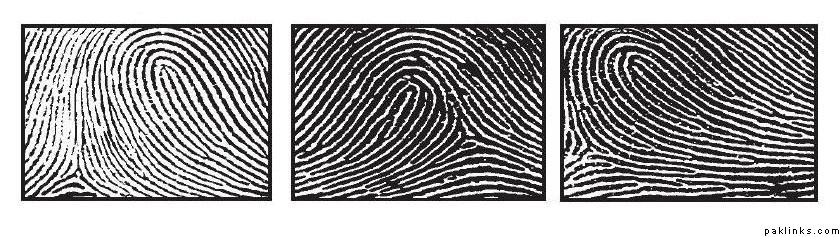
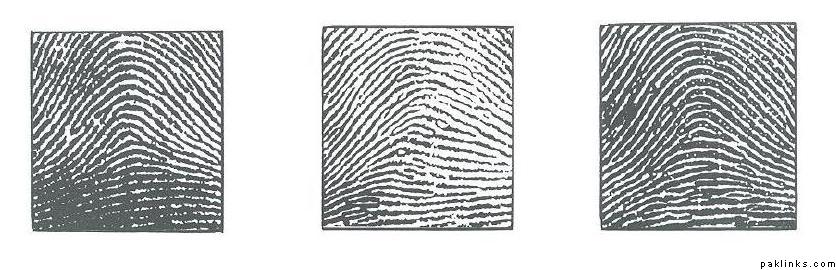
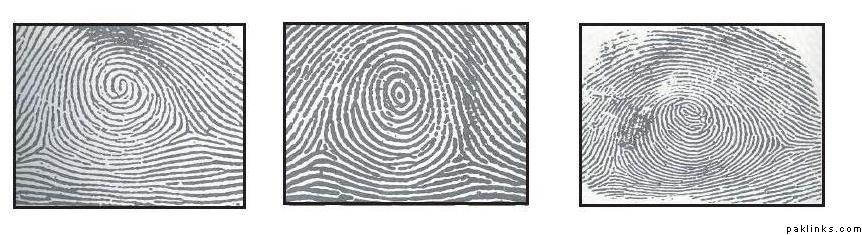
Although no two fingerprints are identical they can be grouped into 3 main families: Loops, Arches and Whorls.
A** loop pattern** is characterised by a ridge that enters from one side, rises and curves and then exits on the
same side it entered from.
An **arch pattern **is characterised by a ridge that enters from one side, rises and curves and then exits on the opposite side it entered from.
A whorl pattern is characterised by ridges that are usually circular.
This is only the tip of the iceberg. Before we continue onto the individual ridge characteristics and suspect print matching, let’s practise fingerprint patterns first. Can you examine your own fingerprints and tell us what pattern your fingerprints are? Loops, acrches, whorls, mixed, others?
PS: The whorl pattern is the best… only because all of my fingers have a whorly pattern! 
Re: Who Dunnit?!
According to my expert opinion Barbie did it 
Re: Who Dunnit?!
Lets throw aanday at Barbie
Re: Who Dunnit?!
 mein ki kitta!
Does anyone care about the theory part? Do you only want the exercises and not the explaination? Good if thats the case, it would only save me all that writing!  Now look at your fingers and tell me what fingerprint pattern you have!
Re: Who Dunnit?!
ok ghussa na karoo…mine are whorl and loop 
Re: Who Dunnit?!
My prints are a mix of whorl and loop patterns
Re: Who Dunnit?!
BarbieCue, there is an old Anil Kapoor movie in which it is said that whorls are lucky, and if somebody has all ten whorls then they are all kinds of awesome. Would you agree with this? Also, is there some kind of scientific formula which will help me to work out how much luck one whorl equals, so that I can then work out how much luck I have overall. If I know how much is available, I won’t use it up in one go.
Seriously, this has been interesting reading. Thank you.
Re: Who Dunnit?!
el topo, sorry about the late reply, it completely slipped my mind.
Ofcourse I would  Awesomeness prevails in those who have 10 whorls!!!

I was joking above. I studied pharmaceutical & forensic science NOT astrology so I haz no idea what you’re on about. 
Personally, I don’t believe in this sorta stuff. I don’t believe my luck/destiny has anything to do with my fingerprints. Also, I have 10 whorls and I am nowhere near awesome so down the drain goes that theory. =D
 one person. ONE PERSON appreciates what took me 20 minutes to write! =(
I will update this thread soon.
Re: Who Dunnit?!
Ha, I wasn’t serious - about the luck, not about the thanks.
A desi girl doing Forensic Science? Dude, that is awesome.
Re: Who Dunnit?!
K, up next is a straight forward exercise. Still working on the overall fingerprint pattern (loop, arch, whorl), can you match the following “mark” collected from the crime scene
to any of the suspects’ prints below?
Suspect A
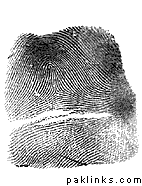
Suspect B
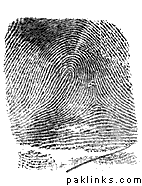
Suspect C
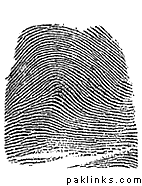
Suspect D
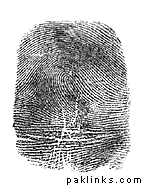
Suspect E
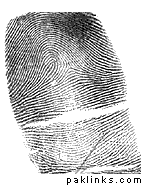
Suspect F
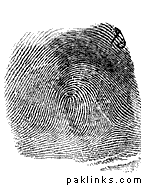
Re: Who Dunnit?!
Me says suspect F
Re: Who Dunnit?!
I need my CSI computer for this
Re: Who Dunnit?!
Suspect B? 
Re: Who Dunnit?!
Look closer guys :rotato:
Re: Who Dunnit?!
ist E for sure
Re: Who Dunnit?!
I think its E
Re: Who Dunnit?!
I should change my mind but i’m going to be stubborn as an ass and stick with F for FAIL! 
Re: Who Dunnit?!
I was thinking k answer bataun ya na bataun, I’m super duper lazy right now and then I realised OMG… OMGGG… I haven’t had tea/coffee all day today o_O BRB!!!
runs to get a dose of caffeine
Re: Who Dunnit?!
Okie dokie, all high on caffeine now 
Here’s what you’ve learned so far:
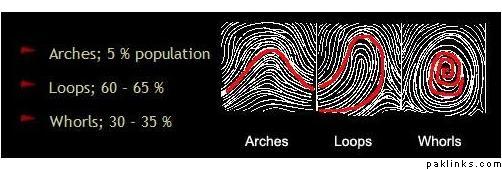
Three basic patterns; arches, loops and whorls.
Your first exercise was to match fingerprints based on the overall pattern. The correct answer was Suspect E, so well done to those who got it right.
Now… If you were to go into a court as a forensic expert and say Suspect E dunnit, you would get kicked out right away.
The reason being, fingerprint matching on the basis of the overall pattern just isn’t good enough. Suspect E has a loop pattern. So what? Bazillions others have loops too! And what about human error? You yourself saw how we had different answers coming from different people in this thread. In the same way, scientist A could point his/her finger to one suspect and scientist B could point to another! So who do you believe? There is NO ROOM for error in forensic science. All the analytical techniques have to be precise and not vague.
Another reason why this isn’t good enough is because you will NEVER EVER obtain perfect “marks” from a crime scene. You will almost always have partial fingerprints.
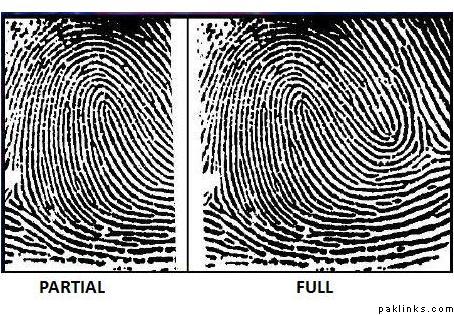
In the above example, you can see that it isn’t possible to match the two prints based on the overall pattern because we can’t even the see the full fingerprint. So what do we do??? Well, we look at ridge characteristics.
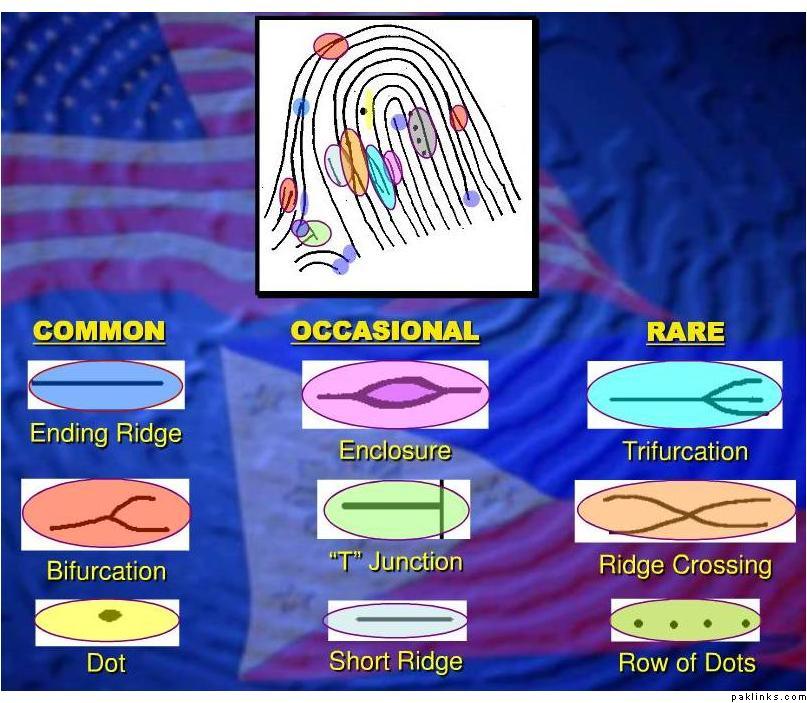
A fingerprint can have over 150 ridge characteristics which will be unique to that fingerprint ONLY! See below:
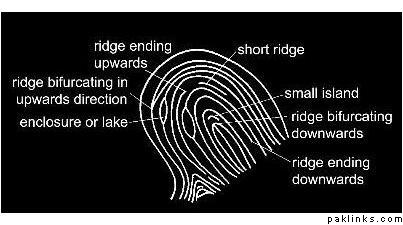
Some common ridge characteristics:
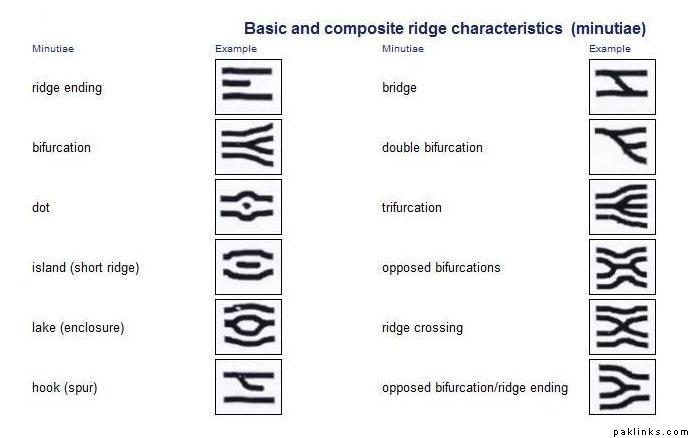
Same as above but more clearly drawn:
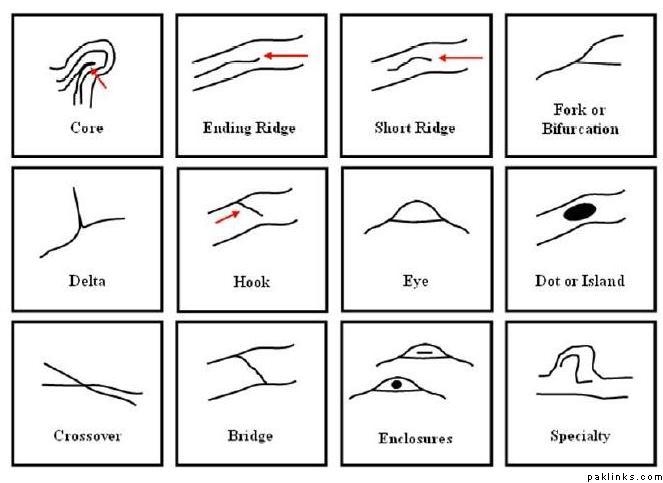
See where I’m coming from?
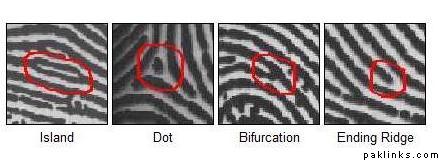
Next exercise:
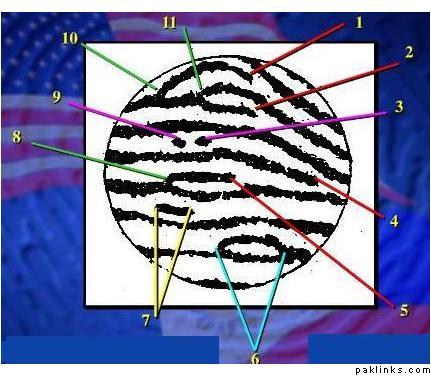
Can you name the ridge characteristics labelled 1 - 11 in the following fingerprint?
Once you have this done, we will then move onto the next lesson/exercise.