HAIL—Sheema Kirmani. Well done! Bravo!!
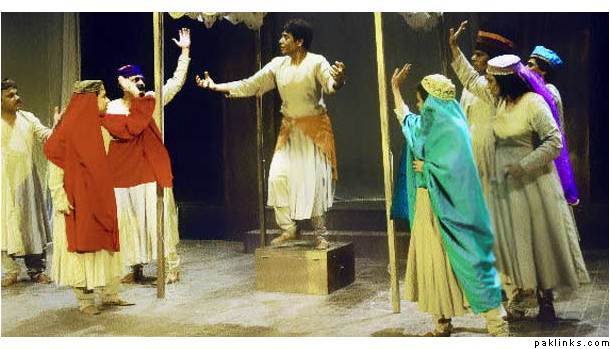
KARACHI: The last instalment of Tehrik-e-Niswan’s Tlism theatre festival kicks off on Friday. Audience members who enjoyed the high-intensity realism of plays such as Birjees Qadar Ka Kunba and Jinnay Lahore Nahin Vekhya will be surprised to see that the troupe has a much lighter, more fantastical side.
In Eik Hazar Aur Eik Thi Rataen (1001 Nights) – a unique dance-drama which runs at the Karachi Arts Council through Sunday – the actors sing, dance, smile, sway, and even ham it up.
One of the reasons this musical offering is so enjoyable is that the cast seems to be having a lot of fun. Their energy is admirable as they take on multiple roles, execute quick, on-stage costume changes, improvise props, and alternate between comedy and pathos.
Admittedly, their pleasure in the performance may also stem from a fond nostalgia. In many cases, the actors who today comprise the Tehrik-e-Niswan troupe embarked on their theatrical careers with the first performance of Eik Hazar… in 1998.
Audience members may also find themselves feeling nostalgic for their childhood as the play weaves together some of the most popular tales from 1001 Nights. Still, it is not the subject matter, but the way in which it is conveyed, that makes Eik Hazar… a success.
Much like other Tehrik-e-Niswan performances, the play touches on women’s issues such as domestic violence, honour killings, the dictates of patriarchy, and the pitfalls of being an unaccompanied virgin. Here, however, the themes are cloaked in the devices of a variety of folk theatres: the participatory nature of traditional nautanki, the chorus of the classical Greek drama, the stylisations of Japanese kabuki.
The innovative use of props and costumes helps transport viewers from Samarkand to Baghdad and beyond. In one particularly effective scene, a few sashes are snuck out of a box to transform the stage into a vegetable market. In another sequence, the male actors are masked as if in a pantomime and their movements – from effeminate to lumbering to jerky and crab-like – effectively caricature masculine archetypes such as the vizier, the qazi, the king, and the nobleman.
That said, the fluidity with which actors move across stage – using dance and well-timed drumbeats to muster the epic proportions of 1001 Nights – is probably the most remarkable feature of the play.
Thanks to the direction of Anwer Jafri, through choreographed stage movements, 10 actors are able to evoke bustling marketplaces, forests, stormy seas, ancient town squares and more. Nothing more than the stylised reach of their arms conveys either that they are rowers on a ship or woodcutters in a forest at sunset. Indeed, the various incarnations of these actors in the space of one evening are the true tlism of this festival.
The use of music throughout the play is also magical. At times, songs help further the narrative. At other times, they are sung simply to set the mood. Most of the play’s comedy comes through in songs with catchy beats and clever lyrics. But comedy quickly turns to tragedy when the musical tone changes and ditties slow down to sound more like dirges.
Overall, though, the folksy and informal way in which the actors sing makes Eik Hazar… feel natural, despite the fact that it is the first full-scale spectacle that Tehrik-e-Niswan has staged this month.
For those who have been attending the Tlism festival, Sheema Kermani’s convincing portrayal of an earnest prince and Mahvash Faruqi’s fine acting in the role of the legendary Scheherazade will not come as a surprise. But the real show stealer – if there can be such a thing in a play that relies so heavily on group coordination – is Saife Hassan.
While he performed competently in Tehrik-e-Niswan’s recent shows, he comes into his own when in a sultan’s garb. Even better, he takes his prowess through to cameo roles as a lecherous old man, an elderly character, and an illiterate vendor.
If there is one point of contention with Eik Hazar…, it is the play’s length. Running at almost three hours, the performance asks a lot of its viewers in terms of stamina. For the most part, audiences will not notice the time passing. But the refrain of some songs is quite repetitive and as the chorus begins to seem familiar, viewers might find themselves checking their wristwatches.