Karachi is not an ancient city. It was a small fishing village that became a medium-sized trading post in the 18th century. British Colonialists further developed this area as a place of business and trade.
Re: Visual Karachi: From Paris of Asia, to City of Lights, to Hell on Earth
‘Paris of Asia?’ – Karachi (in 1910). Karachi was always a city of migrants. Hindus and Muslims alike came here from various parts of India to do business and many of them settled here along with some British. In the early 1900s, encouraged by the city’s booming economy and political stability, the British authorities and the then mayor of Karachi, Seth Harchandari (a Hindu businessman), began a ‘beautification project’ that saw the development of brand new roads, parks and residential and recreational areas. One British author described Karachi as being ‘the Paris of Asia.’
Re: Visual Karachi: From Paris of Asia, to City of Lights, to Hell on Earth
A group of British, Muslim and Hindu female students at a school in Karachi in 1910: Till the creation of Pakistan in 1947, about 50 per cent of the population of the city was Hindu, approximately 40 per cent was Muslim, and the rest was Christian (both British and local), Zoroastrian, Buddhist and (some) Jews.
Re: Visual Karachi: From Paris of Asia, to City of Lights, to Hell on Earth
Members of Muslim, Hindu and Zoroastrian families pose for a photograph before heading towards one of Karachi’s many beaches for a picnic in 1925: Karachi continued to perform well as a robust centre of commerce and remained remarkably peaceful and tolerant even at the height of tensions between the British, the Hindus and the Muslims of India between the 1920s and 1940s.
Re: Visual Karachi: From Paris of Asia, to City of Lights, to Hell on Earth
Lyari in 1930 - Karachi’s oldest area (and first slum): Even though Karachi emerged as a bastion of economic prosperity (with a strategically located sea port); and of religious harmony in the first half of the 20th century, with the prosperity also came certain disparities that were mainly centred in areas populated by the city’s growing daily-wage workers. By the 1930s, Lyari had already become a congested area with dwindling resources and a degrading infrastructure.
Re: Visual Karachi: From Paris of Asia, to City of Lights, to Hell on Earth
Karachiites celebrate the creation of Pakistan (August 14, 1947) at the city’s Kakri Ground: The demography and political disposition of the city was turned on its head when the city became part of the newly created Pakistan. Though much of India was being torn apart by vicious communal clashes between the Muslims, Hindus and Sikhs at the time, Karachi remained largely peaceful.
Re: Visual Karachi: From Paris of Asia, to City of Lights, to Hell on Earth
Hindus prepare to board a ship from Karachi’s main seaport for Bombay in 1948. To the bitter disappointment of Pakistan’s founder, Mohammad Ali Jinnah (a resident of Karachi), the city witnessed an exodus of its Hindu majority. Jinnah was banking on the Hindu business community of the city to remain in Karachi and help shape the new country’s economy.
Re: Visual Karachi: From Paris of Asia, to City of Lights, to Hell on Earth
Commuters board a tram in Karachi’s Saddar area in 1951: As if overnight, the 50-40 ratio of the city’s population (50 Hindu, 40 Muslim) drastically changed after 1947. Now over 90 per cent of the city’s population was made up of Muslims with more than 70 per cent of these being new arrivals. A majority of the new arrivals were Urdu-speaking Muslims (Mohajirs) from various North Indian cities and towns. Since many of them had roots in urban and semi-urban areas of India and were also educated, they quickly adapted to the urbanism of Karachi and became vital clogs in the city’s emerging bureaucracy and economy.
Re: Visual Karachi: From Paris of Asia, to City of Lights, to Hell on Earth
Karachi’s Burns Road in 1963: It grew into a major Mohajir-dominated area. By the late 1950s, Karachi began to regenerate itself as a busy and vigorous centre of commerce and trade. It was also Pakistan’s first federal capital. It was the only port city of Pakistan and by the 1960s it had risen to become the country’s economic hub.
Re: Visual Karachi: From Paris of Asia, to City of Lights, to Hell on Earth
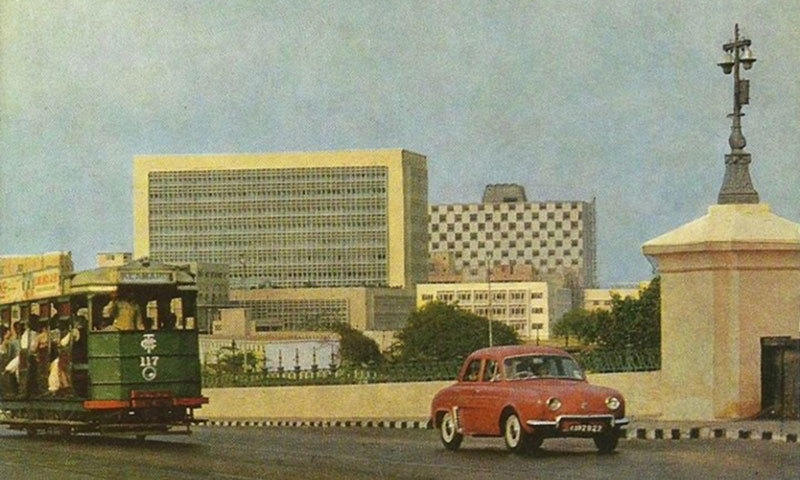
Karachi 1961: Brand new buildings and roads in the city began to emerge in the 1960s. The government of Field Martial Ayub Khan that came into power through a military coup in 1958 unfolded aggressive industrialisation and business-friendly policies, and Karachi became a natural city for the government to solidify its economic policies.