Re: Virtues of Muharram
[QUOTE]
one of my good friend fwded me this email . I cant really comment on its authenticity. but original author did talk about rather few of the misconceptions (provided by gng). i find all the point mentioned here very convincing. JAK
[/QUOTE]
Muharram
By Mufti Taqi Usmani
- Fasting During the Month
- The Day of 'Ashurah'
- Misconceptions and Baseless Traditions
- Lamentations and Mourning
Muharram is the month with which the Muslims begin their lunar Hijrah Calendar. It is one of the four sanctified months about which the Holy Quran says, "The number of the months according to Allah is twelve (mentioned) in the Book of Allah on the day He created heavens and the earth. Among these (twelve months) there are four sanctified."
These four months, according to the authentic traditions, are Dhul-Qa'dah, Dhul-Hijjah, Muharram and Rajab. All the commentators of the Holy Quran are unanimous on this point, because the Holy Prophet, Sall-Allahu alayhi wa sallam, in his sermon on the occasion of his last Hajj, declared: "One year consists of twelve months, of which four are sanctified months, three of them are in sequence; Dhul-Qa'dah, Dhul-Hijjah, Muharram, and the fourth is Rajab."
The specific mention of these four months does not mean that any other month has no sanctity, because the month of Ramadan is admittedly the most sanctified month in the year. But these four months were specifically termed as sanctified months for the simple reason that their sanctity was accepted even by the pagans of Makkah.
In fact, every month, out of the twelve, is originally equal to the other, and there is no inherent sanctity that may be attributed to one of them in comparison to the other months. When Allah Almighty chooses a particular time for His special blessings, the same acquires sanctity out of His grace.
Thus, the sanctity of these four months was recognized right from the days of Sayyidina Ibrahim, alayhi salam. Since the Pagans of Makkah attributed themselves to Sayyidina Ibrahim, alayhi salam, they observed the sanctity of these four months and despite their frequent tribal battles, they held it unlawful to fight in these months.
In the Shariah of our Noble Prophet, Sall-Allahu alayhi wa sallam, the sanctity of these months was upheld and the Holy Quran referred to them as the "sanctified months".
Muharram has certain other characteristics special to it, which are specified below.
Fasting During the Month
The Noble Prophet, Sall-Allahu alayhi wa sallam, has said: 'The best fasts after the fasts of Ramadan are those of the month of Muharram."
Although the fasts of the month of Muharram are not obligatory, yet one who fasts in these days out of his own will is entitled to a great reward by Allah Almighty. The Hadith cited above signifies that the fasts of the month of Muharram are most rewardable ones among the Nafl or voluntary fasts.
The Hadith does not mean that the award promised for fasts of Muharram can be achieved only by fasting for the whole month. On the contrary, each fast during this month has merit. Therefore, one should avail of this opportunity as much as he can.
The Day of 'Ashurah'
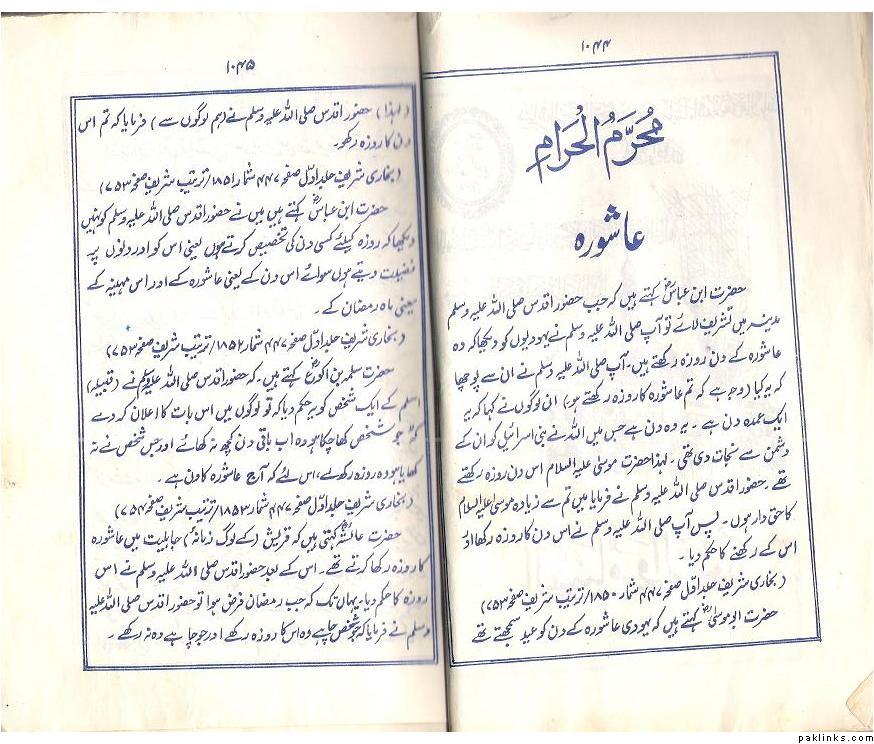
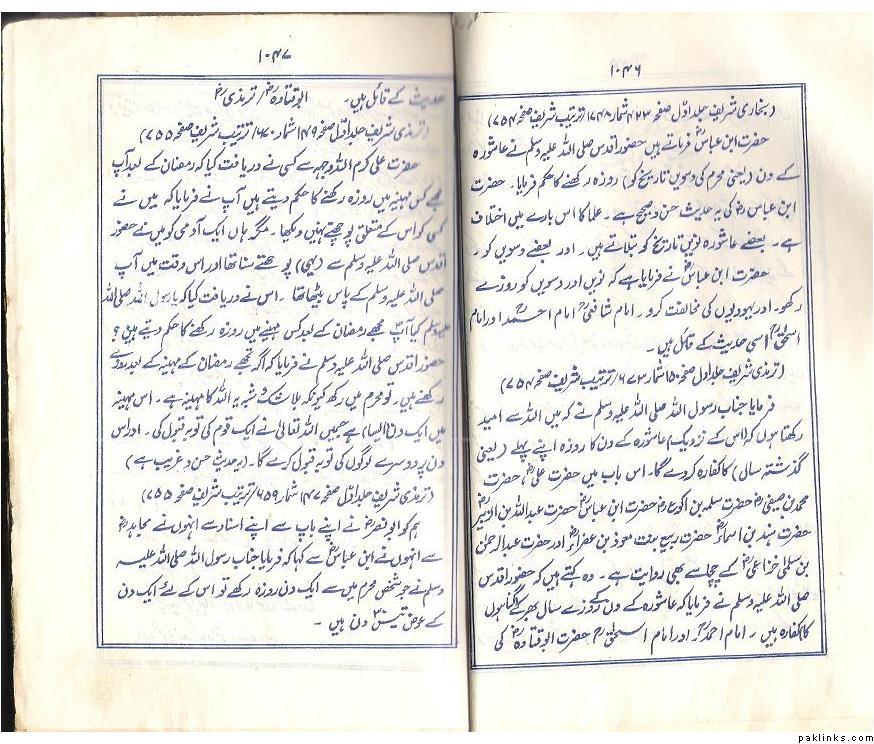
Although Muharram is a sanctified month as a whole, yet, the 10th day of Muharram is the most sacred among all its days. The day is named 'Ashurah'. According to the Holy Companion Ibn 'Abbas, Radi-Allahu anhu. The Holy Prophet, Sall-Allahu alayhi wa sallam, when migrated to Madinah, found that the Jews of Madinah used to fast on the 10th day of Muharram. They said that it was the day on which the Holy Prophet Musa (Moses), alayhis salam, and his followers crossed the Red Sea miraculously and the Pharaoh was drowned in its waters. On hearing this from the Jews, the Holy Prophet, Sall-Allahu alayhi wa sallam, said, "We are more closely rotated to Musa, alayhi salam, than you," and directed the Muslims to fast on the day of 'Ashura'. (Abu Dawood)
It is also reported in a number of authentic traditions that in the beginning, fasting on the day of 'Ashura' was obligatory for the Muslims. It was later that the fasts of Ramadan were made obligatory and the fast on the day of 'Ashura' was made optional. Sayyidina 'Aisha, Radi-Allahu anha, has said:
"When the Holy Prophet, Sall-Allahu alayhi wa sallam, came to Madinah, he fasted on the day of 'Ashura' and directed the people to fast. But when the fasts of Ramadan were made obligatory, the obligation of fasting was confined to Ramadan and the obligatory nature of the fast of 'Ashura' was abandoned. Whoever so desires should fast on it and any other who so likes can avoid fasting on it." (Sunan Abu Dawud)
However, the Holy Prophet, Sall-Allahu alayhi wa sallam, used to fast on the day of 'Ashura' even after the fasting in Ramadan was made obligatory. Abdullah ibn Musa, Radi-Allahu anhu, reports that the Holy Prophet, Sall-Allahu alayhi wa sallam, preferred the fast of 'Ashura' on the fasts of other days and preferred the fasts of Ramadhaan on the fast of 'Ashura'. (Bukhari and Muslim)
In short, it is established through a number of authentic ahadith that fasting on the day of 'Ashura' is Sunnah of the Holy Prophet, Sall-Allahu alayhi wa sallam, and makes one entitled to a great reward.
According to another Hadith, it is more advisable that the fast of 'Ashura' should either be preceded or followed by another fast. It means that one should fast two days: the 9th and 10th of Muharram or the 10th and 11th. The reason of this additional fast as mentioned by the Holy Prophet, Sall-Allahu alayhi wa sallam, is that the Jews used to fast on the day of'Ashura alone, and the Holy Prophet, Sall-Allahu alayhi wa sallam, wanted to distinguish the Muslim way of fasting from that of Jews. Therefore, he advised the Muslims to add another fast to that of 'Ashura'.
Some traditions signify another feature of the day of 'Ashura. According to these traditions, one should be more generous to his family by providing more food to them on this day as compared to other days. These traditions are not very authentic according to the science of Hadith. Yet, some Scholars like Baihaqi and Ibn Hibban have accepted them as reliable.
What is mentioned above is all that is supported through authentic sources about Ashura.
Misconceptions and Baseless Traditions
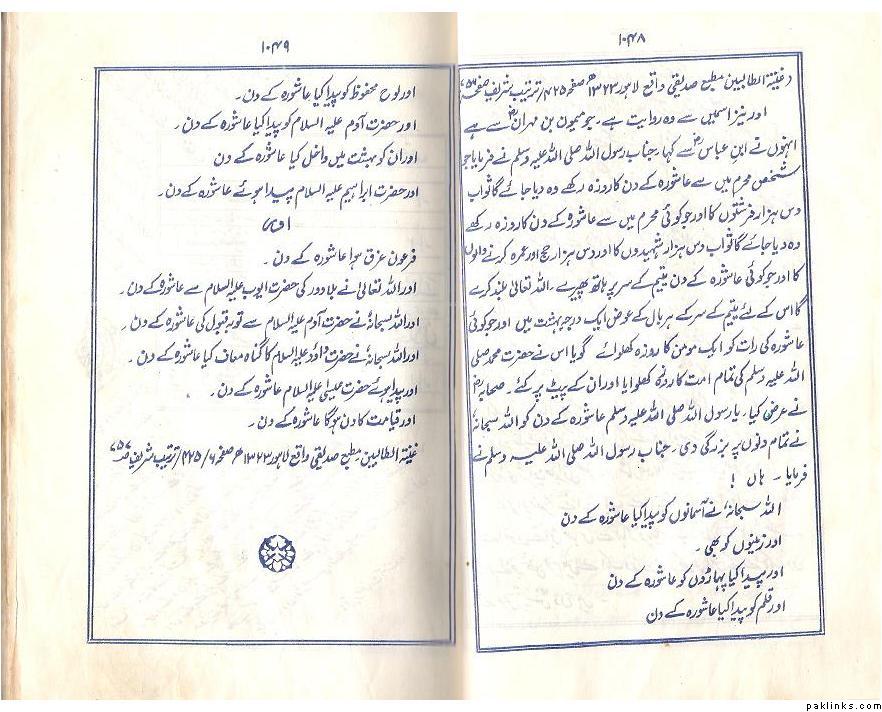
However, there are some legends and misconceptions with regard to 'Ashura' that have managed to find their way into the minds of the ignorant, but have no support of authentic Islamic sources, some very common of them are these: This is the day on which Adam, alayhi salam, was created. This is the day when Ibrahim, alayhi salam, was born. This is the day when Allah accepted the repentance of Sayyidina Adam, alayhi salam. This is the day when Qiyaamah (doomsday) will take place. Whoever takes bath on the day of 'Ashura' will never get ill.
All these and other similar whims and fancies are totally baseless and the traditions referred to in this respect are not worthy of any credit.
Some people take it as Sunnah to prepare a particular type of meal on the day of 'Ashura'. This practice, too, has no basis in the authentic Islamic sources.
Some other people attribute the sanctity of 'Ashura' to the martyrdom of Sayyidna Husain, Radi-Allahu anhu, during his battle with the Syrian army. No doubt, the martyrdom of Sayyidina Husain, Radi-Allahu anhu, is one of the most tragic episodes of our history. Yet, the sanctity of 'Ashura' cannot be ascribed to this event for the simple reason that the sanctity of 'Ashura' was established during the days of the Holy Prophet, Sall-Allahu alayhi wa sallam, much earlier than the birth of Sayyidna Husain, Radi-Allahu anhu.
On the contrary, it is one of the merits of Sayyidna Husain, Radi-Allahu anhu, that his martyrdom took place on the day of 'Ashura'.
Another misconception about the month of Muharram is that it is an evil or unlucky month, for Sayyidna Husain, Radi-Allahu anhu, was killed in it. It is for this misconception that people avoid holding marriage ceremonies in the month of Muharram. This is again a baseless concept, which is contrary to the express teachings of the Holy Quran and the Sunnah. If the death of an eminent person on a particular day renders that day unlucky for all times to come, one can hardly find a day of the year free from this bad luck because every day is associated with the demise of some eminent person. The Holy Quran and the Sunnah of the Holy Prophet, Sall-Allahu alayhi wa sallam, have liberated us from such superstitious beliefs.
Lamentations and Mourning
Another wrong practice related to this month is to hold the lamentation and mouming ceremonies in the memory of martyrdom of Sayyidna Husain, Radi-Allahu anhu. As mentioned earlier, the event of Karbala is one of the most tragic events of our history, but the Holy Prophet, Sall-Allahu alayhi wa sallam, has forbidden us from holding the mourning ceremonies on the death of any person. The people of jahiliyyah (ignorance) used to mourn over their deceased through loud lamentations, by tearing their clothes and by beating their cheeks and chests. The Holy Prophet, Sall-Allahu alayhi wa sallam, stopped the Muslims from doing all this and directed them to observe patience by saying "Innaa lillaahi wa innaa ilayhi raaji'oon". A number of authentic Ahaadith are available on the subject. To quote only one of them:
"He is not from our group who slaps his checks, tears his clothes and cries in the manner of the people of jahiliyyah." (Sahih Bukhari)
All the authentic jurists are unanimous on the point that the mourning of this type is impermissible. Even Sayyidna Husain, Radi-Allahu anhu, shortly before his demise, had advised his beloved sister Sayyidah Zainab, Radi-Allahu anha, at not to mourn over his death in this manner. He said, "My dear sister! I swear upon you that in case I die you shall not tear your clothes, nor scratch your face, nor curse anyone for me or pray for your death." (Al-Kamil, ibn Kathir vol. 4 pg. 24)
It is evident from this advice of Sayyidna Husain, Radi-Allahu anhu, that this type of mourning is condemned even by the blessed person for the memory of whom these mourning ceremonies are held. Every Muslim should avoid this practice and abide by the teachings of the Holy Prophet, Sall-Allahu alayhi wa sallam, and his beloved grand child Sayyidna Husain, Radi-Allahu anhu.

 gng for sharing it.