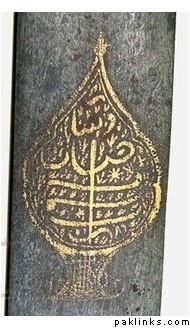
I have been looking for help in regards to my research on a marking of a Indian Tulwar sword. I have been looking at different languages such as Urdu, Dari, pushto, and many others for weeks, but I just don’t have the knowledge in this area. Some have said the cartouche says Allah for sure, but there is a shadda or “tashdiid”, so some say no. The sword was most likely from the Northwest Frontier, possibly Afganistan. 17th or 18 century, but probably 18th. Any Ideas?
Thank you for your time and help with my research.
The Hilt is definatley of the Tulwar style. The disc pommel is a definate giveaway. The actual curve of the blade is very deep on the second image almost “Shamshir like” however the hilt design is not like a Shamshir. Were that an Afghan example or “Pulwar” the Hilt would have quillons extended and pointing down the blade which this example does not.
It appears to be made of Wootz so I would say it was 18 or 19th Century. This is almost certainly a fine example of a North Indian weapon most likely Moghul in origin but the cartouche design is quite badly worn, either that or the craftsman who stamped it was using a very old or poor quality stamp. If you look closely it is almost certainly the character in Arabic for “Allah”.#
My best guess is that it was probably forged by for some local chieftain or possibly even a tribal bandit, possible origins such as a Ghakar or Rajput fuedal force. The weapon which is almost certainly a functional blade seems to have seen some action and it obviously has not been made for decorative purposes… in fact it is the sort of sword one would carry as a main battle sword during the later mughal period.
My best guess is that it is from the region of Northern Hindustan, most likely late 18th Century.
Is that the only marking or is there one on the other side of the blade?
Some Mughal and Afghan swords were stamped with the war cry “Allah-u-Wahid!”
One side of the sword would have the characters for “Allah” and the other side would have “Wahid” this was common feature for the Mughal period of the late 17 and early 18 century but this sword seems a later weapon than that era when Aurangzebs armouries tried to make standard issue swords.
If it was from Afghan region then it is almost certainly either a war trophy from India or a local replica of an older Mughal blade.
Or a very poor stamp. As many swords of the period were also stamped so a bad mould or damaged mould on the stamp can also affect the way it comes out on the blade. Wootz is also a very hard variety of pattern welded steel so if the stamp was cast iron then that can also explain the reason becuase the softer iron could have been distorted by the impact when it was stamped against the stronger metal.
**i agree with you…this could be the reason because in old days “Khush-Khatii” was taught in schools. i have never seen any member of the older generation who got a bad handwriting…
…one strange observation:
**most women have similar bad handwriting [both English N urdu and Hindi] … their handwritings are so similar that sometimes you think that they are all sisters. it’s TRUE even NOW!!!
Naah seriously I think a poor stamp is probably the most realistic likelihood for the poor quality turnout.
Even today in weapons manufacutre and engineering it is a common problem in the North West frontier and parts of the Sub-continent. For example even the legandary and reliable AK 47 is mostly made using cheap stamped frames and stamped parts. Trouble is some of the moulds are decades old and they have worn down or been damaged which is why the turnout is so poor. Offcourse the more expensive rifles and other weaponry are made from Milled parts and recievers which means they are cut on the spot to exact tolerances which give better finished products…
**are nahiiN baba…us zamaane meN aurat yeh sab kaam kahaN kiyaa kartii thii
YES, a poor mold/cast is the real culprit as u suggested …
…but now the question arises…why did the owner of the sword [whom i suppose was a rich guy, probably some kinda ruler] ACCEPT such a bad engraving?
another likelihood could be that since the sword is solid copper, oxidation process [rusting/decay] over the years may have disfigured the engraving! what u say?**
Two theories on this. One he may well have been a ruler or chieftain perhpas even a small Jagirdar or other nobleman who was in bad times… many nobles rose from rags to riches becuase on the battlefield skill was as good a way to promotion as any. However swords had always been relatively expensive to produce and the Metalsmiths who forged such weapons could charge a huge price. I mean to make one sword the metal you need could easily make over a dozen spear points or even a hundred arrow heads… so a sword was very much a weapon for the elite. I minor nobleman must have spent a lot of money on such a blade and perhaps lacked the funds to get a second one made… guess he did not count on the Metalsmith tho mess up the first attempt. In which case one fears for the unfortunate maker… this might have been his last blade.
Secondly it could be that this sword was actually commisioned on masse from a state armoury and dozens were produced in bulk for a one off cost. Decorations would have been minimal and perhaps they were also made on orders from a nobelman not as his personal weapon but perhaps as a weapon for an elite regiment or bodyguard unit. That would mean the weapon needed to be functional and of working qaulity but perhaps did not require major decorations or decorations were kept to a minimal and some minor mishaps such as bad calligraphy or poor moulds would have been excused especially if the weapon was to be produced in a batch and for a war. In times of war when batches of weapons are made quality sometimes give way to qauntity and so swords came out in this way.
I think the latter is the more likely scenario.
You say it could be due to natural ageing of the weapon, however the material of this weapon looks to be of pattern welded steel, i’m assuming its Wootz which would mean that it is one of the most long lasting finishes on a blade ever. The finails on the Qutub Minar are made of simmilar steel and they have been engraved almost a millenia ago but are still clear as crystal. It is unlikely that a stamp could deterioate so badly on a more recent Wootz piece. Though one cant rule it out I belive the elements are less likely to effect this weapon, the only way it would be so distorted is if it were exposed to extreme heat.
Well I’m glad I know it says Allah, I was leaning towards an armory mark when the sword was made or delivered to the armory, it would be given a mark usually a number, but why would it say Allah then? Also there have been examples of writing on blades by somewhat illiterate markers, not to say that the stamper was uneducated, it may have been the fact that blades were traded very often to and from neighboring countries with diffrent writing styles and languages. The only other mark on the blade has the eyelash stampings commonly found on higher quality blades and as a talisman effect. I uploaded the eyelash picture. So does that stamp have any any other wording that is hard to make out or is the whole stamp the word Allah? Forgive my ignorance I am in the very early stages of learning Arabic.
I’m not familiar with swords. I hav seen all images don’t know about the latest uploaded image. But the word wasn’t looks like written ‘Allah’. Its something else like a desing.
Those eyelash stampings are actually a Rajput equivalent of a coat of arms / majic medicine. It seems to make sense now it was probably forged by Rajputs using old Moghul stamps what explains the fact it was probably sourced from the North West frontier or Afghanistan is the fact that many Pathan invaders often took such swords as war booty.
Those eyelash marking are very widespread and in many areas and times. You can find a sword produced in the southern part of india and find the same marking in a sword produced in the afgan region or beyond. Where have you heard that those markings were coats of arms? do you have examples?
Thank you psyah,
Your time was greatly appreciated. It is somewhat similar to the cartouche posted, perhaps a new direction to research. I have spent countless hours on this, and feel that I must know what it says. As a positive I am learning about the arabic language and islam
What would be a great help would be if you can find other examples of the same stamp on other items. Slight variations will perhaps give more clues. I think I saw your sword on the vikingsword forum as well and people there have given some good information … I have also learnt that some swords of this type can come with gurmukhi inscriptions and not necessarily urdu/persian/arabic inscriptions …
What is clear to me though is that the stamp is inferior to the design of the sword and hence conclude that it must have been punched after the production … so it will not be something that was punched by the manufacturer.


 In which case one fears for the unfortunate maker… this might have been his last blade.
  kaise?


 aray nahi. Actually is woh image ko rotate kr ke dekhan hy ke kiy likha hy.