Armughal,
Can you please define the shirk?
Armughal,
Can you please define the shirk?
Re: To Armughal -Define the Shirk please
since u talk about "the shirk" i assume its something specific that u want....
so be clear about the question....
obviously this is coming after my comment on someone calling Muhmmad (saw) as omnipresent as shirk....
well, do u know what omnipresent means????
Re: To Armughal -Define the Shirk please
Shirk is explained in quran in easiest manner and to smallest details, there is no question of ambiquity whatsoever.
But we (sadly) do not pay heed to Quran.
Like many ayat, which clearly tells that there is absolutely no pardon for Shirk. and it is the biggest sin in front of Allah.
here is the verse of quran which makes it crystal clear
Sora Fatir (35)
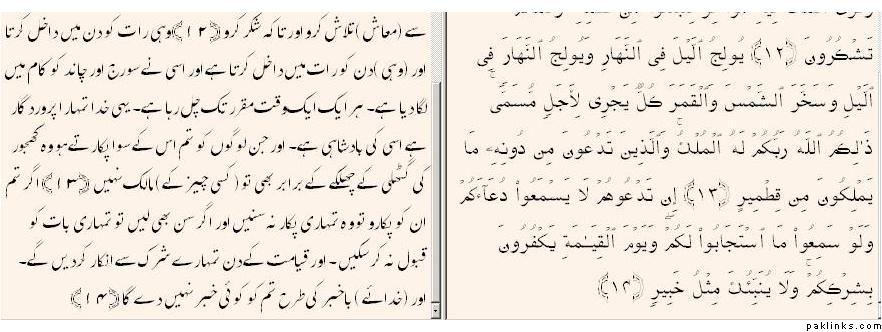
Those people who pray to Muhammad (pbuh), Ali(ra) , Saints or Angels can read quran and find quidance. Although, praying to other dieties /personalities beside Allah is against the fundamental belief of ISlam, but some ignorant muslim do that due to ignorance. May Allah guide us. ameen
Re: To Armughal -Define the Shirk please
There is another ayah in the holy Qur'an
Surah Al Ahqaf ayah 5:
"And who is more astray than one who calls on (invokes) besides Allah.such as will not answer him till the Day of Resurrection,and who are (even) unaware of thier calls to them?
Re: To Armughal -Define the Shirk please
Another tactic that the Khawarij used to use during the time of Rasul-Allah (saws) and the Khulafa ar-Rashidin was using ayats in the Qur'an which refer to the non-Muslims but instead using them and trying to apply them upon Muslims.
Why don't you talk about Tawassul and Tabarruk, and the al-Abdal (Awliya-Allah), all these things clearly and completely accepted during the life of Rasul-Allah (saws).
Let me ask you a question, do you believe that by Muslims celebrating Mawlid un-Nabi (saws), that they are committing shirk or are worshpping him???
Please make your stance clear here so that I can act upon your response accordingly. I'm ready so anytime, when I get back here right away you will see my response, in the meantime, put forward your rebuttals and I will address you tomorrow, time to sleep here, good night ullu's.
Allahumma Salee 'Ala Muhammadin wa 'ala alee Muhammadin Wa Sallim.
Re: To Armughal -Define the Shirk please
Sir, there is no need to get obssessed with milaad or something.
If you celebrate or don’t it , wont have a any clumsiest effect on the pathetic state of affairs of Muslims. Better concentrate on something more substantial like how to convince muslims to stop killing muslims here and there
OR
Stop them from distributing complimentary Passes to hell for there brethern 
Re: To Armughal -Define the Shirk please
To sultan madina
Well,Prove it that this ayah (ahqaf:5)is only for non muslims?
and when did the Khwarijs said this ayah(ahqaf:5) is for muslims or non-muslims?
(with refs)
Re: To Armughal -Define the Shirk please
this thread is not for tawassul or tabbaruk..........
Re: To Armughal -Define the Shirk please
12} He causes the night to enter in upon the day, and He causes the day to enter in upon the night, and He has made subservient (to you) the sun and the moon; each one follows its course to an appointed time;** this is Allah, your Lord, His is the kingdom; and those whom you call upon besides Him do not control a straw.** {13} If you call on them they shall not hear your call, and even if they could hear they shall not answer you; and on the resurrection day they will deny your associating them (with Allah); and none can inform you like the One Who is Aware. {14}
Code_Red,
You couldn’t have done a better job than this. MashAllah, excellent Ayah selection to prove your point.
Here’s what I think. The focus of the celebration of Prophet Mohammad’s:saw: birth should be to learn more from our beloved Prophet’s(SAW) habits and how can we bring his habits(sunnahs) into our lives. Regarding praying to Prophet Mohammad and also as some people pray to Allah with association of the name of sufis, is dead wrong as explained by the above mentioned Ayah.
Regardless of the topic, it’s not bad if you don’t celebrate the birth of Prophet Mohammad (SAW), you should have utter & great respect for him as he’s given us the best path(i.e. Islam). But, the focus of his birth celebration should be how can we make ourselves better…
On the side note, we had a bomb blasted in Karachi and 40people died on the day of 12th Rabi ul Awal. Those people who carry out these horrendous acts will God willing, end up in Hell as they devastated families and they portray a wrong message for Pakistan..
Umer
Re: To Armughal -Define the Shirk please
Yes killing Muslims here and there, such at the bombings in karachi killing Muslims celebrating Milad, what rubbish you speak about killings, talk about wahhabi extremists why don’t you then.
You say this thread has nothing to with Tabarruk and Tawassul, well YES it does actually, you are claiming here that asking for the intercession of rasul-Allah is shirk, well guess what children, it is not because these acts are identified as tawassul and tabarruk, so please, stop beating around the bush and brush up on your understanding of things.
Shaykh Sayyid ibn Alawi from Madinah explains in this article this subject in clear detail:
The Intermediary of Shirk.
From the Mafaheem of Sayyid ibn Alawi
Translated by Khalid Williams
Many people falter in their understanding of the reality of intermediaries, and haphazardly rush to the judgement that any intermediary is Shirk, and that he who takes an intermediary, whatever the fashion, has associated partners with Allah, and that his state in this affair is that of the polytheists, who said ‘we do not worship them except that they might bring us near to Allah’ (Surat al-Zumar, 3). This statement is incorrect, and the attempt to use this Ayah as an evidence is here misplaced. This is because this noble verse is clear in its severe condemnation of the polytheists for their worship of idols as gods besides Allah, the Exalted, and their association of them with Him, claiming that their worship of these idols is nothing more than a means of drawing closer to Allah. The kufr and shirk of their action stems from their worship of these idols, and their belief that they are lords besides Allah.
Something of great importance which must be stressed here is that this Ayah confirms that the polytheists were not sincere in their attempt to justify their worship of idols by claiming that they used them to draw near to Allah. For had they been truthful in this assertion, Allah would have been greater to them than their idols, and they would not have worshipped other than Him. However, Allah forbade the Muslims from insulting the idols of the polytheists with His words: ‘Do not curse those upon whom they call beside Allah, lest they wrongfully curse and revile Allah through ignorance. Thus to every nation have we made their deeds seem fair. Then to their Lord is their return, when He will inform them of that which they used to do’ (Surat al-An’am, 108).
It is narrated from ‘Abd al-Razzaq, and ‘Abd ibn Hamid, and ibn Jarir, and ibn al-Mundhir, and ibn Abi Hatim, and Abu al-Sheikh, from Qutada (may Allah be pleased with him), who said: “The Muslims used to curse and revile the idols of the disbelievers, and so the disbelievers reviled and cursed Allah, the Mighty, the Magnificent. So Allah revealed ‘Do not curse those upon whom they call beside Allah, lest they wrongfully curse and revile Allah through ignorance’.” This is the reason for the revelation (sabab nuzul) of the Ayah, which strongly forbids the believers from uttering insults against the idols that the polytheists used to worship in Makkah, because such insults would inevitably enrage those who believed in their hearts that those statues and idols were gods, with the ability to benefit and harm. This rage would drive them to meet the Believers with similar insults against the One whom they worshipped, the Lord of the Worlds, and so they would ascribe to Him defects, though He is utterly free of all defects. Again, if they were truly sincere in their claim that their idol-worship was only a means of drawing closer to Allah, they would not have dared insult Him to avenge their idols when they were insulted. It is entirely clear from this that the polytheists held Allah in far less esteem than they held their own idols.
This is also apparent from Allah’s words ‘And if you were to ask them who created the heavens and the earth, they would surely say “Allah!”’ (Surat al-‘Ankabut, 61). If the polytheists had truly believed that Allah the Exalted is the only Creator, and that their idols had not created anything, they would have worshipped Allah instead of their idols, or at the very least their reverence towards Allah would have been greater than their reverence towards their stones and statues. Is this consistent with their utter vilification of Allah, the Mighty, the Magnificent, out of vigilance for their own idols against Him? It is abundantly clear that it is not consistent in the slightest. Furthermore, the Ayah that we are considering is not the only evidence that Allah was lower in the esteem of the polytheists; rather it has many counterparts. Of them is the statement of Allah the Exalted: ‘They assign to Allah a portion of the crops and cattle which He created, and they say “this is for Allah”, in their imagination, “and this for (His) partners in regards to us.” Thus, that which they apportion for His partners in them does not reach Allah, and that which they apportion to Allah goes to their partners. Evil is their ordinance’ (Surat al-An’am, 137.) If they did not hold Allah in lesser esteem than their idols, they would not have weighed against Him this bias, which as related in the Ayah merited the judgment of Allah upon them: ‘Evil is their ordinance.’
Further evidence is the call of Abu Sufyan (may Allah be pleased with him), before he entered Islam, ‘Hubal, be though exalted!’ as was related by Bukhari, calling upon the idol named ‘Hubal’, in order that he might, in that moment of conflict[1]](Misc. Articles - Intermediaries of Shirk by Sayyid Maliki), overwhelm the Lord of the Heavens and the Earth and His army of Believers, who desired to overwhelm their idols. This is a clear measure of the state of the polytheists, and how they viewed their idols in relation to Allah, the Lord of the Worlds.
It is essential that this be understood with true comprehension, for too many people build their arguments upon it without any understanding.
Do you not see that when Allah ordered the Muslims to face the Ka’aba in their prayers, they turned towards it when they worshipped, and took it as a direction of prayer (Qiblah)? The worship was not directed to the Ka’aba, and nor is the kissing of the Black Stone anything other than the worship of Allah the Exalted, and the imitation of the Prophet (may the Peace and Blessings of Allah be upon him and his family and companions). Were any of the Muslims to intend to worship to either of them, he would be a polytheist, like those who worship idols.
To worship Allah by means of intermediaries is essential, and cannot be termed shirk, and it cannot be said that everyone who takes an intermediary between him and his Lord is a mushrik; if it were otherwise, then every single human being would be a polytheist, for all of our affairs require intermediaries. The Prophet (may Allah bless him and give him peace) received the Qur’an through the intermediation of Jibril, and so Jibril is the intermediary of the Prophet (may Allah bless him and give him peace), and he was the greatest intermediary to the Sahaba (may Allah be pleased with them), for they would rush to him in times of crisis, and complain of their needs to him, and seek his intercession and Du’a. In these times, the Prophet (may Allah bless him and give him peace), never said to them ‘you have committed shirk and kufr! It is not permissible to complain to me, nor to seek anything from me; rather you must go and supplicate and ask Allah yourselves, for verily Allah is closer to you than I am!’ Rather he would stand and supplicate for them, although they knew full well that the Bestower in reality is Allah, and that the Preventer, and the Expender, and the Provider is Allah alone, and they knew also that the Prophet (may Allah bless him and give him peace) would not avail them anything save with the permission of Allah, and through His Bounty. The Prophet himself (may Allah bless him and give him peace) said‘I am nothing but an apportioner; Allah is the one who bestows.’[2]](Misc. Articles - Intermediaries of Shirk by Sayyid Maliki)
Therefore, it becomes evident that it is permissible and correct to describe any ordinary person as one who delivers from distress, and satisfies needs; that is, that he is an intermediary for them, so what of the Noble Master and Eminent Prophet, the Most Illustrious of Mankind and Jinn, the Undisputed Best of Creation? Did the Prophet (may Allah bless him and give him peace) not say ‘he who delivers a Muslim from distress, Allah delivers him from the distress of the Day of Resurrection[3]](Misc. Articles - Intermediaries of Shirk by Sayyid Maliki)’? So the Believer is a deliverer from distress and crisis.
Did he not say (may Allah bless him and give him peace) ‘he who fulfils the need of his brother, I will stand at his balance (on the Day of Judgement), and if (his good deeds) do not outweigh (his bad), I will intercede for him.[4]](Misc. Articles - Intermediaries of Shirk by Sayyid Maliki)’? So the Believer is a fulfiller of needs.
Did he (may Allah bless him and give him peace) not say ‘he who shelters a Muslim, Allah will shelter him on the Day of Resurrection[5]](Misc. Articles - Intermediaries of Shirk by Sayyid Maliki)’?
Did he (may Allah bless him and give him peace) not say ‘verily, Allah has among His creation those who are sought for in times of need[6]](Misc. Articles - Intermediaries of Shirk by Sayyid Maliki)’?
Did he (may Allah bless him and give him peace) not say ‘Allah is engaged in the aid of his servant as long as the servant is engaged in the aid of his brother[7]](Misc. Articles - Intermediaries of Shirk by Sayyid Maliki)’?
Did he (may Allah bless him and give him peace) not say ‘he who comes to the aid of someone in need, Allah writes for him ninety-three good deeds[8]](Misc. Articles - Intermediaries of Shirk by Sayyid Maliki)’?
So the Believer relieves hardships, aids, protects, fulfils needs, and is sought out in times of trial, although in reality it is Allah, Exalted and Magnificent, who aids, fulfils, and protects. However, as the Believer is the intermediary in all of this, attributing the actions to him is entirely appropriate.
Many Hadiths have been related from the Prophet (may Allah bless him and give him peace) which illustrate that Allah, Sublime and Exalted, alleviates punishment from all who dwell on the earth by means of those who seek His forgiveness, and those who maintain His mosques, and that by their means He provides the masses with sustenance and support, and protects them from trials and perils.
Tabrani related in ‘al-Mu’jam al-Kabeer,’ and Bayhaqi in ‘al-Sunan’ from Mani’ al-Daylmi (may Allah be pleased with him) that the Prophet (may Allah bless him and give him peace) said ‘Were it not for the sake of certain servants of Allah whom He makes bow to Him, and certain infants whom He makes suckle, and certain cattle whom He makes graze, He would unleash His punishment upon you all, and would destroy you utterly.’
Bukhari related from Sa’ad ibn Abi Waqqas (may Allah be pleased with him) that the Prophet (may Allah bless him and give him peace) said ‘are you given victory and sustenance except by means of those of you who are weak?’
Tirmidhi related from Anas (may Allah be pleased with him), that the Prophet (may Allah bless him and give him peace) said ‘it may be that you are provided with sustenance by means of him.[9]](Misc. Articles - Intermediaries of Shirk by Sayyid Maliki)’ Al-Hakim declared this Hadith to be Sahih.
Abdullah ibn ‘Umar (may Allah be pleased with them both) narrated that the Prophet (may Allah bless him and give him peace) said: ‘Verily, Allah has men whom he created for the needs of the people, who rush to them in times of crisis. They are those who are safe from the punishment of Allah the Exalted[10]](Misc. Articles - Intermediaries of Shirk by Sayyid Maliki).’
Jabir ibn Abdullah (may Allah be pleased with him) narrated that the Prophet (may Allah bless him and give him peace) said: ‘Truly, Allah confers righteousness upon a Muslim’s child, and his grandchild, and his family, and the families of his neighbours, by means of that Muslim’s piety and righteousness, and they are in the protection of Allah as long as he is amongst them.[11]](Misc. Articles - Intermediaries of Shirk by Sayyid Maliki)’
Ibn Umar (may Allah be pleased with them both) narrated that the Prophet (may Allah bless him and give him peace) said: ‘Verily Allah, by the means of a pious Muslim, protects one hundred of his neighbours from hardship and strife.’
Ibn Umar then recited the Ayah ‘And had Allah not repelled some people by means of others, the earth would have been corrupted’ (Surat al-Baqarah, 251).[12]](Misc. Articles - Intermediaries of Shirk by Sayyid Maliki) A Hadith is related from Thawban[13]](Misc. Articles - Intermediaries of Shirk by Sayyid Maliki) which states ‘There will remain among you seven men by whom you will be given victory, rain and sustenance until the Affair of Allah arrives (the Day of Judgement).’
‘Ubada ibn al-Samit narrated that the Prophet (may Allah bless him and give him peace) said ‘The Adbal[14]](Misc. Articles - Intermediaries of Shirk by Sayyid Maliki) of my community are thirty, by means of them you are all provided with sustenance, rain and victory.’ Ubada said ‘I hope al-Hasan[15]](Misc. Articles - Intermediaries of Shirk by Sayyid Maliki) to be one of them [16]](Misc. Articles - Intermediaries of Shirk by Sayyid Maliki).’
The four preceding Hadiths were mentioned by al-Hafidh ibn Katheer in his Tafseer of the above Qur’anic Ayah ‘And had Allah not repelled some people…’ and they are appropriate to be used as proofs, indeed by their body the content becomes Sahih (rigorously authenticated).
Anas bin Malik (may Allah be pleased with him) narrated that the Prophet (may Allah bless him and give him peace) said: ‘The earth will never be deprived of forty men of the like of the Intimate friend (khalil) of Allah,[17]](Misc. Articles - Intermediaries of Shirk by Sayyid Maliki) by means of them you are given water and succour. Each time one of them dies, Allah substitutes another in their stead[18]](Misc. Articles - Intermediaries of Shirk by Sayyid Maliki).’
The Greatest Intermediary
On the Day of Resurrection, the Day of Tawheed, the Day of Iman, the Day in which the Throne will appear, the benefit of the greatest intermediary will come to light: that of the possessor of the Praiseworthy Station (al-Maqam al-Mahmoud), he whose intercession is never rejected, and whose surety is never dispelled by He who promised never to disappoint him, or debase him, or dismay him, or grieve him on account of his community, when all of creation seek him out and plead for his intercession, and he stands before his Lord and does not return except with the height of nobility and honour revealed to us by the words of Allah to him: ‘O Muhammad! Raise your head, and intercede, your intercession will be met; and ask, you shall be given!’
May the peace and blessings of Allah be upon him, and upon his family, companions, and all those who follow them until the Day of Judgement.
Translated from the book ‘Notions which must be Corrected[19]](Misc. Articles - Intermediaries of Shirk by Sayyid Maliki)’, by the Eminent and Noble Prophetic Scion and Imam of the People of Hijaz, the Late Sheikh Sayyid Muhammad ibn al-Alawi al-Maliki al-Hassani. May Allah forgive him and be pleased with him, and reward him from His infinite bounty; and may He benefit us with his works that we might better serve His Deen and the community of His Noble Prophet, may the peace and blessings of Allah be upon him. Amin.
NOTES
[1]At the Battle of Uhud.
[2]Related by Bukhari from Mu’awiyah (may Allah be pleased with him)
[3]Related by Bukhari and Muslim from ibn Umar (may Allah be pleased with them both)
[4]Related by Abu Na’eem from ibn Umar (may Allah be pleased with them both)
[5][FONT="] Related by Bukhari and Muslim from ibn Umar (may Allah be pleased with them both)
[6]See below for the reference for this Hadith
[7]]Related by Muslim and Abu Dawud and others from Abu Huraira (may Allah be pleased with him)
[8]Related by Abu Ya’la and al-Bazar and Bayhaqi
[9]Full text of the Hadith : ‘There were two brothers at the time of the Prophet (may Allah bless him and give him peace), of whom one would come to the Prophet (may Allah bless him and give him peace) to seek knowledge, and the other would work to provide for them both. The worker felt that the situation to be unfair and complained about his brother to the Prophet (may Allah bless him and give him peace), who replied: ‘it may be that you are provided with sustenance by means of him.’
[10]Related by Tabrani and Abu Na’eem and al’Qada’i with a good (hasan) chain
[11]Related by ibn Jareer, and by Tabari in his Tafseer
[12]Related by Tabrani
[13]A servant of the Prophet (may Allah bless him and give him peace)
[14]The Substitutes. Explanation of their status is to be found in the Hadith below related by Anas ibn Malik, Insha Allah.
[15]Al-Hasan al-Basri, one of the Tabi’een.
[16]Related by Tabrani
[17]The Prophet Ibrahim (peace be upon him)
[18]Related by Tabrani. These are the Abdal (Substitutes).
[19]Mafaheem Yajib an Tusahhah
Re: To Armughal -Define the Shirk please
If what you say about Muslims seeking intercession is true, then explain this Umer:
Ye who believe! Fear Allah and seek the means of approach unto him, and strive with might and main in his cause: that ye may prosper.
(Qur'an, Surah al-Ma'idah, Ayah 35)
Who is that who can intercede with Him but with His permission?
(Qur'an, Surah Baqarah Ayah 255 also known as Ayat al-Kursi)
**None shall have the power of intercession, but such a one as has received permission (or promise) from ((Allah)) Most Gracious.
**(Qur'an Surah A'la, Ayah 87)
I can show you many more. The point here is, people are not worshipping Rasul-Allah (saws) - it is impossible to do so. The Qur'an emphatically declares as Allah subhanahu wa ta 'ala commands us to seek a means of approach, which is an intermediary unto Allah subhanahu wa ta 'ala.
The verses in which you are talking about polytheism, refer to the polytheists who ascribe God figures beside Allah subhanahu wa ta 'ala. Seeking the means of the Prophet (saws) as an approach unto Allah is what you are supposed to do all of your life! So what is it going to do to you to remember his blessed birth?
If Muslims worshipped the Prophet (saws), nauzubillah, why would they acknowledege Allah subhanahu wa ta 'ala? And besides, acknowledge his blessed birth? If Muslims who celebrate his birth really committed shirk as seeking the prophet as an approach unto Allah (swt), don't you think they would start referring to the prophet as their God, but they don't!!!!! So give it up already are you intellectual derelicts you cannot comprehend this point already?? Go read and learn about this subject before using one ayah of Qur'an to issue your personal fatawa.
Re: To Armughal -Define the Shirk please
*Allahumma inni asaluka bi-Nabiyyika
**Allahumma inni asaluka bi-jahi Nabiyyika
**Allahumma inni asaluka bi-Haqqi Nabiyyika
*The Abbasid caliph, Mansur al-Dawaniqi, once asked **Malik ibn Anas **the founder of the Maliki School of jurisprudence whether he should turn towards the shrine of the Prophet (s) or face the Qiblah for supplication? Malik answered him:
Why do you want to turn away from the Prophet (s) when he (Prophet Muhammad (s)) is the wasilah (means) for you and for your father Adam, towards Allah on the Day of Resurrection. Turn to him (the Prophet) and seek his intercession (shafa’at).1
Imam al-Nawawi in describing the manners and etiquette of making pilgrimage to the shrine of Prophet Muhammad (s), writes:
The pilgrim should face the shrine of the Messenger of Allah (s), make him a means (tawassul) towards reaching God and seek his wasilah as intercession (shafa’at), in the same manner as the Bedouin who visited the Prophet’s shrine and standing beside it said: Peace unto you O Messenger of Allah, I have heard Allah has said:
…Had they, when they had wronged themselves, come to you and asked Allah’s forgiveness and the Apostle had asked forgiveness for them, they would certainly have found Allah Most-Propitious, Most-Merciful. (Holy Qur’an 4: 64).
Therefore, I have come to you for forgiveness of my sins and seeking your intercession with Allah.2
**ibn Qudamah Hanbali, **defining the manner of pilgrimage to the shrine of the Prophet (s), writes in the book al-Mughni:
Stand beside the tomb of the Prophet (s), and say: I have come to you for forgiveness of my sins and to seek your intercession with Allah.3
Allahumma inni asaluka bi-haqqi al-sa’ilina 'alayk
[
[
[
2. Al-Majmu’, vol. 8, p. 274; Fayd al-Qadir, vol. 2, p. 134; I’anah al-Talibiyyin, p. 315.
[
](“http://www.al-islam.org/mot/tawassul.htm#r7")](“http://www.al-islam.org/mot/tawassul.htm#n8”)](“http://www.al-islam.org/mot/tawassul.htm#n7”)](“http://www.al-islam.org/mot/tawassul.htm#n7”)]("http://www.al-islam.org/mot/tawassul.htm#n6”)
Re: To Armughal -Define the Shirk please
Sultan e Madina,
Salam u Alaikum.
I never made a point that celebrating Prophet Mohammad's birth is shirk. But my point is that the celebration focus should be to bring about changes in ourselves so we can be better Muslims.
Also, as demonstrated by Ayahs's, Allah's pious people can guide us to truth and seeking their guidance is perfectly ok to make our lives better for this world and for hereafter. What I'm against is asking these people to do miracles for us. But doing dua let's say with reference to Prophet Mohammad SAW is perfectly ok but not with anybody's else's name. Since the highest regard is given to Prophet Mohammad than anyone else.
As far as extremism is concerned, I'm against any kind of extremism whether it be from Wahhabis or Christian fundamentalists. Also, I agree with you 110% as explained by you thru the Quran references and Ahadith about approaching pious/noble people for guidance. It's not committing shirk. What I'm against is asking these people do miracles for us. Had this been shirk, probably we would never have all the ulema karam and scholars who have done some brilliant work for Islam...
P.S. : I really like the way you proved your points and you couldn't have done a better job than this. Thanks, I learned something and that's the way to interact with calmness and makes it easy to interact.
Thanks and Jazak Allah khair. May Allah guide all of us to the straight path. Ameen.
Umer
Re: To Armughal -Define the Shirk please
As Salaamu 'Alaiykum brother Umer, I appreciate your refreshing response and comments. I do agree with you that if people are out there expecting others to do miracles and work wonders for them while they do nothing with their lives and improving themselves, and continually disobey the guidance of their teachers who are the 'Ulama and 'Urafa, then they are truly astray. Obeying Rasul-Allah (saws) and his representatives after him, the Awliya-Allah, is obeying Allah subhanahu wa ta 'ala. Those who are humble servants who care not for their own selves, not for their own egos, these are the truthful ones. These are the people whom we are supposed to seek out and follow, only that way will we be obeying Allah subhanahu wa ta 'ala and His Rasul (saws); and not obeying ourselves (nafs ul-amara). That is why we should always be careful in making sure that we have proper adab and piety when we speak of such people whom Allah has appointed as his deputies on Earth. It is true that there are many fakers out there, but at the same time there are those people amongst our Ummah who are trying to extinguish the light of love in people's hearts for Rasul-Allah (saws) and his blessed family and descendants (alaiyhis-salaatu was-salaam).
Sunni' and Shi'a alike should recognize, that there are thigns which they need to reconcile amongst each other because we need to be united in our stand against the ones who try to create fitnah for Muslims - like bombing Masjid al-Askari in Iraq; or putting a bomb underneath a stage in a Masjid in Karachi during a Mawlid un-Nabi (saws) program, or destroying the graves of the prophet's blessed family members and his blessed companions at Jannat ul-Baqi/Baqi al-Gharqad; destroying the house of Bibi Khadija (alaiyhis-salaam) and turning it into a toilet; planning on painting the green dome in Madinah Munawwarah to silver...why do all these people whoever they may be, need to do such things?
When Muhammad ibn Abi Bakr (radi'Allahu anh') was a young boy and his father Sayyidina Abu Bakr as-Siddiq (radi'Allahu anh') passed away, his mother Asma bint Umays (radi'Allahu anha') remarried to Sayyidina Imam Ali ibn Talib (alaiyhis-salaam), and Sayyidina Ali (as) adopted Muhammad ibn Abi Bakr at the age of 3 years and raised him like his own son.
The level of love and respect which Sayyidina Abu Bakr as-Siddiq (ra) had for Sayyidina Imam Ali ibn Abi Talib (as) was known to him, and both of them know a secret which was given to them by As-Sayyidina Rasul-Allah Sal' Allahu 'alaiyhi wa ala alihi wa sallim.
A person who lacks affection and love for them especially for Rasul-Allah (saws), to do such things in this day and age to disrespect him, make Hotels which overshadow the Kaaba....what can we or what should we say about these people? Are they in business for dunya or are they in business for the akhira?
Also I just wanted to clarify, my username is not Sultan-e-Madina (saws), this is the title of as-Sayyidina ar-Rasul-Allah (saws). I say Ya before his most blessed name because he is my approach unto Allah Azza wa jaal, ar-Rahmanir-Raheem.
I would just like to say once again I appreciate your response Akhi, wassalaamu'Alaiykum.
Re: To Armughal -Define the Shirk please
well put.
Re: To Armughal -Define the Shirk please
very well said brother. I agree 100 %. To remember the Prophet(saw) we don’t need to decorate streets and markets. This is a waste of money in a country where so many people sleep hungry every night. We can not claim to love the prophet more than Sahaba and we know that they did not celebrate it the way it is done now a days.
Re: To Armughal -Define the Shirk please
The bottom line is that the birth of Rasul-Allah (saws) is the birth of Islam.
All the Sahabah al-Kiram knew this and so should all of us, inshallah.
Re: To Armughal -Define the Shirk please
^ if the birth of the Propeht (saw) was such an important event, dont u think our islamic calendar wud be starting from that year????
the bottom line is that perhaps none of the sahaba ever bothered to find out which day/date the Prophet (saw) was born....
cuz they knew very well that birth or death of any individual has no significance in Islam....
Re: To Armughal -Define the Shirk please
that means birth of Hazrat Ibrahim(as) was also birth of islam..........he was a muslim........you can see in the Quran
Re: To Armughal -Define the Shirk please
sultan madina so this is the reason for the fall of the Abbasids.............they had started "grave worshippng"................