Re: The worst day…
Nice information Farris :k: I love to read and gain knowledge
Re: The worst day…
Nice information Farris :k: I love to read and gain knowledge
Re: The worst day…
And the plot thickens… 
Wonderful job as always. I have learnt more about Indian history here than from my textbooks decades ago. Hats off to you.
The rivalry between descendants of the Chagatai Ghengis Khan’s two sons (and your being a Mongol, but still being a Mughal rival), and the rivalry between Afghans and Mughals bring the past back to life.
Bohut, bohut khoob!
Re: The worst day…
Thanx alot for all this precious information. I am gonna have to dedicate a day to read and absorb all of it. I’ll read it in complete peace of mind, so I can understand all angles of this true kahani. Bohat shukriya.
Re: The worst day…
Thanks again everyone for your continued support.
We last heard about how the Marathas had in the summer of 1760 made thier decision to march North in response to the Afghan invasion of Hindustan. By the Autum of that year they had reached the territories of the Jatt Rajah Surajmal and were fast approaching Delhi the Mughal capital. To this point the Maratha army had been swelled by constant support from the locals of lands as far North as Berar and Indore as well as Agra and Gwalior all these were recent Maratha aquisitions. The vast army was predominantly made up of Hindu’s and the forces were further boosted as the Jaat Rajputs joined in with the Maratha confederacy. Almost all the great Chiefs of the Maratha nation had sent troops into the Peshwa’s army, an army that was to be the largest Maratha force in History if all the accounts are to be taken word for word.
In the race to the North the Marathas had arrived before Delhi only to be faced by the vanguard of Abdali’s army that had been sent to fortify Delhi. The Afghan plan had from the start been to launch a punishment raid deep into India, firstly to avenge the Maratha attack against Attock, and secondly to loot what they could for the treasury of Afghanistan which like the Mughals had learned under Aurangzeb was prone to dry up fast when the ruler waged constant wars. Abdali had supposedly promised his Afghan horde a daily salary of one Laakh ruppees, 250 years ago that was an immense fortune at a time when the Rupee was almost as strong as the Sterling. Abdali had no intention of keeping his army in India for a long period, with such a fortune being spent every day he needed to get the war over and done as fast as possible. Being deeply religous he had plans to return to Kabul in time for Ramzan (Ramadan) which would be that very winter. However the Maratha forces had no idea Abdali was planning such a short trip and perhaps had they known they would not have doen what they would do later.
When Abdali’s advance force of 2000 strong ran into the huge Maratha army outside Delhi it was almost a repeat of Baraee Ghat except instead of a small force of Marathas being ambushed it was the Afghans turn to feel the wheel of destiny. In the resultant debacle the Marathas swatted aside this tiny force and converged on Delhi just before Abdali’s army was able to reach the Northern Bank of the Jamuna (Yamuna) river. Having beaten Abdali in the race to Delhi the Maratha’s were lucky to find the City fall into thier hands without a single shot being fired, Abdali on the other hand heard of his vanguards defeat and beheaded the unfortunate commander for his incompetance and supposed cowardice the poor fellow had left most of his army and guns to the enemy.
But the Marathas did not get much of a warm welcome finding the once great Capital City like a ghost town, the Mughals having fled thier own capital either in fear or for strategic reasons, afterall the Mughals were in the middle of a civil war. The Angry Prince Vishwas Rao son of the Peshwa and one of the leading Maratha nobility was livid at what he took for Mughal cowardice. Many contemporary sources go on to claim that Vishwas Roa believed the Mughals did not deserve thier power anymore and was ambitious enough to perhaps lay claim to the throne himself. Personally I cannot verify if that did indeed happen or not but it seems very possible, since the whole Sub-Continent was open to whoever could take and hold it. If an ambitous Prince was a potential problem it was not quite so alarming a problem as an ambitous Rajah, for the Jatt Rajah Surajmal also lay claim to Delhi arguing the Rajputs had rights over the Capital since thier territory was closest to Delhi out of all the Coalition army. However the Maratha Chiefs and noblemen could not agree to let the Rajputs take Delhi, had they come to an agreement perhaps they would have created an empire that would have lasted to this day. As it was the bickering and jealous rivalry continued for many days until the Jatt’s pulled out of the Coalition all together and marched thier army back to thier own territory not wishing to have any further part in the war. The Jatts would still have a role to play but that comes much later.
So the Maratha army had taken Delhi and almost secured the North of India they had just two problems now. The first and most obvious was the Afghan army on the North bank of the Jamuna river, the sudden and terrible Monsoon rains had swelled the river level creating a temporary barrier between the two armies. However the floods could recede at any time and that meant there was still a possiblity of having a battle at some point. Unkown to the Marathas the Afghan king Abdali was almost ready to leave India altoghether except the Marathas inadvertently made him stay a while longer.
For the Second of the Maratha forces problems was the army itself and the thousands of civillian camp followers and fammilies which they had bought with them all the way from Pune. With such a massive host and a Capital City that was like a skeleton. The Maratha army was in dire straits, food and water seemed plenty but the Marathas were not being paid a salary of one laakh rupees a day and they dare not loot the locals to make up the deficiet. The Mughal treasury was stripped bare and the contents had disapeared with the Mughals the inhabitants of Delhi had also run for the hills leaving a confused and worried Maratha command. All was not lost though becuase almost when the Maratha Commanders had began to lose control over thier tired and frustrated army they had come up with a plan at last.
That plan would result in the war being extended by many months and it would be almost a year before the final chapter of this tragic and most haunting of periods in the Histoy of our Nations.
I will soon post the next part and again thank you all.
Re: The worst day…
Superb! How do we get this forum more attention from the rest of the folks? This is top class writing, and needs to be dispersed among more people.
Re: The worst day…
Thanks again to everyone for thier support.
We continue with the Maratha army in Delhi facing serious problems chief of which was the Afghan army on the North bank of the Jamuna river which was in stalemate due to the flood conditions. However the Maratha commanders had the imediate problem of a rebbelious and fractured army, desperate to make some further gains the Marathas decided not to sack Delhi but only becuase they recieved intelligence of yet more loot. Adbali and the Army of Najib Khan the Rohilla had stored much treasure in a Fortress called Kunjpura, however unlucky for them Kunjpura was now on the Maratha side of the river. With a Fortress full of loot a mere 100 miles or two to three days march away the Marathas jumped at the oppurtunity and leaving a small rearguard to keep watch on the Afghans the majority of the Maratha host converged on Kunjpura. After a breif and brutal siege in which the entire garrison was put to the sword the Marathas took great pleasure in defeating the small garisson and recovering a vast sum of money.
Meanwhile Abdali was yet again furious and while the Marathas had lost many allies in the row over Delhi stewardship he made several gains. Abdali allready had the support of the Rohilla army but his ranks were swelled by the Nawab of Uhud Shuja Ud Dowla. Shuja was a Shia and no friend of Abdali’s but he chose to side with his fellow Muslim against a common enemy the Hindu Maratha’s. In what would be a brutal coalition of Muslim against Hindu.
I would like to digress for a moment and explore this clash because it is not all clear cut black against white. The Maratha empire was indeed predominantly a Hindu empire however we can be certian two of it’s most powerfull army units were almost certainly Muslim. Popular Culture and tradition in India states the Maratha artillery commander to have been a Pathan named Ibrahim Khan, who had once served the Army of Hyderabad. I cannot confirm this becuase most of the contemporary sources at that time make little mention of such a man, nor do the French manuscripts of the time detail them to have ever trained such a man. But I cannot rule out the possibility that there may have been a small number of French trained Pathans fighting for the Marathas. If that sounds far fetched and unlikely then I would like to point out the presence of a second more definte Muslim unit in the Maratha army. The unit is refered to as the hardest fighting force in India a regiment in the service of the Marathas was formed from Arab mercenaries and Portugese mercenaries from the colony of Goa.
Likewise Adbali also had a mixed force as it seems some Sikhs and Rajput lords sent small fighting units to serve the Afghan war lord, we can presume the small rulers had little choice but to comply for fear the Afghans would attack them if they did not. However both Armies were clearly made up by a very different force and one was predominantly Hindu and certianly Hindu led whilst the other was Muslim. Howver despite the religous and nationalistic sentiments the war was purely over land and wealth and particualrly the latter.
Just as the Maratha’s celebrated thier triumph of capturing Kunjpura, two days later against all odds Abdali had led his army across the flooded river Jamuna and turned the Maratha army. To the Marathas it was a complete shock, they were certian the river was too flooded for anyone to attempt a crossing but Abdali had personally led his army across a fording point. Worse yet Abdali had just recaptured Delhi and cut down the Maratha rearguard. The South Indian Maratha army now had it’s road home blocked by the Afghans, any reinforcements were sent in trickles which were cut to pieces by the Afghan army. As the horror of the situation was begining to dawn on the Marathas many now regretted thier decision of bringing thier fammilies with them. Why they did this in the first place is a bit of a mystery in itself, Maratha sources claim the fammilies were brought in supreme confidence that the Army would beat the invaders and then allow the civillains to make a pilgramage to the Ancient battlefield of Kurakshtra a site mentioned in the Mahabaratha and of significane to the Hindu faith. While other sources including Rajput and Rohilla scholars seem to indicate the Maratha’s had harboured long term colonial ambitions and brought thier fammilies north to cement the conquest.
Whatever the case the Marathas found themselves isolated and without any allies or anyone willing to support them in the North. The Afghans on the other hand were equally desperate to leave even though the tide was turning in thier favour they too had fammilies but thier fammilies were in Afghanistan and many had not been home for months. At this point just before both armies were forced to fight thier dramatic battle. Just before the great cataclysmic event that would change history forever and with bloody consequences both sides had a slight glimmer of hope.
In the moment before all went dark, both sides engaged in a brief talk had they come to a diplomatic settlement how different the Sub-Continent would have been but alas… they leave us one grave lesson which we shall all learn in the next post.
Re: The worst day…
Great post as always. One question -
How come the Pathans in the Maratha army were trained by the French. Was the French position dominant in Hindusthan at that time? Were they (the French) better warriors, or did they have better weaponry? How did the French benefit by training the Pathans (who fought for the Marathas)?
Re: The worst day…
I’ll interject just for a quick note to you Southie.
The French position wasn’t dominant per se but they were a presence alright. They were the only real challengers to the British colonial threat and they ultimately did collapse through a series of confrontations. They had their own East India Company just like the British along with the Dutch. The Danish also have a history in colonial India.
They French weren’t better warriors than the British but they were another option if that makes sense. An enemy of the enemy if you will.
The French benefited by training the Maratha forces because of the Maratha conflict with the British. Again the whole enemy of my enemy is my friend. There’s a history in itself.
Ofcourse I speak from basic knowledge so I’m sure Faris will correct me if I’m wrong.
Re: The worst day…
Well said merey bhai and I’m sure your knowledge is more than basic. :k:
I’ll digress to add a little history of firearms in India if I may. Historically the first to make profound use firearms in the Subcontinent were the Mughal and Afghan forces of Zahir-Udeen Mohammad Babur the first Mughal emperor. Babur had most of his guns deployed behind a moving screen and his best gunners were Afghan marksmen armed with Matchlock guns that were far superior to anything seen in Europe. It is a common misconception that the Euroopeans had a monopolly on firearms and thus defeated the less advanced nations with better guns. I will in the course of this narrative give further details on weaponry and millitary tactics when the time comes, for now I thought I would just give a brief taster. As for why the French trained Afghan Pathan’s in Maratha employ the answer is pretty simple. Pathans were indeed among the best warriors of that time but they did not have infantry or artillery tactics merely a notable skill as marksmen. The French bought European tactics to the Subcontinent however like the British European warfare was totally different to the fighting methods of Indian subcontinet. Again I will explain this in my next big post as I dont want to keep repeating the same things. 
We shall continue from where I left off with the Maratha army and the Afghan forces in opposing positions. Critically the Marathas had come too far North and were desperate becuase the Afghans were now to thier rear cutting them off from thier homeland. Likewise the Afghans were also cut off from thier homeland and were spared the worst of the ordeal becuase they sat on the Maratha supply lines and used this power to live off the land and loot thier enemies supplies. On the other hand the Marathas were in hostile territory without any support and with thier lines of communications and supplies cut off. Yet again both forces were in a stalemate postition, neither side willing to wait too long before decidng the matter over the field of battle, but both armies in typical Asian fashion were relactunt to fight. Not becuase one or the both sides were cowards, no both factions new that any battle would be a terribly costly affair. The armies were closely matched, one had superior technology but the other had superior experience and skill.
At this point the Marathas and Afghans even came to peace talks. History has often written out this phase of the action but many efforts were made by people on both sides to settle the issue without coming to blows. The Afghans and Marathas both wanted to avoid fighting if possible and the offers were generous from both parties. The Marathas tempted the Afghans by offering them control of Northern and Western India as far as but not including Delhi. But the Afghans argued that it was not for the Marathas to decide Delhis future becuase they were Hindus and the rulers of Delhi the Mughals were Muslim. Obviously niether side wanted to let the other have Delhi realising that whoever had Delhi controlled India, and both sides were obvious looking for maximum gains here… it seems neither side wanted to let Delhi slip thier grasp and the Mughals were too weak to take control at this point.
The talks halted abruptly after Abdali’s army found out that the Marathas were still trying to forge allainces with a local Ruler Govind Pant of Bhundel. Subseqeuntly the Afghans found out about the preparations and after ambushing the Maratha allies and a large sum of cash looted from Delhi they executed the unfortunate Govind Pant. This was a clear signal if any were needed to the Marathas that the peace talks had ended and both sides dug in for a long time, preapring for the final confrontation.
At this point scholars from what have now become the states of Pakistan and India weep and wail at the missed opportunity. For as far back as 1760 we could have made our nations without any bloodshed or horror that would take place in 1947. Further more had the armies of 1760 consolidated thier powers and come to a peacefull conclusion I believe that the whole subcontinent would have benefitted while it is clear that there is no way we could garuntee that the two sides might have yet come to blows. We can be almost certain that all the foriegn powers like the British who were watching this events like greedy vultures would never have been able to snap up the Subcontinent the way they did.
Anyhow the story is not quite finished and the final event has yet to be played out… what would happen next would be a historic battle and the largest battle of it’s kind to take place between two powers of the Subcontinent up till the wars of our current history such as 1965 war of India and Pakistan.
The scale and ferocity of the resulting clash was so great that not until world war one would the word see such a slaughter on a single day…
For on the legendary battle of Panipat some 50-60 miles North west of Delhi and for the third time and hopefully last time in History the future of the whole Subcontinent was resting at the tip of a sword blade. So join me as I shed new light on this titanic battle that took place 250 years ago…
I look forward to seeing you all there… and thankyou for supporting me on this long and sorrowfull as well as eye opening discovery.
Re: The worst day…
Thanks awesome and Faris for the explanation!
Re: The worst day…
“At this point scholars from what have now become the states of Pakistan and India weep and wail at the missed opportunity.”
Nice!
Re: The worst day…
gooo faris … i don’t kno why ppl don’t come and read this stuff … its sad really
Re: The worst day…
Thankyou again to everyone for your support.
I shall continue with my narrative of events.
As we last learned the Maratha and Afghan forces had stalled thier peace talks in late 1760. Had they concluded the matter who knows to what extent they would have saved themselves in the long term. In the short term that breakdown in talks led to a brief siege and a terrible and decisive battle that would still haunt the Subcontinent over 250 years later.
Before we go into the details of that titanic clash we need to discuss the important differences in both military systems of the opposing sides. We need to consider the strengths and weaknesses of each side and how they influenced the final outcome. At the same time we need to sift the fact from the fiction which has naturally grown over the subject in the last 2 centuries or so.
We know for a fact that Abdali left Aghanistan with a force of 50 to 60 thousand men. Most of his forces were almost certianly cavalry based and included a lot of cammels used to carry supplies. The Afghan army was not soley made up of Afghan Pathans it included Central Asian Turkic Nomads, Persians and even Baloch mercenaries. It was a mix of the tribal warriors of the old world. In India Abdali’s forces were boosted by the Rohilla Chief Najib Khan and Ouhd Nawab Shuja Ud Dowla. We can assume that Abdali’s Indain allies could raise forces of an additional 20 thousand each. This gives us a total of around a Hundred thousand men, more or less.
The Maratha army numbers are more arguable. Some sources claim exagerated figures ranging from a wild guess of half a Million, to as little a force as a Hundred thousand. In terms of size I will discount the larger numbers and go along a more educated conclusion. My friends in India have researched the Maratha armies for a long time and can conclude that the Army that Marched from Pune was at leat 2 Hundred Thousand strong. In vindication of the claims by contemporaries who give the half Million figure perhaps they include the non-combatants such as camp followers and fammilies. The Maratha army included a strong core of Infantry trained in European fighting styles by the French. The Marathas had perhaps as many as a Hundred Thousand cavalry and a huge force of modern artillery. Some might frown at such large figures but one has only to look at battles that the Marathas fought against the British half a century later. At Assaye in 1803 just two Maratha Princes had assembled a Hundred Thousand soldiers and artillery of one hundred heavy guns. It is easy to see how the entire Maratha confederacy could easily have sent a force twice that size in the battle of Panipat in 1761.
It can be easy for most to conclude that the Marathas seemed to have a numerical advantage of 2 to 1 against the Afghans, but after months of siege conditions and with supplies low and disease rates soaring… the Maratha army may not have had the advantage that seems so clear. Some have suggested that by 1761 the Maratha army may have been half the size of the force that had marched from Pune almost a year before. Even then however the Marathas still had a considerable force.
Some popular sites such as Wikipedia have proven useless in this matter with claims of commanders and forces going from unlikely to impossible. In fact some state that among the Muslim commanders on the Afghan side there were such famous names as Tipu Sultan! This is impossible becuase the Tipu was at that time a mere child… and besides he was an Indian ruler from the South.
At Panipat the Maratha and Afghan forces were worlds apart. The Maratha army was modern and equiped with over two hundred cannon as well as organised Infantry battalions and a horde of Cavalry in disciplned formations. The Afghans on the other hand were at best a ragtag army which looked out dated and was using much out-dated weaponry. The Afghans and thier allies had a mere 60-80 cannon and the army lacked diciplined Infantry regiments.
In my next post I will discuss in greater detail the types of soldiers that fought on that day and the general events and tactics used by the commanders.
Allready we have figures of armies that would not be comparable to anything in the world at that time. Just to put things in perspective when the two armies finally met on the battlefield in Januray the 14th 1761 they fought across a front that was 12 miles long!
The much celebrated battle of Waterloo in Europe that took place in 1815 had a front which was a mere mile in length. But what makes Panipat yet more shocking is the scale of the loss of life. It is debatable but perhaps not till the First World War and the advent of machine guns would there be such a tragic loss of life.
I cant say I look forward to revealing the events of that long ago day but it is important to understand the price of our nations history and how thanks to leaders who could not sit and talk the matter out two whole generations were practically wiped out and two empires breathed thier last.
So our journey of knowledge must follow the road to Panipat.
Re: The worst day…
nice job faris
Re: The worst day…
“when the two armies finally met on the battlefield in Januray the 14th 1761 they fought across a front that was 12 miles long!”
Priceless!
Re: The worst day…
wow! Great job faris compiling all this info! Though I have just started reading it but keep them coming.
Re: The worst day…
Faris you are so sexy.
Re: The worst day…
wow Awesome bhai !!
Re: The worst day…
Thankyou everyone for your continued support.
I am now pioneering a new method in my narrative. I aplogise for those among you who have found reading my long posts rather tediuos and repetative. I will make up for this by breaking up things and giving you more bite sixed chunks as well as introducing imagery to the text.
Now when we last left the Afghan and Maratha armies were finally at the point were Battle was unavoidable. Before we discuss the clash of arms we need to understand the different fighting methods of the opposing forces and their different command structures and tactics.
The Maratha forces were by far the more modern Army as they posessed the greater number of heavy guns and infantry. Guns were first bought to India two centuries before by Babur in the first battle of Panipat he made great use of them to defeat an army ten times that of his own. in 1761 the artillery in the Subcontinent was among the most awesome in the whole World, at a time when European cannon were forged to standardised wieghts and callibers it is easy to make some quick comparrisons.
In Europe the heaviest guns to be deployed on the battelfield were ones that shot a 12 pound solid cannon ball. Whilst the biggest guns used for sieges were of the 18 to 24 pound caliber and the largest Naval batteries used to punch holes in ships were 32 pound shots. Th subcontinent can boast guns many times heavier, in the days of Emperor Akbar the Mughal armies standard cannon caliber was 64 pounds! Thats a cannon ball almost half the wieght of a man! Nothing in Europe could match such a monstrous cannon and these guns required teams of elephants to pull them into battle. It’s not known how common these super guns were but modern research shows that this was a standard size and very common on Indian battlefields. On another annecdote anyone who has seen the classic film Mughal E Azam will note that the guns used in that films battle scene were also 64 Pound shots. In fact 64 pound shot was still considered small when placed in comparrison to this famous gun Jaivana. Whih can still be seen at Jaigarh fort in Jaipur. But for those who cant make the distance heres a brief clip of this monstrous gun.


At Panipat the Marathas possesed more than 200 hundred cannon, however not all cannon would be so massive but it would be right to assume that as many as one in ten of those guns was of larger than 18 pound caliber. Many claim that the Marathas had even rifled the barrels of those cannons to give them greater range and accuracy which I personally doubt but if it’s true then it really does make you wonder becuase in 1815 Napoleon was still using largely smoothbore cannon at Waterloo.
The Agfhans possesed as little as 60-80 field guns. few of which would have been larger than 12 pounders. Though one famous example in Abdali’s artillery was indeed an 18 pounder gun. You can still see Kim’s Gun which is the famous Zamzama outside Lahore Museum on Jinnah Road.

However Abdali’s Afghan forces while they lacked the numbers and size of the Maratha guns they did have as many as another 40 cannon which were of very small caliber but which were mounted on cammels. These guns were no more than 4 pounders and fired apple sized shots. However they were very mobile guns and could fire over thier own soldiers ranks being so mounted on the back of dromedaries.
The average soldiers on both sides also differed strongly. By 1761 the Maratha army was made up of much lighter infantry and cavalry units while a large contingent of as many as 15,000 soldiers were armed with French style flintlock muskets. The majoriy however carried leaf shaped spears or pikes as thier primary weapon, these being 8 feet long for Infantry and 10 feet long for cavalry. Due to the introduction of firearms most soldiers saw armour as being obsolete on the battlefield, this was not neccasarily the case becuase armour can never be obsolete but the simple Chainmail and Plate armour was too heavy and bulky, besides it was not really bulletproof. This was the chief reason while so few of the Maratha army still wore armour. The Maratha army was not suitable for close combat but it was adapted to suit the modern style of European fighting where the guns and infantry ground down the enemy and the cavalry finished off. The Maratha army was not very mobile becuase of it’s fixed heavy guns. However they did posess as many as 100,000 light cavalry which could be used to pursue a broken enemy.
http://upload.wikimedia.org/wikipedia/commons/9/90/Maratha_Solider.jpg
This is an engraving of a typical Maratha soldier of the time.
This was not exactly the case with Abdali’s forces who had a sizeable amount od specail heavy soldiers armed and armoured from head to foot. At close quarters they weilded a variety of lethal weapons ranging from axes and maces to rifles and lances. But like the Marathas both sides carried slashing swords for close quarters. Abdali had no European trained or diciplined Infantry but his armies strength lay in mobility of it’s light soldiers and shock power of his heavy soldiers. In close fighting the Afghans were to prove superior and while they lacked the long range guns and Infantry massed volley fire. The Afghans did posses marksmen who could shoot thier specialised hunting rifles at targets much further than the Maratha musketmen. As well as this the Afghans continued to make large use of the Composite bow a weapon which one would have thought very much out of date, but at that time the Bow had a greater range and firing speed if not the power of guns.
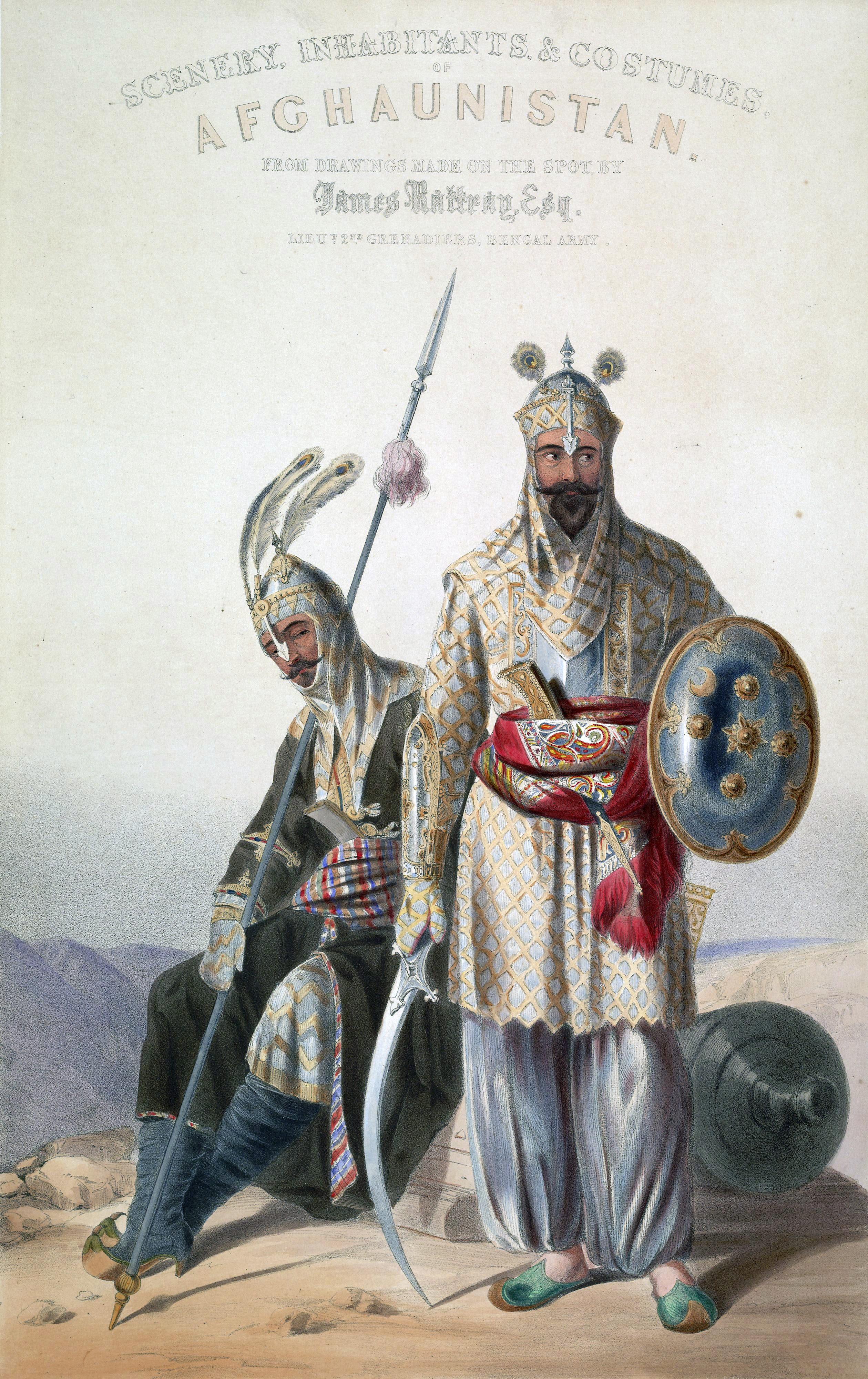
This is an image of the type of Elite heavy shock troops employed by the Afghan army.
The Maratha army lacked heavy shock troops but made use of it’s guns to smash and break up the enemy and then finish them off with a pursuit. In close quarters however few Maratha soldiers wore any form of armour at all. Wheras even the poorest of the Afghan soldiers wore leather armour and the better equiped still had chainmail, against the sort of slashing swords used in the Subcontinet this type of armour was still worth it’s wieght in gold.
The battlefield of Panipat itself was an anceint battle ground. There are signs of a Bronze age fortress in the locality and today it remains much the same as it was in 1761. There have been three decisive battles fought there within the last seven centuries. The first and second were already a distant memory but sadly in 1761 it was to be soaked by yet more blood and for the third time was about to affect the history of the Subcontinent.
Re: The worst day…
Nice imagery - adds a lot to the story. Contrast between Maratha soldier lack of armor vs Afghan soldier armor very interesting. Ditto the cannon size difference.
PS - no apologies needed re: long or tedious repetitious narration - I did not think your narration was any of these. But the images do enhance the story.