Re: The spirit of Lahore
thejoke it would be much appreciated if you post the summary of this article or whatever it is. Links are not enough for thread description.
Re: The spirit of Lahore
I would love to post the whole article but Iget this:-
Sugar and spice and all things nice. That is what Lahoris were always made of. But let me ramble. The year was 1968, it had been a great monsoon and in September the mid-morning sun was sharp and clear but it did not hurt. My friend Sajid and I stood on the pavement outside Tollinton Market (yes, there was a pavement in those days) watching the world go by as we talked of the weather.
Sajid said, “The power of summer is broken.” Translate that into Punjabi for that is what we spoke. A man walking past overheard, paused, turned around and came up to us.
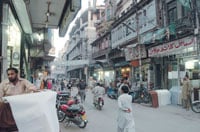
“Yes” he said. “It"s broken. It"s broken into two. And I"ve seen it; it"s lying on the far bank of the Ravi.” In Punjabi he said, eyes wide and wagging his finger, “do totay hoya ai, do!”(split into two) And having delivered his piece, he turned around and marched off and the two of us burst out laughing.
Or there was the time when an out-of-Lahore family went shopping in Anarkali (Liberty did not exist then) and having done their business, the lady of the household was leading this young paandi (the carrier you could hire for large loads) with a huge bundle of towels on his head. Two passing Lahoris espied this and said one to the other, “Yar, lagda ai aina day ghar tay luma hi nahana dhona rehnda ai.”
But the cream of the crop is the one narrated by an-ex Kinnaird College student. Back in the early 1970s she and a friend were walking through Anarkali, one limping with an ankle tied up in a crepe bandage and the other with her wrist similarly dressed. An elderly gentleman, hookah in hand, sat outside a store regarding them as they approached. As they came abreast, he shook his head and said, “Huc ha. Lattan vi toot gaiyan, tay bavaan vi toot gaiyan pur ghar beh kay chain nahin jay aanda.”
That was the ramble that I just had to do to tell all you new age Lahoris what you don"t even know about this wonderful city and how her sons and daughter behaved. You, who have forgotten to smile at a stranger"s quip, have lost the culture of the city you claim as your home. The witticisms were just that: witticisms. There was never any vulgarity or an attack on one"s person; on how dark or bald one was. That was not what Lahoris did. Gujranwala perhaps would have been famous for that.
But the story that needs telling begins sometime in 1957 or thereabout for I was then five and that is the time I can easily recall. For her sartorial requirements my mother had two places. The one was Feroz Din in Mclagan Road and the other Latif in Dhani Ram Street
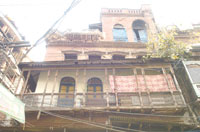
just off Anarkali. And Anarkali was the haunt of this rather smallish man who I imagine was no more than a couple of inches more than five feet. He had a chunky and rather kindly sort of a face with a slightly lop-sided smile, was always dressed in white trousers and a matching shirt – both clean but somewhat the worse for wear.
On one arm he dangled a bulging cloth bag as he ambled around the then rather uncrowded Anarkali. His call was, “Babyeeeeeee!” And his merchandise was potato crisps in sealed paper bags with the legend “Baby Chips.” My sisters and I and later when my brother Imran was old enough to handle the crisps never missed any chance to wheedle our mother for at least one helping per head. Like so many other children of that time, we were pretty well-known to the Baby Chips-walla, because that is what we called him.
memory
lane
The spirit of Lahore
Anecdotes for all new age Lahoris what they don"t know about this wonderful city…
By Salman Rashid
Sugar and spice and all things nice. That is what Lahoris were always made of. But let me ramble. The year was 1968, it had been a great monsoon and in September the mid-morning sun was sharp and clear but it did not hurt. My friend Sajid and I stood on the pavement outside Tollinton Market (yes, there was a pavement in those days) watching the world go by as we talked of the weather.
Sajid said, “The power of summer is broken.” Translate that into Punjabi for that is what we spoke. A man walking past overheard, paused, turned around and came up to us.
“Yes” he said. “It"s broken. It"s broken into two. And I"ve seen it; it"s lying on the far bank of the Ravi.” In Punjabi he said, eyes wide and wagging his finger, “do totay hoya ai, do!”(split into two) And having delivered his piece, he turned around and marched off and the two of us burst out laughing.
Or there was the time when an out-of-Lahore family went shopping in Anarkali (Liberty did not exist then) and having done their business, the lady of the household was leading this young paandi (the carrier you could hire for large loads) with a huge bundle of towels on his head. Two passing Lahoris espied this and said one to the other, “Yar, lagda ai aina day ghar tay luma hi nahana dhona rehnda ai.”
But the cream of the crop is the one narrated by an-ex Kinnaird College student. Back in the early 1970s she and a friend were walking through Anarkali, one limping with an ankle tied up in a crepe bandage and the other with her wrist similarly dressed. An elderly gentleman, hookah in hand, sat outside a store regarding them as they approached. As they came abreast, he shook his head and said, “Huc ha. Lattan vi toot gaiyan, tay bavaan vi toot gaiyan pur ghar beh kay chain nahin jay aanda.”
That was the ramble that I just had to do to tell all you new age Lahoris what you don"t even know about this wonderful city and how her sons and daughter behaved. You, who have forgotten to smile at a stranger"s quip, have lost the culture of the city you claim as your home. The witticisms were just that: witticisms. There was never any vulgarity or an attack on one"s person; on how dark or bald one was. That was not what Lahoris did. Gujranwala perhaps would have been famous for that.
But the story that needs telling begins sometime in 1957 or thereabout for I was then five and that is the time I can easily recall. For her sartorial requirements my mother had two places. The one was Feroz Din in Mclagan Road and the other Latif in Dhani Ram Street
just off Anarkali. And Anarkali was the haunt of this rather smallish man who I imagine was no more than a couple of inches more than five feet. He had a chunky and rather kindly sort of a face with a slightly lop-sided smile, was always dressed in white trousers and a matching shirt – both clean but somewhat the worse for wear.
On one arm he dangled a bulging cloth bag as he ambled around the then rather uncrowded Anarkali. His call was, “Babyeeeeeee!” And his merchandise was potato crisps in sealed paper bags with the legend “Baby Chips.” My sisters and I and later when my brother Imran was old enough to handle the crisps never missed any chance to wheedle our mother for at least one helping per head. Like so many other children of that time, we were pretty well-known to the Baby Chips-walla, because that is what we called him.
Then we grew up. Rauha, the eldest, married and went off to live in Karachi, my brother and I had other pursuits. Only Noshaba continued to visit Dhani Ram Street with mother, but we seldom ever asked after the chips-walla. Occasionally, passing through Anarkali or Dhani Ram I would run into him and exchange a pleasantry or two. In 1972, home on leave from the army when Rauha was visiting from Karachi, the four of us were together in Dhani Ram Street after a very long time. It was now somewhat more crowded, but still not the madhouse it has turned into now.
Above the general din of the street came the cry “Babyeeeeeee!” It was as if we were electrified. And sure enough, there he was. The same easy amble, the white attire, the chunky face now rather more lined, the head with fewer hair and even those mostly grey. But the cheer in his lop-sided grin remained. The only difference was that the one-anna packet that we got back in the early 60s was now twenty-five paisas. (Remember, we went metric in 1962).
Something happened thinking about which even today mists up my eyes. The chips-walla, whose name none of us ever knew, recognised us. No surprise there for he had seen us growing from little children into adults. But when he saw Asiya in my sister"s arms, he was beside himself with pride and joy. He lavished my four year-old niece with bag after bag of potato crisps. My sister protested, but our nameless chips-walla would have nothing of it. He kept saying “Baby kha lay gi.”
And when my sister tried to pay him for what we had got, the good man simply refused. My sister persisted but he remained adamant: there was no way he was taking any money for the gift he had lavished upon us, his old customers.
In 1974 our chips-walla still had worn-out clothing on his body, he was now much older than when we had first seen him in the late 1950s. Obviously there were responsibilities he had to work hard to meet. Yet this good man possessed that largesse of the spirit, regard for an old acquaintance and a kindness of the heart that was beginning to ebb away out of the collective mass of humanity that we called Lahoris.
That was the last time we ever saw him. In 1980, a couple of years out of the army and living in Karachi, I was visiting Lahore when I went looking for him. Some store-keepers remembered him, some did not. But no one knew why he had stopped coming. One casually remarked that he may have passed on. Our chips-walla had been a virtual fixture in Dhani Ram Street, yet when his time was up one fretted about his sudden disappearance; no one attempted to ask what had befallen him.
But the four of us, now ranging from in age from fifty-one to sixty, think of him. We think especially of his munificence upon seeing my niece for the first time. The chips-walla was imbibed with the spirit of Lahore.
-----------------xxxxxx
Its very easy to avoid the formating tag screwing you whole copy paste post.
Once you paste the text in Reply box then press Ctrl+A ( to select whole text ) then press the top left corner button. which says “Remove Text Formating”
It takes hardly few seconds 
Nice memories shared. Thanks for posting :k: