A bit long, but worth a read. A wonderful insight into the way Imran manages any project he undertakes. He knows his strengths and limitations, and knows how to delegate power and authority to his associates and team members. That is what makes a great leader, not one who pretends to be a know-it-all.
The men behind Imran Khan’s bid to lead Pakistan - Telegraph Peter Osborne
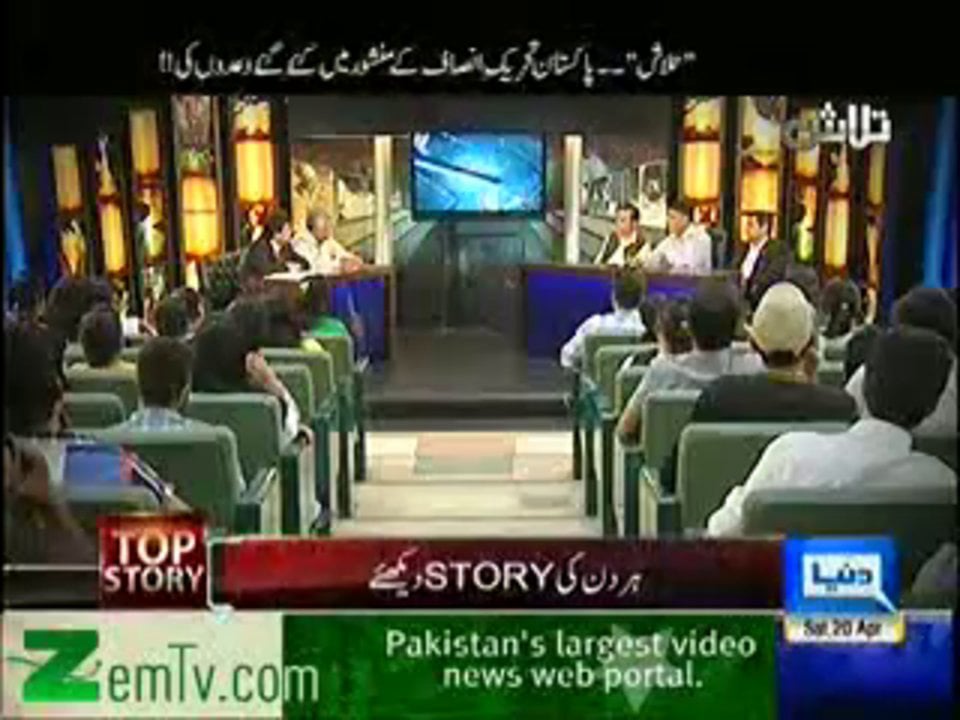
Gathered around a table in a room in Islamabad, a group of 20 men are engaged in vigorous debate. The qualifications for a seat at the table are formidably high. One of the men is Pakistan’s most respected industrialist; another is a highly successful broadcaster; a third, one of the country’s best known political campaigners. And at the head of the table, elegantly clad in a shalwar kameez and listening attentively to each of the arguments, is the most famous Pakistani in the world: the cricket-captain-turned-political-leader, Imran Khan.
In less than four weeks, Khan hopes to be prime minister. Sixteen years after forming his party, Pakistan Tehreek-e-Insaf (PTI) or Pakistan’s Movement for Justice, the man responsible for countless improbable victories on the cricket field believes he can secure the biggest win of his life at the general election on May 11.
“It will be a clean sweep,” he has declared. “It is only a question of whether it will be a simple majority, or if we will get two-thirds.”
Once in power he’s promising to transform the country, bring an end to corruption and rescue the economy. His first move will be to close down the lavish prime-ministerial palace and set up office in his hilltop bungalow.
But is victory really within his grasp? Political analysts say the system is against him. Both of the two main parties – the Pakistan Muslim League and the Pakistan People’s Party – have networks of patrons and “feudal” landlords that control the votes of large swathes of the rural population. And the current president, Asif Ali Zardari, still benefits from the very powerful political inheritance of his late wife Benazir Bhutto and her father, Zulfikar Ali.
Yet, as one travels the country, there is a fervour surrounding the Khan campaign that is impossible to ignore. A recent poll gave Khan a 70 per cent approval rating, compared with 14 per cent for Zardari. His rallies are like rock concerts, attracting a young crowd pumped up by Khan’s attacks on the country’s elite and his calls for a new style of politics.Pakistan’s Newsweek has even invoked the spirit of Barack Obama: “Yes He Khan”, it declares.
Of course, Khan has his critics. They cite his lack of experience (the PTI has only ever gained one of the 272 elected seats in the National Assembly, which Khan held for a brief period) and dismiss him as a creator of slogans, with no practical programme for government or any heavyweight personnel.
I travelled to Pakistan to test these claims and to meet the inner circle that surrounds Khan. I moved widely across the country, joined the crowds at one of his rallies and went behind the scenes for private meetings. My objective was not to meet Khan himself; my mission was to probe the men and women who advise him. Above all, I was eager to find out whether Khan really has created a genuine political movement with a programme for this troubled country. As far as Khan’s inner circle is concerned, it soon became clear that, while his enemies have been busy lobbing accusations of political incompetence, Khan has assembled a crack team of advisers featuring some of Pakistan’s most erudite, powerful and influential men; men who could be enjoying an easy life outside politics but whose sense of commitment to their country has persuaded them to join Khan.
The 60-year-old’s biggest coup was landing Asad Umar. Now PTI’s senior vice-president and election organiser, Umar was the chief executive of Engro, one of Pakistan’s biggest conglomerates, and, reportedly, the country’s best-paid businessman. Between 2004 and 2012 he lifted company revenues from £94 million to £768 million. If PTI wins, he is tipped to occupy an economics post.
In the party’s modest office in Lahore, I ask Umar why he joined Khan. It was, he says, a long courtship which began several years ago in a television studio. “As [Khan] was taking off his clip he turned to me and said in Urdu: ‘You are wasting your time, you should come and join us,’” says Umar. Several years later he attended a business conference where Khan was speaking. In reply to one question from the floor he said: “The day people like Asad Umar come and join us is the day we become successful.” But the wooing started in earnest in late 2011 when Umar received a text message from Khan which read: “This is the year of the revolution, and you cannot continue to stand on the sidelines. You have to take the plunge.”
Umar says that he then engaged in an intense dialogue with the ex-cricketer. “I’m testing him again and again on his commitment to the new Pakistan, to find out whether he really understands what it takes.” He says that the clinching moment came when he asked Khan whether he realised that PTI’s plans for tax reform would mean some of PTI’s own donors being forced to pay taxes. (At present less than one per cent of the country pays their taxes, and even an incredible 70 per cent of MPs do not do so.) Khan replied that, yes, he was aware of the consequences. Shortly afterwards Umar resigned from Engro and joined the party.
“The Pakistan state has been captured by the elite,” he tells me. “The state is not collecting taxes from the rich and powerful and not spending money on the welfare of the people. Some 25 million children of school age don’t go to school, and 1,000 children below the age of two die every day because of malnutrition and lack of health care.” In government, he says, PTI “will collect taxes from the rich and powerful [and] there will be unprecedented increases in social spending, in particular for the education of girls.”
Such social reforms would bring the PTI in conflict with the Pakistani Talibanwho infamously left 15-year-old schoolgirl Malala Yousafzai for dead in October last year after she asserted her right to go to school. But, even though Khan was quick to visit Malala in hospital, critics have accused him of toning down his criticism of the Taliban in order to shore up right-wing votes. The English-language weekly newspaper, The Friday Times, even features a scathing column written by “Im the Dim”, a delusional and naive former cricketer who dreams of becoming prime minister and whose tactic for dealing with terrorism is to give the terrorists what they want, “and then they’ll go away and be good till the next time they’re bad”.
But, in an interview for Time magazine last year, Khan rejected any suggestion that he had been soft on extremists. “Oh please,” he said. “Do you really think I’m going to get votes from the Taliban?” Instead, he said he was intending to target the large sector of the electorate – 56 per cent of eligible voters – who historically don’t bother to visit a polling station on election day.
His party claims 10 million registered members, a phenomenal number which makes PTI by some distance the largest political party not just in Pakistan but in the world, and Khan is the only politician in the country to have used social media on a large scale to communicate with his followers and reach out to potential supporters. He regularly tweets campaign updates and policy messages to his half-a-million followers on Twitter and his official Facebook page has more than 700,000 “likes”. On my travels through Karachi, Lahore and Islamabad – Pakistan’s three greatest cities – I was struck by how many ordinary people, especially the young, insist they will vote for Khan. At rallies young men barely old enough to remember his heroics as a cricketer crowd the stage seeking autographs.
But one of Khan’s other successes has been to convince the electorate he is a man of the people, despite the fact that he and many of his inner circle come from the same privileged elite they accuse of betraying the country. Khan went to Aitchison College, the Eton of Pakistan, before moving to the UK and studying at Oxford. His foreign affairs spokesman,Shah Mehmood Qureshi, also attended Aitchison.
When I visit Qureshi in his beautifully furnished home in Lahore there is a history of Aitchison College on the table in his study and a photograph of Qureshi and other students (including the Conservative politician Bernard Jenkin) at Corpus Christi College, Cambridge, hanging on the wall. Qureshi comes from a long line of saints, scholars, politicians and landowners, but became a populist hero in 2011 when he quit as Pakistan’s foreign minister (the equivalent of British foreign secretary) after Zardari pushed to grant immunity to a CIA agent who had shot dead two unarmed Pakistanis in Lahore.
“My view was that he was not a diplomat as the Americans claimed,” Qureshi tells me. “Mr Zardari was of the view that he should be granted diplomatic immunity.” As soon as he had resigned, he was immediately approached by Nawaz Sharif, chairman of the Pakistan Muslim League (N).
“He said words to the effect that I can’t see a better person than you to be foreign minister of Pakistan,” says Qureshi. But he turned down the offer.
“Frankly, the way I saw things deteriorate I am convinced that this country cannot be run on the basis that it has been run. Structural changes have to be made. For the first time I feel people are genuinely worried about the future. I feel serious concerns about an existential threat to this country. We are collapsing from within.”
As well as a failing economy, Pakistan is plagued with chronic power shortages, an epidemic of local insurgencies and sectarian violence on a terrifying scale. And stable government is absolutely crucial over the next 12 months as British and American troops prepare to pull out ofAfghanistan. A collapse of the Pakistan state raises unimaginable nightmares. The entire region could be dragged into a set of conflicts even more terrible than the civil war that engulfed Afghanistan after the collapse of Soviet rule in the Nineties. It would also present new opportunities for terror groups and crime syndicates from Afghanistan, trafficking drugs, weapons and people to the West. The danger of political instability are all the graver since Pakistan, like neighbouring India, holds nuclear weapons.
For Qureshi, Imran Khan’s PTI is the only party capable of guarding against these dangers. And Umar is specific about the “structural changes” required. The PTI, he says, would break up Pakistan’s centralised state.
“We need to bring power down to the grass roots level,” he tells me. “In terms of governance, we want to take it back to where it was when Jinnah was governor-general.”
Muhammad Ali Jinnah, the founder of Pakistan, died in 1948, a year after Pakistan gained her independence. Therefore Umar is effectively saying that he wants Pakistan’s system of government to return to the high standards of probity and efficiency it enjoyed at the time of British rule. One of the common themes among Khan’s inner circle is a despair at the existing two-party system and its failure to solve Pakistan’s problems.
Before I leave Pakistan, I conduct one final interview. It is with Khan’s political strategist, Javed Hashmi, who, I noticed, was treated with the most deference by Khan at the private meeting I attended. One of the country’s best-known public figures, Hashmi has been involved in Pakistani politics since the Sixties, when, as a student agitator, he was imprisoned and tortured by the military dictator Ayub Khan. In all, he has endured five long terms of imprisonment, of which the most recent was a long stretch courtesy of President Pervez Musharraf, who stepped down as Pakistan’s military ruler five years ago. Hashmi was accused of treason after criticising military rule.
Why has he joined forces with Khan?
“Bringing democracy to this country and fighting against corrupt leaders is my agenda as well as his,” Hashmi tells me. “People see [Muslim League leader] Nawaz Sharif, they see Zardari, they see nothing has changed. For 10 years Imran Khan has struggled and worked. He is saying the right things, I must follow him.”
Just over 40 years ago most people dismissed the chances of Ali Bhutto when his newly formed Pakistan People’s Party ran in the 1970 national elections. Defying all the odds, his new party caught the national mood, and swept home in West Pakistan. Could Imran Khan, the sporting legend famous for snatching victory from the jaws of defeat, be about to repeat history? It’s a real possibility.