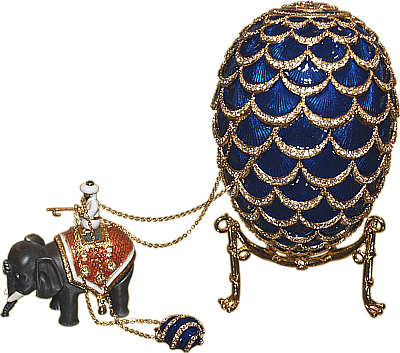
“A Fabergé egg is considered to be any one of the sixty-nine jeweled eggs made by Peter Carl Fabergé and his assistants between 1885 and 1917. Fifty of those eggs—known as the Imperial Fabergé Easter eggs—were made and presented to Czars Alexander III and Nicholas II of Russia, initially as gifts for their wives, the Tsarinas. At that time, a tradition was started within the royal Russian family that included making a jeweled egg to commemorate Holy Days and special celebrations.
Each Fabergé egg is custom made of precious metals or hard stones decorated with combinations of enamel and gemstones. Every egg is unique and the designs, at least initially, included a surprise inside.
The name Fabergé Egg has become synonymous with luxury and opulence. Today they are valued not only as masterpieces of decorative art, but the original Imperial eggs are also regarded as part of the legacy and historical record connected to the last days of the Romanov Dynasty.
In 1885, under the commission of Czar Alexander III of Russia, Carl Fabergé and his goldsmiths designed and constructed the first Imperial egg. It was presented as an Easter gift for the Tsar’s wife Maria Fyodorovna.
On the outside it looked like a simple egg of white enameled gold, but upon opening, it revealed a golden yolk. The yolk itself had a golden hen inside it, which in turn had a tiny crown with a ruby hanging inside, reminiscent of the matryoshka nesting dolls.
Empress Maria was so delighted by this gift that Alexander appointed Fabergé “Court Supplier” and commissioned an Easter gift each year thereafter, stipulating only that it be unique and contain a surprise. His son, Nicholas II of Russia continued the tradition, annually presenting an egg each spring to his wife Alexandra Fyodorovna as well as his then-widowed mother.
From 1885, the eggs were produced on a nearly annual basis. Once an initial design was approved, the work was carried out by an entire team of artisans under the supervision of Peter Carl Fabergé. Among the designers were Michael Perkhin, Henrik Wigström and Erik August Kollin. At the peak of his production Faberge employed hundreds of craftsmen in his St. Petersburg studio, however, it was his own ingenuity and inventiveness that drove the success of his business.
The Imperial eggs soon garnered international fame, as members of royalty in Europe became aware of them. Fabergé went on to make fifteen more (known) eggs for private clients. Among them were a series of twelve Easter eggs commissioned by Alexander Ferdinandovich Kelch, a Siberian gold mine industrialist. These eggs were not as extravagant as the Imperial eggs, and were not as unique in design; they often copied the originals.
With the advent of the Bolshevik Revolution in 1917, the eggs were ultimately scattered throughout the world; some were lost or destroyed; others were later rediscovered and purchased by collectors.” ( Fabergé egg - New World Encyclopedia)
"The process of making the eggs usually took about one year. The first part of the process involved detailed and meticulous planning, followed by the preparation of sketches and models. Lastly, there was a team of jewelers, stone-cutters, lapidary workers, silversmiths, goldsmiths, and enamelers that would combine their talents to make the final creation. When an egg was complete, it was brought to the Palace and presented to the Czar by Fabergé in person.
From 1885 to 1917, the House of Fabergé completed 54 Imperial eggs for Alexander III to present to his Empress and for Nicholas II to present to his mother, the Dowager Empress Maria Fedorovna and his wife the Empress Alexandra Fedorovna. Of these, 42 have survived and the others are missing. The eggs for 1917 were never completed, but have been discovered in recent years."
(http://www.jrjewelersblog.com/designers-jewelry/imperial-faberge-eggs/)
http://www.jrjewelersblog.com/wp-content/uploads/2011/04/the-swan-faberger.gif
http://bittsandbytes.net/ARTICLES/FABERGE/coronation_egg_smaller.jpg
http://bittsandbytes.net/ARTICLES/FABERGE/lilies_maybe.jpg
http://bittsandbytes.net/ARTICLES/FABERGE/memory_of_azov1.jpg