Now a days issue of Thar has been at top of our media list .

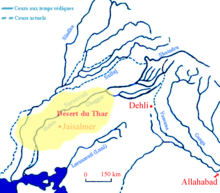
Thar is the world’s 18th biggest desert and situated almost in India , Rajhistan also called Rajputana . It is on the eastern bank of river Sutlaj and goes upto Indian Ocean or Baheera e Arab . A Muslim majority state of Rajputana , Bahawalpur opted Pakistan in 1947 partition so some part of this desert comes in Pakistan which is called Choolistan . Most historic place in Pakistani Thar is Drawar Fort .

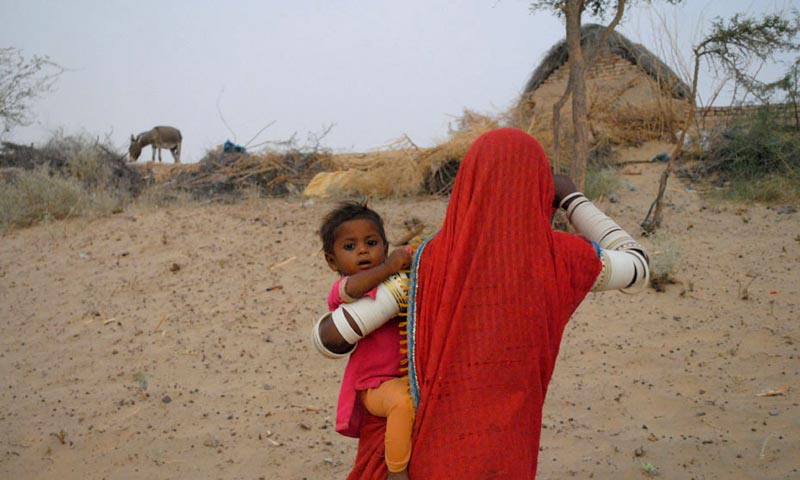
The southern portion in Pakistan’s Sindh is inhabited by primarily by Sindhis and Kolhis. A colourful culture rich in tradition prevails in this desert. The people have a great passion for folk music and folk poetry.. Poor people love their home place . The main occupation of the people in desert is agriculture and animal husbandry. In past years there has been a tremendous increase in human population as well as animal population. This has led to improper control of grazing and extensive cultivation resulting into the deterioration of vegetation resources. The increase of human and livestock population in the desert has led to deterioration in the ecosystem resulting in degradation of soil fertility.
The living standard of the people in the desert is low. The Thar Desert is the most densely populated desert in the world, with a population density of 83 people per km. vs 7 in other deserts .
http://upload.wikimedia.org/wikipedia/en/thumb/d/d1/Khejro_Lopping.JPG/220px-Khejro_Lopping.JPG

The Sindh area attached to this desert is called Tharpaker .
Tharparkar consists of two words, Thar means ‘desert’ while Parkar stands for ‘the other side’. Years back, it was known as Thar and Parkar but subsequently became just one word ‘Tharparkar’ for the two distinct parts of Sindh province. On the western side, Parkar is the irrigated area whereas Thar, the eastern part, is known as the largest desert of Pakistan with a rich multifaceted culture, heritage, traditions, folk tales, dances and music due to its inhabitants who belong to different religions, sects and casts. The Parkar area has been formed by the alluvial deposits of river Indus while Thar mostly consists of barren tracts of sand dunes covered with thorny bushes. The only hills of the district, named Karon-Jhar, are in the extreme south-east corner of Nagar Parkar Taluka, a part of Thar. These hills are spread over about 20 kilometers in length and attains a height of 300 meters. Covered with sparse jungle and pasturage, they give rise to two perennial springs as well as streams caused after rain.
Climate:
The Thar area has a tropical desert climate. The months of April, May and June are the hottest ones during the day. The average maximum and minimum temperatures during this period remain 41 centigrade to 24 centigrade respectively while December, January and February are the comparatively coldest months with average maximum and minimum temperatures 28 centigrade to 9 centigrade respectively. Rainfall varies from year to year. Most of the rain falls in the monsoon months between June and September whereas the winter rains are insignificant. For many times in last decades there was no rain in Thar during whole the year . It is often not much cold in winter .
Some worth-seeing places:
Though sand is all around in Thar. But, in the Nangarparkar, the egg-shaped hills of Karon-Jhar and the charm of its valleys coupled with some sacred places for Hindus may give unforgettable memories.
A few kilometers away in the north-western side from Nangarparkar, Hindus’ holy place Saroharo attracts its believers as hindus denote this temple to their Mahadev (the biggest god). Saroharo is on the brink of a seasonal stream and a all-season-pond where Hindus come for their rituals. Since they have faith on the presence of these hills and pond in their holy books, they throw the bones and ashes of dead bodies into whirlpool of this pond after burning them. They also celebrate Shorateri fair here every March. Above Saroharo, there is the Rishi’s aasthan (a very small room used for worship) and ten impressions of his fingers of feet. According to a belief that Rishi worshipped here for ten thousand years but finally lost his invocation by touching a young girl. (He is the same Rishi whose request to the god turned the sea into a desert.)
Gaomakhi is another aasthan, just a kilometer away in the north of Saroharo. Here the tips of two hills join each other, making the shape of a cow. A 30-feet high waterfall may be witnessed here during the monsoon season. Hindus come here too for their rituals. At the distance of a few yards in the south of Gaomakhi, here is a very deep pond named Bhemgoda. It is 20 feet wide and around 30 feet long pond that never dries up. Inchlas is another aasthan towards the south-western of Nangarparkar. Here, three streams come out of different hills. Water flows from these natural streams all the year. A tavern is here for the travelers and Hindus who visit Inchlas aasthan. Chandan Gud is a fort, built by Rana Chandan, one of the Parkar rulers, in 1859. Now, only its remains are there.
Main
parts of Thar (box item)**Chachro, Mithi, Diplo, Nangarparkar, Umerkot
**A tale of Rishi’s “buddua” (Side-bar or Box item)Once upon a time, there was a Rishi (worshiper) who was in search of an isolated place to worship. One day when he was in trans, he saw the Karon-Jhar Hills and decided to go there for his worship. He spent almost ten thousand years in devotion standing on each finger of his feet. During the last days of his worship, the Rishi’s wife sent a letter to him tied around the neck of a butterfly requesting him to come back. Replying back to his wife, the Rishi wiped off the drops of perspiration from his forehead and wrapped in his wife’s letter and returned the butterfly back to his wife. While passing over the sea, an eagle attacked the butterfly, and Rishi’s sweat-drops fell in the mouth of a fish. Later on the fish gave birth to a girl who was brought-up by fishermen and named after Machandra. In her youth, she turned to be a most beautiful girl, used to sail in the full-moon nights. Meanwhile, the Rishi has completed his worship and went to the fishermen so that they could take him to the other side of the sea. But, all fishermen were busy and they asked Machandra to take the Rishi other side of the sea. After sitting in the boat and watching the beauty of Machandra, the Rishi fell in love with the girl. He rubbed the back of girl. Realizing his wrong-doing, he stopped himself at once but he has lost his ten thousand years’ worship. Than he raised his hands for buddua (asking something from god against someone) and said, “O’ Parkar no Rishi or Monk shall take birth on thy soil”. Rishi’s buddua led the sea dried and a busy harbour turned to a desert. The history has no evidence to any Rishi or Monk on the soil.Average temperature (Centigrade) and precipitation recorded at Umar Kot, a part of Thar
Month Max. Min. Precipitation in mm
January 25.6 7.6 1.00
February 29.5 10.7 2.00
March 35.3 16.6 1.00
April 39.9 20.7 1.00
May 42.4 25.0 1.00
June 40.8 27.3 10.00
July 37.2 26.8 50.00
August 35.1 25.8 76.00
September 36.2 24.2 23.00
October 36.4 20.1 5.00
November 32.3 13.9 1.00
December 27.4 8.7 1.00
Source: Meteorological Department, Government of Pakistan, Islamabad.
I will try to the post the details of recent problem in my next post in this thread , Hope some serious discussion here .


 Yah Loog Nasal Dar Nasal Hamari Ghulami kartay aain hain, Hum inn ko haqooq ka batain
  Inn ka haq hay bus hamari khidmat karna, Mola Khush Rakhay :cobra: