A disgusting situation in Pakistan exchange rate started with new government. We should know that most of Pakistani debts are in dollars and one rupee appreciation in value of dollar means 45 billion rupees increase in Pakistani external debt. Dollar appreciated by Rs 5.30 during last 6 months, increasing Pakistani external debt by around Rs 240 billion. I do not know what to say but it seems that maybe this is what Pakistanis want and deserves:
Misery of Pakistan rupee devaluation started after Bhutto took over in 1973. Officially dollar was Rs 4.76 from early 50s until 1973, but Bhutto officially devalued rupee to Rs 11 that later was re-valued to Rs 9.90. This was official rate until Zia moved the rupee to managed float with rupee open market rate (or true rate) few rupees more than managed rate. Under managed float rupee kept devaluing and when Zia died n 1988, rupee in open market was around Rs 17.
Mega corrupt period of NS and BB started in 1988 and with this corrupt period rupee in open market devalued 320 percent from around Rs 17 to a dollar in 1988 to Rs 54 in 1999.
Initially when Musharraf came to power, rupee kept devaluing and peaked at Rs 67 to a dollar in 2001 (one reason of heavy devaluation during this initial period was that apart of readjustment of economy to new reality, Pakistan rupee was made completely convertible by Shaukat Aziz during this period, that means official rate and open market rate became more or less one).
Since then rupee stared appreciating and reached Rs 57 to a dollar at the end of 2003 when Pakistan government interfered and started buying dollars to reduce strength of Rupee, resulting in rapid increase of dollar reserve. Since then government manoeuvred managed devaluation in open market, stabilising exchange rate at Rs 60 to a dollar by end of 2004. Since 2004 to end of 2007 (for 3 years), rupee was stable at around Rs 60 to a dollar (varying between Rs 60 and Rs 61).
Rupee stayed within the range of Rs 60 to Rs 61 till the time PML(Q) government stayed (Nov 2007) but with fading expectation PML(Q) government return and expectation of new government led by past corrupts, Rupee started devaluing again and today it is touching Rs 66 (devalued around Rs 5 in last 6 months). I do not know what to say and where this devaluation would end. I can only hope and pray that this rot stops.
For instance dollar exchange rate: 25 October 2007 to 25 April 2008 = 6 months Rupee devalued from Rs 60.65 to a dollars to Rs 65.95 to a dollars (Rs 5.30 devaluation in 6 months).
Forex update: KARACHI, Jan 02: The Pakistani Rupee was traded at Rs 61.5, to the US Dollar in the open market. (Bureau Report) (Updated @ 14:15 PST)
**Forex update:**KARACHI, Feb 01: The Pakistani Rupee was traded at Rs 62.7 to the US Dollar in the open market. (Bureau Report) (Updated @ 16:00 PST)
**Forex update:**KARACHI, March 03: The Pakistani Rupee was traded at Rs 62.8 to the US Dollar in the open market. (Bureau Report) (Updated @ 14:16 PST)
**Forex update:**KARACHI, April 01: The Pakistani Rupee was traded at Rs 63.35 to the US Dollar in the open market. (Bureau Report) (Updated @ 14:10 PST)
**Forex update:**KARACHI, April 25: The Pakistani Rupee was traded at Rs 65.95 to the US Dollar in the open market. (Bureau Report) (Updated @ 16:02 PST)
[For exchange rate of 25th April 2008: http://www.dawn.com/2008/04/25/welcome.htm]
I am glad that u have realised the disaster Mush-led govt have brought on Pakistan.
Now u agreed on the fact that Dollar has been appreciated at 5.3% in last six months... believe by any mean, this new govt. has nothing to do with that fact, but yes u r rite, the previous govt. did this to increase the liability on Pakistan.. for some personal benefits or they were dumb enough to not to realise where this thing can lead to... i wonder what u were doing when previous govt. was in charge.... it would have been lot more help if these numbers were presented in their govt... but i guess, like others,u are trying to put the dirt on the new govt....
Brother, what a comment :). Well, I have given you the exchange rate figures of previous government too. Do you think that keeping the exchange rate stable for so long was bad? Can’t you see that dollar was Rs 54 in 1999 and it was around Rs 60 in 2007. Is that bad currency exchange rate management along with accumulating huge foreign exchange reserves without increasing dollar debt or substantially increasing even total Pakistani debt?
Actually what I can clearly see is that, Pakistani rupee has not seen such stability in exchange rate since 1973 rupee turmoil what it has seen during PML(Q) government (2002-2007), along with huge accumulation of foreign exchange reserves, substantial decrease in debt to GDP ratio (from 110 percent in 1999 to 50 percent in 2007), external trade increasing from 17 billion dollars to around 50 billion dollars, stock market valuation increasing from less than 5 billion dollars to over 60 billion dollars, robust economy with over 7 percent real growth and GDP increase from 62 billion dollars in 1999 to 160 billion dollars in 2008.
I am not liar and present government [especially people in PML(N)] are full of liars, so maybe you might think that what I wrote is lie too :). Hence, let me give you site that has record of open market exchange rate variations from 1992 till today. This is most reliable site as it belongs to biggest Pakistan foreign exchange dealer (Khanani and Kalia international) that deals with most of open market foreign exchange transactions in Pakistan.
You have to put dates and currency. Site would give you the graph of rupee exchange variations with respect to that currency. You can read the value from the graph or put the cursor on the graph to see the figure at any particular point.
Actually, I believe that this recent rupee devaluation has started because people do not trust politicians in present government and thus flight of Capital has already started, increasing demand of dollars and selling of rupee assets. Else Pakistan has huge foreign exchange reserves, something Pakistan never had before Musharrf came to power, not even 10 percent of the reserves Pakistan has today, so pressure on rupee and start of devaluation only means flight of capital in big way due to mistrust and lack of confidence on present government full of liars, thugs, thieves, corrupts and incompetents.
Successive governments have failed to control the economy and inflation. Prices of raw materials have increased manyfold within the last few months. Industries are facing great hardships to remain competitive these days.
For example the price of sheet metal has risen to Rs 95 per kg from Rs. 44 per kg within last few months.
The factors responsible for the current situation are moslty external. The question is the new govermnment is capable of controlling them?
Actually, I was hoping that this no-confidence move from investors would not start until after holiday period and they would run after seeing corruption and mismanagement of new governments, but it seems that past baggage of present government has already started many running away. I am praying that this rot stops as Pakistan economy is still quite robust.
The reason is not the mistrust in new government, but the mistrust in present "system". That is, with Musharraf as President and his "opposition" in the Parliament, investors do not know for how long will it continue. There are fears that "athwanja 2-b" may axe the new government anytime.
Plus the judges issue is also a destabilising factor, with PML-N saying that they will quit the government and lawyers threatening coming to streets, also makes the confidence in stability of new government less.
^^ I agree, the minute the Musharaf is removed, there will be political stability and investors will be back in Pakistan.
Pakistan is one of hottest emerging market of the in the globe, no investor want to miss the chance to have their piece of the pie.
The Issue of Cheif Justice and Musharaf are the major hurdle as of we speak.
As far as the corruption is concerned there are only fewer investor who are sacred of it, large number prefer the country where corruption is at high... why ??? it is totally different story...
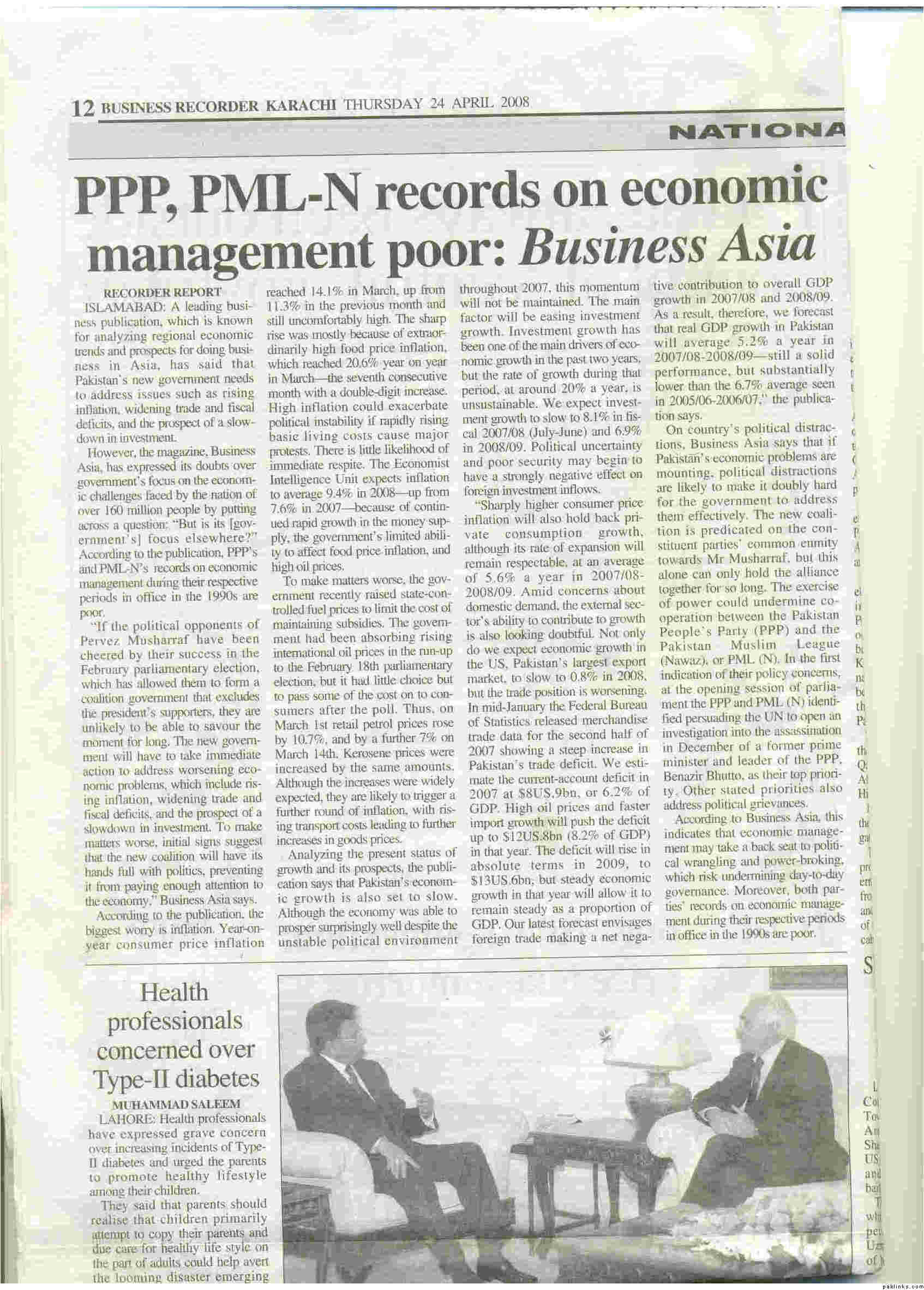
There are tough demands on I Dar. He has to perform instead of blaming the previous government. His previous record is not so promising. Please read the above article. (Bussiness Recorder April 24, 2008)
**Those who do not know the real economy and depend on government statements, many are foreign Pakistani investors: **These people are prone to what government says about condition of economy. Liars like Daar and political economic gurus in Pakistan are lying about present Pakistani economy. For instance, if one understands economical figures and facts of economics than one should check lies of Daar on his TV briefings. His statement that Pakistan inflation was high and that debt has increased due to excessive borrowing during last 8 years was such a big and obvious lie that anyone who knows a bit of economics and maths can tell easily (even using his own graphs he presented on TV, though those graphs was also a bit misleading adversely from reality). Obviously, such statements must have scared many investors and believing that Pakistan debt has increased must have felt safe moving their money abroad. Hence pressure on rupee exchange rate.
Second are foreign investors who do their work before investing: These people know the reputation of present corrupt government and seeing that present government finance minister is lying blatantly on TV would have realised that intention of present government is to do corruption again as they use to do in past, else they would not lie but acknowledge and build up on the robust economy they have inherited. Hence these foreign investors must have got scared of their investment and must have started moving their investment out. Hence pressure on rupee exchange rate.
**Third are those investors who live in the country and know state of government (as even today, Presidency and establishment is very strong), state of economy and must be making their decision accordingly: **These people might be thinking that Daar being habitual liar is lying, still President Musharraf is in power and thus corruption would not be easy for these corrupt politicians. They also know that economy is robust and there is little chance for Pakistan to fall badly with such robust economy and President holding strong office would not let it happen easily. So, these people have not panicked. It is showing in performance of Pakistani stock exchange that has not plummeted but is holding ground with some gains.
Ideally, if economy would have been in bad shape then stock market would have plummeted especially when flight of capital has started (can be seen from devaluation of rupee), but that is not happening, showing that local investors are holding their ground. I think they would hold their ground as long as President Musharraf is in power and if he is gone, things would change badly. One can see that rehearsal if one go back and look at what happened when news was there that President Musharraf is going to shed his uniform at the end of 2004 (stock market started plummeting), but when he did not, stock market boom started from beginning of 2005.
A disgusting situation in Pakistan exchange rate started with new government. We should know that most of Pakistani debts are in dollars and one rupee appreciation in value of dollar means 45 billion rupees increase in Pakistani external debt. Dollar appreciated by Rs 5.30 during last 6 months, increasing Pakistani external debt by around Rs 240 billion. I do not know what to say but it seems that maybe this is what Pakistanis want and deserves:
This govt has been in power for little over a month now and you're blaming them for currency devaluation of for last 6 months? How fair of you!!!
BTW, Mush govt was keeping rupee artificially floating around 60 to a dollar for last 6 or 7 years which is not sustainable forever.
This govt has been in power for little over a month now and you're blaming them for currency devaluation of for last 6 months? How fair of you!!!
BTW, Mush govt was keeping rupee artificially floating around 60 to a dollar for last 6 or 7 years which is not sustainable forever.
Pakistani currency is not managed but convertible currency. It does not have managed exchange rate but convertible exchange rate. Government can lower the exchange rate of such currency (make currency weaker in market) by selling such currency and buying foreign currency, but could not keep the exchange rate higher (make the currency stronger in market) as that would require government to keep selling foreign currency (dollars) and no government have unlimited foreign reserve to support their currency (well, Pakistan reserves was increasing and that means they were keeping the rupee exchange rate undervalued).
I am blaming the devaluation on present government not because of their economic policy but because of investors lack of confidence on present government as Pakistani currency is getting devalued not because of Pakistan economical reason (as that would have shown in stock market too) but because of no confidence on present government and thus resulting in flight of capital from Pakistan.
Currency devaluation and its impact on the economy
Devaluation is usually undertaken as a means of correcting a deficit in the balance of payments. Some analyst are of the view that weakening the value of currency could actually be good for the economy – since a weaker currency will boost exports, which in turn will lift employment and all this will set in motion economic growth and keep the economy going
By Parveen Zaiby
Devaluation means decreasing the value of nation’s currency relative to gold or the currencies of other nations. Devaluation occurs in terms of all other currencies, but it is best illustrated in the case of only one other currency. Devaluation and Depreciation are sometimes used interchangeably, but they always refer to values in terms of other currencies and the value of currency is determined by the interplay of money supply and money demand. In common modern usage, it specifically implies an official lowering of the value of a country’s currency within a fixed exchange rate system, by which the monetary authority formally sets a new fixed rate with respect to a foreign currency. In contrast, (currency) depreciation is most often used for the unofficial decrease in the exchange rate in a floating exchange rate system.
Historically, early currencies were typically coins stamped from gold or silver by an issuing authority which certified the weight and purity of the precious metal. A government in need of money and short on precious metal might abruptly lower the weight or purity of the coins without announcing this, or else decree that the new coins had equal value to the old, thus devaluing the currency.
Present day currencies are usually fiat currencies with insignificant inherent value. As some countries hold floating exchange rates, others maintain fixed exchange rate policy against the United States dollar or other major currencies. These fixed rates are usually maintained by a combination of legally enforced capital controls or through government trading of foreign currency reserves to manipulate the money supply. Under fixed exchange rates, persistent capital outflows or trade deficits may lead countries to lower or abandon their fixed rate policy, resulting in devaluation (as persistent surpluses and capital inflows may lead them towards revaluation).
Devaluation is usually undertaken as a means of correcting a deficit in the balance of payments. Some analyst are of the view that weakening the value of currency could actually be good for the economy—since a weaker currency will boost manufacturing production, which in turn will lift employment and all this will set in motion economic growth and keep the economy going. But the dangers of a falling rupee too quickly, would be that the foreigners will stop investing in the country, which would make it impossible to finance the current account (trade) deficit. It will then be forced to push interest rates up to defend the rupee (crashing rupee stock and bond markets is supposed to make the rupee more valuable), and that could create recession.
In an open market, the perception that a devaluation is imminent, may lead speculators to sell the currency in exchange for the country’s foreign reserves, increasing pressure on the issuing country to make an actual devaluation. When speculators buy out all of the foreign reserves, a balance of payments crisis occurs. Economists Paul Krugman and Maurice Obstfeld state that the balance of payments crisis occurs when the real exchange rate (exchange rate adjusted for relative price differences between countries) is equal to the nominal exchange rate (the stated rate). In practice, the onset of crisis has typically occurred after the real exchange rate has depreciated below the nominal rate. The reason for this is that speculators do not have perfect information; they sometimes find out that a country foreign reserve are at lower level after the real exchange rate has fallen. In these circumstances, the currency value will fall rapidly. This is what occurred during the 1994 economic crisis in Mexico.
Devaluation of a currency was a matter of prestige in the past. However with the lapse of time it has been learnt that such an operation is sometime necessary to save the country from economic hardships. Devaluation is not an enduring way to improve the economy, unless the Government revises its method of economic planning and execution of plans, no amount of devaluation will stabilise the external value of our currency. We must give highest priority to the consolidation of our economy vis-a- vis expansion. A strong discipline should be exercised over all the unproductive expenditure whether it is in public or private sector.
Possible impact of the devaluation on the economy
Possible impacts of the devaluation on the economy could be the stimulation of merchandise exports, discouraging merchandise imports and thus improving terms of trade, increase revenue collection and savings in repatriation of profits and royalties by existing foreign investors, bringing illegal foreign exchange leakages into official channels and putting an end to gold smuggling. Inflow of foreign capital can be improved by devaluation only if prices do not rise. It is supposed to provide an escape from vexation import controls that prevent utilisation of full industrial capacity, stifle export drive, bestow monopoly profits on a few, inefficient market regulation and pressure on budget and domestic prices will sky rocket. The obvious consequence of devaluation in the short run would be to worsen the balance of payment position and raise the burden of Pakistan’s foreign debt and debt service liability and foreign loans repayment would break the back of the budget, which would in turn increases the trade gap. It will upset all the cost-price relationships in the economy, lead to galloping inflation, and will stall many ongoing projects due to rising costs.
Persistent adverse trade balance and disequilibrium in balance of payment are the main causes, which compels a country to devalue its currency. Major components of trade balance are exports and imports of a country. Adverse trade balance is generally the result of slackness in exports in comparison to imports. It might affect exports prices and thus wipe out all the edge that might be hoping to gain in the export markets through devaluation. The markets for Pakistan’s traditional export are inelastic, therefore devaluation may thus in fact give no big boost to their exports, because there is a small quantum of value added exports and major requirement is based on export of raw material. Further the quality of export not competitive in the foreign market. If an export -boom in agro-based industries does come about, the consequential diversion of land from food crops will raise food prices and cause a rise in wages unaccompanied by any gains in productivity. Moreover, most of the bigger enterprises will face increasing difficulties in loan repayments and the cost of new industrial investments will shoot up sharply.
In Pakistan, industries are heavily dependent on imported raw materials for industrial goods and capital goods and components, and their access too many advanced countries are blocked by quotas and tariffs. , any rising of the prices of such inputs through devaluation, would raise industrial costs and reduce the intensity of capacity utilisation. Therefore, it should be avoided as a resort to deficit financing. Devaluation with its implications will cause a contraction in economic activity and consequential slide down in income tax receipts will raise the burden of Pakistan’s defence equipment, and foreign debt overnight. It cannot stop smuggling as long as black- market transactions in foreign exchange continue. Devaluing the Pak. Rupee means devaluing the price of Pak labour and talent in the international market who send foreign exchange through home remittance. Devaluation will make Pakistan lose heavily both as seller and as a buyer and will make no good substitute for remedial changes in economic policies and developmental planning. Devaluation of Pakistan Rupee will mean devaluation of Pakistan labour and talent in the international market evaluation will serve as a drug rather as a stimulant and cause an unprecedented inflation.
Bold steps must be taken to enliven capital market and more foreign aid procured. Strong disciplined should exercised over all unproductive expenditure, whether it be public sector or private sector. Lavish spending of aid was bad enough, but it would be even worse to raise the cost of debt repayment through devaluation, whose benefits in terms of larger foreign investment are quite illusory.
Central exercise as well as sales tax receipts and custom duties should go down due to lower volume and high prices of imported inputs resulting in cut-backs in industrial production.
Devaluation in Pakistan in different periods
Pakistan had experienced an increased in wholesale price, after its first devaluation in 1955, due to inelastic production structure, which had generated uncontrollable inflationary pressure. Again on 11th May 1972, Pakistani Rupee was devalued by 56.7% in terms of gold to a new, unified Official Rate of PRs11.00 per U.S. Dollar and 4.5% fluctuation range for the currency was also introduced. At the same time, the entire Export Bonus Voucher scheme with its complex accessory rates was abolished. On 8th January 1982, the Rupee was devalued when the currency was unhitched from its link to the U.S. Dollar and the fixed Official Rate abolished. A controlled, floating Effective Rate for the Rupee, initially at the Rupee dollar exchange rate was Rs9.9 per U.S. Dollar was established in relation to a trade-weighted basket of currencies, Pakistan has been on a system of managed float since January, 8, 1982, under this system the country has experienced massive downward slide in its exchange rate. In 1997, retail prices rose significantly to 20 to 24 rupees/kg (US 55.4 to 66.5 cents/kg), indicating short domestic supplies, the devaluation of the rupee against the dollar was highest in 1996, which contributed to the rise in price since sugar had been traded internationally in US dollars. As imports had increased in the 2 years period, the rising price of imported sugar (in rupees) was also reflected in the rising domestic price. An import tariff of 10 percent was removed in mid-1997, so as not to contribute to increasing sugar prices. It rose to very high amounting to Rs64.1 in July 2001. The economic indicators showed some visible improvement since the year 2001-02 and it continued to be so, which helped the authorities to turn around the creeping devaluation and the rupee has stabilised in the range of (Rs) 59-60 per dollar till 2006 and May 2007 (Rs60), but after that the currency has started devaluing since 2007 to date i.e., April 2008 it stands to now Rs63.40 against a dollar. It is concluded that devaluation may temporarily boost exports only if the demand of exported goods in the foreign country is price elastic, but this is not necessary for those goods for which the demand is not price elastic. We therefore, should first try to analyse the price elasticity of demand of goods exported from Pakistan, because experienced has taught that devaluation did not lead to increase in exports. Further to this, it has been observed that successive devaluation in the past have failed to evoke a favourable long term response in terms of improved exports. Apart from encouraging speculation it also shatters the confidence of the foreign investor in the domestic economy. It takes the economy on the path of devaluation aided cost push inflation and is a never ending vicious circle. A long term plan is required to put the economy on the right track. This should provide a framework for exporting value added branded products, improving the quality and image of existing products, finding new export markets and better marketing strategy.
We should try to effectively utilise the human resources, which is abundant in Pakistan and is under- utilised. Moreover, cut in government expenditure, improvement in budget and trade deficit, multiple and persistent exchange rate would also be of great help. But devaluation is not the solution of the current economic crisis and should not be resorted to in future.
**Those who do not know the real economy and depend on government statements, many are foreign Pakistani investors: **These people are prone to what government says about condition of economy. Liars like Daar and political economic gurus in Pakistan are lying about present Pakistani economy. For instance, if one understands economical figures and facts of economics than one should check lies of Daar on his TV briefings. His statement that Pakistan inflation was high and that debt has increased due to excessive borrowing during last 8 years was such a big and obvious lie that anyone who knows a bit of economics and maths can tell easily (even using his own graphs he presented on TV, though those graphs was also a bit misleading adversely from reality). Obviously, such statements must have scared many investors and believing that Pakistan debt has increased must have felt safe moving their money abroad. Hence pressure on rupee exchange rate.
Second are foreign investors who do their work before investing: These people know the reputation of present corrupt government and seeing that present government finance minister is lying blatantly on TV would have realised that intention of present government is to do corruption again as they use to do in past, else they would not lie but acknowledge and build up on the robust economy they have inherited. Hence these foreign investors must have got scared of their investment and must have started moving their investment out. Hence pressure on rupee exchange rate.
**Third are those investors who live in the country and know state of government (as even today, Presidency and establishment is very strong), state of economy and must be making their decision accordingly: **These people might be thinking that Daar being habitual liar is lying, still President Musharraf is in power and thus corruption would not be easy for these corrupt politicians. They also know that economy is robust and there is little chance for Pakistan to fall badly with such robust economy and President holding strong office would not let it happen easily. So, these people have not panicked. It is showing in performance of Pakistani stock exchange that has not plummeted but is holding ground with some gains.
Ideally, if economy would have been in bad shape then stock market would have plummeted especially when flight of capital has started (can be seen from devaluation of rupee), but that is not happening, showing that local investors are holding their ground. I think they would hold their ground as long as President Musharraf is in power and if he is gone, things would change badly. One can see that rehearsal if one go back and look at what happened when news was there that President Musharraf is going to shed his uniform at the end of 2004 (stock market started plummeting), but when he did not, stock market boom started from beginning of 2005.
I slighlty disagree with ur categorization of Investors.
the first kind u mentioned just simply does not exist and even if they do, there number is not significant...
There is a kind of investors ( and they are in big number) who must invest in Pakistan due to some issues they have in their country of residence... For Example the resident of Arabian Gulf Country, normally invest in Pakistan, no matter what the economic situation is there... they do there homework on the particular invest, despite the few, who are dragged in the real-estate frauds... most of them get good returns on their investments. These people normally have no choice but to invest in Pakistan, they normally invest in Real-Estate, Education, Retail business and/or Small industrial projects. These projects normally done under the supervision of their direct relative or close friends.
Now the delima is not every one have these direct relatives and/or close friends who can work their investments... a huge amount of investment can be directed to the Pakistan if such entity is there ( a business tip, for a company who advice/manage the investments of overseas Pakistanies).
2) 2nd Kind of investor which are classified as foreign investors ( huge institutes) can be termed as "Fasli-Bateray". they come to any country with certain time frame and returns in their mind and they use all the resources to acheive them. These kind of Investments have a short-term effect on the over all economy but in the long run the out-flow of the cash gets higher than the inflow... I.E> getting the local currency weaker... Unlike the first kind, these investors enjoy certain incentives and tax holidays... as far as my opinion is concerned ( which is valued in the companies i advice) these are the crocodile govt have to be carefull from. If the right law to protect local currency and economy are not in place then it is the receipe for disaster.
3) The Local investor is the one who should be given and backed by the govt. there should be govt. backing for these investors to invest in other emerging markets and/or someway buy power houses across the globe.... these kind of investors are the one which are vital to any economy and make country stronger...
Dilema for Pakistan is that, only 2nd type of investors enjoy the benefits provided by the govt or let me put it this way, the benefit are only for 2nd type of investors...
previous govt. ( including civilian) banked on th e2nd type of investors, that why we have pear shape economy which is directly being dictated by the foreign entities...
In my opinion it is still not too late, Pakistani govt, should puts its weight on the 1st and 3rd type of investors and the 2nd will be forced to follow the tune, the only problem with this is, the govt. official will not be getting huge kick-backs and commissions...