you are not right quran start addressing mothers of ummah from ayah 28.
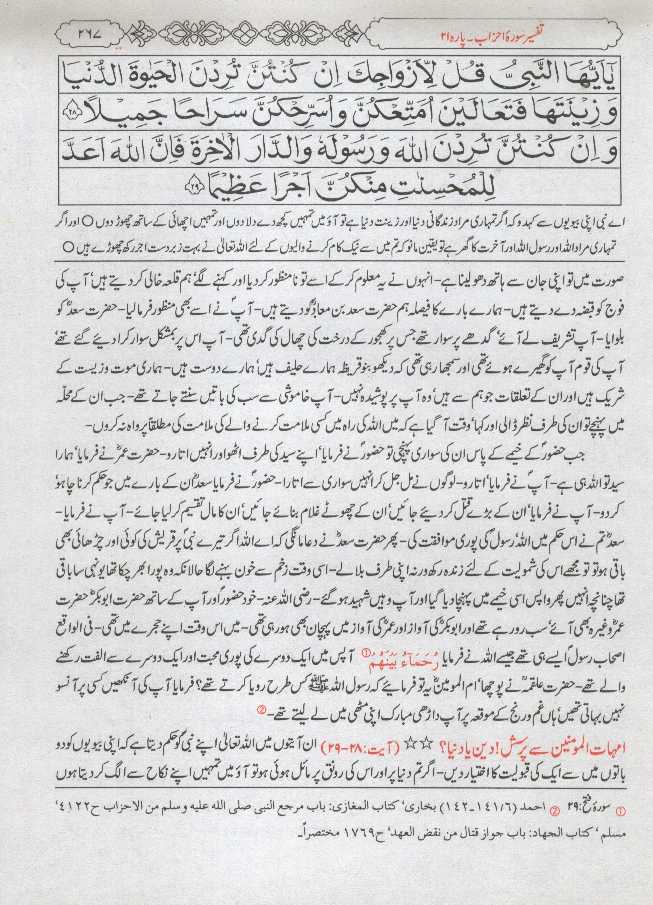
(28. O Prophet! Say to your wives: "If you desire the life of this world, and its glitter, then come! I will make a provision for you and set you free in a handsome manner.'') (29. "But if you desire Allah and His Messenger, and the Home of the Hereafter, then verily, Allah has prepared for the doers of good among you an enormous reward.'')
Giving the Wives of the Prophet صلى الله عليه وسلم the Choice
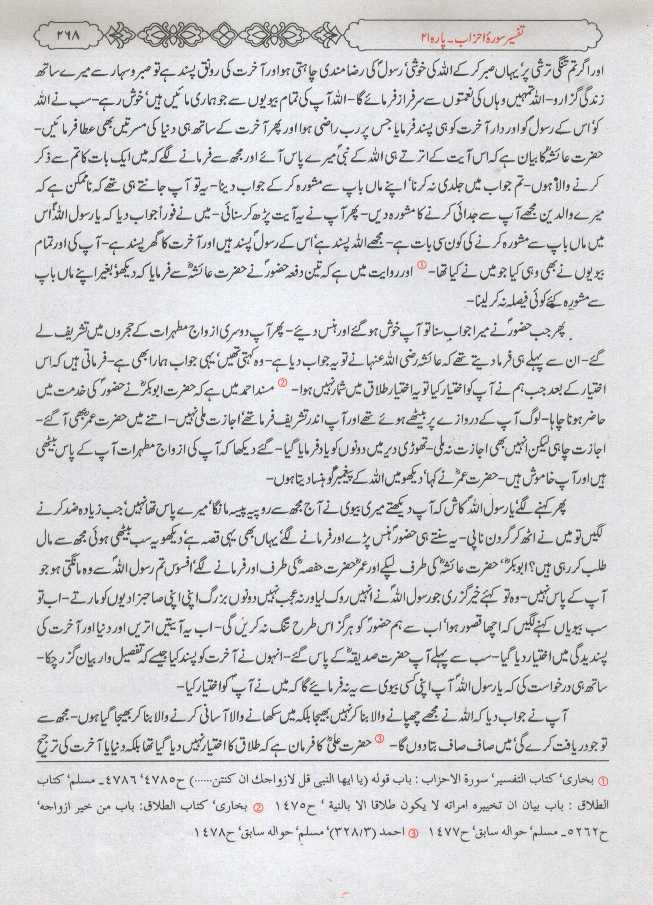
Here Allah commands His Messenger to give his wives the choice of separating from him so that they may go to someone else with whom they can find what they want of the life of this world and its attractions, or of patiently bearing the straitened circumstances with the Prophet for which they will have a great reward with Allah. They chose Allah and His Messenger and the Home of the Hereafter, may Allah be pleased with them. Then Allah gave them the best both of this world and of the Hereafter. Al-Bukhari narrated from `A'ishah, may Allah be pleased with her, the wife of the Prophet that the Messenger of Allah came to her when Allah commanded him to give his wives the choice. She said, "The Messenger of Allah started with me, and said,
[FONT=Traditional Arabic]«إِنِّي ذَاكِرٌ لَكِ أَمْرًا فَلَا عَلَيْكِ أَنْ تَسْتَعْجِلِي حَتْى تَسْتَأْمِرِي أَبَوَيْك»
(I am going to tell you about something and you do not have to hasten to respond until you consult your parents.)'' He knew that my parents would never tell me to leave him. Then he said:
[FONT=Traditional Arabic]«إِنَّ اللهَ تَعَالَى قَالَ:
[FONT=Traditional Arabic]يأَيُّهَا النَّبِىُّ قُل لاٌّزْوَجِكَ]»
(Allah says: ("O Prophet! Say to your wives...'')) and he recited the two Ayat. I said to him, "Concerning what do I need to consult my parents I choose Allah and His Messenger and the Home of the Hereafter.'' He also narrated it without a chain of narrators, and added, "She said, then all the wives of the Prophet did the same as I.'' Imam Ahmad recorded that A'ishah, may Allah be pleased with her, said: "The Messenger of Allah gave us the choice, and we chose him, so giving us that choice was not regarded as divorce.'' It was recorded by (Al-Bukhari and Muslim) from the Hadith of Al-Amash. Imam Ahmad recorded that Jabir, may Allah be pleased with him, said: "Abu Bakr, may Allah be pleased with him, came to ask permission to see the Messenger of Allah and the people were sitting at his door, and the Prophet was sitting, but he did not give him permission. Then Umar, may Allah be pleased with him, came and asked permission to see him, but he did not give him permission. Then he gave Abu Bakr andUmar, may Allah be pleased with them both, permission, and they entered. The Prophet was sitting with his wives around him, and he was silent. Umar, may Allah be pleased with him, said,I will tell the Prophet something to make him smile.' Umar, may Allah be pleased with him, said,O Messenger of Allah, if only you had seen the daughter of Zayd -- the wife of `Umar -- asking me to spend on her just now; I broke her neck!' The Messenger of Allah smiled so broadly that his molars could be seen, and he said,
[FONT=Traditional Arabic]«هُنَّ حَوْلِي يَسْأَلْنَنِي النَّفَقَة»
(They are around me asking me to spend on them.) Abu Bakr, may Allah be pleased with him, got up to deal with A'ishah; andUmar, may Allah be pleased with him, got up to deal with Hafsah, and both of them were saying, You are asking the Prophet for that which he does not have!' But the Messenger of Allah stopped them, and they (his wives) said,By Allah, after this we will not ask the Messenger of Allah for anything that he does not have.' Then Allah revealed the Ayah telling him to give them the choice, and he started with `A'ishah, may Allah be pleased with her. He said,
[FONT=Traditional Arabic]«إِنِّي أَذْكُرُ لَكِ أَمْرًا مَا أُحِبُّ أَنْ تَعْجَلِي فِيهِ حَتَّى تَسْتَأْمِرِي أَبَوَيْك»
(I am going to tell you something, and I would like you not to hasten to respond until you consult your parents.) She said, `What is it' He recited to her:
[FONT=Traditional Arabic]يأَيُّهَا النَّبِىُّ قُل لاٌّزْوَجِكَ]
(O Prophet! Say to your wives...) A'ishah, may Allah be pleased with her, said,Do I need to consult my parents concerning you I choose Allah and His Messenger, but I ask you not to tell of my choice to your other wives.' He said:
[FONT=Traditional Arabic]«إِنَّ اللهَ تَعَالَى لَمْ يَبْعَثْنِي مُعَنِّفًا، وَلَكِنْ بَعَثَنِي مُعَلِّمًا مُيَسِّرًا، لَا تَسْأَلُنِي امْرَأَةٌ مِنْهُنَّ عَمَّا اخْتَرْتِ إِلَّا أَخْبَرْتُهَا»
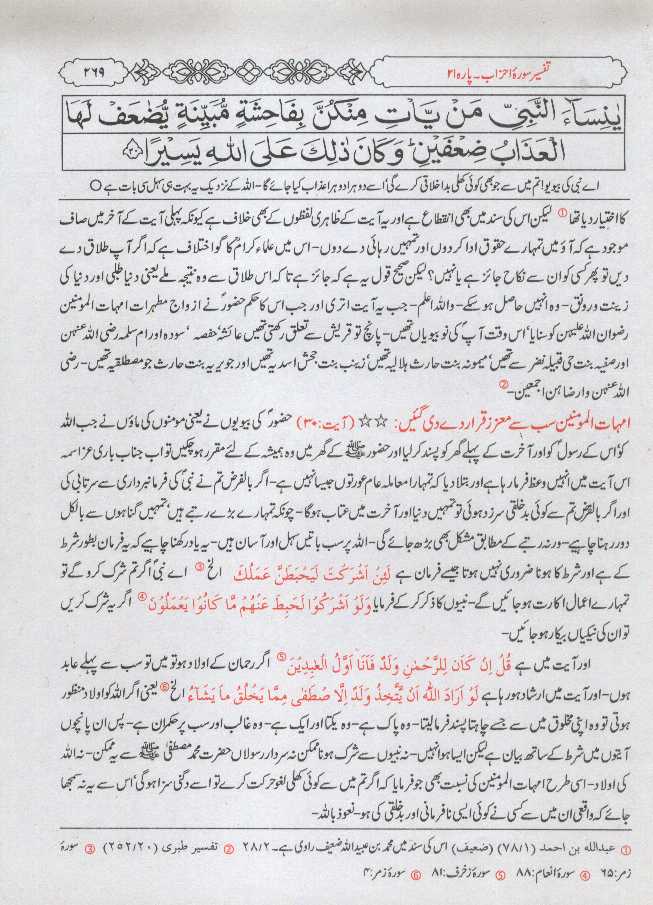
(Allah did not send me to be harsh, but He sent me to teach in a gentle and easy manner. If any of them asks me what your decision was, I will tell her.)'' This was also recorded by Muslim, but not Al-Bukhari; An-Nasa'i also recorded it. Ikrimah said: "At that time he was married to nine women, five of them were from Quraysh --A'ishah, Hafsah. Umm Habibah, Sawdah and Umm Salamah, may Allah be pleased with them. And he was also married to Safiyyah bint Huyay An-Nadariyyah, Maymunah bint Al-Harith Al-Hilaliyyah, Zaynab bint Jahsh Al-Asadiyyah and Juwayriyyah bint Al-Harith Al-Mustalaqiyyah, may Allah be pleased with all of them.
[FONT=Traditional Arabic]ينِسَآءَ النَّبِىِّ مَن يَأْتِ مِنكُنَّ بِفَـحِشَةٍ مُّبَيِّنَةٍ يُضَاعَفْ لَهَا الْعَذَابُ ضِعْفَيْنِ وَكَانَ ذَلِكَ عَلَى اللَّهِ يَسِيراً - وَمَن يَقْنُتْ مِنكُنَّ للَّهِ وَرَسُولِهِ وَتَعْمَلْ صَـلِحاً نُؤْتِهَـآ أَجْرَهَا مَرَّتَيْنِ وَأَعْتَدْنَا لَهَا رِزْقاً كَرِيماً ]
(30. O wives of the Prophet! Whoever of you commits an open Fahishah, the torment for her will be doubled, and that is ever easy for Allah.) (31. And whosoever of you is obedient to Allah and His Messenger, and does righteous good deeds, We shall give her, her reward twice over, and We have prepared for her a noble provision.)
The Wives of the Prophet are not like Other Women
This Ayah is addressed to the wives of the Prophet who chose Allah and His Messenger and the Home of the Hereafter, and remained married to the Messenger of Allah . Thus it was befitting that there should be rulings which applied only to them, and not to other women, in the event that any of them should commit open Fahishah. Ibn `Abbas, may Allah be pleased with him, said: "This means Nushuz (rebellion) and a bad attitude.'' Whatever the case, this is a conditional phrase and it does not imply that what is referred to would actually happen. This is like the Ayat:
[FONT=Traditional Arabic]وَلَقَدْ أُوْحِىَ إِلَيْكَ وَإِلَى الَّذِينَ مِن قَبْلِكَ لَئِنْ أَشْرَكْتَ لَيَحْبَطَنَّ عَمَلُكَ]
(And indeed it has been revealed to you, as it was to those before you: "If you join others in worship with Allah, surely your deeds will be in vain.'') (39:65)
[FONT=Traditional Arabic]وَلَوْ أَشْرَكُواْ لَحَبِطَ عَنْهُمْ مَّا كَانُواْ يَعْمَلُونَ]
(But if they had joined in worship others with Allah, all that they used to do would have been of no benefit to them.) (6:88)
[FONT=Traditional Arabic]قُلْ إِن كَانَ لِلرَّحْمَـنِ وَلَدٌ فَأَنَاْ أَوَّلُ الْعَـبِدِينَ ]
(Say: "If the Most Gracious had a son, then I am the first of (Allah's) worshippers.'') (43:81)
[FONT=Traditional Arabic]لَّوْ أَرَادَ اللَّهُ أَن يَتَّخِذَ وَلَداً لاَّصْطَفَى مِمَّا يَخْلُقُ مَا يَشَآءُ سُبْحَـنَهُ هُوَ اللَّهُ الْوَحِدُ الْقَهَّارُ ]
(Had Allah willed to take a son, He could have chosen whom He willed out of those whom He created. But glory be to Him! He is Allah, the One, the Irresistible.) (39:4). Because their status is so high, it is appropriate to state that the sin, if they were to commit it, would be so much worse, so as to protect them and their Hijab. Allah says:
[FONT=Traditional Arabic]مَن يَأْتِ مِنكُنَّ بِفَـحِشَةٍ مُّبَيِّنَةٍ يُضَاعَفْ لَهَا الْعَذَابُ ضِعْفَيْنِ]
(Whoever of you commits an open Fahishah, the torment for her will be doubled,) Malik narrated from Zayd bin Aslam:
[FONT=Traditional Arabic]يُضَاعَفْ لَهَا الْعَذَابُ ضِعْفَيْنِ]
(the torment for her will be doubled,) "In this world and the next.'' Something similar was narrated from Ibn Abi Najih, from Mujahid.
[FONT=Traditional Arabic]وَكَانَ ذلِكَ عَلَى اللَّهِ يَسِيراً]
(and that is ever easy for Allah.) it is very easy indeed. Then Allah mentions His justice and His bounty, in the Ayah:
[FONT=Traditional Arabic]وَمَن يَقْنُتْ مِنكُنَّ للَّهِ وَرَسُولِهِ]
(And whosoever of you is obedient to Allah and His Messenger,) i.e., obeys Allah and His Messenger ,
[FONT=Traditional Arabic]نُؤْتِهَـآ أَجْرَهَا مَرَّتَيْنِ وَأَعْتَدْنَا لَهَا رِزْقاً كَرِيماً]
(We shall give her, her reward twice over, and We have prepared for her a noble provision.) i.e., in Paradise, for they will be in the dwellings of the Messenger of Allah in the highest reaches of `Illiyin, above the dwellings of all the people, in Al-Wasilah which is the closest of the dwellings of Paradise to the Throne.
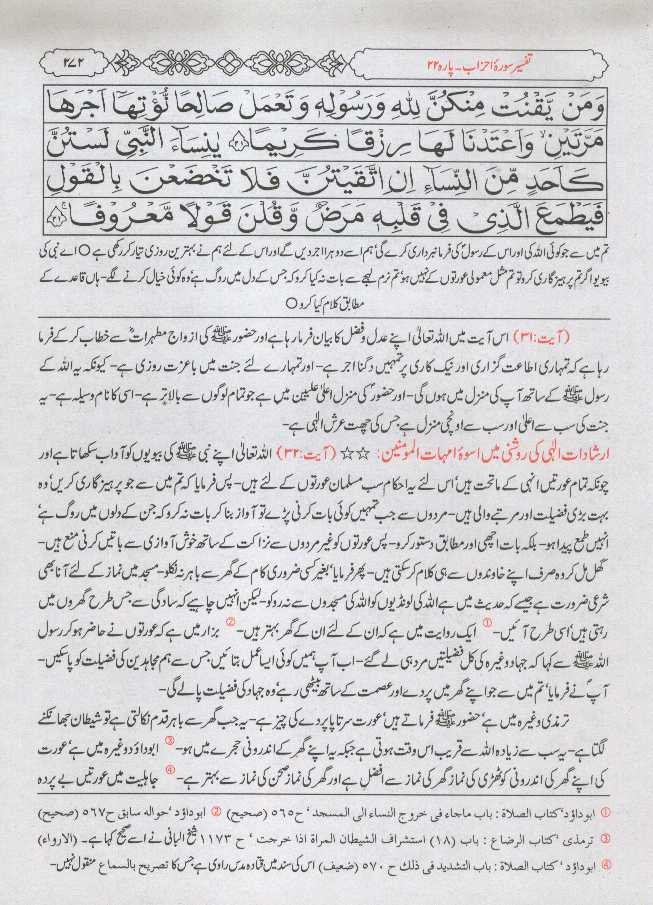
[FONT=Traditional Arabic]ينِسَآءَ النَّبِىِّ لَسْتُنَّ كَأَحَدٍ مِّنَ النِّسَآءِ إِنِ اتَّقَيْتُنَّ فَلاَ تَخْضَعْنَ بِالْقَوْلِ فَيَطْمَعَ الَّذِى فِى قَلْبِهِ مَرَضٌ وَقُلْنَ قَوْلاً مَّعْرُوفاً - وَقَرْنَ فِى بُيُوتِكُنَّ وَلاَ تَبَرَّجْنَ تَبَرُّجَ الْجَـهِلِيَّةِ الاٍّولَى وَأَقِمْنَ الصَّلَوةَ وَءَاتِينَ الزَّكَـوةَ وَأَطِعْنَ اللَّهَ وَرَسُولَهُ إِنَّمَا يُرِيدُ اللَّهُ لِيُذْهِبَ عَنكُـمُ الرِّجْسَ أَهْلَ الْبَيْتِ وَيُطَهِّرَكُمْ تَطْهِيــراً - وَاذْكُـرْنَ مَا يُتْـلَى فِى بُيُوتِكُـنَّ مِنْ ءَايَـتِ اللَّهِ وَالْحِكْــمَةِ إِنَّ اللَّهَ كَانَ لَطِيفاً خَبِيراً ]
h(32. O wives of the Prophet! You are not like any other women. If you keep you have Taqwa, then be not soft in speech, lest he in whose heart is a disease should be moved with desire, but speak in an honorable manner.) (33. And stay in your houses, and do not Tabarruj yourselves like the Tabarruj of the times of ignorance, and perform the Salah, and give Zakah and obey Allah and His Messenger. Allah wishes only to remove the Ar-Rijs from you, O members of the family, and to purify you with a thorough purification.) (34. And remember, that which is recited in your houses of the Ayat of Allah and Al-Hikmah. Verily, Allah is Ever Most Courteous, Well-Acquainted with all things.)
Enjoining certain Manners so that the Mothers of the Believers may be an Example; and the Prohibition of Tabarruj
These are the good manners which Allah enjoined upon the wives of the Prophet so that they would be an example for the women of the Ummah to follow. Allah said, addressing the wives of the Prophet that they should fear Allah as He commanded them, and that no other woman is like them or can be their equal in virtue and status. Then Allah says:
[FONT=Traditional Arabic]فَلاَ تَخْضَعْنَ بِالْقَوْلِ]
(then be not soft in speech,) As-Suddi and others said, this means, do not be gentle in speech when addressing men. Allah says:
[FONT=Traditional Arabic]فَيَطْمَعَ الَّذِى فِى قَلْبِهِ مَرَضٌ]
(lest he in whose heart is a disease should be moved with desire,) means, something unclean.
[FONT=Traditional Arabic]وَقُلْنَ قَوْلاً مَّعْرُوفاً]
(but speak in an honorable manner.) Ibn Zayd said: "Decent and honorable talk that is known to be good.'' This means that she should address non-Mahram men in a manner in which there is no softness, i.e., a woman should not address a non-Mahram man in the same way that she addresses her husband.
[FONT=Traditional Arabic]وَقَرْنَ فِى بُيُوتِكُنَّ]
(And stay in your houses,) means, stay in your houses and do not come out except for a purpose. One of the purposes mentioned in Shari`ah is prayer in the Masjid, so long as the conditions are fulfilled, as the Messenger of Allah said:
[FONT=Traditional Arabic]«لَا تَمْنَعُوا إِمَاءَ اللهِ مَسَاجِدَ اللهِ وَلْيَخْرُجْنَ وَهُنَّ تَفِلَات»
(Do not prevent the female servants of Allah from the Masjids of Allah, but have them go out without wearing fragrance.) According to another report:
[FONT=Traditional Arabic]«وَبُيُوتُهُنَّ خَيْرٌ لَهُن»
(even though their houses are better for them.)
[FONT=Traditional Arabic]وَلاَ تَبَرَّجْنَ تَبَرُّجَ الْجَـهِلِيَّةِ الاٍّولَى]
(and do not Tabarruj yourselves like the Tabarruj of the times of ignorance,) Mujahid said: "Women used to go out walking in front of men, and this was the Tabarruj of Jahiliyyah.'' Qatadah said:
[FONT=Traditional Arabic]وَلاَ تَبَرَّجْنَ تَبَرُّجَ الْجَـهِلِيَّةِ الاٍّولَى]
(and do not Tabarruj yourselves like the Taburruj of the times of ignorance,) "When they go out of their homes walking in a shameless and flirtatious manner, and Allah, may He be exalted, forbade that.'' Muqatil bin Hayyan said:
[FONT=Traditional Arabic]وَلاَ تَبَرَّجْنَ تَبَرُّجَ الْجَـهِلِيَّةِ الاٍّولَى]
(and do not Tabarruj yourselves like the Tabarruj of the times of ignorance,) "Tabarruj is when a woman puts a Khimar on her head but does not tie it properly.'' So her necklaces, earrings and neck, and all of that can be seen. This is Tabarruj, and Allah addresses all the women of the believers with regard to Tabarruj.
[FONT=Traditional Arabic]وَأَقِمْنَ الصَّلَوةَ وَءَاتِينَ الزَّكَـوةَ وَأَطِعْنَ اللَّهَ وَرَسُولَهُ]
(and perform the Salah, and give Zakah and obey Allah and His Messenger.) Allah first forbids them from evil, then He enjoins them to do good by establishing regular prayer, which means worshipping Allah alone with no partner or associate, and paying Zakah, which means doing good to other people.
[FONT=Traditional Arabic]وَأَطِعْنَ اللَّهَ وَرَسُولَهُ]
(and obey Allah and His Messenger.) This is an instance of something specific being followed by something general.
**
The Wives of the Prophet are Members of His Household (Ahl Al-Bayt)
[FONT=Traditional Arabic]إِنَّمَا يُرِيدُ اللَّهُ لِيُذْهِبَ عَنكُـمُ الرِّجْسَ أَهْلَ الْبَيْتِ وَيُطَهِّرَكُمْ تَطْهِيــراً]
(Allah wishes only to remove Ar-Rijs from you, O members of the family, and to purify you with a thorough purification.) This is a clear statement that the wives of the Prophet are included among the members of his family (Ahl Al-Bayt) here, because they are the reason why this Ayah was revealed, and the scholars are unanimously agreed that they were the reason for revelation in this case, whether this was the only reason for revelation or there was also another reason, which is the correct view. Ibn Jarir recorded that `Ikrimah used to call out in the marketplace:
[FONT=Traditional Arabic]إِنَّمَا يُرِيدُ اللَّهُ لِيُذْهِبَ عَنكُـمُ الرِّجْسَ أَهْلَ الْبَيْتِ وَيُطَهِّرَكُمْ تَطْهِيــراً]
(Allah wishes only to remove Ar-Rijs from you, O members of the family, and to purify you with a thorough purification.) "This was revealed solely concerning the wives of the Prophet.'' Ibn Abi Hatim recorded that Ibn `Abbas said concerning the Ayah:
[FONT=Traditional Arabic]إِنَّمَا يُرِيدُ اللَّهُ لِيُذْهِبَ عَنكُـمُ الرِّجْسَ أَهْلَ الْبَيْتِ]
(Allah wishes only to remove Ar-Rijs from you, O members of the family,) "It was revealed solely concerning the wives of the Prophet .'' Ikrimah said: "Whoever disagrees with me that it was revealed solely concerning the wives of the Prophet , I am prepared to meet with him and pray and invoke the curse of Allah upon those who are lying.'' So they alone were the reason for revelation, but others may be included by way of generalization. Ibn Jarir narrated that Safiyyah bint Shaybah said: "A'ishah, may Allah be pleased with her, said, The Prophet went out one morning wearing a striped cloak of black camel's hair. Al-Hasan, may Allah be pleased with him, came and he wrapped him in the cloak with him. Then Al-Husayn, may Allah be pleased with him, came and he wrapped him in the cloak with him. Then Fatimah, may Allah be pleased with her, came and he wrapped her in the cloak with him. ThenAli, may Allah be pleased with him, came and he wrapped him in the cloak with him, then he said:
[FONT=Traditional Arabic]إِنَّمَا يُرِيدُ اللَّهُ لِيُذْهِبَ عَنكُـمُ الرِّجْسَ أَهْلَ الْبَيْتِ وَيُطَهِّرَكُمْ تَطْهِيــراً]
(Allah wishes only to remove Ar-Rijs from you, O members of the family, and to purify you with a thorough purification.) This was recorded by Muslim. In his Sahih, Muslim recorded that Yazid bin Hayyan said: "Husayn bin Sabrah, Umar bin Muslim and I went to Zayd bin Arqam, may Allah be pleased with him, and when we had sat down with him, Husayn said:You are so fortunate, O Zayd! You saw the Messenger of Allah and heard his speeches, and you went on military campaigns with him, and you prayed behind him. You are so fortunate, O Zayd! Tell us what you heard from the Messenger of Allah .' He said, O son of my brother, by Allah, I have grown old and it has been a long time, and I have forgotten some of the things that I used to know from the Messenger of Allah . Whatever I tell you, accept it, and whatever I do not tell you, do not worry about it.' Then he said,One day, the Messenger of Allah stood up to address us by the well of Khumm, between Makkah and Al-Madinah, and he praised Allah and thanked Him, and he preached and reminded us. Then he said:
[FONT=Traditional Arabic]«أَمَّا بَعْدُ، أَلَا أَيُّهَا النَّاسُ فَإِنَّمَا أَنَا بَشَرٌ يُوشِكُ أَنْ يَأْتِيَنِي رَسُولُ رَبِّي فَأُجِيبَ، وَأَنَا تَارِكٌ فِيكُمْ ثَقَلَيْنِ: أَوَّلُهُمَا كِتَابُ اللهِ تَعَالَى، فِيهِ الْهُدَى وَالنُّورُ فَخُذُوا بِكِتَابِ اللهِ وَاسْتَمْسِكُوا بِه»
(Thereafter! O people, I am merely a human being and soon the messenger of my Lord will come and I will answer him. I am leaving behind two things with you, the first of which is the Book of Allah in which is guidance and light, so seize the Book of Allah and hold fast to it.) He urged them to cling to the Book of Allah, then he said:
[FONT=Traditional Arabic]«وَأَهْلُ بَيْتِي أُذَكِّرُكُمُ اللهَ فِي أَهْلِ بَيْتِي، أُذَكِّرُكُمُ اللهَ فِي أَهْلِ بَيْتِي»
(And the members of my family (Ahl Al-Bayt): Remember Allah with regard to the members of my family, remember Allah with regard to the members of my family.) saying it three times.' Husayn said to him, Who are the members of his family (Ahl Al-Bayt), O Zayd Are not his wives members of his family' He said,His wives are members of his family, but the members of his family are those who are not permitted to receive charity after he died.' He said, Who are they' He said,They are the family of Ali, the family ofAqil, the family of Jafar and the family ofAbbas, may Allah be pleased with them.' He said, Were all of these forbidden to receive charity after his death' He said,Yes.''' This Commentary is from Zayd bin Arqam and is not Marfu`
The Command to follow the Qur'an and Sunnah
The one who ponders the meaning of the Qur'an will have no doubt that the wives of the Prophet are included among those who are referred to in the Ayah:
[FONT=Traditional Arabic]إِنَّمَا يُرِيدُ اللَّهُ لِيُذْهِبَ عَنكُـمُ الرِّجْسَ أَهْلَ الْبَيْتِ وَيُطَهِّرَكُمْ تَطْهِيــراً]
(Allah wishes only to remove Ar-Rijs from you, O members of the family, and to purify you with a thorough purification.) The context clearly refers to them. Allah then says:
[FONT=Traditional Arabic]وَاذْكُـرْنَ مَا يُتْـلَى فِى بُيُوتِكُـنَّ مِنْ ءَايَـتِ اللَّهِ وَالْحِكْــمَةِ]
(And remember, that which is recited in your houses of the Ayat of Allah and Al-Hikmah.) meaning, act in accordance with that of the Qur'an and Sunnah which Allah revealed to His Messenger in your houses.' This was the view of Qatadah and others.And remember this blessing with which you alone of all the people have been favored, that the revelation comes down in your houses and not those of other people.' A'ishah As-Siddiqah bint As-Siddiq, may Allah be pleased with them, was foremost among them with in this blessing and was the most fortunate, and the most favored with this mercy. For the revelation did not come to the Messenger of Allah in the bed of any of his wives except hers, as he stated. Some of the scholars, may Allah have mercy on them, said: "This was because he did not marry any other virgin besides her, and no man slept with her in her bed before him , may Allah be pleased with her.'' So it was befitting that she should be singled out for this blessing and high status. But if his wives are members of his household, then this title is even more fitting for his own relatives. Ibn Abi Hatim recorded that Abu Jamilah said: "Al-Hasan binAli, may Allah be pleased with them both, was appointed as Khalifah when Ali was killed.'' He said: "While he was praying, a man leapt on him and stabbed him with a dagger.'' Husayn claimed that he heard that the one who stabbed him was a man from Banu Asad, and Al-Hasan, may Allah be pleased with him, was prostrating at the time. He said, "They claimed that he received the wound in his hip. He was ill as a result for many months, then he recovered. He ascended the Minbar and said:O people of `Iraq! Have Taqwa of Allah concerning us, for we are your leaders and your guests, and we are members of the family (Ahl Al-Bayt) concerning whom Allah said:
[FONT=Traditional Arabic]إِنَّمَا يُرِيدُ اللَّهُ لِيُذْهِبَ عَنكُـمُ الرِّجْسَ أَهْلَ الْبَيْتِ وَيُطَهِّرَكُمْ تَطْهِيــراً]
(Allah wishes only to remove Ar-Rijs from you, O members of the family, and to purify you with a thorough purification.)' He kept saying this until there was no one left in the Masjid who was not weeping and sobbing.''
[FONT=Traditional Arabic]إِنَّ اللَّهَ كَانَ لَطِيفاً خَبِيراً]
(Verily, Allah is Ever Most Courteous, Well-Acquainted with all things.) means, `by His kindness towards you, you have reached this status, and by His knowledge of you and that you are qualified for that status, He has given this to you and singled you out for it.' Ibn Jarir, may Allah have mercy on him, said: "And remember how Allah blessed you by causing the Ayat of Allah and Al-Hikmah to be recited in your houses, so give thanks to Allah for that and praise Him.
[FONT=Traditional Arabic]إِنَّ اللَّهَ كَانَ لَطِيفاً خَبِيراً]
(Verily, Allah is Ever Most Courteous, Well-Acquainted with all things.) means, He is kind towards you, for He has caused the Ayat of Allah and Al-Hikmah to be recited in your houses,' and Al-Hikmah means the Sunnah. And He is Well-Acquainted with you means,He chose you as wives for His Messenger.' Qatadah said:
[FONT=Traditional Arabic]وَاذْكُـرْنَ مَا يُتْـلَى فِى بُيُوتِكُـنَّ مِنْ ءَايَـتِ اللَّهِ وَالْحِكْــمَةِ]
(And remember, that which is recited in your houses of the Ayat of Allah and Al-Hikmah.) "He is reminding them of His favor.'' This was narrated by Ibn Jarir. Atiyah Al-Awfi commented on the Ayah:
[FONT=Traditional Arabic]إِنَّ اللَّهَ كَانَ لَطِيفاً خَبِيراً]
(Verily, Allah is Ever Most Courteous, Well-Acquainted with all things.) "He knows when and where to reveal Al-Hikmah.'' This was recorded by Ibn Abi Hatim, then he said: "This was also narrated from Ar-Rabi` bin Anas from Qatadah. ''
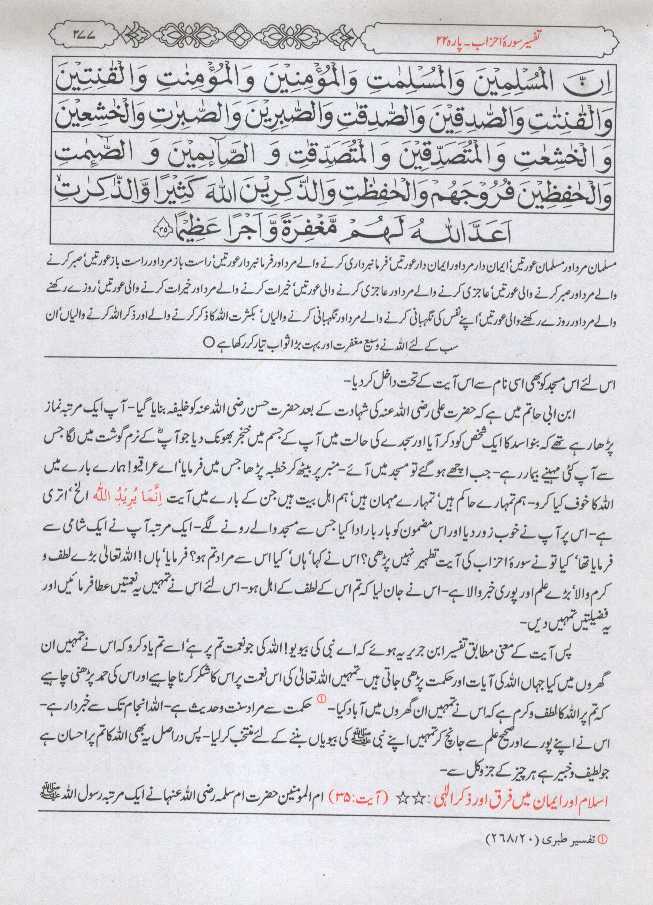
[FONT=Traditional Arabic]إِنَّ الْمُسْلِمِينَ وَالْمُسْلِمَـتِ وَالْمُؤْمِنِينَ وَالْمُؤْمِنَـتِ وَالْقَـنِتِينَ وَالْقَـنِتَـتِ وَالصَّـدِقِينَ وَالصَّـدِقَـتِ وَالصَّـبِرِينَ وَالصَّـبِرَتِ وَالْخَـشِعِينَ وَالْخَـشِعَـتِ وَالْمُتَصَدِّقِينَ وَالْمُتَصَدِّقَـتِوالصَّـئِمِينَ والصَّـئِمَـتِ وَالْحَـفِظِينَ فُرُوجَهُمْ وَالْحَـفِـظَـتِ وَالذَكِـرِينَ اللَّهَ كَثِيراً وَالذَكِرَتِ أَعَدَّ اللَّهُ لَهُم مَّغْفِرَةً وَأَجْراً عَظِيماً]
(35. Verily, the Muslims: men and women, the believers: men and women, the Qanit: men and the women, the men and women who are truthful, the men and the women who are patient, the Khashi`: men and the women, the men and the women who give Sadaqat, the men and the women who fast, the men and the women who guard their chastity and the men and the women who remember Allah much with their hearts and tongues, Allah has prepared for them forgiveness and a great reward.)
The Reason for Revelation
Imam Ahmad recorded that Umm Salamah, may Allah be pleased with her, the wife of the Prophet said, "I said to the Prophet , `Why is it that we are not mentioned in the Qur'an as men are' Then one day without my realizing it, he was calling from the Minbar and I was combing my hair, so I tied my hair back then I went out to my chamber in my house, and I started listening out, and he was saying from the Minbar:
[FONT=Traditional Arabic]«يَاأَيُّهَا النَّاسُ إِنَّ اللهَ تَعَالَى يَقُولُ:
[FONT=Traditional Arabic]إِنَّ الْمُسْلِمِينَ وَالْمُسْلِمَـتِ وَالْمُؤْمِنِينَ وَالْمُؤْمِنَـتِ]»
(O people! Verily Allah says: (Verily, the Muslims: men and women, the believers: men and women...)) to the end of the Ayah.'' This was also recorded by An-Nasa'i and Ibn Jarir.
[FONT=Traditional Arabic]إِنَّ الْمُسْلِمِينَ وَالْمُسْلِمَـتِ وَالْمُؤْمِنِينَ وَالْمُؤْمِنَـتِ]
(Verily, the Muslims: men and women, the believers: men and women...) indicates that Iman is something other than Islam, and that it is more specific, because Allah says:
[FONT=Traditional Arabic]قَالَتِ الاٌّعْرَابُ ءَامَنَّا قُل لَّمْ تُؤْمِنُواْ وَلَـكِن قُولُواْ أَسْلَمْنَا وَلَمَّا يَدْخُلِ الايمَـنُ فِى قُلُوبِكُمْ]
(The bedouins say: "We believe.'' Say: "You believe not but you only say, `We have surrendered (in Islam),' for faith has not yet entered your hearts.'') (49:14). In the Two Sahihs, it says:
[FONT=Traditional Arabic]«لَا يَزْنِي الزَّانِي حِينَ يَزْنِي وَهُوَ مُؤْمِن»
(The adulterer does not commit adultery at the time when he is a believer.) For it snatches away his Iman, although that does not mean he is a disbeliever, according to the consensus of the Muslims. This indicates that Iman is more specific than Islam, as we have stated at the beginning of our commentary on Al-Bukhari.
[FONT=Traditional Arabic]وَالْقَـنِتِينَ وَالْقَـنِتَـتِ]
(the Qanit: men and the women,) Al-Qunut means obedience during quite time.
[FONT=Traditional Arabic]أَمَّنْ هُوَ قَانِتٌ ءَانَآءَ الَّيْلِ سَـجِداً وَقَآئِماً يَحْذَرُ الاٌّخِرَةَ وَيَرْجُواْ رَحْمَةَ رَبِّهِ]
(Is one who is (Qanit,) prostrating himself or standing in the middle of the night, fearing the Hereafter and hoping for the mercy of his Lord...) (39:9)
[FONT=Traditional Arabic]وَلَهُ مَن فِى السَّمَـوَتِ وَالاٌّرْضِ كُلٌّ لَّهُ قَـنِتُونَ ]
(To Him belongs whatever is in the heavens and the earth. All are Uqnuti (Qanitun) to Him.) (30:26)
[FONT=Traditional Arabic]يمَرْيَمُ اقْنُتِى لِرَبِّكِ وَاسْجُدِى وَارْكَعِى مَعَ الرَكِعِينَ ]
(O Maryam! "Uqnuti to your Lord and prostrate, and bow with Ar-Raki`in (those who bow).'') (3:43)
[FONT=Traditional Arabic]وَقُومُواْ لِلَّهِ قَـنِتِينَ]
(And stand before Allah Qanitin) (2: 238). So, beyond Islam there is a higher level to be reached, which is Iman, and Qunut stems from them both.
[FONT=Traditional Arabic]وَالصَّـدِقِينَ وَالصَّـدِقَـتِ]
(the men and women who are truthful,) This refers to their speech, for truthfulness is a praiseworthy attribute. Some of the Companions, may Allah be pleased with them, were never known to have lied even once, neither during Jahiliyyah nor in Islam. Truthfulness is a sign of faith, just as lying is a sign of hypocrisy. Whoever is truthful will be saved:
[FONT=Traditional Arabic]«عَلَيْكُمْ بِالصِّدْقِ فَإِنَّ الصِّدْقَ يَهْدِي إِلَى الْبِرِّ، وَإِنَّ الْبِرَّ يَهْدِي إِلَى الْجَنَّةِ، وَإِيَّاكُمْ وَالْكَذِبَ، فَإِنَّ الْكَذِبَ يَهْدِي إِلَى الْفُجُورِ، وَإِنَّ الْفُجُورَ يَهْدِي إِلَى النَّارِ، وَلَا يَزَالُ الرَّجُلُ يَصْدُقُ وَيَتَحَرَّى الصِّدْقَ حَتَّى يُكْتَبَ عِنْدَ اللهِ صِدِّيقًا، وَلَا يَزَالُ الرَّجُلُ يَكْذِبُ وَيَتَحَرَّى الْكَذِبَ حَتَّى يُكْتَبَ عِنْدَ اللهِ كَذَّابًا»
(You have to be truthful, for truthfulness leads to righteousness and righteousness leads to Paradise. And beware of lying, for lying leads to immorality and immorality leads to Hell. A man will keep telling the truth and striving to do so until he will be recorded with Allah as a truthful. And a man will keep telling lies and will persist in doing so until he will be recorded with Allah as a liar.) And there are many Hadiths on this topic.
[FONT=Traditional Arabic]وَالصَّـبِرِينَ وَالصَّـبِرَتِ]
(the men and the women who are patient,) This is the attribute of those who are steadfast, which is patience in the face of adversity and knowing that what is decreed will inevitably come to pass. So, they face it with patience and steadfastness. Patience is the most difficult when disaster first strikes, then after that it becomes easier, and this is true steadfastness.
[FONT=Traditional Arabic]وَالْخَـشِعِينَ وَالْخَـشِعَـتِ]
(the Khashi: men and the women,) Khushu means serenity and tranquillity, deliberation and dignity and humility. What motivates a person to be like this is the fear of Allah and the awareness that He is constantly watching, as mentioned in the Hadith:
[FONT=Traditional Arabic]«اعْبُدُ اللهَ كَأَنَّكَ تَرَاهُ فَإِنْ لَمْ تَكُنْ تَرَاهُ فَإِنَّهُ يَرَاك»
(Worship Allah as if you can see Him, for if you cannot see Him, He can see you.)
[FONT=Traditional Arabic]وَالْمُتَصَدِّقِينَ وَالْمُتَصَدِّقَـتِ]
(the men and the women who give Sadaqat,) As-Sadaqah (charity) means doing good to people who are in need or who are weak and have no means of earning a living and none to financially support them. They give them from the excess of their wealth in obedience to Allah and as a good deed to His creation. It was recorded in the Two Sahihs:
[FONT=Traditional Arabic]«سَبْعَةٌ يُظِلُّهُمُ اللهُ فِي ظِلِّهِ يَوْمَ لَا ظِلَّ إِلَّا ظِلُّهُ فَذَكَرَ مِنْهُمْ وَرَجُلٌ تَصَدَّقَ بِصَدَقَةٍ فَأَخْفَاهَا حَتَّى لَاتَعْلَمَ شِمَالُهُ مَا تُنْفِقُ يَمِينُه»
(There are seven whom Allah will shade with His Shade on the Day when there will be no shade except His Shade -- and among them he mentioned -- . ..a man who gave in charity and concealed it to the extent that his left hand did not know what his right hand was giving.) According to another Hadith:
[FONT=Traditional Arabic]«وَالصَّدَقَةُ تُطْفِىءُ الْخَطِيئَةَ كَمَا يُطْفِىءُ الْمَاءُ النَّار»
(Sadaqah extinguishes bad deeds just as water extinguishes fire.) There are many Hadiths which encourage charitable giving; this topic is discussed in detail elsewhere.
[FONT=Traditional Arabic]والصَّـئِمِينَ والصَّـئِمَـتِ]
(the men and the women who fast,) According to a Hadith narrated by Ibn Majah:
[FONT=Traditional Arabic]«وَالصَّوْمُ زَكَاةُ الْبَدَن»
(Fasting is the Zakah of the body.) In other words, it purifies it and cleanses it of things that are bad in both physical and Shari terms. Said bin Jubayr said: "Whoever fasts Ramadan and three days of each month, is included in the Ayah,
[FONT=Traditional Arabic]والصَّـئِمِينَ والصَّـئِمَـتِ]
(the men and the women who fast,)'' Fasting is also one of the greatest means of overcoming one's desires, as the Messenger of Allah said:
[FONT=Traditional Arabic]«يَامَعْشَرَ الشَّبَابِ مَنِ اسْتَطَاعَ مِنْكُمُ الْبَاءَةَ فَلْيَتَزَوَّجْ، فَإِنَّهُ أَغَضُّ لِلْبَصَرِ وَأَحْصَنُ لِلْفَرْجِ، وَمَنْ لَمْ يَسْتَطِعْ فَعَلَيْهِ بِالصَّوْمِ فَإِنَّهُ لَهُ وِجَاء»
(O young men! Whoever among you can afford to get married, let him do so, for it is most effective in lowering the gaze and protecting the chastity. And whoever cannot get married, then let him fast, for it will be a protection for him.) It is quite apt that next should be mentioned:
[FONT=Traditional Arabic]وَالْحَـفِظِينَ فُرُوجَهُمْ وَالْحَـفِـظَـتِ]
(the men and the women who guard their chastity) i.e., they protect their private parts from forbidden and sinful things, except for that which is permitted. Allah says:
[FONT=Traditional Arabic]وَالَّذِينَ هُمْ لِفُرُوجِهِمْ حَـفِظُونَ - إِلاَّ عَلَى أَزْوَجِهِمْ أَوْ مَا مَلَكَتْ أَيْمَـنُهُمْ فَإِنَّهُمْ غَيْرُ مَلُومِينَ - فَمَنِ ابْتَغَى وَرَآءَ ذلِكَ فَأُوْلَـئِكَ هُمُ الْعَادُونَ ]
(And those who guard their chastity. Except from their wives or the whom their right hands possess -- for they are not blameworthy. But whosoever seeks beyond that, then it is those who are trespassers.) (70:29-31)
[FONT=Traditional Arabic]وَالذَكِـرِينَ اللَّهَ كَثِيراً وَالذَكِرَتِ]
(and the men and the women who remember Allah much) Ibn Abi Hatim recorded that Abu Sa`id Al-Khudri, may Allah be pleased with him, said that the Messenger of Allah said:
[FONT=Traditional Arabic]«إِذَا أَيْقَظَ الرَّجُلُ امْرَأَتَهُ مِنَ اللَّيْلِ فَصَلَّيَا رَكْعَتَيْنِ كُتِبَا تِلْكَ اللَّيْلَةَ مِنَ الذَّاكِرِينَ اللهَ كَثِيرًا وَالذَّاكِرَات»
(If a man wakes his wife at night and they pray two Rakahs, they will recorded that night as being among the men and the women who remember Allah much.) This was recorded by Abu Dawud, An-Nasa'i and Ibn Majah from the Hadith of Abu Said and Abu Hurayrah, may Allah be pleased with them both, from the Prophet . Imam Ahmad recorded that Abu Hurayrah, may Allah be pleased with him, said: "The Messenger of Allah was walking along a road in Makkah, and he came to (the mountain of) Jumdan, and said,
[FONT=Traditional Arabic]«هَذَا جُمْدَانُ، سِيرُوا، فَقَدْ سَبَقَ الْمُفَرِّدُون»
(This is Jumdan, go ahead, for the Mufarridun have gone ahead.(The men and the women who remember Allah much) Then he said,
[FONT=Traditional Arabic]«اللَّهُمَّ اغْفِرْ لِلْمُحَلِّقِين»
(O Allah, forgive those who shaved their hair.) They said, `And those who shortened.' He said,
[FONT=Traditional Arabic]«اللَّهُمَّ اغْفِرْ لِلْمُحَلِّقِين»
(O Allah, forgive those who shaved their hair.) They said, `And those who shortened.'
[FONT=Traditional Arabic]«وَالْمُقَصِّرِين»
(And those who shortened.) This was recorded by Imam Ahmad with this chain of narration. It was also recorded by Muslim, except for the last part of it.
[FONT=Traditional Arabic]أَعَدَّ اللَّهُ لَهُم مَّغْفِرَةً وَأَجْراً عَظِيماً]
(Allah has prepared for them forgiveness and a great reward.) Here Allah tells us that for all of those mentioned in this Ayah, He has prepared for them forgiveness of their sins and a great reward, meaning, Paradise.
[FONT=Traditional Arabic]وَمَا كَانَ لِمُؤْمِنٍ وَلاَ مُؤْمِنَةٍ إِذَا قَضَى اللَّهُ وَرَسُولُهُ أَمْراً أَن يَكُونَ لَهُمُ الْخِيَرَةُ مِنْ أَمْرِهِمْ وَمَن يَعْصِ اللَّهَ وَرَسُولَهُ فَقَدْ ضَلَّ ضَلَـلاً مُّبِيناً ]
(36. It is not for a believer, man or woman, when Allah and His Messenger have decreed a matter that they should have any option in their decision. And whoever disobeys Allah and His Messenger, he has indeed strayed into a plain error.)
**