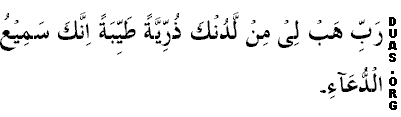
Like me, some of you may be advised to increase our recitation of Surah Maryam & Surah Yusuf during pregnancy. The first for ease at childbirth, and the latter for a beautiful baby.
However, I was reluctant to follow such advise as i couldn’t find evidence from the Quran and Sunnah supporting singling out these surahs for the reasons mentioned.
I contacted a scholar and got the following reply from Shiekh Faraz Rabbani. Just thought I’d share it here too.
Walaikum assalam wa rahmatullahi wa barakatuh,
I pray this finds you in the best of health and spirits.
It isn’t specifically-recommended from the Prophetic teachings to specifically recite Surat Yusuf or Maryam.
However, the entire Qur’an is a mercy and healing for those who revere it, recite it, reflect on it, and resolve to act on its guidance. Allah Most High says:
“And We reveal of the Qur’an that which is a healing and a mercy for believers…” [Qur’an, 17.82]
Through the experience of scholars and others, some parts of the Qur’an have been proven to have particular benefits–such as in healing, or in particular circumstances. There is nothing wrong with acting on these suggestions. It would be akin to a specific application of the general Divine promise that the Qur’an is “a healing and a mercy for believers.”
However, this shouldn’t be considered a specific sunna or somehow something one “really needs to do.”
Also, this shouldn’t keep the pregnant woman from the general sunna of reciting Qur’an from beginning to end.
i too have been told many times to recite certain surahs to help the pains experienced during pregnancy. i decided to recite the entire quran instead and eventually i'll get to those surahs as well. its been soothing reading the quran esp during intence pains and nausea and helps distract my mind from the pain.
but i don't know why i love reading surah maryam daily just because of the story, and i feel that surah is personal and touching to women expecting.
Thanks for the information but I loved to read Surah Yaseen and Surah Marriam during pregnancy.And I got so hooked up with Surah Maryam that I read the tafseer later on and I still love to recite it. May be there are some surahs you like more to recite.
^ I was told by a friend to recite that ayat when we had started trying to conceive and it was taking time, but I conceived before I could start. I recited it only once or twice with meaning when she gave it to me, maybe Allah miyaan heard my duaa :)
i have heard this as well that the rooh comes at 120 days etc. roughly 4 months when the angel blows life into the womb.
but i'm confused. at 5-6 weeks the fetus's heart starts beating inside his mother's womb - so isn't the rooh already there?
You can have a heart beating, but the ruh doesn't need to be there... the way I understand it you can have someone breathing on a machine but their rooh has already left the body. Same way with babies. It is just the mechanical stuff that is there... the heart, the body but no spirit.
On the authority of Abu Abdur Rahman Abdullah ibn Mas'ud, who said: the Messenger of Allah (SAW), and he is the truthful, the believed, narrated to us:
"Verily the creation of each of you is brought together in his mother's belly for forty days in the form of seed, then he is a clot of blod for a like period, then a morsel of flesh for a like period, then there is sent to him the angel who blows the breath of life into him and who is commanded about four matters: to write down his means of livelihood, his life span, his actions, and whether happy or unhappy. By Allah, other than Whom there is no god, verily one of you behaves like the people of Paradise until there is but an arm's length between him and it, and that which has been written over takes him and so he behaves like the people of HellFire and thus he enters it; and one of you behaves like the people of HellFire until there is but an arm's length between him and it, and that which has been written over takes him and so he behaves like the people of Paradise and thus he enters it."
It was related by Imam Al-Bukhari and Imam Muslim.