Since ancient times man has sought to protect himself from outside threats be they invaders from tribes not of his own, or even in some cases natures unwanted invasions of animals and sometimes even tides and rivers.
This has over time led to man building strongholds to protect himself and his possesions from being raided and the solutions have varied from simple earthen walls and ramps built to keep back rivers from flooding lands or to stop wolves from taking sheep. To the great stone bastions that even today can resist bombardment from above as well as on a flat trajectory. Many of these fortifications are built using natural resources and some have gone beyond to create almost impenetrable barriers on par with anything from a science fiction novel.
Here is a list of particular strongholds from the Sub-continent many of whom I have personally had the great fortune of visiting and studying up close as well as a few others that I have heard about or researched. Sadly many of these strongholds are now forgotten relics lost to the mists of time but there are a few that still exist and need to be restored and looked after for posterity.
The following collection is not ranked in any particula order but nevertheless I will talk in some detail about theier specific purpose in terms of defence and also some nice features you might want to look into in more depth.
I begin by talking about a personal favourite of mine. Attock Fort is unfortunately off limits to visitors (unless you are able to get some passage via the Pakistan Army who own the fortress) as its still a modern millitary headquarters of the Pakistan armed forces.
It was built between 1581 and 1583 by the orders of Mughal Emperor Akbar the great to guard the Mountain passages from Afghanistan into India across the Indus. Its Master Builder Khwaja ShamsUdeen chose to use the foundations of an older hill fort made of mud. He added stone breastworks and created a truly formidable fort which at the time it was built was designed for protection against mostly archers and musketmen. Cannons also posed a threat in later days so the outer fort was backed up with a stone glacis to deflect the shots over the outer wall. Its weakness lay in that it was surrounded by other higher peaks but this at the time was not so much of a problem as only light artillery could reach those peaks and light guns had no effect on Attocks massive walls.
Its other great advantage was the river that guarded Attock fort on one side and the Kabul river (river Indus) is very deep and fast flowing almost all year.
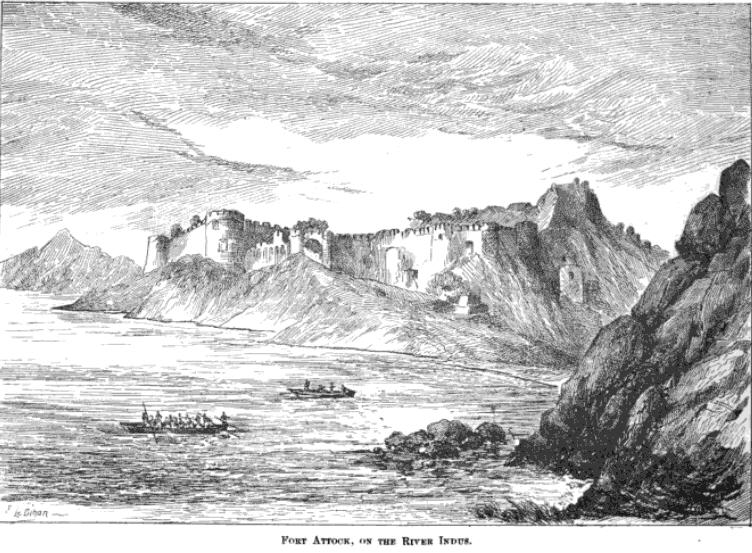
The above picture gives us an idea how diffcuilt it would be to mount an attack at this fortress.
Attock resisted attackers from both Afghanistan and Persia for over 200 years when it finally got surrendered to Nadir Shah without a shot being fired as the Mughal defenders abondoned it and fled across the Indus.
It was then taken in a brave escalade (attack by ladders) by Maratha general Raghonath Rao brother of Peshwa Balaji Baji Rao the second when the Maratha army threw the Son of Ahmad Sha abdali out of India provoking Abdali’s 5th invasion of India.
It finally fell in the Battle of Attock to Marhrana Ranjeet Singh whose engineers with British help managed to defeat an Afghan army outside the walls of Attock and again the fort was surrendered before its walls suffered any bombardment. It still stand stoday overlooking the Indus and its massive walls can be viewed from a distance of several miles away, although I advise if you do try and see it you might be able to spot it from the river but check before you try and take any photos of it.
Now from a tumultous stronghold in Pakistan to an older and less well known fortress in India.
Many know about the battles that took place at Panipat in India which were decisive events in Indian History. However few look at the actual City of Panipat itself which was home to one of the second largest metropolises in India and second only to Delhi at one time.
Panipat fort was renovated several times but in the first period it was a mud hill fort and some claim it dates right back to the period of the battle of Kurekshetra mentioned in the Mahbharata.
The modern Fortress is obviously a lot bigger but its built on the foundations of the ancient structure and boasts 15 gates and many turrets and bastions to protect them.
Most of the old fort has been swallowed up by the city itself with some shops and houses actually built using the old fort itself visitors will be shocked to find even the old barracks and stable blocks are now used as garages.
Although the best part of the fort is preserved as a Masjid and if you ask to see the Kabuli Masjid you will be taken to the last remaining bastions of Panipat fort which under the Patronage of the Mughals was best protected by a huge outer wall and that still survives and from which the Masjid itself is part of.
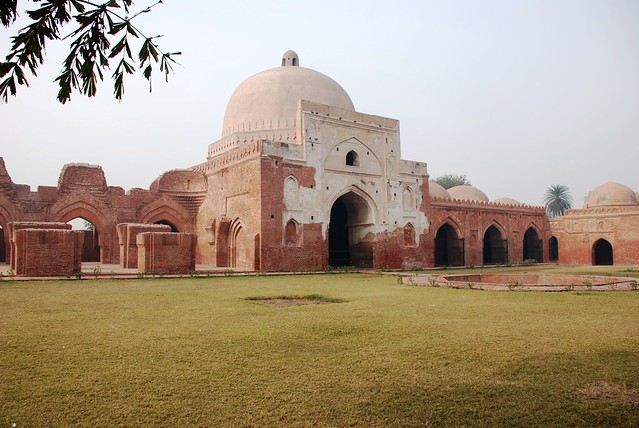
The above image is the last bastion of the old Panipat fort and is the last surviving section of the old wall that has survived the ravages of time. Sadly Panipat as we all know has not only been ravaged by time but countless invaders and there have been too many breaches to count. At least however you will be delighted to know that plenty of tour operators will tie a visit to Paniapat for you and theres easy access both from Delhi and Agra as well as the rest of India although if you travel by road one advises to be very carefull and perhaps travel in the morning when its less hot and although the traffic will be heavy its better than driving in the mid day sun.
Stay with us and in my next posts I will look at two more Strongholds of the Subcontinent.