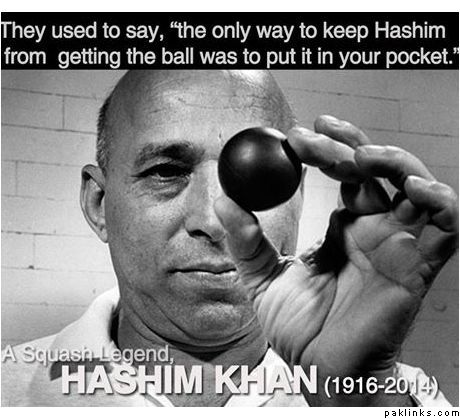
Squash great Hashim Khan passed away Monday night

Inna Lillahi wa inna ilaihi raji’un
what a legend and brave man he was.

Squash great Hashim Khan dies Monday night
By Associated Press August 19 at 12:21 AM

DENVER — Hashim Khan, one of the greatest squash players of all time, died of congestive heart failure Monday night. He was believed to be 100.
His son, Mo, said in a phone interview that Khan died in his home in Aurora, Colorado, with family by his side.
Khan was the patriarch who got the ball rolling on Pakistan’s squash supremacy, winning seven British Open titles, including his first in 1951 at an age when most players retire. Khan brought his family to the U.S. in the early 1960s after being offered a lucrative deal to teach squash in Detroit. He later took a pro position in Denver and played the game into his 90s.
Over the last six months, his health had drastically deteriorated. Hospice workers were providing around-the-clock care for him at his home.

Before he died at 10:05 p.m. EDT, he told his family to get his shoes, cane and passport because he was going to see his wife, who died a few years ago.
“The world just lost the greatest player of all time,” said Mo Khan, the youngest of 12 kids. “He’s going to be remembered for his sportsmanship and for what a wonderful man he was. He loved his family first and loved the game of squash and everyone that played the game. He was one of a kind.”

No one knew the exact age of Khan since he never had a birth certificate. The family’s best guess was 100 and that’s what they celebrated on July 1.

Just another intriguing layer to the lore of Khan, who learned the play the game barefoot.

A vast collection of his trophies are displayed inside the Hashim Khan Trophy Room, which is a squash court the members at the Denver Athletic Club converted into a shrine to him.

Khan was exposed to squash through his father, Abdullah, a chief steward at a British officer’s club in Peshawar. Back then, the youngster would go to the outdoor courts to watch the officers play and fetch their errant shots.

Eventually, the officers would head inside to escape the baking sun. That’s when Khan sauntered onto the court and emulated their shots wearing no shoes, holding a cracked racket and using a broken ball.

His father died in a car accident when he was 11, and he dropped out of school to become a full-time ball boy. He honed his skills playing the officers in friendly games. He later became one of the club’s squash coaches.

At 37 — and at the behest of the Pakistan government eager for a national hero — Khan went to the British Open, considered the most prestigious tournament. He beat the best player in the world, Mahmoud El Karim of Egypt, 9-5, 9-0, 9-0, for his first title. His last was at 44.

About then, he taught his brother, Azam, to play squash and he won four titles. Hashim Khan’s cousin, Roshan Khan, and nephew, Mohibullah Khan, each captured one. Throw in Khan’s cousin’s son, Jahangir Khan, who dominated the scene at one point by winning 10 straight titles, and the “Khan Dynasty” accounted for 23 British Open titles.

Mo Khan said his father’s funeral is tentatively scheduled for Wednesday.

Squash great Hashim Khan dies Monday night - The Washington Post
Re: Squash great Hashim Khan passed away Monday night

:inna:

A legend truly
RIP

Re: Squash great Hashim Khan passed away Monday night

Inna Lillahi wa inna ilaihi raji'un

Re: Squash great Hashim Khan passed away Monday night

:inna:

Re: Squash great Hashim Khan passed away Monday night

So sad.. A great chapter in Pakistani sports is closed. He was a true legend

Re: Squash great Hashim Khan passed away Monday night

His obituary, a beautiful dedication to Great Hashim Khan!

The Barefoot Squash Player Who Conquered the World - The Atlantic

The Barefoot Squash Player Who Conquered the World

The late Hashim Khan’s unlikely origins and symbolic power made him a global legend.
JAMES ZUGAUG 20 2014, 8:30 PM ET

When the squash player Hashim Khan died earlier this week, obituaries ran in dozens of newspapers around the world. Twitter lit up with photos and quotations. Websites and blogs mourned his passing. He was a legend.

Part of his fame came from the sheer improbability of his journey from obscurity to being the greatest and most well-known practitioner of a popular game (15 million people worldwide, spread across almost every nation, play squash regularly).

Born in 1914, Khan was raised in a tiny village in what was then the North-West Frontier Province of India. His father was killed in a truck accident when he was 11. He dropped out of school a year later and took an apprenticeship as a ball boy at the British military club in Peshawar where his father had worked. He learned the game of squash there, playing barefoot on open-air, plaster-covered brick courts. At age 28, he got a job as a squash pro at another club in town. The salary meant he could marry, and with his wife Mehria Begum he’d go on to have 16 children, 12 of which survived infancy.

In 1944 Khan took a two-day train ride down to Bombay to compete in a regional Indian tournament. It was the first time he had played on a court with a wooden floor. He won the event and came back two more years to win it again.

Then came Partition. The new country of Pakistan, eager to assert its independence, flew Khan to Great Britain to enter the 1951 British Open. It was the first time he had been on an airplane or out of his country. He didn’t arrive shoeless (it was his distant relative Roshan Khan who a few years later notoriously landed in London without any squash gear whatsoever), but he was completely unheralded. No one had heard of him or seen his name. But he went on to win the British Open, the Wimbledon of squash, with legendary ease. He emphatically defeated the defending champion in the final, winning the last two games without losing a point.

It was like fiction: The mysterious, anonymous figure who dashes into town and beats everyone handily.

Hashim Khan went on to capture six more British Opens. He was 44 when he took the last one—a record never equaled in a sport as physically demanding as squash. And consider all the many lost years when he was young and in his prime and the only people who saw him, the greatest ever, playing squash were the British officers at the Peshawar Club.

Khan was the original squash barnstormer. It turned out he loved to travel. He flew around the world, running clinics, opening courts, signing autographs (he always scribbled both the English and Arabic versions of his name) and winning tournaments. He loved giving exhibitions. He would play a dozen people in a row, a game each and dismiss them, one after another, no matter how good they were. After Khan’s death, one player remembered playing him in such an exhibition in Baltimore in the early 1970s; Khan was dressed in a three-piece suit and barefoot—and still won.

He was also a symbol of decolonization and diversity, becoming first national hero of Pakistan. A million people came out to greet him when he returned to the country in 1951. It was like Australian cricket in the 1880s or Brazilian soccer in the 1950s—a watershed moment when the colonized came back and taught the masters a lesson in their own game.

This part of his appeal was very apparent in the U.S. In 1960 Khan left Pakistan and moved to America, first living in Detroit and then in Denver from 1973 until his death. At many clubs in the preppy, Ivy Leagued world of squash, Khan was the first person of color and the first Muslim to step on their courts.

It was a watershed moment: The colonized came back and taught the masters a lesson in their own game.Off-court, he was ebullient, funny, and charismatic. He forever spoke in a pidgin-English, studding it with sapient aphorisms, jokes, and malapropisms. He wasn’t a glad-handing salesman or late-night raconteur: He didn’t drink or smoke, and he tried to keep to his regular hours of sleeping between 8:30 p.m. and 6:30 a.m. But he was engaging and warm. People traveled to Detroit or Denver regularly to get lessons from him; one Detroit cardiologist had a lesson every day Khan was in town.

Reporters loved him. The media attention around his first visits to the U.S. was amazing for a cloistered sport like squash: Life magazine, Sports Illustrated,Newsweek, New York Times, New York Herald Tribune. Herbert Warren Wind became so captivated by Khan that he wrote three profiles in the New Yorker, and a fourth in Holiday magazine.

It was a far, far cry from the days when he was a ball-boy in Peshawar and would go out on moon-lit nights to play squash, alone and barefoot.


Restored attachments:

:inna:

Re: Squash great Hashim Khan passed away Monday night

May his soul rest In Peace.

Re: Squash great Hashim Khan passed away Monday night

RIP. A true legend of Squash

He must have been supremely fit to have won his first British Open title aged 37 and his last aged 44

To put things into perspective, Jahangir Khan (arguably the greatest squash player of all time), won his first title aged 19 and his final and 10th straight British Open title aged 28

Re: Squash great Hashim Khan passed away Monday night

RIP.

Didn't know the famous Jahangir Khan was his cousin's son.

Re: Squash great Hashim Khan passed away Monday night

We really proud oh him.

Re: Squash great Hashim Khan passed away Monday night

No doubt Jahangir was the greatest player which ever Pakistan produced

http://www.paklinks.com/gs/other-sports/641081-greatest-sportsman-of-history-pakistan-ever-produced-king-jahangir-khan.html

Re: Squash great Hashim Khan passed away Monday night

You will be amazed to know 7 Squash legends were from the same Area.

http://www.paklinks.com/gs/other-sports/642743-7-squash-champions-50-years-of-rule.html