Since the other thread is closed, so I am replying to Coolguyin in this thread regarding the following question he asked:
Let me write the hadith you are referring to:
“Thauban (Allah be pleased with him) reports that the Messenger of Allah (peace and blessings of Allah be on him) said: ‘Thirty people will make false claim to prophethood in my Ummah even though I am ‘Khatamun Nabbiyeen’ and there is no prophet after me.“’ (Abu Daud: Kitab Alfitan).
Now, let me draw your attention to the Hadith related to Messiah of the latter days. This is contained in the book Al-Sahi Muslim Kitab-Alfitan in the chapter about the Dajjal.
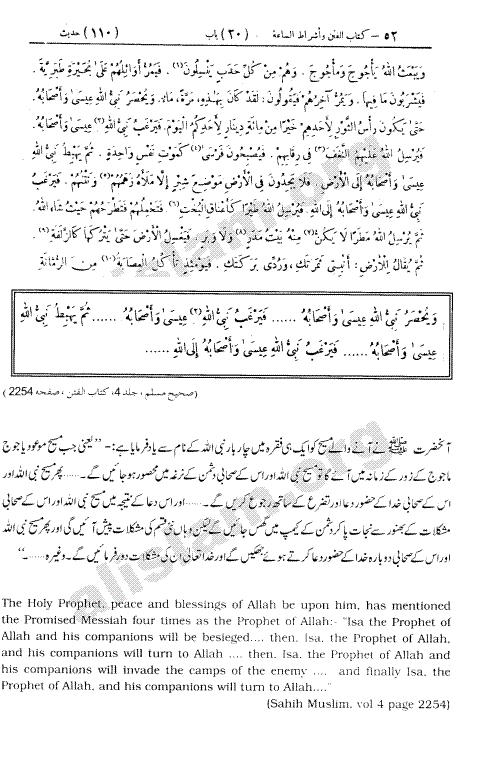
Narrating the accounts relating to the descent of Messiah son of Mary, the Holy Prophet (peace and blessings of Allah be on him) says: ” . . ..The prophet of Allah, Jesus, peace and blessings of Allah be on him, will be besieged along with his companions, Allah be pleased with them.” Then he says: “Then, the prophet of Allah, Jesus, peace and blessings of Allah be on him, will turn to God with full attention along with his companions, Allah be pleased with them…”
This Hadith is noted in Al-Sahi Muslim one of the books of the six most authentic compilations of Ahadith. It is to be noted that the Holy Prophet (peace and blessings of Allah be on him) calls the Messiah who is to come as the prophet of God four times. In addition, the Holy Prophet (peace and blessings of Allah be on him) calls the companions of the Messiah as ‘Sahaba’ followed by the appellation ‘Raziallaho Unhum’ - ‘Allah be pleased with them’.
Now you may say Jesus (peace be on him) was on old prophet. That is why he has been mentioned as prophet of Allah. How would you explain the use of words ‘Sahaba’ for the companions of the Messiah? According to you, ‘Sahaba’ is a term used exclusively for the companions of the Holy Prophet (peace and blessings of Allah be on him). It is very obvious that the Holy Prophet (peace and blessings of Allah be on him) was referring to an event that was to take place in the future.
Irrespective of the fact whether we have thirty or thirty million dajjals or impostors, the fact remains that the Holy Prophet (peace and blessings of Allah be on him) has called the Messiah of the latter days as a prophet of God. No one can change that.
The fact of the matter is that the Holy Prophet (peace and blessings be on him) possessed immeasureable honor and status both in heaven and on earth. He calls the Messiah of the latter days a prophet of God four times consecutively in one Hadith. Now, who is there to deprive him of this status? Who can close this door that has been opened by him?
With regards to the appearance of thirty dajjal in the Muslim Ummah, I have the following in Ikmal- Al-lkmal, a commentary of Al-Sahi Muslim (vol. 7, pg. 258 Egyptian)
“It would be evident to every student of the history of Islam that the truth of this Hadith has been fully established. The number of impostors from the time of the Holy Prophet (peace and blessings of Allah be on him) till today has reached the count indicated by the Holy Prophet (peace and blessings of Allah be on him) in his prophecy.“
This, indeed, is the fulfillment of a divine plan that the prophesied count of the impostors was completed before the advent of the true claimant to prophethood and it was documented in the book noted above by Muhammad Bin Yusuf Al-Sannusi Al-Hassani (died 895 A.H.).
It could be argued that there may have been some more impostors making claims following the year 895 A.H. till the time of Promised Messiah (peace be on him). This would make the number mentioned in the Hadith about thirty dajjal as dubious. But that was not so. This argument is put to rest by a top scholar of Ahle Hadith, Nawab Siddique Hassan Khan, an almost contemporary of the Promised Messiah (peace be on him). He writes:
The prophecy made by the Holy Prophet (peace and blessings of Allah be on him) regarding the advent of Dajjal in this Ummah has been fulfilled and their number as foretold has been completed. (Hijaj Al-Keramah pg. 239, published 1291 A.H. / 1874 A.D.).
Not only are both these statements BEFORE the claim of Hazrat Mirza Ghulam Ahmad, but also the leader of the Ahli Hadith sect makes the second statement.
There are Ahle Hadeeth people on this board right now who will cite this Hadeeth to show that Hazrat Ahmad (as) is false. However, their very own leaders have already admitted, before even the advent of Hazrat Ahmad (as), that the 30 liars have already appeared.
However, even if they retract their statemente now, the Sahi Muslim Hadeeth is very clear that the Messiah that is to come will be Nabi’Ullah. Call him the literal Isa (as) if you want, that’s a whole different debate. But as far as your question as to how can we accept another Prophet (sa) after Muhammad (as), the Hadeeth is clear - the Messiah will be Nabi’Ullah and Ahle Hadeeth have already accepted that the 30 liars have come and gone.
But that’s not all. There are several more Hadeeth to show that Prophets can still come
"Abu Bakr is the best of men after me except a prophet should appear.” (Kanzul Ummal)
“Abu Bakr is the best of the people after me except one who may be a prophet.” (Tabrani Kabir Kamil Ibne Adi quoted in Jame Saghir by Imam Suyuti, p.5)
“Abu Bakr is the best of my followers except anyone who might be a prophet.” (Dalmy quoted by Kanzul Haqaiq of Imam Mondadi, p. 7)
“Abu Bakr holds the highest place in this Ummah except that a prophet is raised amongst them.” (Kanzul Haqaiqi Hadith Khair-el-Khalaiq by Alama Abdur Rauf, Munavi)
These Hadeeth are very unambiguous and clear that the Ummah is to regard Abu Bakr (rz) as the best in the Ummah, unless a prophet is raised among them. No question that the Prophet(sa) knew that another prophet very well could come. He said these hadeeth to make clear that until a Prophet comes, Abu Bakr (rz) is the best.
Now the only way to rectify these hadeeth with the ones you cited, is to recognize that he only spoke of law bearing prophethood as coming to an end, not Prophethood in every manner.
I can go on with more and more Hadeeth but I’ll stop here for now. I hope this made sense. You’ll notice everything is cited.