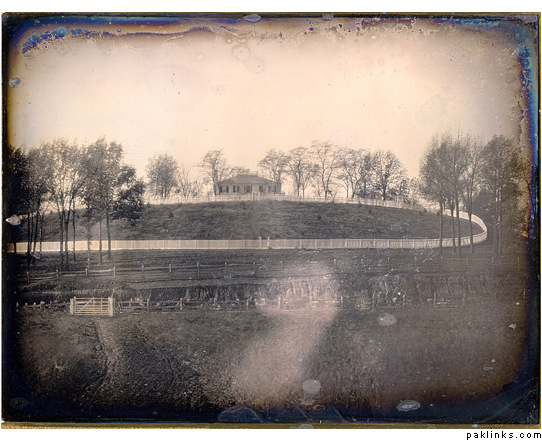
A daguerreotype of what really can be called "Old Broadway" — showing the famous New York City thoroughfare as the 1840s country road it once was — is going up for sale at Sotheby's auction house.In the early to mid-19th century, between the American Revolution and the Starbucks revolution, the Upper West Side of Manhattan was open countryside, with large estates, white picket fences and wagons trundling along a rutted road already known as Broadway.
Photographic evidence of that era is scant, as most studios offering the newfangled daguerreotypes were located several miles away at the island's populated lower end and focused, literally, on that area. But one rural scene, recently discovered in New England, is going up for sale at Sotheby's on Monday. It's believed to date to 1848.
"It is one of the earliest known photographs of New York City that we know of," says Denise Bethel, a Sotheby's vice president and its curator of photographs.
"The only earlier one is of a Unitarian church in Lower Manhattan in the early 1840s," now in Washington's National Museum of American History.
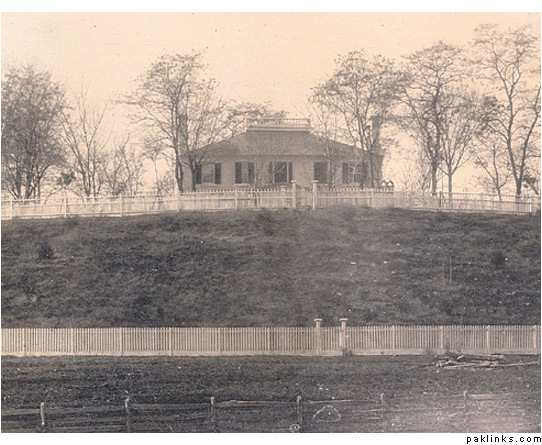
The picture has a quaint, Grandma Moses quality about it — a white house with shutters and balustrade, half-hidden behind a grassy hillside studded with tiny evergreens and surrounded by a picket fence, and on the sunken road in the foreground, a horse-drawn carriage with passengers.
Because the carriage is not blurred, Bethel believes it had paused to accommodate the photographer, who would have needed several minutes to capture the image on a 4 1/2- by 5 1/2-inch copper half-plate.
"It wasn't what we would call a snapshot," she said.
The process, which led to the development of modern photography, was patented in Paris by Louis-Jacques-Mande Daguerre in 1839. Initially it was used for portraiture; outdoor shooting was difficult owing to weather conditions, changing light and other factors, Bethel said.
As the Sotheby's picture predates the laying out of Gotham's numbered cross streets, the exact location is unknown, but a notation on the back, signed by "L.B.," identifies it as on "the main road ... called a continuation of Broadway."
Bethel says that was a term used by city directories of the day for the Bloomingdale Road, laid out in 1703 as one of two main north-south arteries in early Manhattan — the Boston Road, now Park Avenue, being the other.
Bloomingdale was an Anglicized version of the Dutch Bloemendale, as the Upper West Side was once known.
The road cut at times through hilly terrain, now harder to see because of urban expansion of the Upper West Side, noted today for cultural institutions like Lincoln Center and Columbia University as well as gourmet groceries, hip restaurants and trendy boutiques.
Sotheby's estimates the presale value of the daguerreotype at $50,000 to $70,000. As is often the case, it declined to identify the seller or the picture's provenance, other than that it was discovered in a small auction in New England.
Bethel said it was rare to stumble across an early daguerreotype of New York City and for one to have survived for 160 years with a note attached, offering information about where and when it was taken.
"If we did not have that note, would you think this was New York City? That is the only clue we have to tell us where we are," Bethel said. "Even with scenes of buildings there is often no way to tell that it's New York."
She added, however, that the picture may not be the only one tucked away, forgotten, in a drawer somewhere.
"I'll bet there are others out there," she said.