Quaid-e-Azam M. A. Jinnah

**Today is his birthday.
**
Please share your thoughts and tributes on him.

SPEECHES & QUOTES
Transfer of the Power JUNE 3 (1947)

Broadcast Speech on 3rd June, 1947 from the All India Radio, New Delhi, giving his reactions to June-3 Plan

I am glad that I am afforded an opportunity to speak to you directly through this radio from Delhi. It is the first time, I believe, that a non-official has been afforded an opportunity to address the people through the medium of this powerful instrument direct to the people on political matter. It augurs well and I hope that in the future I shall have greater facilities to enable me to voice my views and opinions which will reach you directly.

The statement of His Majesty’s Government embodying the plan for the transfer of power to the peoples of India has already been broadcast and will be released to the press to be published in India and abroad tomorrow morning.

It gives the outlines of the plan for us to give it our most earnest consideration.

We must remember that we have to take momentous decisions and handle grave issues facing us in the solution of the complex political problem of this great sub-continent inhabited by 400 million people.

The world has no parallel for the most onerous and difficult task which we have to perform.

**Grave responsibility lies particularly on the shoulders of Indian leaders. **

Therefore, we must galvanize and concentrate all our energy to see that the transfer of power is effected in a peaceful and orderly manner. I most earnestly appeal to every community and particularly to Muslim India to maintain peace and order.

We must examine the plan, in its letter and in its spirit and come to our conclusions and take our decisions. I pray to God that at this critical moment. He may guide us and enable us to discharge our responsibilities in a wise and statesmanlike manner.

It is clear that the plan does not meet in some important respects our point of view and we cannot say or feel that we are satisfied or that we agree with some of the matters dealt with by the plan. It is for us now to consider whether the plan as presented to us by His Majesty’s Government should be accepted by us as a compromise or a settlement.

On this point, I do not wish to prejudge the decision of the Council of the All-India Muslim League, which has been summoned to meet on Monday, June 9; and the final decision can only be taken by the Council according to our constitution, precedents and practice. But so far as I have been able to gather on the whole, reaction in the Muslim League circles in Delhi has been hopeful. Of course the plan has got to be very carefully examined in its pros and cons before the final decision can be taken.

I must say that I feel that the Viceroy has battled against various forces very bravely and the impression that he has left on my mind is that he was actuated by a high sense of fairness and impartiality, and it is up to us now to make his task less difficult and help him as far as it lies in our power in order that he may fulfill his mission of transfer of power to the people of India, in a peaceful and orderly manner.

Now the plan that has been broadcast already makes it clear in paragraph II that a referendum will be made to the electorates of the present Legislative Assembly in the North West Frontier Province who will choose which of the two alternatives in paragraph four they wish to adopt; and the referendum will be held under the aegis of the Governor-general in consultation with the provincial government. Hence it is clear that the verdict and the mandate of the people of the Frontier Province will be obtained as to whether they want to join Pakistan Constituent Assembly or the Hindustan Constituent Assembly. In these circumstances, I request the Provincial Muslim League of the Frontier Province to withdraw the movement of peaceful civil disobedience which they had perforce to resort to; and I call upon all the leaders of the Muslim League and Mussalmans generally to organize our people to face this referendum with hope and courage, and I feel confident that the people of the Frontier will give their verdict by a solid vote to join the Pakistan Constituent Assembly.

I cannot but express my appreciation of the sufferings and sacrifices made by all the classes of Mussalmans and particularly the great part the women of the Frontier played in the fight for our civil liberties.

Without apportioning blame, and this is hardly the moment to do so, I deeply sympathize with all those who have suffered and those who died or whose properties were subjected to destruction and I fervently hope that Frontier will go through this referendum in a peaceful manner and it should be the anxiety of everyone to obtain a fair, free and true verdict of the people of the Frontier. Once more I most earnestly appeal to all to maintain peace and order.

[RIGHT]Pakistan Zindabad[/RIGHT]
PAKISTAN AND USA : EQUAL PARTNERS IN DEFENCE OF DEMOCRACY

Reply to the speech made by the first Ambassador of the United States of America at the time of presenting
Credentials to the Quaid-i-Azam, on 26th February, 1948

Your Excellency,

It gives me great pleasure to welcome you in our midst as the first Ambassador of the United States of America. Though Pakistan is a new State, for well over a century now there have been many connections of trade and commerce between the people of Pakistan and the people of the United States.

This relationship was strengthened and made more direct and intimate during two world wars and more particularly and more recently during the second world war when our two people stood shoulder to shoulder in defense of Democracy the historic fight for self-government by your people and its achievement by them, the consistent teaching and practice of democracy in your country had for generations acted as a beacon light and had in no small measure served to give inspiration to nations who like us were striving for independence and freedom from the shackles of foreign rule

I cordially share your pleasure at the evidence of friendship and sympathy shown by your country in opening diplomatic relations with Pakistan from the every first day of its establishment as a new State. I would like to add that this friendship has been diligently and consistently furthered by your very able and esteemed colleague Mr.Charles Lewis, the Charge-d' Affairs who represented your country here pending Your Excellency's arrival.

Pakistan was confronted with grave and dangerous issues and problems from its early days. *Though as a new State we have to face a serious situation, we have no doubt in our own minds that by our united will and determination to live as a free and peace-loving people, we shall overcome them successfully. *

I thank Your Excellency for your friendly assurances of sympathy in dealing with our many problems. I also deeply appreciate your confidence that our traditions and our past will help us to fulfill the hopes and ideals of our people. In return I can assure Your Excellency that after having emerged from an eclipse which lasted over a century and a half, the people of Pakistan desire nothing which is not their own, nothing more than the goodwill and friendship of all the free nations of the world.

We in Pakistan are determined that having won our long-lost freedom we will work to the utmost limit of our capacity not only to build up a strong and happy State of our own but to contribute in the fullest possible measure to international peace and prosperity.

I am glad to learn that Your Excellency and the great country and people you represent, will give your co-operation to us in order to advance our economic and cultural relations for the mutual benefit of both the countries. I am hopeful that good relations and friendship already existing between the peoples of America and Pakistan will be further strengthened and the bonds of friendship between our two countries will be more firmly riveted.

Your Excellency, I assure you that my government and I will do all that lies in our power to give you every assistance in the fulfillment of what is our common desire and objective. I once more extend to Your Excellency a warm welcome to Pakistan as the first Ambassador of the United States of America.
[RIGHT]Pakistan Zindabad[/RIGHT]

Re: Quaid-e-Azam M. A. Jinnah

As we can see he had a clear vision where to take the country.

Nowhere he sounds like so many want to make him as.

He wanted to see the country which can go along peacefully with ideas of democracy.

I think he had vision of making the country for muslims where muslims would be free to exercise their rights of following their beloved religion as well as be progressive, friendly and open to any good ideas.

Re: Quaid-e-Azam M. A. Jinnah

4shared.com - online file sharing and storage - download A Tribute To Qaid-e-Azam Muhammad Ali Jinnah.flv

Re: Quaid-e-Azam M. A. Jinnah

Nice contributions Diwana .. very nice. Thanks :)

Agreed, Thanks:bb: for this nice thread and great contribution for Quaid’s Birthday

Awww! Thanks. :)

No matter where we are and no matter which land we become residents/citizens of, we owe to the motherland.

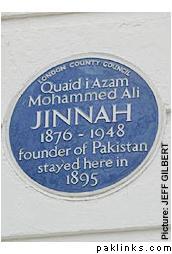
The blue plaque erected by the London County Council outside 35 Russell Road tells why this 14-room, three-storey house in West Kensington has such historical importance for Pakistanis: "Quaid i Azam Mohammed Ali Jinnah 1876-1948 founder of Pakistan stayed here in 1895.

" Quaid i Azam, which means “the great leader”, is worshipped in Pakistan.

Near the plaque are his watchwords, “Unity, Faith Discipline”.

(The news in 2003 was that Pakistan could buy and take care of this building?)

Re: Quaid-e-Azam M. A. Jinnah

Unity | Faith | Discipline

Re: Quaid-e-Azam M. A. Jinnah

A positive aspect of Nehru Report was that it resulted in the unity of divided Muslim groups.

In a meeting of the council of All India Muslim League on March 28, 1929, members of both the Shafi League and Jinnah League participated.

Quaid-i-Azam termed the Nehru Report as a Hindu document, but considered simply rejecting the report as insufficient.

He decided to give an alternative Muslim agenda. It was in this meeting that Quaid-i-Azam presented his famous Fourteen Points.

These points were as follows:

  1. The form of the future constitution should be federal with the residuary powers vested in the provinces.

*2. A uniform measure of autonomy shall be granted to all provinces. *

  1. All legislatures in the country and other elected bodies shall be constituted on the definite principle of adequate and effective representation of minorities in every province without reducing the majority in any province to a minority or even equality.

  2. In the Central Legislative, Muslim representation shall not be less than one-third.

  3. Representation of communal groups shall continue to be by means of separate electorate as at present, provided it shall be open to any community at any time to abandon its separate electorate in favor of a joint electorate.

  4. Any territorial distribution that might at any time be necessary shall not in any way affect the Muslim majority in the Punjab, Bengal and the North West Frontier Province.

*7. Full religious liberty, i.e. liberty of belief, worship and observance, propaganda, association and education, shall be guaranteed to all communities. *

  1. No bill or any resolution or any part thereof shall be passed in any legislature or any other elected body if three-fourth of the members of any community in that particular body oppose such a bill resolution or part thereof on the ground that it would be injurious to the interests of that community or in the alternative, such other method is devised as may be found feasible and practicable to deal with such cases.

  2. Sindh should be separated from the Bombay presidency.

  3. Reforms should be introduced in the North West Frontier Province and Baluchistan on the same footing as in the other provinces.

*11. Provision should be made in the constitution giving Muslims an adequate share, along with the other Indians, in all the services of the state and in local self-governing bodies having due regard to the requirements of efficiency. *

  1. The constitution should embody adequate safeguards for the protection of Muslim culture and for the protection and promotion of Muslim education, language, religion, personal laws and Muslim charitable institution and for their due share in the grants-in-aid given by the state and by local self-governing bodies.

  2. No cabinet, either central or provincial, should be formed without there being a proportion of at least one-third Muslim ministers.

  3. No change shall be made in the constitution by the Central Legislature except with the concurrence of the State's contribution of the Indian Federation.

(The council of the All India Muslim League accepted fourteen points of the Quaid.
A resolution was passed according to which no scheme for the future constitution of the Government of India would be acceptable to the Muslims unless and until it included the demands of the Quaid presented in the fourteen points)

*On March 24, 1940, the Muslims abandoned the idea of federalism and defined a separate homeland as their target. *