From the Toronto Star of April 05, 2009
TheStar.com | Insight | Dubai: How not to build a city
Dubai: How not to build a city
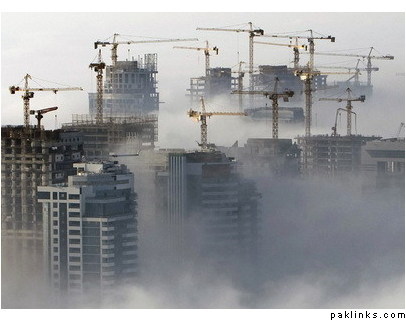
Heavy fog rolls by highrise construction sites near the Dubai Marina.
A cross between Vegas and Mississauga, Dubai is in danger of becoming a ruin-in-waiting
Apr 05, 2009 04:30 AM
Christopher Hume
Urban affairs columnist
DUBAI – If this really is a city and not some sheikh’s mad idea of what a metropolis should be, it’s a city despite itself.
Its vast wealth notwithstanding, the things that make Dubai liveable are those that happened when the planners weren’t looking. But life will out, even in a city built by oil-fuelled hubris.
To most, the image conjured up by Dubai is one of superlatives: This is the location of the world’s tallest tower (the Burj Dubai), the world’s most expensive hotel (the Burj Al Arab), the world’s richest horse race (the Dubai World Cup), the world’s … Well, you get the idea.
And not to be outdone, there’s the brand new The Tiger Woods Dubai, a golf course in the desert that requires four million gallons of water a day to stay green. This in a country built on sand.
It’s also the site of some of the planet’s worst congestion. It’s not just that everyone here drives; everyone drives badly. In March 8 of last year, for example, three people were killed and 277 injured in a highway pile-up that involved more than 200 vehicles.
**Still, it’s hard not to be impressed by what has been accomplished here. The extent of this ruin-in-waiting is truly mind-boggling. **
The question is where to start. The main street, Sheikh Zayed Road, may be as good a place as any. It runs through the city and continues on to Abu Dhabi, Dubai’s quieter, richer cousin, and capital of the United Arab Emirates. This, the road where the accident occurred, reaches 14 lanes in places – and that’s in the heart of the city. Speed limits exist, but only to be ignored.
In neither city are pedestrians welcome anywhere near the street. But in Dubai, the visitor realizes in nanoseconds that this is a city dedicated, enthusiastically, if not slavishly, to the car, the bigger the better. People just aren’t meant to be pedestrians here, but drivers.
According to a recent story in Abu Dhabi’s new English-language newspaper, The National, locals overwhelmingly view traffic accidents as the major cause of death and injury among children. No kidding. Anyone crossing a road in these parts is fair game. To step out means taking your life into your hands.
And if SUV sales have collapsed in North America, Emirates remain as committed as ever to driving the biggest set of wheels they can find. Hummers, Escalades and Cayennes abound. Dubai’s traffic, like its wealth, depends on oil, a commodity that’s already running out. It’s Abu Dhabi, back down the road, that has the vast bulk of the U.A.E.'s oil reserves – 95 per cent. Dubai has less than five per cent, and it is not expected to last more than a decade. The economy relies on real estate, tourism and Abu Dhabi, the emirate that is reported to have invested upwards of $10 billion (U.S.) in Dubai’s economy. The truth may be that this city will be obsolete in less time than it takes most communities to figure out who and what they are.
**But at the moment Dubai is famous for its architecture. Landmarks such as the Burj Al Arab hotel, which sits in the water off the city’s waterfront, have become designated icons, reproduced endlessly in kitsch souvenirs sold everywhere. In another context, such a building, despite its glorious bad taste, would still be a monument. Here it’s just another symbol of built excess, one of hundreds, if not thousands. **
**The most interesting aspect of the hotel is the helipad that extends conspicuously from the top of the sail-like structure. Though obviously intended to convey a sense of riches, it actually addresses the underlying frustration of trying to get around by car. **
To be fair, Dubai is now constructing a new above-ground metro. It will be the region’s first serious attempt at public transit, not including bus lines that serve the huge immigrant underclass brought here to do the dirty work. Keep in mind that fully 90 per cent of Dubai’s population comes from somewhere else, typically Pakistan, Bangladesh and the Philippines.
As for those skyscrapers that crowd Sheikh Zayed Rd., each more outrageous than the next, they have the strange effect of cancelling each other out. Each becomes unexpectedly meaningless, rendering any discussion of architecture irrelevant.
One is reminded that as much as anything architecture derives much of its significance from its context. There’s no better example than the Burj Dubai, which, but for the fact it’s the tallest building in the world, couldn’t be less interesting. What’s so curious is that it’s enough simply to be the tallest; there’s no pressure to aspire for excellence. For all the difference it would have made, it could have been designed by engineers.
As a result of this frantic race to outdo the guy next door, architecture has been turned into a sideshow attraction. Starchitecture is the least of this city’s problems. Dubai resembles nothing so much as a cross between Mississauga and Las Vegas, but on a massive scale; it’s not that there’s no there there, but that there are so many.
Despite everything, Dubai is a thriving city of 1.4 million, the overwhelming majority being expatriates. To wander the streets of the quarters where these guest workers live and work – Bastakiya for example – is to encounter something that approximates what urban Canadians would recognize as neighbourhoods. They don’t resemble anything North American, but there’s life at street level in shops, restaurants and so on. Walking may not be any easier in these parts, but an urban sensibility prevails. It couldn’t be further from the malls, freeways and sprawl of suburbia as we know it, or from “downtown” Dubai for that matter.
Where traditional cities have evolved over centuries, sometimes millennia, Dubai was built in decades. Not much was happening here before the 1960s, a mere blink ago in the life of a Paris, London or Rome. By U.A.E. standards, even Toronto seems positively ancient.
Though there’s something undeniably exciting, even exhilarating, about the idea of Instant City, a place unencumbered by the past and free to embrace the future, the reality says otherwise. Indeed, this isn’t so much a city of the future as a city in denial of the future.
**The old Jane Jacobs’ notion of the city as organized complexity – the sense that order can be found underneath the apparent chaos – becomes almost precious in this context. On the other hand, informal networks of various sorts have been created, self-organized, mostly by foreigners. A small but vivid example is a grassy verge that visiting workers have adopted as an informal meeting place. The expatriates can be seen sitting in groups, large and small, once the heat of the day has subsided. **
Mostly, however, tradition seems more an intrusion. The most obvious instance, perhaps, is the Muslim call to prayers, which cuts through the din five times daily, literally a voice from the past.
Perhaps even that will fall silent once this city has become the “colossal wreck” of which Percy Bysshe Shelley spoke in his famous sonnet Ozymandias. Only the desert will remain, and the sand that covers every surface.