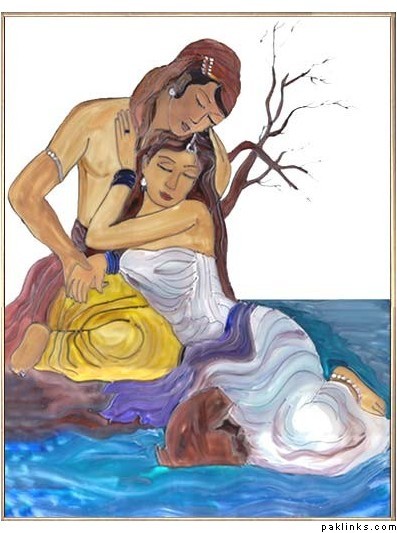
Re: Pakistani Romantics: For Valentines Day
Heer Ranjha
Ranjha quarrels with his brothers and their wives and leaves his home in Takht Hazara
Takht Hazara is a pleasant place on the banks of the river Chenab. It is the abode of the Ranjhas who live there in proud luxury. Mauju Chaudhri was chief land owner in the village. He had eight sons and two daughters.Of all his sons Ranjha was the most beloved of his father; and as his father loved him, so his brethen hated him. Now it came to pass on the Night of Nights that the leaves of the Tree of Life were shaken and by the decree of God, Mauju died.
After Mauju's death, the good land was given to the brothers and the land barren and inhospitable land was given to Ranjha: and Ranjha's enemies flapped their arms exultantly  and said, 'Now Ranjha's brethren have entangled him in a net'. And they jeered at the Jatt, saying, ' How can a man plough who wears long hair and anointshis head with curds'? His brothers jeered saying, 'He wears a looking glass on his thumb like a woman. He plays on the flute all day and sings all night.

So Ranjha, with his flute under his arm, left his father's country declaring that he would no longer eat or drink in Takht Hazara. Ranjha quarrelled with his brethren and left Takht Hazara.
Ranjha reaches the mosque
After much journeying he reached a mosque, hunger and cold fell upon him and weariness of travel. Then he took up his flute and played, and strange things happened. Some became senseless and others hearts yearned when they heard the music. Not a man or woman remained in the village. They all thronged around the mosque. Last of all out came the Mullah who was a very bag of quarrels.
The Mullah protested that he knew all the doctrines of the faith and all the prayers ordained for believers, and could lead the pious across the bridge of salvation. 'But', said he, 'lewd fellows like Ranjha should be spurned from the assemblies of honest men.

Hearing this, Ranjha jested right merrily at the Mullah's morals and his bawdy tricks, so that his hearers were much astonished and not a fewe were mightily pleased. He teased the Mullah sorely, 'Mullahs run after women in mosques and cultivated land like laymen. They are like curses clinging to the house of God'. The Mullahs face was blackened. So Ranjha slept in the mosque during the night and at early dawn he set forth on his travels.
Ranjha reaches the bank of the Chenab
At the third watch of the day, when the sun began to slope to the west, Ranjha reached the bank of the river Chenab. Many travellers were assembled at the ferry waiting for Luddan, the ferryman, to take them across. Ranjha said, 'Master ferryman, for the love of God take me across the river.'
Ranjha, weary of entreating the ferryman, sat down in a corner by himself. He drew out his flute and played the sad music of separation from one's beloved. Ranjha, having solaced his soul with music, paid no heed to the entreaties of the folk at the ferry, but taking his shoes in his hands, set his feet in the river. Luddan's wives tried to prevail on him to return and caught the skirt of his clothing. But Ranjha replied to them, 'It is best that those in trouble should die.'

But the people ran and caught him and brought him back saying, 'Friend, wenter not the river or you will be drowned.' So they caught Ranjha by the arms, put him in the boat and seated him on the couch of Heer. Enquiring as to who's couch it was, the people replied, 'This is the couch of a Jatt damsel, the daughter of Mihr Chuchak. She is as lovely as the moon. The queen of the fairies always seeks Gods protection from her beauty. Those who have become a prey to her charms can find no shelter on earth. Her beauty slays rich Khojas and Khatris in the bazaar, like a murderous Kizilbash trooper riding out of the royal camp armed with a sword. Luddan and his boatmen are afraid of her, even as a goat fears the wolf. She is the pride of the Sial assembly. Her name is Heer.'
Heer and her companions come to the ferry
Heer and her girl friends came to the river to bathe. The tinkling of their anklets was heard from afar. They descended on the boatman as a hailstorm sweeps over a field. They ordered the guards to be bound hand and foot. Heer spoke straightaway and said, 'Luddan, you black-faced rogue, why have you defiled my couch? Whom have you allowed to sleep on my bed? have you no respect for me or fear of God that you have done this thing?'
Luddan lifted his hands and said, 'Spare me, Lady, I am innocent. I did not invite the lad to sleep on your bed. The songs that he sings have cast a spell over our hearts.' Heer made answer in her anger, 'Does he not know that this is the kingdom of my father Chuchak; I care for no one, be he a lion, an elephant or the son of a noble. Does he think he is the son of Nadhu Shah or that he is the Pir of Baghdad?'

Heer turning to Ranjha said, 'Sleeper, arise from my bed. Who are you and why have you chosen my sleeping place?' Heer cried aloud in her wrath to her maid servants to belabour him with cudgels. The queen in her wrath was furious to behold.
The meeting of Ranjha and Heer
Ranjha opened his eyes and beheld Heer and said, 'Be gentle with me sweatheart.' Heer's heart melted within her even as the snow of Kashmir melts under the tyrannous sun of June.
Ranjha had his flute under his arm, and earrings in his ears. His beauty was as that of the full moon. Their four eyes met and clashed on the battlefield of love. The heart of Heer swelled with happiness even as a loaf swells with heaven. She sat in his lap as lovingly as arrows nestle in the embrace of a quiver. They conversed happily,one with the other. Love triumphant rode on the field of victory.

'It is well,' quoth she, 'that I did not beat you or say anything that was unbecoming.' Ranjha replied, 'This world is a dream. Even you, proud lady, will have to die. Take back your couch and quilt and I will depart hence and be seen no more.

Heer made reply, 'This couch, Heer and everything of mine is yours. I have been wandering masterless amongst my friends, and now God has sent me Ranjha to be my Master.'

Ranjha replied, 'Oh beauteous Lady. The wine of your beauty has intoxicated me, but you walk disdainfully.' Heer replied, 'I am your slave. Tell me, friend, whence have you come?'

Ranjha replied, 'Giurl, I am Ranjha and a Jatt by caste. I am from Takht Hazara.' And he told her his story. Heer replied with folded hands, 'I will remain your slave and all my hand maidens will do your bidding. Journeys end in lovers' meeting.
Ranjha becomes Chuchaks Cowherd
So Heer pledged her faith and Ranjha trusting her, stood before Mihr Chuchak. Heer went into the presence of her father and made Ranjha stand beside her. Heer said, 'My father, hail. My father, I have found a servant who can tend our buffaloes.'
Chuchak said, 'He seems to be a mere lad, but he has wise eyes and a kindly disposition. You are championing his cause with zeal. We will see how the boy turns out. We accept what you say; the boy can be given charge of the buffaloes, but bid him take care, as it is no easy task to tend buffaloes in the Bar.'

Thus it came to pass that after a while Heer came to Ranjha and consoled him with sweet talk. Heer said, 'I will bring you butter and sugar and sweat bread. Go and drive the buffaloes into the forest and trust in God. I and my sixty maids will accompany you and together we will track the footprints of the lost cattle.'
Ranjha meets the Five Pirs in the forest.
Ranjha took upon himself the task of a herdsman. Good fortune however came to him and he met the Five Pirs on the way. Ranjha saw by their countenances that they were holy men and besought their help.
The Pirs replied, 'Child, eat your fill and drink grey buffaloes milk and live on fat of the land. Dismiss all sadness from your mind. God himself will set your affairs right.' Ranjha replied, 'Sirs, I am in great distress. I beseech you bestow the girl Heer upon me, for the fire of love is devouring me.'

The holy Pirs answered and said, 'Child, all your wishes will be fulfiled; your arrow will hit the target, and yourboat will reach the shore. Heer has been bestowed on you by the Darbar of God.' Thus by the grace fo God and the kindness of the Five Pirs, Heer, the Jatt girl, was bestowed on Ranjha.
Heer and Ranjha meet in the forest.
Heer Jatti set out from the Jhang Sial. She came to fulfill the eagerness of her heart, for she was possessed with love for Ranjha. She brought him boile rice, sugar, butter and milk, and she said, with weeping eyes, 'I have been searching for you all over the forest.' Ranjha said, 'God himself hath said in the holy Koran, Verily your deceit is great. Satan is the lord of evil spirits and women. Women falsify the truth and feel no shame. Only if you intend to keep your word, Heer, can the son of Mauju endure the humiliation of being a servant.'
Heer comforted Ranjha with sweet words and poured out all her sould to him. She said, 'We shall be surrounded by enemies and you must confront all troubles with patience. But beware of Kaidu, my wicked uncle. The world will reproach us and those who are ignorant will cast taunts at us, but the true lover sacrifices his life for his beloved. Lovers have no support but God.
Thus everyday Heer used to take a bowl of rice and pudding to Ranjha in the forest, and she swore to be true to him. She gave up her spinning and no longer sat with her girl friends. She was with Ranjha all the day. She set aside the blanket of beholding her wantonness.

The news spread over the whole of Jhang that Heer had fallen in love with a shepherd and that she went to visit him every day in the forest.
Heer's mother is angry with her and Kaidu finds her in the forest with Ranjha
When Heer came back from the forest, her mother rebuked her, saying, 'The taunts of the village folk have consumed us utterly. If you cease not from wickedness your father Chuchak and your brother Sultan will cut you in pieces.'
Heer replied, 'Listen Milki, my mother, as long as breath remains in my body I will not leave Ranjha.' Heer would not listen to her mother and continued to visit Ranjha in the forest.

Meanwhile Kaidu the cripple, Heer's uncle, constantly urged Chuchak to Chastise Heer. He kept watch over her footsteps as a spy.

Heer had gone to the river to fetch water, and Ranjha was sitting alone, so Kaidu, in the guise of a mendicant faqir, came to him and begged for alms in the name of God, and retired towards the village.

When Heer came back from the river she asked Ranjha where the other half of the pastry was, and he told her that a crippled faqir had come and begged in God's name. Heer replied, 'Ranjha, where have your wits gone? That was no saintly faqir but my Satanic uncle Kaidu who goes about to destroy me.

The heart of Heer was scorched with anger against Kaidu. So she ran and overtook him in the way and fell upon him in her wrath like a tigress. Half of the pastry fell on the ground, and the other half Kaidu snatched from Heer, and having secured his prize, the cripple ran off as fast as his crooked legs would carry him to the village.

Kaidu came before the council of village elders and said, 'See, here are the pieces of pastry which Heer gave to Ranjha. Will you now believe when I tell you she is a shameless hussy?' The elders came and told Chuchak what Kaidu had been saying in the assembly of the elders. Chuchak was wroth and said, 'Kaidu is a talebearer and a liar; he chases moths all day.

Kaidu said to Milki, 'For god's sake get your daughter married.'   Heer withstood her parents to their faces and refused to give up Ranjha.
Scandal Spreads in the village and Chuchak dismisses Ranjha and then recalls him
When Ranjha brought the cows back that night Chuchak was wroth, and he called Ranjha and in the presence of all his kinsfolk rebuked him saying, 'Friend, give up the buffaloes and go away.'
Thereupon Ranjha threw down his shepherds crook and blanket and quit Chuchak's herd of cattle, even as a thief leaves the hole in the wall when he hears the watchman's footsteps. And he spoke to Chuchak in his anger, 'For twelve years I have been grazing your buffaloes and now you turn me away without wages.' Ranjha in a rage shook the dust of the Sials off his feet and gave up the service of Chuchak.

Milki said to Chuchak, 'All the people curse us for having turned the cowherd out without paying him his wages. Go and beseech him to come back. Tell him Heer is disquieted by his absense.' Chuchak said to Milki, 'Go you and pacify him.'

Milki having found him, she entreated him saying, 'Do not fret over much about the quarrel you had with Chuchak. Parents and children often fall out in such small matters. Come back and milk our buffaloes and spread Heer's couch. Since you have gone she has been much displeased with us. Our cattle, our wealth, the Sials and heer are all yours.' So Ranjha Hearkened to the words of Heer's mother, and once more became Chuchak's herdsman.
The Qazi admonishes Heer but she refuses to give up Ranjha
When Heer came back from the forest her parents sent for the Qazi. The Qazi said, 'It is not becoming for the daughter of Chuchak to talk to cowherds and penniless coolies. In a few days the messengers of your wedding will be here. The preparations for the marriage are all but complete. The Kheras will bring a marriage procession in a few days to take you to the house of your husband.'
Heer replied to her father, 'As wine-bibblers cannot desert the bottle, as opium-eaters cannot live without opium, so i cannot live without Ranjha. The Qazi was wroth and said, 'Nobody can stop or stay this wicked girl. heer's pride knows no bounds. She must be given in marriage at once.'

Heer called aside one fo her girl friends and sent her to Ranjha at once with the following message, 'My parents and the Qazi are oppressing me and my life is being taken from me even as sugar is pressed out of a sugar mill. You, friend, are living happily but an army of sorrows is invading me.'
Ranjha has audience of the Five Pirs and Mithi discourses on love.
Ranjha stood before the Five Pirs with folded hands and weeping eyes, and he prayed, 'For God's sake, help me, or my love will be ruined.' They said, 'Ask any favour of us and we will give it up.' Ranjha replied, 'Admit me to your holy order, make me Malang and give me Heer as my Malangan and Mate.'
Ranjha and Heer took counsel how they might conceal their plans from Heer's parents, so they decided to take mithi, the barber woman, into their confidence so that they might meet in Mithi's house. Mithi's house was near the watering place of the cattle.

Heer used to come during the night and stay till one watch of the night remained and then slip back to their own house. In the morning Ranjha drove the buffaloes out to graze in the forest. Under the pretence of bathing, Heer and her friends used to meet him in the forest on the banks of the Chenab.

But the shephards heard of these things and came and told the news to Kaidu, and Kaidu told Milki. Milki sent for Heer as Kaidu went about the village saying, 'I tell you the girl walks arm in arm with Ranjha all day in the forest.'
Heer thrashes Kaidu and Kaidu complains to the village elders
Heer's girl frienhds came to her saying, 'Your evil uncle is stiring up the whole assembly of elders against you. So Heer took counsel together with her girls, and at her bidding they waited for an opportunity and caught Kaidu and surrounded him. They tore off his beggars girdle and threw him on the ground. Their blows resounded like the hammers of the coppersmiths. They then burnt his hut and let the dogs and chickens loose all over his property.

So Kaidu resolved in his own mind how he might catch Heer and Ranjha in the forest, and bring Chuchak to see them. The next morning Ranjha drove the cattle intot he forest, anda fter two watches of the day had gone, Heer and her companions in their scarlet clothes came into the forest. The girls played together and then went back to their homes. Ranjha and Heer stayed behind and slept together peacefully in the forest. Kaidu ran off to the village as fast as his cripple legs would carry him, and said to the Assembly of Elders, 'Come and see the strange things in the forest.'
Chuchak finds Heer and Ranjha in the forest.
Chuchak muttered to himself, 'We have been dishonoured before the whole assembly.' He saddled his horse and took a spear in his hand. Heer heard the noise of the oncoming horse, and said to Ranjha, 'Get up, my father is coming.' Then she wept and said, 'I shall not come here again, so forgive me.' And she hurried from Ranjha's side.
Mihr Chuchak was tortured with rage and said, 'I will break your legs in two and cut off your head. Only thus will the scandal be stopped.' Heer turned towards Ranjha and said, 'Shepherd, leave your buffaloes and go away to your home. No one in future will care for what has happened. I am your own dear daughter and it is not meet for men of gentle birth to bring their own disgrace by publishing abroad their daughters' defects.' Chuchak bewildered and bethought that Heer ought to be given away in marriage soon.

When Ranjha became a shepherd, news was taken to his brethren in Takht Hazara. The brothers of Ranjha wrote to the Sials. 'Ranjha has cut off our nose by becoming a grazier of buffaloes. We shall be grateful to you if you will send him back; otherwise we shall have to come with a special embassage to lay our request before you.'

Chuchak replied, 'We have employed Ranjha as Heer's servant. Why have you turned such a young man as this out of your house? He is neither lame nor lazy nor clumbsy fingered. We will not turn him over, but if he wishes to see his brothers no one will prevent him.'

Ranjhas brothers and their wives wrote tauntingly to Heer. Heer had the letter read out to her and she told the contents to Ranjha, and after consulting him, she caused the following answer to be written on her behalf. 'Your letter has been recieved. We are shocked at its contents. We have employed Ranjha as a grazier of buffaloes and we will not let him go.'
Chuchak proposes to get Heer married.
Chuchak was determined to marry Heer somewhere to avert disgrace, and his brethren agreed with him, but they urged that the Sials had never given their daughters tot he lwly Ranjha tribe and that they would be disgraced if they gave their daughters to such lowly and needy folk. The brotherhood recommended an alliance with the house of the Kheras as being Jatts of good lineage whom Chuchak would be proud to won as relations. So CHuchak took the advice of the brotherhood and announced the betrothal to his friends and relations. They sang songs and made merry. The Kheras recieved the news with great joy. They assembled in crowds and danced with delight. But when Heer and Ranjha heard the merriment, Heer was angry with her mother for betrothing her against her will and said she would never go with the Kheras however much her mother tried to make her.

Heer said to Ranjha, 'Great tyranny has fallen upon us. Let us go away to some distant part of the country, for when once I am admitted into the house of the Kheras they will never allow me to come back. Ranjha replied, 'Love does not taste well if it is composed of theft and stealth and abduction.'

The girls of the Jhang Sial assembled together and came before Ranjha and asked, 'How fares it with you now? You should say to her, "If you intended to turn your face from me why did you make me undergo such hardships?" Ranjha replied to the girls and said, 'The uttering of many words is folly; all ills must be borne with patience. If God is good, the Kheras and Heer Sial will never mate together. The patience of the heart is victorious over the world. Those who keep silent always succeed.'

Heer's girls came and said to her, 'You have been insincere and have deserted your faith. If you intended to break faith with him why did you first encourage him and then break his heart? He has borne the taunts of the whole world for your sake and you have been a great tyrant. Remember that the throne of God trembles when a man is deprived of his right.'

Heer replied to the girls, 'Hide him under your sheet and bring him to me disguised as a girl, but do not let my parents know.' So one night the girls brought Ranjha disguised as a girl, and Heer and Ranjha once again pledged their troth to be true to one another.
Heer is married to Saida against her will.
Meanwhile the Kheras asked the Brahmans to consult the Stars and to fix the marriage. The Brahmans fixed Virwati (thursday) in the month of Sawan for the wedding. The guests turned green with jealousy when they saw the abundance of good things. A large host of people came to enjoy Chuchak's hospitality.

Ranjha left his buffaloes and sat in a corner sad at heart.
Meanwhile flocks of beautiful women lined the tops of all the houses to watch the marriage procession. The crowd and the noise was great as at the Fairs of Pakpattan. The girls went wild with jealousy when they saw the costly robes of the married Sial women. Then came the musicians, the dancing girls and the jesters and the minstels with trumpets and cymbals even from Kashmir and the Dekhan.

When the procession arrived Ranjha's sould and his heart were scorched like roasted meat; and said to himself sadly, 'Saida is drunk with joy today though he has not touched wine. Saida has become a Nawab and Heer his princess. Who cares for Ranjha the poor shepherd? Death is better than life without my beloved.'

When the relations of the bride and the bridegroom met they put the bridegroom and his best man on horseback.

The bride and bridegroom were made to sit facing each other and put 'surma' in each other's eyes. The Qazi who was to solemnise the marriage was given a seat on the floor. They appointed two witnesses and an attorney and prepared to offer prayers. They told her the definition of Faith and made her repeat, 'There is only one God and Muhammad is his Prophet.' They made her read the six Kalmas and taught her the Five TImes of Prayer.

The Qazi again admonished Heer but she was displeased and refused to say a word to him. The Qazi said to Heer, 'You should obey the oders of your religion, if you wish to live.'

Heer replied, 'I shall cry out in the Court of God that my mother betrothed me to Ranjha and has broken her promise. My love move is known ot Dhul Bashak, to the Pen and the Tablet of Destiny and to the whole earth and sky. Where the love of Ranjha has entered ther eis no place for the authority of the Kheras. If I turn my face to Ranjha what shelter will there be for me in the Day of Judgement?'

For a whole watch of the day did the Qazi admonish Heer and urge her to accept the marriage arranged by her parents. Chuchak said to the Qazi, 'Listen to me. The marriage procession of the Kheras is sitting at my door, and if the marriage is not accomplished I shall be disgraced and the face of the Sials will be blackened.' The Qazi replied, 'You can only gain your object by deceit. Tell the bride's attorney that consent to the marriage must be wrung from Heer, even against her will. If Ranjha the shepherd makes trouble we will cast him into the fire.'
Heer is taken to Rangpur
Thus Heer was married by strategem and put into the Doli by force. Heer cried out to Ranjha, 'Today your wealth has been looted by the kheras. Takht Hazara and Jhang are left masterless. Other brides have clothes of gren, red and yellow but I wear only mournful white.' The Kheras marched with the Doli of Heer, and at dawn they reached the forest, they halted and sat down to eat and drink and be merry.

The Kheras rode after deer and hunted lions and foxes and showed much cunning with their bows and arrows. They roasted the meat they had killed and set aside a portion for Heer. Heer finding herself alone and the Kheras merry making, made signal to Ranjha, called him into he Doli and embraced him tenderly. One of the Kheras noticed this and urged the procession to move on, and at last they reached the village of Rangpur. The girls lifted the bride out of the Doli and poured oil over the threshold. Heer's mother-in-law swung water round her bride's head and drank it and gave thanks to God.

When they espied Ranjha sitting near, they snatched the basket form his head and frightened him away. He drew near Heer by stealth and spoke to her. Heer said, 'Ranjha, this love of ours must last for all our life long. The Five Pirs stand witness between you and me. I swear I will never be the wife of Saida. I will write to you that you should come and see me in disguise of a fakir. If you do not come and see me, my soul will vanish away.
Heer is unhappy in her new home.
Ranjha resolved to become a fakir and get his ears bored and bing back Heer captive or perish in the attempt. Meanwhile Heer languished in the house of her father-in-law. She refused to put on jewellery or gay clothes. She ate no food and lay awake all night thinking of Ranjha.

Sehti, her husbands sister, spoke to her saying, 'Sister what spell has overcome you? You are growing weaker everyday. Tell me the secret of your heart that I may cure it.' So Heer told Sehti all her history and Sehti sat by Heer and consoled her saying she too had a lover, Murad Bakhsh, a camel driver, and that somehow they must contrive to help each other in their troubles.

One night Saida full of delight placed his foot on Heer's bed. Heer thrust him away saying, 'I have not yet said my prayers.' But Saida was wilful and would not heed, so Heer in her distress prayed to her Pir. The Pir at once appeared and Heer said, 'I am the betrothed of Ranjha. My love is pledged to him.' So the Pir chastised Saida, broke his bones and tied up his hands and feet.
The Five Pirs saw Heer sitting in devout meditaion they appeared at aonce by the order of God. They awakened her and said, 'Child get up. What grief has overcome you?' Heer gave a deep sigh and tears came from her eyes as she replied, 'The love of the Jatt whom you gave to me has made me mad. This love of the shepherd has ruined me. God has made you my protector and I come to the Pirs for help in my trouble.'

The Pirs were overcome with compassion, and said, 'He will meet you in person very soon for so it has been ordained by God.'
Heer sends a message to Ranjha
After a year had passed a Jatt girl from Rangpur was returning to Jhang Sial to visit her own home and she came to Heer andoffered to take any message she might want to send her parents. Heer replied, 'say, "You have given me over into the hands of enemies. May my parents be drowned in the deep stream. I will have nothing to do with them." Then seek out Ranjha and say to him, "Come to me or I shall die. I have thrown dust on the head of the Kheras and spat in the face of Saida."'

When the girl reached Jhang of the Sials she asked the folk there, 'Where is the boy Ranjha?' The girls replied, 'He is now a grown up lad and has given up all affections of the world. He roams about in the forest where there are wolves and tigers.'

So the girl went in search of Ranjha and said to him, 'Heer is on the point of death. She shows no affection for her husband's house, although they have made all efforts to please her. She will not allow Saida to touch her and she will not go near him. Go back to her disguised as a Jogi and manage to meet her somehow.'

Ranjha, heard this message, rejoiced exceedingly. He said to himself, 'The river of Love is deep but a boat must be fashioned to cross it. I must disguise myself as a fakir.'
Ranjha decides to become a Jogi
Ranjha set off for 'Tilla', the hill where Balnath the Jogi dwelt. After many days journeying, Ranjha reached Tilla, and bowed his head and placed a piece of gur before Balnath as an offering, and clasped the fet of the Jogis. Ranjha folded his hands before Balnath and said, 'Make me a fakir. Let me be your chela and be my Pir. He said to Ranjha, 'My lad, your looks are saucy and you have commanding airs. Your demeanour is not that of a servant but of onw whom others obey. Only those whose souls are submissive can become Jogis.' 'Oh Jatt, tell the truth. What has befallen you that you wish to relinquish the pleasures of life and become a fakir? The tast of Jog is bitter and sour. You will have to dress as a Jogi, to wear dirty clothes, long hair, crpped skull and to beg your way through life. You will have to become divinely intoxicated by taking kand, mul, post, opium and other narcotic drugs. You Jatts cannot attain Jog.'

Ranjha replied to Balnath, 'I accept all your conditions. I beseech you to give me Jog and to drown me in the deep waters of the Fakiri.'

The guru took Ranjhas clothes and having rubbed him in ashes and embarrassed him, made him sit by his side. Then he took a razor of separation and shaved him completely. Then he bored his ears and put earrings on him. He gave him the beggar's bowl, the rosary, the horn and the shell in his hands, and made him learn the words of Allah. He taught him the way of God and the gurus from the beginning, 'Your heart should be far from other men's women.

Ranjha having achieved his desire and having been granted Jog, shook off the disguise pentience. Balnath was sad and hung his head and he said, 'Verily I repent and am sorry for having given Jog to this youth.'

Ranjha laughed him to scorn saying, 'We Jatts are cunning strategists and we use all measn to compass our hearts desire. I will invoke the name of my Pir, my guru and of God and pitch my flag in Rangpur where I will cut off the nose of the Kheras and spite the Sials. What can a Jatt do with a beggars bowl or horn, whose heart is set only on ploughinh? My heart begs for Heer and for Heer alone.'

At last the guru understood that Ranjha had been wounded sore by the arrow of love and that he would never give up the search for his beloved. He closed his eyes in the Darbar of God and uttered this prayer:

'Oh God, the lord of earth and sky, Ranjha the jatt has given up his kith and kin and that he possesses and has become a fakir for love of the eyes of Hir, who has slain him with the arrow of love. Grant, Oh Lord, that he may get his hearts desire.'

The Five Pirs also prayed in the Court of God that Ranjha might receive that which his heart desired. Then there came a reply from the Darbar of God, Heer has been bestowed on Ranjha and his boat has been taken ashore.' Balnath opened his eyes and said to Ranjha, 'My son, your prayer has been granted. Go and invade the Kheras and utterly subdue them.'
Ranjha arrives at Rangpur
So it came to pass that Ranjha came to the village of the Kheras. The beauties of Rangpur thronged round the Jogi. When the women of the village saw the beauty of the Jogi they surrounded him in multitudes, old and young, fat and thin, married and unmarried. They poured out all their woes to the fakir and many wept as they told their stories. Some complained of their faither-in-law or mother-in-law. Some complained that their husbands beat them, others that neighbours were unkind. Ranjha made all the girls sit close to him and told them of ways to help themselves.

Saida's sister said to Heer, 'Sister, this Jogi is as beautiful as the moon and as slender as a cypress tree. He cries "God be with you". Some say he has come from Jhang Sial. Others say he has come from Hazara. Some say he is not a Jogi at all but has got his ears bored for the sake of Heer.' Heer replied, 'I entreat you not to touch on this subject. It appears to me that this is a true message form God, and that it is Ranjha. Heer said to the girls, 'Bring him somehow to me that we may find out where he comes from and who he is, who is his guru and who bored his ears.'

The girls encircled round the handsome Jogi and asked him ceaseless questions about himself. The girls then went and told Heer, 'Heer, we have enreated the Jogi but he will not listen to us.

Meanwhile Heer's heart was rent with the pangs of separation from her lover and she was devising come way of seeing Ranjha. The Jogi at the same time decided to visit the house of Mehr Ajju. So Ranjha took up the beggars bowl and went from door to door, playing his shell and crying, 'You mistress of the courtyard, give alms, give alms.'

The Jogi passed on into the courtyard of a Jatt who was milking a cow. He blew his horn and played on his shell and roared like an intoxicated bull. The cow alarmed by the noise kicked the rope and spilt the milk. The Jatt in a fury exclaimed, 'Fancy giving alms to this poisonus snake.'

The Jatt's wife flew at Ranjha and abused him and all his kith an kin, his grandparents and great-grandparents for spoiling the milk. She pushed him away and tore his shirt and flung taunts at him. The Jogi in his wrath kicked her and knocked out all her teeth. The jatt seeing his wife on the ground raised a hue and cry and shouted, 'The bear has killed the fairy. He has killed my wife. Firends, bring sticks and come to my aid.' The men cried, 'We are coming, we are coming.'

And the Jogi in alarm took to his heels. As he passed by one of the houses he saw a beautiful girl sitting all alone like a princess in a jewelled chamber of the king. He knocked at the door and said, 'Heer, bride of the Kheras, are you well? Give me alms, give me alms.'

Saida's sister Sehti appears, and begins to quarrel with the Jogi.
Ranjha meets Heer
Sehti said, 'Jogi, if you have all these powers perhaps you can cure our bride Heer. Everyday she is getting weaker.' Ranjha replied, 'Sehti, beguile me not with vain words. Bring your bride here that I may see her and inspect the colour of her eyes and face.

About this time Heer came into the courtyard and from one of the inner chambers she overheard the words of the Jogi. ZShe wondered who the speaker might be and she said to herself, 'Perhaps he is my king Ranjha!' Heer said to the Jogi, 'Jogi, go away from here. Those who are unhappy cannot laugh.' The Jogi replied to Heer, 'We are the perfect fakirs of God. Ask anything from us, fair beauty, and we can bring it about.' Heer replied, 'It is not true, Jogi; parted friends cannot be reunited. Tell mewhen the true God will bring back the lover I have lost?' The Jogi replied, 'I know all the secrets of the universe. On the Resurrection Day everything will be revealed.'

Heer stood up and said, 'This Jogi has reas the signs of the stars correctly. He is a true pandit and Jotshi. Tell me Jogi, where is my lover who stole my heart away and brought ruin on himself.' The Jogi replied, 'Why are you searching outside, your lover is in your house. Put off your veil, my beautiful bride and look if you cannot see your lost lover.'

Heer said, 'Jogi, it cannot be true. He cannot bee in the house.' Then she decided to draw aside her veil. She glanced att he Jogi and behold! It was her lost lover. And she said to him softly, 'Our secret must be hidden from the eyes of Sehti.' The Jogi replied, 'Bride of the Kheras, do not teach wisdom to the wise. Be not proud of your beauty but be kind to ol friends.'
Sehti quarrels with the Jogi and turns him out of the house
When Sehti saw the hearts of Heer and the Jogi had become one and that Heer had fallen under his spell, she began abusing the Jogi to her, 'Sister, all Jogis are liars. This snub-nosed squat dirty-faced wicked Jogi cannot be trusted.

The Jogi: 'A Jatt woman is only good for four things, pressing wool, scaring sparrows, grazing lambs and nursing a baby. She loves quarrels and beats fakirs. She looks after her own family and abuses others.'

Heer glanced at the Jogi and made signs to him to stop quarrelling and she urged Sehti not to quarrel with the Jogi. Sehti lost her temper and said to her maid-servant Rabel, 'Let us give this fakir alms and turn him out. Give him a handful of millet and tell him to go away.' The Jogi and Sehti continue to quarrel.

Heer said to Sehti, 'What strange perverseness is this? Why quarrel with holy fakirs whose only support is God?' Sehti replied, 'O viruous one whose sheet is as stainless as a praying mat! The whole house is yours and who are we? You are as important as if you had brought a shipload of clothes from your father's house. You flirting hussy and milker of buffaloes! You are still running after men. You never speak a word to your husband Saida, but you are hand in glove with the Jogi.'

Heer replied, 'You have picked up a quarrel with the fakir. Beware the fakir is dangerous.' Sehti replied, 'As sure as I am a woman, I will tell my brother of your disgraceful conduct with the shepherd.'

Ranjha complained bitterly to Heer of the way he had been used, and he entreated God, saying, 'Why hast thou separated me from my beloved after bringing us together?' And the Jogi wept bitterly and he said to himself, 'I will fast forty days and forty nights and I will recite powerfil enchantments which will overcome all difficulties and will unite me to my beloeved.'
Ranjha retires to Kalabagh
Ranjha meditated deeply in his heart, and he collected ashes from the hearth and sat down on a hillock in the garden of Kalabagh. Then he recited spells and incantations and a voice came from the Five Pirs saying, 'Go to, my child, your grief is gone. You will meet your beloved in the morning.'

It came to pass that on Friday all the girls of the village assembled to pay a visit to the garden in Kalabagh. They put out his fire, threw away his beggars bowl and wallet and scattered his bhang. They broke his pestle and mortar. They threw away his turban, his chain and his tongs, his cup and his horn. Then the Jogi gave a loud roar from inside the garden and wih a stick in his hand advanced to attack them. The girls hearing the terrible roar of the Jogi, all ran away, all save one beautiful sparrow whom he caught.

She cried, 'Help, help,' and threw off all her clothes and ornaments to save her life. If you touch us we shall die. What have you to tell me? My aunt Heer has been your friend from the beginning. We all know she is your beloved. I will take her any message you give me.'

The Jogi sighed when he heard the name of Heer and he sent a message through the girl to Heer complaining how badly she had treated him, and the girl ran off and told Heer. Heer replied to the girl, 'Ranjha has been foolish to babble the secret of his heart to a woman.'

The next day in order to compass the object of her desire, Heer went to Sehti and clasped her feet and tried to win her over with soft words saying, 'help me to meet my Ranjha. Those who do good actions will be rewarded in Paradise. If you restore Heer to her lover, you will meet your lover Murad.'
Sehti and Heer make Friends
Sehti's heart leapt with joy and she said to Heer, 'Go, I have forgiven your fault, as you have been faithful in love from the beginning. Let us go and bring about a reconciliation of the lovers'. So Sehti filled a big dish with sugar and cream and covered it with a cloth and put five rupees therein. Then she went to the garden of Kalabagh and stood with her offering near the Jogi.

Ranjha said, 'The dish is filled with sugar and rice and you have out five rupees on the top of it. Go and see, if you have any doubt in your mind.' Sehti uncovered the dish and looked at it, and behold, it was full of sugar and rice. When Sehti beheld the miracle which the fakir had performed, she besought him with folded hands saying, 'I have been your slave from the beginning with all my heart and soul. I will follow your footsteps and serve you with devotion as your maid-servant. My heart, my property, all my gril friends and Heer herself belong to you. i now pu all my trust in God's fakir.'

Ranjha said to Sehti, 'I have grazed buffaloes for many years for the sake of Heer. Tell her that a grazer of buffaloes is calling her. Bring Heer, the Sial, to me, and then you will obtain your lover Murad.
Sehti takes Ranjha's Message to Heer and Heer meets Ranjha in the garden
Sehti went to Heer and gave the message of the Jogi, saying, 'You got him to tend your buffaloes by deceit and now you have broken your promise and married Saida. By the practise of great austerities, he has obtained the help of the Five Pirs, and he has shown me his power by a miracle. Go to him at once as a submissive subject with a present in your hand, for a new governor has been appointed to rule over us.

So heer took a bath and clothed herself in silk and scented her hair with attar of roses and all manne of sweet scents. She painted her eyes with antimony and rubbed 'watna' and 'dandasa' on her face and lips, and the beauty of them was doubled. She put handfuls of earrings in her ears and anklets on her feet. Jewels shone on her forehead. She was as beautiful as a peacock.

Heer salaamed with folded hands and caught Ranjha's feet, saying 'Embrace me, Ranjha, for the fire of separation is burning me. My heart has been burnt to a cinder. I return your deposit untouched. Since I plighted my troth to you I have embraced no other man. Let us go away together, my beloved, wherever you will. I obey your orders.' And Heer threw herself round his neck. Like mas things they swung together int he intoxication of love. The poison of love ran fire through their blood.

Heer left Ranjha and consulted Sehti on how she might arrange to meet him again.
Sehti and Heer plan a stratagem
Sehti and Heer consulted together how Heer might leave the Kheras and be united to Ranjha. Sehti went to her mother and spoke about Heer. Heer came before her mother-in-law like Umar the Trickster and wove a cunning web of deceit saying, 'Mother, i am weary of staying indoors. May I go into the fields with Sehti?'

Sehti's mother replied, 'Heer may go and walk about, and may be she will recover her health and strength. But remember Heer, be prudent, and when you leave this house do not do what is unbecoming to a bride. Take God and the Prophet to witness.'

Sehti assembled her girl friends together. To please the bride Heer, she is to be taken into the garden and she will also pick cotton in the fields. So int he morning they all assembled together.

They laughed and sang and played games together, and one of them took a sharp thorn from an acacia bush and pricked Heer's foot. Sehti bit it with her teeth and caused blood to flow, and they pretended like Heer had been biten by a snake. Sehti raised a cry, 'The bride has been biten by a black snake.'

The people of the village when they saw Heer said, 'Search out an enchanter who knows powerful spells.' And the Kheras brought hundreds of fakirs and hakims and enchanters and they gave her cunning drugs.

Heer's mother-in-law beat her breast and said, 'These cures do no good. Heer is going to die. Heer's fate will soon be accomplished.' Sehti said, 'This snake will not be subdued by ordinary spelss. There is a very cunning Jogi in the Kalabagh garden in whose flute there are thousands of spells.'

So Ajju said to Saida, 'Son, brides are precious things. Go to the fakir and salaam him with folded hands.' When the Jogi heard Saida's voice his heart leapt within him and he suspected that Sehti and Heer had invented some cunning startagem.
Ranjha is called in to cure Heer's snake bite
Ajju went and stood before the Jogi with folded hands and besought him o come and cure Heer. Nad the Jogi at last consented, and as he went to the house of Ajju a partridge sang on the right for good luck.

Meanwhile, Sehti took charge of the Jogi and lodged him in the hut belonging tot he village minstrel. He gave orders that bread must be cooked for the holy man. 'No man or woman must come near or cast their shadow on it. A separate place must be prepared and Heer's couch placed on it. Only Sehti may come; only a virgin girl must be allowed to cross the threshold.'

Ranjha went outside the house and made ready to depart, and Sehti came to him and salaamed to him saying, 'For the love of god, take my poor boat ashore. I have set all plans of the Kheras at naught and tarnished the reputation of the whole family. For the sake of your love, I have given Heer into your hand. Now give me my lover Murad. This is the only request I make of you.'

And Ranjha lifted his hands and prayed to god, 'O godrestore this jatti's lover to her.' So god showed his kindness and Murad, her lover stood before her. So Murad took Sehti on his camel and Ranjha took Heer. Thus the bridegrooms set forth with their brides.
The discovery of Heer's escape with Ranjha
The next morning the ploughmen yoked their oxen and went forth to plough, and so, the house of the sick bride was empty. They looked inside ans outside and they woke up the watchman who was asleep near the door. There was a great stir in the town and everybody said, 'Those wicked girls Heer and Sehti have brought great disgrace on the whole village. They have cut off our nose and we shall be defamed through the whole world.'

So the Kheras drew up their armies on hearing the news. Now the armies of the Kheras succeeded in overtaking Murad, ut the Balooches drew up their forces and drove back the Kheras.

Destiny overwhelmed both the lovers. For the Kheras came in pursuit and found Ranjha asleep, his head resting on Heer. They took Heer away and beat Ranjha unmercifully with whips until body was swollen.

Heer advised Ranjha to seek for justice from Raja Adali. So Ranjha cried out aloud, and the Raja heard it and said, 'What is this noise?'
Ranjha and Heer before the Raja
Ranjha came before the raja and his body was sore with the blows of the Kheras' whips and he said, 'May you and your kingdom live long. I have been beaten in your kingdom and have commited no fault.'

So the Raja issued orders to his armies and they overtook the Kheras and brought them before the Darbar of the Raja.

The Raja was angry with the Kheras and said, 'You have committed a great sin in troubling this holy fakir. I will cut your nose and ears off and hang you all, if the Qazi says you are liars.

So they came before the Qazi, and the Qazi said, 'Let each side make a statement on aoth and I will administer the justice of Umer Khattab.' So the Kheras spoke.

Then the Qazi turned to Ranjha and said, 'Fakir, have you got any witnesses? Without witnesses to the marriage she can be no wife.' Ranjha replied, 'Listen to my words, you who know the law and the principles of religion. On the day our souls said yes, I was betrothed to Heer. In the Tablet of Destiny, God has written the union of our souls. What need have we of earthly love when our souls have attained the Divine Love?'

The Qazi was angered and snatched heer from Ranjha and gave her to the Kheras saying, 'This fakir is a swindler and a pious fraud.'

Heer sighed with grief and said, 'O God, see how we are consumed as with fire. Fire is before us and snakes and tigers behind us and our power is of no avail. O Master, either unite me with Ranjha or slay both of us. The people of this country have exercised tyranny against us.

Thus did Heer invoke curses on the city. And Ranjha lifted up his hands likewise and invoked curdses on the city.

See the power of God. Owing to the sighs of the lovers, the city caught fire. Fire broke out in all four quarters of the city. It destroyed houses both small and great.

The astrologers cast their lots and said to the raja, 'The pens of your officials are free from sin. But God has listened to the sighs of lovers. Hence this misfortune has overwhelmed us. Fire has descended from the city. If you will call up and conciliate the lovers, perhaps god will forgive all those who have sinned.'

So the raja sent out his soldiers, and they caught the Kheras and brought them into his presence. And the Raja took Heer fromt he Kheras saying, 'I will hang you all. Heer the Jatti belongs to Ranjha. Why do you oppress strangers?'

So Ranjha and Heer stood before the Raja, and he said to them, 'God's curses on those who tell lies. I will kill those who oppress the poor. I will cut off the nose of those who take brides. You may go to your rightful husband.
*** The poisoning of Heer and the Death of Ranjha***
Thus God showed his mercy and the Raja caused the two lovers to meet again. And Ranjha called down blessings on the Raja saying, 'God be praised and may weal and wealth come toy our kingdom. May all troubles flee away and may you rule over horses, camels, elephants, batteries, Hundustan and Sind.' So Ranjha set off towards his home taking Heer with him.

Now the shepherds were grazing their buffaloes in the jungle and they espied Heer and Ranjha and when they drew close, they recognised them. They went and told the Sials, 'Behold the shepherd has brought the girl Heer back. He has shaved the beard of the Kheras without water.'

The Sials said, Do not let them go away. Bring Heer to her aunts and tell Ranjha to bring a marriage precession in order to wed Heer.' And they brought Heer and Ranjha to the Sials.

The the brotherhood brought Heer and Ranjha to their home and laid a rich couch for them to sit on and all the family was happy. They took the Jogi's rings out of his ears. They shaved him and out a rich turban on his head, they gave him a silk shirt and sat him on the throne. They ensnared the heart of Ranjha with their cunning, for they were communing in their heart how they might kill Heer. Kaidu was forever plotting evil against them. Thus they became responsible for the murder and they themselves caused the blot on their own fame.

Meanwhile, Ranjha at the suggestion of the Sials had gone to his home, and he told his brethren to prepare a marriage procession so that he might go and marry Heer. Many baskets of fruit and sweets were put on the heads of the barbers. They prepared bands of minstrels and fireworks, and Ranjha's brothers' wives danced with happiness and sang songs.

Ah, put not your trust in life. Man is even as a goat in the hands of butchers.
Meanwhile, somebody whispered into Heer's ears that her parents were gonna send her back tot he Kheras and that they had already sent a message to have her fetched away. Nad Kaidu chided Heer saying, 'If the Kheras come there will be trouble, many quarrels and much disturbance. The witnesses of the marriage will come and they will confound your made-up tales.'

Kaidu and he Sials held counsel together, and Kaidu said, 'brethren of the Sials, such things have never befoer been said of our tribe as will be said now. For men will say, 'Go and look at the faithfulness of these Sials. They marry their daughters to one man and then contemplate giving her in marriage to another.'

And the brethren made the answer, 'Brother, you are right. Our honour and your honour are one. All over the world we are taunted with the story of Heer. We shall lose fame and gain great disgrace if we send the girl off with the shepherd. Let us poison Heer, even if we become sinful in the sight of god. Does not Heer always remain sickly and poor in health?'

So Kaidu in his evil cunning came and sat down beside Heer and said, 'My daughter, you must be brave and patient.' Heer replied, 'Uncle, what need have I of patience?' And Kaidu replied, 'Ranjha has been killed. Death with a glittering sword has overtaken him.'

And hearing Kaidu's words Heer sighed deeply and fainted away. And the Sials gave her sherbet and mixed poison with it and thus brought ruin and disgrace on their name. The parents of Heer killed her. This was the doing of god. When the fever of death was upon her, she cried out for Ranjha saying, 'Bring Ranjha here that I may see him once again.' And kaidu said, 'Ranjha has been killed, keep quiet or it will go ill with you.'

So Heer breathed her last crying words, 'Ranjha, Ranjha.'

They buried her and sent a message to Ranjha saying, 'The hour of destiny has arrived. We had hoped otherwise but no one can escape the destiny of death. Even as it is written in the Holy Quran, 'Everything is mortal save only God.'

They sent a messenger with the letter and he left Jhang and arrived at Hazara, and he entered the house of Ranjha and wept as he handed the letter. Ranjha asked him, 'Why this dejected air? Why are you sobbing? Is my beloved ill? Is my property safe?'

The messenger sighed and said, 'That dacoit death from whom no one can escape has looted your property. Heer has been dead for the last eight watches. They bathed her body and buried her yesterday and as soon as they began the last funeral rites, they sent me to give you the news.'

On hearing these words Ranjha heaved a sigh and the breath of life forsook him.

Thus both lovers passed away from this mortal world and entered into the halls of eternity. Both remained firm in love and passed away steadfast in true love. Death comes to all.

The world is but a play and fields and forests all will melt away in the final day of dissolution. Only the poet's poetry remains in everlasting remembrance. for no one has written such a beautiful *Heer*.