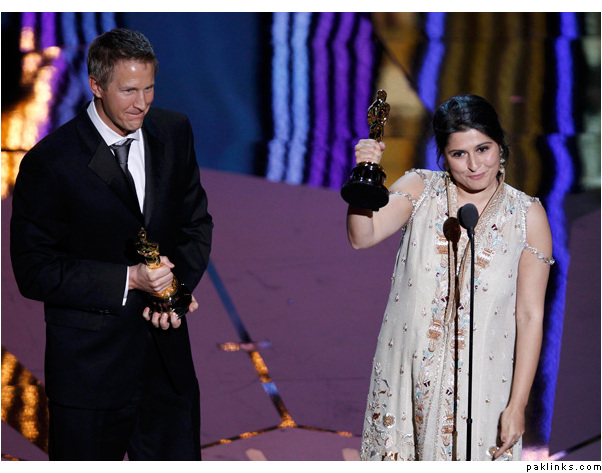
An Oscar nomination is certainly no mean feat. Sharmeen Obaid-Chinoy deserves all the accolades for being an exceptionally talented individual whose efforts are being celebrated at such a global level.
**
“First Person: Nominated**
**
Unless you have been away on a ship with no TV or radio, you would most likely have heard of the filmmaker from Pakistan who is in the running to receive an Academy Award.**
Meet Sharmeen Obaid-Chinoy, the first and only Pakistani so far to have been nominated for an Academy Award. Her entry, Saving Face, is a 52-minute documentary which talks about the plight of women subjected to acid attacks, and a doctor who comes to Pakistan to treat them and give them hope. Saving Face has been one of the more talked about entries at the event—due largely to its heart-wrenching subject as well as the fact that it’s auteur isn’t from a country known for making many quality films.
It wasn’t an easy film to make for the confessed workaholic. In 2010, Sharmeen had just won an Emmy Award, was dealing with pregnancy and had also just lost her father (he played a monumental role in supporting her work). Anxious to break out of the resulting conflicting emotions, she agreed to Saving Face when Daniel Junge, a co-filmmaker, proposed the idea to her.
Unfortunately, Daniel was only able to come to Pakistan twice to help with the filming. To add to it, production could only commence once Sharmeen managed to convince victims of the acid attacks to come forward and speak about their experience.
Not the simplest task considering the reasons for them to not come on camera: family members of the victims were hesitant to attract more attention, as there was the threat of more attacks as punishment for speaking out, and most saddening was the victims’ own reluctance to being filmed given the scars from their traumatic experience.
But she was also determined to tell their story, “The single act of throwing acid on a woman’s face completely ruins her life. It’s like the living dead, because if you throw acid on a woman’s face, she can seldom go home after that. To me, it’s the most heinous of all crimes against women.”
What helped was that Sharmeen and her crew were Pakistanis; they shared a language, and hence an identity with the victims.
And while none of the people in Abbottabad, where she filmed, knew what the Oscars were, they knew that this was something big and would give them a voice, “I’ve told women’s stories for a decade now. The film needed to show them to have dignity, of how they are resilient women. I don’t want anyone to watch the film and pity these women. I want them to look at this film and say wow, they give me hope!”
And that is how she answers any of her critics who might say that her films cast the Muslim world and Pakistan in a bad light.
Saving Face chooses not to discuss the topic of rampant acid attacks in Pakistan but how a doctor chooses to give back to his country by helping its people; how women politicians work together to get a bill passed in Parliament. Her stance is, “Should we not talk about these things just because they are negative? Because Pakistan can fix its problems if it so chooses.” The last statement is something we have all noticed time and again, from cricket matches to corruption and now to acid attacks.
As a filmmaker, the Academy Awards is not the first time Sharmeen has been nominated for an award while being the only Pakistani in the running. In 2003, she won the Livingston Award for Young Journalists, one of the most prestigious awards in Journalism which no non-American had ever won. When one of the members of the jury called her to talk about her entry, Reinventing the Taliban, she said, “I assume you’re calling because I’m not a US citizen.” But they had actually called to tell her she had won. “I was completely taken in over the phone… I shrieked a lot.”
Besides the Livingston, Sharmeen has won the Overseas Press Club Award, the South Asia Journalist Association Award, the CINE Golden Eagle Award, as well as an Emmy Award in 2010 for Pakistan: Children of the Taliban. This recognition is one of the things that motivate her to make more films.
“Recognition is a great feeling,” she says. “It’s a feeling we should cultivate in Pakistan. We don’t have that cycle here that rewards our young. All our awards are focused around the people who are really on top and there are some people who continuously get awards.”
At the Oscar’s, Sharmeen Obaid says she will be wearing outfits designed by Bunto Kazmi and Sana Safinaz with jewellery by Kiran Aman and Sherezad. Other designers have also come together to design outfits for her to wear at more events, while a reputed airline carrier has volunteered to fly her team out to LA; it’s not an invite to a filmmaker it seems but an invite to a country to join together and send one of their own to one of the biggest awards functions on the planet.
But the jewellery she—and all of Pakistan—wants her to walk away with is the golden boy that the winners receive. When I ask Sharmeen what she thinks her chances are of winning the Oscar, she says, smiling cautiously with her fingers crossed, “One in five!”
**Whether she wins or not (here’s hoping she does), we’re proud of her”
**Hopefully she wins. :jhanda: