Pakistan’s Richest Man Defies Terrorism to Expand Bank Empire

Pakistan’s Richest Man Defies Terrorism to Expand Bank Empire

By Yoolim Lee and Naween A. Mangi

Dec. 3 (Bloomberg) – On a September evening when many of Pakistan’s 165 million people were breaking their fast during the Muslim holy month of Ramadan, billionaire Mian Mohammad Mansha, the country’s richest man, was deciding whether to buy an Indonesian bank.

A phone call to his Lahore office interrupted him: Turn on the television, his son Hassan implored. The Marriott Hotel in Islamabad was in flames after terrorists had detonated a truck packed with explosives. The blast, in a security zone less than a kilometer from the presidential residence, killed 53 and injured 266.

“It was terrifying,” says Mansha, 61, chairman of the Nishat Group financial, textile and cement-making empire, who says he stays at the Marriott when he’s in the capital. Just hours before the blast, Asif Ali Zardari, Pakistan’s new president, had vowed to rid the country of the “cancer” of terrorism.

As Pakistan battles extremist-inspired violence and its worst economic crisis in a decade, Mansha says he’s keeping Nishat Group’s expansion on track.

At home, where his MCB Bank Ltd. is the biggest lender by market value, he was in talks in October to buy a rival he declines to name. He’s looking at four banks in Indonesia, the only country with a bigger Muslim population than Pakistan.

By May, he’ll open a machinery and automobile leasing company in Azerbaijan, a predominantly Muslim country between Iran and Russia. He’s eyeing Kazakhstan and the Mideast for banking. And he’s also looking at Canada, with a Pakistani community estimated at more than 300,000 people.

Following India

Mansha started building in the decades of upheaval that followed Pakistan’s split with India after their independence from Britain in 1947.

Now he’s taking a cue from entrepreneurial Indians. Billionaire Mukesh Ambani, chairman of Reliance Industries Ltd., and Ratan Tata, chairman of Tata Group, expanded as India grew at an average annual rate of 8.8 percent in the five years ended on March 31, 2008.

Pakistan almost kept pace with its larger neighbor: Its gross domestic product rose at an average of 7 percent during the five years that ended on Dec. 31, 2007.

“I want to be the first Pakistani, like some of our counterparts in India, to really go out and show that we Pakistanis can even be successful outside Pakistan,” Mansha says two days after the Marriott bombing.

Mansha is optimistic during a dire period for Pakistan.

Benazir Bhutto

On Dec. 27, 2007, Zardari’s wife, former Prime Minister Benazir Bhutto, was killed in a gunfire and suicide bomb attack. Political wrangling followed, leaving a power vacuum.

In September, Zardari was elected by Parliament as a civilian president in a country dominated by a military that had 619,000 members in 2006, according to the Center for Strategic and International Studies.

Since his election, U.S. forces in Afghanistan have stepped up raids into western Pakistan, targeting Taliban and al-Qaeda fighters who move at will across the border of the lawless area. Pakistan’s rivalry with India adds to the anxiety, as both countries possess nuclear bombs. Relations have improved since a 2003 cease-fire over the disputed territory of Kashmir. Foreign ministers of both countries pledged to advance their more than 5- year-old peace process in a meeting in New Delhi on Nov. 26.

Mumbai Attacks

Later the same day, terrorists stormed five-star hotels and tourist sites in Mumbai – India’s financial capital – killing 195 people. A little-known domestic militant group called the Deccan Mujahadeen claimed responsibility.

India will “go after” individuals and organizations behind the attacks, Prime Minister Manmohan Singh said in a televised address Nov. 27, without identifying the nations. On Nov. 28, Indian Foreign Minister Pranab Mukherjee said elements from Pakistan were behind the attacks. Pakistani Foreign Minister Shah Mahmood Qureshi challenged India to provide evidence of a link. Pakistan, which has fought three wars with India, has denied any role.

The deadliest attacks in India in 15 years have heightened tension in the region, says Robert Broadfoot, the Hong Kong-based managing director of Political & Economic Risk Consultancy Ltd. “It’s a very serious situation,’’ he says. “War is not the most likely scenario but it’s a possibility.’’

“My biggest worry is whether it will fuel nationalism in the country and play into extremism,’’ Broadfoot says. “Emotions run very, very high. How you can channel these emotions into something positive is a major challenge for any country.’’

‘Believe in Détente’

Mansha says escalating tensions between Pakistan and India would be disastrous for the region. “I still strongly believe in detente between India and Pakistan and opening up trade facilities,” he said in a telephone interview on Nov. 28. “That will lead to a situation where misunderstandings will become less between the two countries. I would urge our leaders not to waver from what has to be done. The relationships have to be strengthened.”

Mansha cautioned that harm would come from backtracking on progress the countries have made in their ties. “If we do get into a defensive mode again or closing our minds, that will serve the terrorists,’’ he said. “We need to have courage and move forward.’’

Concern about the Mumbai attacks comes as Pakistan again is trying to skirt default after having once avoided that abyss with a $600 million International Monetary Fund loan in 1999. That year, Pervez Musharraf seized power in a military coup. He named himself president in 2001. Record remittances from Pakistanis overseas and investments by interna tional companies spurred the strongest economic run in decades.

IMF Bailout

By 2008, Pakistan was again seeking IMF help. On Nov. 25, it won final approval on a $7.6 billion loan package after foreign reserves shrank 74 percent to $3.5 billion in the 12 months ended on Nov. 8. The Karachi Stock Exchange 100 Index, which had more than doubled to become the world’s best performer in 2002, tumbled 35 percent in 2008 as of Dec. 2.

The exchange imposed trading curbs on Aug. 28, preventing shares from dropping below their Aug. 27 levels. Inflation jumped to a 30-year high of 25.3 percent in August, and the Pakistani rupee plunged to a record 83.40 to the dollar in October. All of that came on top of the global financial crisis. Europe and Japan fell into recession in the third quarter.

Mansha, who estimates his fortune at about $4 billion, says the world’s economic woes are making companies cheaper for people like him who have money to spend. He added to his purse in May by selling 20 percent of MCB Bank to Malaysia’s Malayan Banking Bhd. for $907 million. That gives him about $1 billion for takeovers in the next 12 months.

‘Opportune Time’

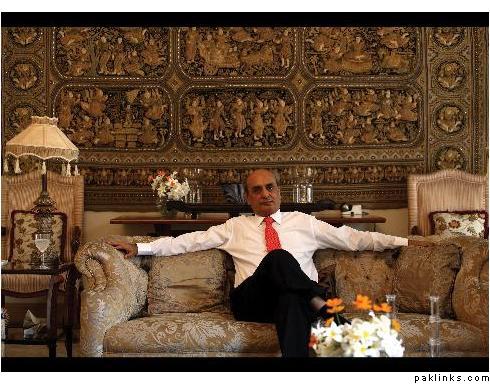
“It’s an opportune time for us,” Mansha says, wearing a crisp white shirt with gold cuff links, a red tie and dark slacks in his office, where Perfect Hostage: A Life of Aung San Suu Kyi is one of about 100 titles on a ceiling-high bookshelf. Democracy advocate and Nobel Peace Prize winner Suu Kyi is under military house arrest in Myanmar.

Mansha isn’t a typical meeting-going executive. He hashes out deals on his mobile phone, often while walking alone in a park across the street from the Lahore home he shares with his wife, Naz, and his three U.S.-educated sons and their families.

“He maintains a low profile, and his people are guided to be the same,” says Muhammad Farid Alam, chief executive officer of AKD Securities Ltd., one of Pakistan’s largest broker ages. If Mansha doesn’t identify himself, people may not recognize him, Alam says.

Mansha keeps his business in the family. Eldest son Raza, 36, graduated from the University of Pennsylvania in 1994 with a bachelor’s degree in international relations. He runs D.G. Khan Cement Ltd., Pakistan’s second-biggest cement maker. Umer, 35, oversees Nishat Group’s textile ventures.

Power Business

Hassan, 28, is in charge of the power business. Hassan’s wife, Iqraa, 26, heads a venture that plans a luxury hotel in Lahore with Le Meridien, which is owned by Starwood Hotels & Resorts Worldwide Inc.

“You will never see my sons in parties,” says Mansha, whose view out his office window includes Lahore’s oldest golf course. “We keep to ourselves and try to do whatever we have to do.”

So far, MCB Bank has dodged the global credit crunch.

With Pakistan’s banking system in its infancy, most lenders stick to such basics as savings accounts. They’ve avoided the high-risk loans and derivatives that got their U.S. and European counterparts into trouble, says Syed Ali Raza, president of National Bank of Pakistan, the country’s biggest lender by assets.

MCB Bank’s net profit rose 10 percent in the quarter ended on Sept. 30 on revenue of 12.8 billion rupees ($160 million), up 31 percent from a year earlier. At the end of September, MCB was able to cover 90 percent of potential loan losses, says Abdul Shakur, an analyst at Invest Capital & Securities Ltd.

Plenty of Capital

MCB says its capital adequacy ratio – a measure of capital reserves compared with assets at risk – was 16.21 percent at the end of September, among the best in the world. Mansha’s D.G. Khan Cement had a 223 million rupee loss in the quarter as loan costs rose. A year earlier, profit was 267.9 million rupees.

Nishat Group’s five publicly traded companies – Adamjee Insurance Ltd., D.G. Khan, MCB Bank and textile ventures Nishat Mills Ltd. and Nishat (Chunian) Ltd. – contributed 7.2 percent of the Karachi index’s market value as of Dec. 2. Nishat Group has nine privately held units, including charter jet operator Pakistan Aviators & Aviation Ltd. and a company that makes bags for cement. They provide many of Pakistan’s goods and services.

“The typical narrative on Pakistan is a war-and-terror type of perspective,” says Soofian Zuberi, Hong Kong-based head of Asia equity capital markets at Merrill Lynch & Co., which advised on MCB ‘s 2006 share listing in London and the stake sale.

“Nishat Group demonstrates the potential for companies in Pakistan to make profits, reinvest those profits in the country and generate strong returns.”

Bright Spot

MCB Bank shares have been a bright spot for investors.

The stock returned an average of 55 percent a year in the 10 years ended on Oct. 31. That compares with 28 percent annually for the Karachi index. In 2008 through Dec. 2, MCB’s shares dropped 41 percent as the rupee and foreign exchange reserves fell.

“It’s a very good bank, which is operated very professionally,” says Mark Mobius, executive chairman of Templeton Asset Management Ltd., which counts MCB among its $30 billion of emerging-market stocks. “Pakistan is going through some difficult times, but the good news is that we now have a democratic government, and business goes on.”

Mansha says Zardari’s fledgling democratic government, working with entrepreneurs like him, can help stabilize Pakistan by providing jobs to curb poverty in South Asia’s second-largest economy.

Biggest Private Employer

Nishat Group employs 30,000 people, more than any entity in Pakistan except the government. Two-thirds of Pakistanis live on less than $2 a day. Many of the poor live in areas bordering Afghanistan where terrorists pay otherwise unemployed recruits.

“Pakistan today is an epicenter both of global terrorism and the fight against religious extremism,” says Dipankar Banerjee, director of the New Delhi-based Institute of Peace and Conflict Studies. “Pakistan has to take a hard stance and develop a strong democratic culture of governance.”

Mansha says he saw poverty-born violence firsthand after he took over D.G. Khan Cement in 1992.

One of its factories was in Punjab province in northeastern Pakistan. The quarry was in a tribal area through which 11- kilometer-long (7-mile-long) conveyor belts ran.

When Mansha inspected the site, local people tried to shoot at him. He told managers to give them jobs, even if the work was menial, such as lifting cement bags. He says he built the area’s first medical facility. He says these efforts cut down violence and helped his business grow.

‘Employment and Poverty’

Pakistan’s cement exports to Afghanistan, India and the United Arab Emirates rose 57 percent to 2.5 million tons in the quarter ended on Sept. 30, according to KASB Securities Ltd., a Karachi-based brokerage.

“The issue of terrorism that we have to face at this moment has to do with employment and poverty,” Mansha says. “We will sooner or later create conditions by putting money in these areas. We must create jobs.”

Mansha has his share of detractors. Saeed Ghani, a labor leader who was fired from MCB Bank more than 10 years ago, led a strike that shut 120 branches in July. The strikers protested the threatened firings of a dozen current union members and demanded that dismissed workers be rehired.

“Mansha is manipulative and two-faced,” says Ghani, speaking of his frustration in trying to get the union members reinstated. Ghani says his father, Usman Ghani, a former MCB trade union leader, was shot to death in 1995 by an unknown gunman on Karachi’s streets.

Mansha says he’s never met Saeed Ghani and doesn’t know anything about the killing.

Migrants on Sidewalks

Karachi, Pakistan’s financial capital, exemplifies the nation’s extremes. Migrants live on the sidewalks and work on construction sites while businessmen and fashion designers buy million-dollar homes near manicured parks and shopping malls. Bankers sip cappuccino, and students hang out at McDonald’s.

Mansha’s 29-story MCB Tower, the nation’s tallest building, rises above the bustling business district. Outside the cities, the poor live without sanitation and heat makeshift stoves with buffalo dung. Children die from complications of preventable maladies such as diarrhea.

Mansha’s Lahore office is about 3 kilometers from his house on Main Gulberg Road, where he’s lived for 37 years. Marigolds and roses grow in flowerpots near a door made of wood carvings that are more than 100 years old. Inside, a living room containing white sofas leads to the family dining hall and its two round tables, each large enough to seat 10.

Cotton Business

Mian Mohammad Yahya, Mansha’s father, and his five brothers left their home in Calcutta, now called Kolkata, India, in 1947. They moved to Faisalabad, near Lahore, and started the family’s cotton business.

Mansha was born that same year, amid the mass migration that defined Pakistan’s split with India when Britain abandoned its rule. The brothers called their cotton company Nishat Mills after Nishat Haroon, a grandson of the eldest brother.

The Korean War of 1950-53 sparked a cotton boom as demand surged for uniforms, bandages and tents. Mansha attended Sacred Heart School, a coeducational convent school run by nuns. He enrolled for its academic standards, not for religious reasons.

He went on to study accounting at Hendon College in London, returning to Pakistan in 1968 before getting a degree because his father had developed cancer. He married Naz Saigol, a former classmate from his hometown who was the daughter of industrialist Yusuf Saigol. It was partly an arranged marriage, as their parents were friends, Mansha says.

East Pakistan

When his father died in 1969, Mansha, then 22, bargained with his uncles for Nishat Mills’s operations in Faisalabad rather than its other factories. His father’s friends warned him not to take over operations in East Pakistan.

Created at the partition of India, East Pakistan was a Muslim-majority province separated from West Pakistan’s power center by more than 1,000 miles. His uncles lost everything when East Pakistan won independence as Bangladesh in 1971.

Mansha became CEO of Nishat Mills, which today has the nation’s largest textile processing and sewing facilities and counts Gap Inc. and Sears Holding Corp. as customers.

As Mansha grew as a textile entrepreneur, Pakistan’s banking industry was locked in government hands. In the 1990s, political rivals Nawaz Sharif and Bhutto alternated power as Pakistan began economic reforms.

Under Sharif, banks got professional boards and made cash provisions for doubtful loans. Bhutto put state-run banks, energy and cement companies on the block. The government handled 165 sales worth 458 billion rupees from 1991 to 2007, according to Pakistan’s Privatisation Commission.

Not a Coincidence

Mansha and 11 other entrepreneurs formed National Group in 1991, which won the right to acquire Muslim Commercial Bank, today’s MCB. Their bid was the third highest of five. Even so, Sharif’s government chose it.

Farooq Leghari, who was federal minister for finance in 1993, told the Senate at the time that National Group had won because of ties to Sharif.

“It did not happen by coincidence,” said Leghari, according to Shahid-ur-Rehman’s 1997 book Who Owns Pakistan? Leghari, who served as Pakistan’s president from 1993 to 1997, declined to comment for this story.

Mansha recalls the incident clearly.

“When we bid for this bank, somebody else also bid much higher than us, a person with dubious reputation,” he says, without naming anyone. “He probably had no genuine intent. He wanted to stall us.”

Political Ties

Mansha says he didn’t have ties to Sharif.

“People think that we bought a lot of things during Nawaz Sharif’s time and that I am very close to him,” he says. “I have never met Nawaz Sharif, one to one, in my life. I have never met Mr. Zardari in my life other than at one wedding. I never met Benazir Bhutto. I have never bribed anyone.”

When Bhutto regained power in 1993, she criticized Sharif’s sales as lacking in transparency. To escape scrutiny, Mansha left Pakistan, says a person close to him who was involved in the MCB deal.

Mansha says he went to Boston for a year and a half. “I had some problem,” he says, declining to elaborate. He spent time with his son Umer, who was at Babson College in Wellesley, Massachusetts. Mansha returned in 1996, when Bhutto left power for the final time.

At MCB, Mansha made decisions that sometimes went against his executives’ advice, says Farid Khan, director for equities at Credit Suisse Pakistan Ltd., who formerly headed MCB’s asset management unit.

‘His Intuition’

Khan says Mansha was usually right.

“Maybe it’s his intuition, his vision, maybe his good luck, but one learns and respects his decision-making ability,” Khan says.

When MCB Bank was readying the sale of $150 million of global depositary receipts in June 2006, the Karachi index tumbled to a seven-month low. Khan urged postponing the sale. Mansha pushed ahead, saying the drop would be temporary. The bank got offers for $707 million of GDRs, more than quadruple the amount available.

Mansha can be ruthless, people who have known him for years say. With MCB, “after he got control, he didn’t spare even friends and family who were defaulters,” AKD’s Alam says.

He even turned down a loan request from a childhood friend, which strained their relationship.

“There had been incidents like this even with family members where temporarily there had been hard feelings,” Naz Mansha says. “It takes a lot to refuse somebody you are so close to.”

Random Calls

Mansha monitors each Nishat Group company by talking with 20- 30 managers a few minutes every day. “You could be hanging from a thread off a cliff, and he’ll let you be, but he won’t let you fall,” says Ahmed Jahangir, a nephew of Mansha’s who oversees Nishat Mills’ textile business as executive director.

The boss knows the bottom line by staying in touch through random calls. “A bad month or a good month, he doesn’t have to be told,” Jahangir says. “He knows exactly what’s coming.”

Mansha molds his executives to be like him, AKD Chairman Aqeel Karim Dhedhi says. “He protects his own interests,” Dhedhi says. Mansha says he personally makes key strategic decisions, such as choosing to sell the MCB Bank stake to a state-controlled lender in Malaysia rather than to the public companies in Europe the bank had considered.

Mansha strengthened his control as Nishat Group grew, Dhedhi says.

“Earlier, one heard Mansha had a different image, but after the acquisition of MCB, he has brought great discipline,” he says. “Nishat Group is one of the best-run groups in Pakistan.”

‘Energy and Food’

Mansha’s wider ambitions run from power production to agriculture. “The future of the world will belong to whoever can harness energy and food,” says Mansha, who’s been buying land for a new business of large-scale farming.

Agriculture is the biggest job source for Pakistanis, accounting for 44 percent of the labor force and 21 percent of GDP in 2007. If yields of major crops – wheat, sugar cane, cotton and rice – match Egypt’s in five years, Pakistan may add 11.5 percentage points to its annual agricultural GDP growth and 2.4 points to total GDP growth, Karachi fund management firm Arif Habib Investment Management Ltd. says.

Mansha’s family is playing a leading role in Nishat’s expansion.

Naz Mansha supervises some of the eight factories that handle every phase of textiles – from spinning and weaving to dyeing and sewing. She’s opened Nishat Linen in a swanky, five-story glass building in Lahore, one of three Nishat stores that feature sheets, tablecloths and aprons in exotic prints.

“Textile is in my blood,” says Naz, sporting a floral shalwar kameez, a traditional outfit worn by women and men, as she shows off a factory in Lahore. Men wearing shalwar kameez sit at a dozen rows of sewing machines, stitching blue sofa covers for Sure Fit Inc., one of the largest U.S. providers of ready-made slipcovers.

Such factories show how Nishat Group has grown during six decades of turbulence. If Mansha can expand with the economy in shambles and a new government struggling with violence, he may provide a model to help Pakistan’s companies – like their neighbors in India – move onto the world stage.
Re: Pakistan’s Richest Man Defies Terrorism to Expand Bank Empire

Such a nice read, thank you Eco-Shan bro for sharing. I personally meet this guy, he has truly down to earth attitude.

Re: Pakistan’s Richest Man Defies Terrorism to Expand Bank Empire

yeah ive heard about that, he spent so much time in exile during benazir's time then nawaz brought him back.
his worth is more than billion dollar but for some reason he doen qualify for forbes

Re: Pakistan’s Richest Man Defies Terrorism to Expand Bank Empire

Piece of advice for Mansha: Stay away from Zardari :D

Re: Pakistan’s Richest Man Defies Terrorism to Expand Bank Empire

^^ for sure, cuz as i mentioned benazir was the one who forced him to exile, and then nawaz brought him again and then he was offered the that government is privatising some struggling companies and he showed interest in MCB and fertilizer sector, and now everyone knows that MCB is the biggest lendor in pakistan, and as a compition he also constructed pakistan's tallest building mainly to beat Habib bank tower in Karachi (and pic aswell)

Pakistan’s Richest Man Defies Terrorism to Expand Bank Empire

Pakistan’s Richest Man Defies Terrorism to Expand Bank Empire

Dec. 3 (Bloomberg) – On a September evening when many of Pakistan’s 165 million people were breaking their fast during the Muslim holy month of Ramadan, billionaire Mian Mohammad Mansha, the country’s richest man, was deciding whether to buy an Indonesian bank.

A phone call to his Lahore office interrupted him: Turn on the television, his son Hassan implored. The Marriott Hotel in Islamabad was in flames after terrorists had detonated a truck packed with explosives. The blast, in a security zone less than a kilometer from the presidential residence, killed 53 and injured 266.

“It was terrifying,” says Mansha, 61, chairman of the Nishat Group financial, textile and cement-making empire, who says he stays at the Marriott when he’s in the capital. Just hours before the blast, Asif Ali Zardari, Pakistan’s new president, had vowed to rid the country of the “cancer” of terrorism.

As Pakistan battles extremist-inspired violence and its worst economic crisis in a decade, Mansha says he’s keeping Nishat Group’s expansion on track.

At home, where his MCB Bank Ltd. is the biggest lender by market value, he was in talks in October to buy a rival he declines to name. He’s looking at four banks in Indonesia, the only country with a bigger Muslim population than Pakistan.

By May, he’ll open a machinery and automobile leasing company in Azerbaijan, a predominantly Muslim country between Iran and Russia. He’s eyeing Kazakhstan and the Mideast for banking. And he’s also looking at Canada, with a Pakistani community estimated at more than 300,000 people.

Following India

Mansha started building in the decades of upheaval that followed Pakistan’s split with India after their independence from Britain in 1947.

Now he’s taking a cue from entrepreneurial Indians. Billionaire Mukesh Ambani, chairman of Reliance Industries Ltd., and Ratan Tata, chairman of Tata Group, expanded as India grew at an average annual rate of 8.8 percent in the five years ended on March 31, 2008.

Pakistan almost kept pace with its larger neighbor: Its gross domestic product rose at an average of 7 percent during the five years that ended on Dec. 31, 2007.

“I want to be the first Pakistani, like some of our counterparts in India, to really go out and show that we Pakistanis can even be successful outside Pakistan,” Mansha says two days after the Marriott bombing.

Mansha is optimistic during a dire period for Pakistan.

Benazir Bhutto

On Dec. 27, 2007, Zardari’s wife, former Prime Minister Benazir Bhutto, was killed in a gunfire and suicide bomb attack. Political wrangling followed, leaving a power vacuum.

In September, Zardari was elected by Parliament as a civilian president in a country dominated by a military that had 619,000 members in 2006, according to the Center for Strategic and International Studies.

Since his election, U.S. forces in Afghanistan have stepped up raids into western Pakistan, targeting Taliban and al-Qaeda fighters who move at will across the border of the lawless area. Pakistan’s rivalry with India adds to the anxiety, as both countries possess nuclear bombs. Relations have improved since a 2003 cease-fire over the disputed territory of Kashmir. Foreign ministers of both countries pledged to advance their more than 5- year-old peace process in a meeting in New Delhi on Nov. 26.

Mumbai Attacks

Later the same day, terrorists stormed five-star hotels and tourist sites in Mumbai – India’s financial capital – killing 195 people. A little-known domestic militant group called the Deccan Mujahadeen claimed responsibility.

India will “go after” individuals and organizations behind the attacks, Prime Minister Manmohan Singh said in a televised address Nov. 27, without identifying the nations. On Nov. 28, Indian Foreign Minister Pranab Mukherjee said elements from Pakistan were behind the attacks. Pakistani Foreign Minister Shah Mahmood Qureshi challenged India to provide evidence of a link. Pakistan, which has fought three wars with India, has denied any role.

The deadliest attacks in India in 15 years have heightened tension in the region, says Robert Broadfoot, the Hong Kong-based managing director of Political & Economic Risk Consultancy Ltd. “It’s a very serious situation,” he says. “War is not the most likely scenario but it’s a possibility.”

“My biggest worry is whether it will fuel nationalism in the country and play into extremism,” Broadfoot says. “Emotions run very, very high. How you can channel these emotions into something positive is a major challenge for any country.”

‘Believe in D tente’

Mansha says escalating tensions between Pakistan and India would be disastrous for the region. “I still strongly believe in detente between India and Pakistan and opening up trade facilities,” he said in a telephone interview on Nov. 28. “That will lead to a situation where misunderstandings will become less between the two countries. I would urge our leaders not to waver from what has to be done. The relationships have to be strengthened.”

Mansha cautioned that harm would come from backtracking on progress the countries have made in their ties. “If we do get into a defensive mode again or closing our minds, that will serve the terrorists,” he said. “We need to have courage and move forward.”

Concern about the Mumbai attacks comes as Pakistan again is trying to skirt default after having once avoided that abyss with a $600 million International Monetary Fund loan in 1999. That year, Pervez Musharraf seized power in a military coup. He named himself president in 2001. Record remittances from Pakistanis overseas and investments by international companies spurred the strongest economic run in decades.

IMF Bailout

By 2008, Pakistan was again seeking IMF help. On Nov. 25, it won final approval on a $7.6 billion loan package after foreign reserves shrank 74 percent to $3.5 billion in the 12 months ended on Nov. 8. The Karachi Stock Exchange 100 Index, which had more than doubled to become the world’s best performer in 2002, tumbled 35 percent in 2008 as of Dec. 2.

The exchange imposed trading curbs on Aug. 28, preventing shares from dropping below their Aug. 27 levels. Inflation jumped to a 30-year high of 25.3 percent in August, and the Pakistani rupee plunged to a record 83.40 to the dollar in October. All of that came on top of the global financial crisis. Europe and Japan fell into recession in the third quarter.

Mansha, who estimates his fortune at about $4 billion, says the world’s economic woes are making companies cheaper for people like him who have money to spend. He added to his purse in May by selling 20 percent of MCB Bank to Malaysia’s Malayan Banking Bhd. for $907 million. That gives him about $1 billion for takeovers in the next 12 months.

‘Opportune Time’

“It’s an opportune time for us,” Mansha says, wearing a crisp white shirt with gold cuff links, a red tie and dark slacks in his office, where Perfect Hostage: A Life of Aung San Suu Kyi is one of about 100 titles on a ceiling-high bookshelf. Democracy advocate and Nobel Peace Prize winner Suu Kyi is under military house arrest in Myanmar.

Mansha isn’t a typical meeting-going executive. He hashes out deals on his mobile phone, often while walking alone in a park across the street from the Lahore home he shares with his wife, Naz, and his three U.S.-educated sons and their families.

“He maintains a low profile, and his people are guided to be the same,” says Muhammad Farid Alam, chief executive officer of AKD Securities Ltd., one of Pakistan’s largest broker-ages. If Mansha doesn’t identify himself, people may not recognize him, Alam says.

Mansha keeps his business in the family. Eldest son Raza, 36, graduated from the University of Pennsylvania in 1994 with a bachelor’s degree in international relations. He runs D.G. Khan Cement Ltd., Pakistan’s second-biggest cement maker. Umer, 35, oversees Nishat Group’s textile ventures.

Power Business

Hassan, 28, is in charge of the power business. Hassan’s wife, Iqraa, 26, heads a venture that plans a luxury hotel in Lahore with Le Meridien, which is owned by Starwood Hotels & Resorts Worldwide Inc.

“You will never see my sons in parties,” says Mansha, whose view out his office window includes Lahore’s oldest golf course. “We keep to ourselves and try to do whatever we have to do.”

So far, MCB Bank has dodged the global credit crunch.

With Pakistan’s banking system in its infancy, most lenders stick to such basics as savings accounts. They’ve avoided the high-risk loans and derivatives that got their U.S. and European counterparts into trouble, says Syed Ali Raza, president of National Bank of Pakistan, the country’s biggest lender by assets.

MCB Bank’s net profit rose 10 percent in the quarter ended on Sept. 30 on revenue of 12.8 billion rupees ($160 million), up 31 percent from a year earlier. At the end of September, MCB was able to cover 90 percent of potential loan losses, says Abdul Shakur, an analyst at Invest Capital & Securities Ltd.

Plenty of Capital

MCB says its capital adequacy ratio – a measure of capital reserves compared with assets at risk – was 16.21 percent at the end of September, among the best in the world. Mansha’s D.G. Khan Cement had a 223 million rupee loss in the quarter as loan costs rose. A year earlier, profit was 267.9 million rupees.

Nishat Group’s five publicly traded companies – Adamjee Insurance Ltd., D.G. Khan, MCB Bank and textile ventures Nishat Mills Ltd. and Nishat (Chunian) Ltd. – contributed 7.2 percent of the Karachi index’s market value as of Dec. 2. Nishat Group has nine privately held units, including charter jet operator Pakistan Aviators & Aviation Ltd. and a company that makes bags for cement. They provide many of Pakistan’s goods and services.

“The typical narrative on Pakistan is a war-and-terror type of perspective,” says Soofian Zuberi, Hong Kong-based head of Asia equity capital markets at Merrill Lynch & Co., which advised on MCB ‘s 2006 share listing in London and the stake sale.

“Nishat Group demonstrates the potential for companies in Pakistan to make profits, reinvest those profits in the country and generate strong returns.”

Bright Spot

MCB Bank shares have been a bright spot for investors.

The stock returned an average of 55 percent a year in the 10 years ended on Oct. 31. That compares with 28 percent annually for the Karachi index. In 2008 through Dec. 2, MCB’s shares dropped 41 percent as the rupee and foreign exchange reserves fell.

“It’s a very good bank, which is operated very professionally,” says Mark Mobius, executive chairman of Templeton Asset Management Ltd., which counts MCB among its $30 billion of emerging-market stocks. “Pakistan is going through some difficult times, but the good news is that we now have a democratic government, and business goes on.”

Mansha says Zardari’s fledgling democratic government, working with entrepreneurs like him, can help stabilize Pakistan by providing jobs to curb poverty in South Asia’s second-largest economy.

Biggest Private Employer

Nishat Group employs 30,000 people, more than any entity in Pakistan except the government. Two-thirds of Pakistanis live on less than $2 a day. Many of the poor live in areas bordering Afghanistan where terrorists pay otherwise unemployed recruits.

“Pakistan today is an epicenter both of global terrorism and the fight against religious extremism,” says Dipankar Banerjee, director of the New Delhi-based Institute of Peace and Conflict Studies. “Pakistan has to take a hard stance and develop a strong democratic culture of governance.”

Mansha says he saw poverty-born violence firsthand after he took over D.G. Khan Cement in 1992.

One of its factories was in Punjab province in northeastern Pakistan. The quarry was in a tribal area through which 11- kilometer-long (7-mile-long) conveyor belts ran.

When Mansha inspected the site, local people tried to shoot at him. He told managers to give them jobs, even if the work was menial, such as lifting cement bags. He says he built the area’s first medical facility. He says these efforts cut down violence and helped his business grow.

‘Employment and Poverty’

Pakistan’s cement exports to Afghanistan, India and the United Arab Emirates rose 57 percent to 2.5 million tons in the quarter ended on Sept. 30, according to KASB Securities Ltd., a Karachi-based brokerage.

“The issue of terrorism that we have to face at this moment has to do with employment and poverty,” Mansha says. “We will sooner or later create conditions by putting money in these areas. We must create jobs.”

Mansha has his share of detractors. Saeed Ghani, a labor leader who was fired from MCB Bank more than 10 years ago, led a strike that shut 120 branches in July. The strikers protested the threatened firings of a dozen current union members and demanded that dismissed workers be rehired.

“Mansha is manipulative and two-faced,” says Ghani, speaking of his frustration in trying to get the union members reinstated. Ghani says his father, Usman Ghani, a former MCB trade union leader, was shot to death in 1995 by an unknown gunman on Karachi’s streets.

Mansha says he’s never met Saeed Ghani and doesn’t know anything about the killing.

Migrants on Sidewalks

Karachi, Pakistan’s financial capital, exemplifies the nation’s extremes. Migrants live on the sidewalks and work on construction sites while businessmen and fashion designers buy million-dollar homes near manicured parks and shopping malls. Bankers sip cappuccino, and students hang out at McDonald’s.

Mansha’s 29-story MCB Tower, the nation’s tallest building, rises above the bustling business district. Outside the cities, the poor live without sanitation and heat makeshift stoves with buffalo dung. Children die from complications of preventable maladies such as diarrhea.

Mansha’s Lahore office is about 3 kilometers from his house on Main Gulberg Road, where he’s lived for 37 years. Marigolds and roses grow in flowerpots near a door made of wood carvings that are more than 100 years old. Inside, a living room containing white sofas leads to the family dining hall and its two round tables, each large enough to seat 10.

Cotton Business

Mian Mohammad Yahya, Mansha’s father, and his five brothers left their home in Calcutta, now called Kolkata, India, in 1947. They moved to Faisalabad, near Lahore, and started the family’s cotton business.

Mansha was born that same year, amid the mass migration that defined Pakistan’s split with India when Britain abandoned its rule. The brothers called their cotton company Nishat Mills after Nishat Haroon, a grandson of the eldest brother.

The Korean War of 1950-53 sparked a cotton boom as demand surged for uniforms, bandages and tents. Mansha attended Sacred Heart School, a coeducational convent school run by nuns. He enrolled for its academic standards, not for religious reasons.

He went on to study accounting at Hendon College in London, returning to Pakistan in 1968 before getting a degree because his father had developed cancer. He married Naz Saigol, a former classmate from his hometown who was the daughter of industrialist Yusuf Saigol. It was partly an arranged marriage, as their parents were friends, Mansha says.

East Pakistan

When his father died in 1969, Mansha, then 22, bargained with his uncles for Nishat Mills’s operations in Faisalabad rather than its other factories. His father’s friends warned him not to take over operations in East Pakistan.

Created at the partition of India, East Pakistan was a Muslim-majority province separated from West Pakistan’s power center by more than 1,000 miles. His uncles lost everything when East Pakistan won independence as Bangladesh in 1971.

Mansha became CEO of Nishat Mills, which today has the nation’s largest textile processing and sewing facilities and counts Gap Inc. and Sears Holding Corp. as customers.

As Mansha grew as a textile entrepreneur, Pakistan’s banking industry was locked in government hands. In the 1990s, political rivals Nawaz Sharif and Bhutto alternated power as Pakistan began economic reforms.

Under Sharif, banks got professional boards and made cash provisions for doubtful loans. Bhutto put state-run banks, energy and cement companies on the block. The government handled 165 sales worth 458 billion rupees from 1991 to 2007, according to Pakistan’s Privatisation Commission.

Not a Coincidence

Mansha and 11 other entrepreneurs formed National Group in 1991, which won the right to acquire Muslim Commercial Bank, today’s MCB. Their bid was the third highest of five. Even so, Sharif’s government chose it.

Farooq Leghari, who was federal minister for finance in 1993, told the Senate at the time that National Group had won because of ties to Sharif.

“It did not happen by coincidence,” said Leghari, according to Shahid-ur-Rehman’s 1997 book Who Owns Pakistan? Leghari, who served as Pakistan’s president from 1993 to 1997, declined to comment for this story.

Mansha recalls the incident clearly.

“When we bid for this bank, somebody else also bid much higher than us, a person with dubious reputation,” he says, without naming anyone. “He probably had no genuine intent. He wanted to stall us.”

Political Ties

Mansha says he didn’t have ties to Sharif.

“People think that we bought a lot of things during Nawaz Sharif’s time and that I am very close to him,” he says. “I have never met Nawaz Sharif, one to one, in my life. I have never met Mr. Zardari in my life other than at one wedding. I never met Benazir Bhutto. I have never bribed anyone.”

When Bhutto regained power in 1993, she criticized Sharif’s sales as lacking in transparency. To escape scrutiny, Mansha left Pakistan, says a person close to him who was involved in the MCB deal.

Mansha says he went to Boston for a year and a half. “I had some problem,” he says, declining to elaborate. He spent time with his son Umer, who was at Babson College in Wellesley, Massachusetts. Mansha returned in 1996, when Bhutto left power for the final time.

At MCB, Mansha made decisions that sometimes went against his executives’ advice, says Farid Khan, director for equities at Credit Suisse Pakistan Ltd., who formerly headed MCB’s asset management unit.

‘His Intuition’

Khan says Mansha was usually right.

“Maybe it’s his intuition, his vision, maybe his good luck, but one learns and respects his decision-making ability,” Khan says.

When MCB Bank was readying the sale of $150 million of global depositary receipts in June 2006, the Karachi index tumbled to a seven-month low. Khan urged postponing the sale. Mansha pushed ahead, saying the drop would be temporary. The bank got offers for $707 million of GDRs, more than quadruple the amount available.

Mansha can be ruthless, people who have known him for years say. With MCB, “after he got control, he didn’t spare even friends and family who were defaulters,” AKD’s Alam says.

He even turned down a loan request from a childhood friend, which strained their relationship.

“There had been incidents like this even with family members where temporarily there had been hard feelings,” Naz Mansha says. “It takes a lot to refuse somebody you are so close to.”

Random Calls

Mansha monitors each Nishat Group company by talking with 20- 30 managers a few minutes every day. “You could be hanging from a thread off a cliff, and he’ll let you be, but he won’t let you fall,” says Ahmed Jahangir, a nephew of Mansha’s who oversees Nishat Mills’ textile business as executive director.

The boss knows the bottom line by staying in touch through random calls. “A bad month or a good month, he doesn’t have to be told,” Jahangir says. “He knows exactly what’s coming.”

Mansha molds his executives to be like him, AKD Chairman Aqeel Karim Dhedhi says. “He protects his own interests,” Dhedhi says. Mansha says he personally makes key strategic decisions, such as choosing to sell the MCB Bank stake to a state-controlled lender in Malaysia rather than to the public companies in Europe the bank had considered.

Mansha strengthened his control as Nishat Group grew, Dhedhi says.

“Earlier, one heard Mansha had a different image, but after the acquisition of MCB, he has brought great discipline,” he says. “Nishat Group is one of the best-run groups in Pakistan.”

‘Energy and Food’

Mansha’s wider ambitions run from power production to agriculture. “The future of the world will belong to whoever can harness energy and food,” says Mansha, who’s been buying land for a new business of large-scale farming.

Agriculture is the biggest job source for Pakistanis, accounting for 44 percent of the labor force and 21 percent of GDP in 2007. If yields of major crops – wheat, sugar cane, cotton and rice – match Egypt’s in five years, Pakistan may add 11.5 percentage points to its annual agricultural GDP growth and 2.4 points to total GDP growth, Karachi fund management firm Arif Habib Investment Management Ltd. says.

Mansha’s family is playing a leading role in Nishat’s expansion.

Naz Mansha supervises some of the eight factories that handle every phase of textiles – from spinning and weaving to dyeing and sewing. She’s opened Nishat Linen in a swanky, five-story glass building in Lahore, one of three Nishat stores that feature sheets, tablecloths and aprons in exotic prints.

“Textile is in my blood,” says Naz, sporting a floral shalwar kameez, a traditional outfit worn by women and men, as she shows off a factory in Lahore. Men wearing shalwar kameez sit at a dozen rows of sewing machines, stitching blue sofa covers for Sure Fit Inc., one of the largest U.S. providers of ready-made slipcovers.

Such factories show how Nishat Group has grown during six decades of turbulence. If Mansha can expand with the economy in shambles and a new government struggling with violence, he may provide a model to help Pakistan’s companies – like their neighbors in India – move onto the world stage.

To contact the reporters on this story: Yoolim Lee at [email protected]; Naween A. Mangi at [email protected]
Last Updated: December 2, 2008 18:00 EST

Bloomberg.com: Exclusive

It is rather unfortunate that praise and curses are pure subjective. If I don't like Zaradari, I will be the first person kick his butt and praise other theives, whom I had sympathies due to same ethnicity or some other personal reasons. We forget that in absolute terms every Pakistani is a theif or crook. Some are bigger others are smaller depending upon the opportunities he/she has in life time.

Saying all that Mansha is not as cleaned as he has been shown here. He is the biggest crook by buying MCB in NS's time ignoring the highest bidder Adamjees who are really rich even before partition.

Richest man after partition in Pakistan is the biggest crook of all time depdending upon connections at top. That is the thumb rule. Read the following news item.

richpaki.tripod.com/masterstroke.htm

Mian Mohammad Mansha and Nawaz Sharif- Privatization of Muslim Commercial Bank
The Master Stroke?
"Investment in the shares of MCB has been one of my biggest business slip ups...........In hindsight, I should have never invested in this bank."
Mian Mohammad Mansha-Interview, daily, The Nation, April 28,1997.
Nawaz Sharif Came into power on November 6,1990, invited bids for the privatization of Muslim Commercial Bank (MCB) on December 15,1990 and announced its privatizaion to successful bidder, Messers Abdullah and others on January 9,1991.
Five bids were received for Muslim Commercail Bank with Tawakkals and Adamjee, being the highest and second highest bidders. Adamjee who formed a joint venture with Yunus Brothers, perhaps the biggest Export Houses in Pakistan, had incorporated Muslim Commercial Bank in 1949. As previous owner, they had the first right of purchase but, third lowest bid by Messers Abdullah and others, a consortium comprising of 12 leading industrialists, mostly from Punjab and headed by Mian Mohammad Mansha, was asked to match the highest bid and declared winner. The consortium which called itself the National Group comprised the following leading industrial groups and families:

1 Mohammad Abdullah Saphire
2 S.M.Muneer Din
3 S.S.Saleem Universal Leather and Footwear
4 Mian Mohammad Mansha Nishat
5 Haji Bashir Ahmad Sitara
6 Tariq Rafi Sadiqsons (United)
7 Mohammad Naseem Shafi Tanneries
8 Mohammad Arshad Arshad Textiles
9 Sheikh Mukhtar Ahmad Ibrahim
10 Saqib Elahi Be Be Jan Pakistan (Pvt) Ltd.
11 Bashir Jan Mohammad F and B Bulk Storage (Pvt) Ltd.
12 Khawaja Mohammad Javed Chakwal

At the press Conference called to announce the sale of MCB to the National Group, Finance Minister Sartaj Aziz said that two highest bids were rejected because the bidders had failed to disclose the source of their income. A press release distributed at the press conference claimed that the committee which scrutinized the five bids was guided by four major considerations namely 1) corporate and financial record of bidders, 2) capability of managing the bank on sound professional basis, 3) dispersal of share-holding to avoid concentration of ownership and control and 4) price offered on " as is where is" basis, without any condition.
Tawakkals filed a case in High Court but withdrew it under pressure from the Finance Ministry. In the subsequent privatization by Nawaz Sharif, Tawakkals succeeded in the privatization of three industrial units in such a dubious manner that Chairman, Privatization Commission came to be known as General Saeed Qadir Tawakkal, to rhyme like Abdul Qadir Tawakkal of Tawakkal group.

For nearly 30 months while Nawaz Sharif was in power, Bhutto and her party leaders ceaselessly attacked the privatization process, particularly privatization of MCB to Mian Mansha and his associates, as an act of favourtism and part of a game plan. Farooq Leghari, Finance Minister in the caretaker govt. of Prime Minister Moeen Qureshi, declared on the floor of the Senate on May 18,1993 that MCB was privatized as part of a grand design to grab some of the most profitable units slated for privatization.

" In the very first case of privatization of MCB, highest bidder who was the oringinal owner was also excluded. The third group got it. And I will tell you later, what happened to the third group and how they manipulated and used MCB for a host of other takeovers of the govt. corporate sector. It did not happen by coincidence. It happened by design", Leghari declared.

But all said and done, the story behind MCB's privatization has not been told and perhaps will never be told because those who could have done it, decided to make real capital after making political capital out of it. Once she came into power in 1993, Benazir developed amnesia about her pledge to investigate the privatization of MCB. However, MCB President Hussain Lawai, accompanied by Mian Mohammad Mansha held at least one meeting with Prime Minister's spouse Asif Zardari. Nobody knows what transpired in the meeting but within a week Mian Mansha went into forced exile, to return to Pakistan only after the ouster of Benazir in Nov 1996. It was also, only after the dissmissal of her govt. that collusion between Lawai and Asif Zardari, in several remunerative deals like award of gold monopoly to ARY Traders, loan to Sadaruddin Hashwani to facilitate the purchase of Occidental Petroleum and dubious UBL privatization to Basharahill became the public knowledge.

During first Benazir govt.(1988-90) Saddaruddin Hashwani had gone into forced exile, after a meeting with Asif Zardari amidst reports that he was under pressure to deliver Pakistan Services Ltd. operating the chain of Pearl Continental Hotels to a nominee of Asif Zardari.

While Mian Mansha was in exile, S M Munir, a member of National Group owning MCB and Chairman, Din group was appointed a federal minister. President MCB, Hussain Lawai was appointed an adviser to the Prime Minister.

" Mian Mansha can not be forgiven", a close aide to Prime Minister Nawaz Sharif, now a cabinet minister told a group of reporters in the National Assembly cafeteria, minutes after the new assembly had taken oath in Feb 1997. Mansha and his associates had wholeheartedly supported first Nawaz govt as is evident from the number of companies incorporated and listed on KSE, by Nishat and Chinioti communitiy. What went wrong between the " Lahore Maphia" and second Nawaz govt is a big mystery? But let us see how MCB was used to raid the State enterprises?

MCB was sold for Rs 2,420 against a down-payment of Rs 804 million. Within a year of privatization of MCB, Privatization Commission sold some of the most profitable cement plants to Mian Mansha, his relatives and business associates. Thus D G Khan Cement was sold to Tariq Saeed Saigol for Rs 1,799 million, Maple Leaf Cement to Nishat Mills for Rs 291 million, Pak Cement and White Cement for Rs 137 million and Rs 188 million respectively to Mian Jehangir Elahi and Associates. Dandot Cement was sold to the Chakwal group for Rs 254 million.

D G Khan Cement was acquired by Kohinoor Textile Mills (KTM) of Tariq Saeed Saigol by borrowing heavily from the bank, as is evident from the annual reports of KTM for 1992 which show no debt and 1993 which reveal heavy indebtedness.

Nishat Mills had assumed the management of Maple Leaf Cement on Jan 8, 1992 but within a few months of the sale D G Khan Cement by KTM to Mian Mansha, Maple Leaf Cement was sold by Mian Mansha to Tariq Saeed Saigol. KTM had also invested in the privatization of White Cement and Pak Cement but its investment was also divested in March 1992, in favour of Mian Mansha.

Dandot Cement was officially privatized to employees group but somehow it has become a part of Chakwal group, also closely related in business to Mian Mansha.

Thus it was through a complex intercorporate financing that Mian Mansha, his relatives and business associates ended up with five of eight privatized cement units which accounted for 45% to total industrial assets privatized by Nawaz Sharif. Within months of their privatization, cement prices catapulated in domestic market, forcing the govt. to order the dormant Monopoly Control Authority (MCA) to hold an inquiry into the possibility of cartelisation of cement. As was expected the inquiry absolved the privatized units of any wrong doing.

It was because of the assets acquired in privatization that Nishat group of Mian Mansha which was at the 15th position among the list of 43 top industrial families in Pakistan in 1972 and sixth in the ranking of the Monthly Herald in 1990 had risen to the top of the corporate world in 1993, by the time, Nawaz Sharif was dismissed on charges of corruption and other irregularities.