Re: Pakistan ‘backed Haqqani attack on Kabul’ - Mike Mullen
But he is directly blaming ISI not the Pakistani Government. Don’t underestimate Americans, they know that army is still calling the shots and more powerful than weak government run by Zardari. I still consider that the threat is very serious. Both Chiefs should come up with proper response to this threat to prove that army is still very strong as you said. Otherwise the clouds of another disaster are appearing on the horizon.
Re: Pakistan ‘backed Haqqani attack on Kabul’ - Mike Mullen
There is something on the base of which Mullen is so confident and I guess ISI knows that well.
How about this one:
US bomb warning to Pakistan ignored American commander asked Pakistan's army chief to halt truck bomb two days before an explosion wounded 77 near Kabul
[Declan Walsh](http://www.guardian.co.uk/profile/declanwalsh) in Islamabad and [Jon Boone](http://www.guardian.co.uk/profile/jon-boone) in Kabul
[guardian.co.uk](http://www.guardian.co.uk/), Thursday 22 September 2011 17.32 EDT
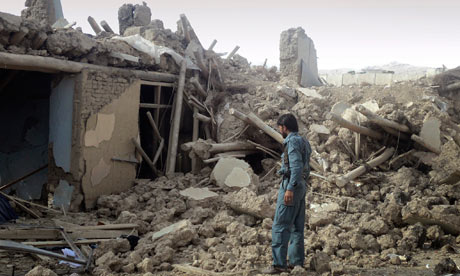
Pakistan intelligence accused of ignoring warnings about a truck bomb that wounded 77 and killed five. Photograph: Mohammad Naser/AP
The American commander of [Nato](http://www.guardian.co.uk/world/nato) in [Afghanistan](http://www.guardian.co.uk/world/afghanistan) personally asked [Pakistan](http://www.guardian.co.uk/world/pakistan)'s army chief to halt an insurgent truck bomb that was heading for his troops, during a meeting in Islamabad two days before a huge explosion that wounded 77 US soldiers at a base near Kabul.
In reply General Ashfaq Kayani offered to “make a phone call” to stop the assault on the US base in Wardak province. But his failure to use the American intelligence to prevent the attack has fuelled a blazing row between the US and Pakistan.
Furious American officials blame the Taliban-inspired group the Haqqanis – and, by extension, Pakistani intelligence – for the 10 September bombing and an even more audacious guerrilla assault on the Kabul US embassy three days later that killed 20 people and lasted more than 20 hours.
On Thursday the US military chief, Admiral Mike Mullen, described the Haqqanis as “a veritable arm of Pakistan’s Inter-Services Intelligence [spy] agency”. He earlier accused the ISI of fighting a “proxy war” in Afghanistan through the group.
Pakistan’s defence minister, Ahmed Mukhtar, rejected the American accusations of Haqqani patronage as “baseless”. “No one can threaten Pakistan as we are an independent state,” he said.
The angry accusations lift the veil on sensitive conversations that have heretofore largely taken place behind closed doors. On 8 September, General John Allen, the Nato commander in Afghanistan, raised intelligence reports of the impending truck bomb at a meeting with Kayani during a visit to Islamabad.
Kayani promised Allen he would “make a phone call” to try to stop the attack, according to a western official with close knowledge of the meeting. “The offer raised eyebrows,” the official said.
But two days later, just after Allen’s return to Kabul, a truck rigged with explosives ploughed into the gates of the US base in Wardak, 50 miles south-west of Kabul, injuring 77 US soldiers and killing two Afghan civilians.
Afterwards the US ambassador to Kabul, Ryan Crocker, blamed the Haqqanis. “They enjoy safe havens in North Waziristan,” he said, referring to the Haqqani main base in the tribal belt.
Allen’s spokesman said Nato “routinely shares intelligence with the Pakistanis regarding insurgent activities” but he refused to confirm the details of the conversation with Kayani.
The Pakistani military spokesman, General Athar Abbas, said: “Let’s suppose it was the case. The main question is how did this truck travel to Wardak and explode without being checked by Nato? This is just a blame game.”
US allegations of ISI links to Haqqani attacks stretch back to July 2008, when the CIA deputy director, Stephen Kappes, flew to Islamabad with intercept evidence that linked the ISI to an attack on the Indian embassy in Kabul.
But American disquiet has never been so uncompromisingly expressed as in recent days. The issue dominated three hours of talks between the secretary of state, Hillary Clinton, and the Pakistani foreign minister, Hina Rabbani Khar.
On Tuesday Mullen said he had asked Kayani to “disconnect” the ISI from the Haqqanis. In Washington the CIA chief, David Petraeus, delivered a similar message in private to the ISI chief, General Shuja Pasha. Even the soft-spoken US ambassador to Islamabad, Cameron Munter, has joined the chorus of condemnation, delivering a hard-hitting message through an interview on Pakistani state radio.
“We’ve changed our message in private too,” one US official said. “Before, we used to make polite demands about the Haqqanis. Now we are saying ‘this has to stop’.”
The new mood is driven by a combination of climbing casualties and brazen attacks. The Haqqanis were also blamed for a recent assault on the InterContinental Hotel, while August was the deadliest month for US forces in Afghanistan, with 71 deaths.
Nato is now investigating whether the Haqqanis had a hand in Tuesday’s assassination of Burhanuddin Rabbani, President Hamid Karzai’s peace envoy to the Taliban. Rabbani was killed at his home by a suicide bomber wearing an explosives-packed turban. A bloodstained four-page letter he was carrying at the time of the attack, a copy of which has been obtained by the Guardian, insisted that “Pakistan is not our boss”.
American officials have vowed to act unilaterally if Pakistan fails to comply with their demands over the Haqqanis. But it remains unclear how far they are willing to go against Pakistan, a nuclear-armed country that still provides vital counter-terrorism support.
There was some hope of resuscitating fragile relations between the Pakistani and American intelligence services, which were buffeted by the US raid that killed Osama bin Laden on 2 May. Officials from both countries hailed a joint operation on 28 August to arrest Younis al-Mauritani, a senior al-Qaida operative, in the western city of Quetta. On 5 September the Pakistani military issued a press release that highlighted Pakistani-American co-operation; some viewed the raid as a possible turning point in relations.
But the flurry of Haqqani attacks over the past two weeks seems to have washed away whatever goodwill was generated by the arrest.
US officials say debate is raging inside US policy circles about what to do next. The defence secretary, Leon Panetta, is said to have privately advocated US military incursions into the Haqqani stronghold in Waziristan – a risky gambit other officials reject as dangerous folly, citing the historical record of failure of western armies in the tribal belt.
Other US officials say Washington could slash non-military aid such as the $7.5bn five-year Kerry-Lugar-Berman package, which was approved in 2009.
There is also debate about the exact nature of the ISI’s relationship with the Haqqanis. One western official said it was not a puppetmaster scenario. “It’s not like they have a chain of command, with the Pakistanis handing down XOs [executive orders],” he said. Neither are the Pakistanis necessarily providing logistical support, he added: “It’s murkier than that.”
But, the official added, the US believes Pakistan is “actively tolerating” the Haqqanis. And the ISI could, if it wanted to, seriously disrupt their activities.
He warned that Pakistan was heading towards international isolation. “If it keeps going like this, it could end up like Syria – before the Arab spring.”
Re: Pakistan ‘backed Haqqani attack on Kabul’ - Mike Mullen
Ehsan,
Those are rhetorical points. If a large military deployment can stop a proxy/militant force then the Soviets would have never been defeated nor would Pakistani “strategists” be claiming that they defeated a superpower. What Americans are accusing us of is being a state sponsor of terror in all but name. Americans will of course downplay that the Taliban have local support in many Afghan areas, but we cannot deny with a straight face that they are not in Pakistan. This is scape goating for sure but it is also an open secret that the Haqqani group is seen by our military as “our boys”.
Re: Pakistan ‘backed Haqqani attack on Kabul’ - Mike Mullen
america khatam ho-gaya afghanistan meh andar, they have to blame somebody for their failure, so puppet number 1 zardari and slave government get blame!
Re: Pakistan ‘backed Haqqani attack on Kabul’ - Mike Mullen
You got a point, Amreekans after 10 years of one victory after another are now looking for a way out, what better way to blame it on Pakis and get done with. It is bad when Pakis say talk to Taliban but it is good when amreeka talks to them. The same Taliban are equivalent of Amreekas founding father when they are on Amreekan side but if they are not they are terrorist… I can sum it up in just few words, “Amreeka you are f…ked” its just a matter of time you declare full victory and tuck…
Here are some hard facts that americans would find very hard to swallow.
America’s SPECTRE syndrome in Afghanistan
By Ejaz Haider
Ernst Stavro Sirajuddin Blofeld Haqqani is now running SPECTRE (SPecial Executive for Counter-intelligence, Terrorism, Revenge and Extortion), renamed in Afghanistan as the Haqqani Network.
All the troubles of the US and its allies stem from this reincarnation of SPECTRE. The only entity that can take care of this shadowy organisation is Pakistan. ** The capacity of this organisation to trouble America is exclusively owed to its ability to retire to North Waziristan after striking inside Afghanistan, sometime as deep as in Kabul. Its members seem to be able to fly in and out of Afghanistan, undetected, despite the presence there of US, Nato and Isaf troops.
It’s the only entity that is hampering the US from neatening up Afghanistan. Get rid of the Network and Afghanistan will be fine — the government will work, the Taliban will vanish, corruption will end, pluralism will flourish, democracy will take root, Afghan society will enter the 21st century, America will be safe and everyone will live happily ever after.**
Am I being reductive? Please read the long report by the Combating Terrorism Centre at West Point which argues that the most “underappreciated dimension” of the Haqqani network is its “global character” and the “central role it has played in the evolution of al-Qa’ida and the global jihadi movement”. Read also the report about the meeting between US Secretary of State Hillary Clinton and Pakistan’s Foreign Minister, Hina Rabbani Khar ,where the “first and last thing” on the agenda was the Haqqani Network and the September 13 Kabul attack.
**The fact is that the Afghanistan problem is not just about the Haqqani Network. Afghanistan has multiple problems, most of which have nothing whatsoever to do with the Haqqanis. Even if the Haqqani Network were entirely taken out, Afghanistan would remain largely the same. In fact, if the only stumbling block between an Afghanistan gone bad and an idyllic Afghanistan were the Network, Afghanistan would have been a piece of cake, not the wicked problem it has become.
Secondly, if the insurgency in Afghanistan was only run by the Haqqanis, JSOC (Joint Special Operations Command) would not be conducting thousands of night operations for the last year-and-half across all of Afghanistan, operations that are terribly unpopular.
Thirdly, if use of force was the only answer to Afghanistan’s problems, the US would have, by now, brought it under control. But the use of force, by itself, is clearly not enough. As Mr Abdullah Abdullah told me in April in Washington, what is missing is the ability of the Afghan government to reach out to its people. It is common knowledge that the Afghan governors cannot even survive in their respective vilayats without striking some kind of deal with the Taliban commanders in the area.
Fourthly, the three spectacular attacks in recent weeks, beginning with the downing of a Chinook carrying a SEAL team, the suicide attack that injured 70 US troops, both in Maydan Wardag, and now the September 13 Kabul attack clearly show that the line of communication of the insurgents cannot stretch back to North Waziristan. All these attacks have happened deep inside the Afghan territory and indicate the steady loss of control of territory by the Afghan government and the foreign troops.
If, for the sake of the argument it is conceded that the Taliban line of communication does extend back to North Waziristan, then the ability of the fighters to go deep in and mount attacks makes an utter mockery of the military and intelligence capabilities of the US and its allies despite the tremendous resources at their disposal.
Fifthly, as should be clear from Sirajuddin Haqqani’s interview to Reuters, his fighters are not based in North Waziristan. It makes eminent sense for him to have relocated to the Loya Paktia given the heightened frequency of the drone attacks in North Waziristan and the fact that the Network controls the three provinces of Khost, Paktia and Paktika. They are also unlikely to be based either in Dande Darpa Khel in North Waziristan or Zambar in Khost, both locations known to intelligence agencies.
Finally, Siraj’s interview dispels the propaganda that the Haqqani Network is Al Qaeda. Instead, Siraj told Reuters that “we would support whatever solution our shura members suggest for the future of Afghanistan”, a clear reference to the Afghan Taliban leadership. Siraj also said that they rejected previous attempts at talks by the US and the Afghan government because those overtures were aimed at “creating divisions” among the Taliban. It is therefore misleading to suggest that the Haqqanis operate outside the overall strategic objectives of the Taliban.**
Siraj’s interview and signalling is in line with Mullah Omar’s Eidul Fitr message, which dealt with three basic points: the Afghanistan-specific focus of the Taliban; their readiness to negotiate meaningfully, and a warning to the neighbours to desist from interfering in Afghanistan’s internal affairs. Another important motif running through that message was Taliban’s an inclusive approach to governance. In that, this year’s Eid message is very different from the one Mullah Omar delivered last year which rejected negotiations and called for the trial of President Hamid Karzai and his political coterie.
A few quick points need to be made. The US has come round to talking to the Taliban despite some opposition to this dialogue both in Washington and Kabul. Most leading Afghan experts around the world think this is the only way forward, especially — and this is crucial — if the Taliban accept that they cannot rule Afghanistan to the exclusion of other entities. There are clear indications, and Maulana Fazlur Rehman confirmed it to some of us at a recent SAFMA (South Asian Free Media Association) meeting in Lahore, that they understand and appreciate this. Given this, and given rising opposition by the Afghans, including officials, to the use of force by the US in Afghanistan, Washington should fast track this dialogue instead of asking Pakistan to open another front for itself by going into North Waziristan. The dialogue is where Pakistan needs to play a positive role because that is where its interests must converge with that of the US.
Maulana Fazlur Rehman also backed my argument that any policy needs to make a clear distinction between the Afghan Taliban and the TTP and its affiliates. The time to go into North Waziristan would be after the US-Taliban talks have reached an advanced level. That would help Pakistan greatly in dealing a blow to the TTP network.
For all the right reasons the US and Pakistan need to cooperate rather than getting into a game of brinkmanship.
Re: Pakistan ‘backed Haqqani attack on Kabul’ - Mike Mullen
The government is not weak as people think. They are not completely powerless. They do not have the control of the defence policy but those who control it have made a big enough mess as it is. The US supports the Pakistan Gov and has successfully divided and ruled the Gov andthe Pak Army.
The Army is a big organisation but incompetent. Thats what happens when greedy Generals run the show.
It does not matter how powerful or weak the Army and Government is - neither reflect the interests of the people, both exploit the resources in Pakistan for their own individual greed, both have done nothing for Pakistan.
Re: Pakistan ‘backed Haqqani attack on Kabul’ - Mike Mullen
Well if the Americans had the information about the truck bombing, and if Pakistan had failed to act upon that, the truck would have crossed the border and travelled within Afghanistan for a couple of hours before attacking them. What about border controls and the American claims that peace has been restored and the terrorists defeated in afghanistan, is it now pakistan’s responsibility to fight them in Afghanistan too. This news seem to be an admittance of defeat by the americans
Re: Pakistan ‘backed Haqqani attack on Kabul’ - Mike Mullen
yes Pakistan as a country is a scapegoat as well, they are themselves providing sanctuaries to terrorists in Eastern Afghanistan but still Pakistan is responsible
Re: Pakistan ‘backed Haqqani attack on Kabul’ - Mike Mullen
Interesting theory? So why arent the Americans destroying Taliban sanctuaries in eastern Afghanistan which they are using to attack Pakistan. Are they turning a blind eye or are they incompetent? which one?
Re: Pakistan ‘backed Haqqani attack on Kabul’ - Mike Mullen
agreed but my main point is that when Taliban use their bases in eastern Afghanistan to attack Pakistan where are the American forces, why can’t they stop them, after all they like to boast about how well equipped and modern technology they possess. is it connivance on their part or incompetence. Therefore they should look at their own deeds before openly attacking Pakistan all the time. Just like when Pakistan wants to talk to Taliban it is bad, yet they themselves are quite happy to talk to “good” Taliban.
Re: Pakistan ‘backed Haqqani attack on Kabul’ - Mike Mullen
Most people in Khyber Pakhtunkhwa and the Tribal Belt believe that the Pakistan Army and ISI actually are in connivance with the Taliban and aid these attacks to happen. There is an element of this no doubt when Swat was slipping out of government control both Taliban and Army had checkpoints within metres of one another.
The view is that if Pakistan shows the militancy is still strong they will receive more aid.
Re: Pakistan ‘backed Haqqani attack on Kabul’ - Mike Mullen
THis is all bull****. The Haqqani network was established and has been a proven CIA asset for 10 years. Now they do what they want. The network has never hit Pakistan ever so why should we go after them.
Its amazing all these people get so close to things yet ISAF and the ANA can not stop them from travelling from Pakistan all the way to Kabul. Talk about a ****ing lapse in security.
Re: Pakistan ‘backed Haqqani attack on Kabul’ - Mike Mullen
I have heard the American military being called many things, but incompetent is not one of them.
I am sure they are too busy fighting the Taliban that attack them personally, than to go after some apparent Taliban who attack Pak Army - who help ‘different’ Taliban attack the US.
Let’s not put our head in the sand about the role of the ISI in helping some Taliban attack the US, and the consequences that can have for the whole country.
Re: Pakistan ‘backed Haqqani attack on Kabul’ - Mike Mullen
ISI just can’t seem to get rid of “good extremist” mentality.
But this time around the government is fully backing ISI. Khar threatened US with losing an ally if this continues.
If ISI/Pak do not support Haqqani network then they should take actions against them. Their excuse that of having not enough resources is losing steam. If Pakistan does not want to lose US as ally, if Pak does not support Haqqanis, if Pak wants to get rid of all militancy, then it must take SOME action against Haqqanis.
I think there are some people here whose sole purpose is to get rid of American influence in Pakistan. This pushes them to deny links between ISI and Haqqani. But the right thing for such people to do is to say it clearly. That they want America out, and that’s why they oppose everything America does.
I want America out too, but not at the expense of accepting extremist fanatics in any form. If I have to choose between the two evils then I would choose Amreeka.
Re: Pakistan ‘backed Haqqani attack on Kabul’ - Mike Mullen
**The Pakistani military spokesman, General Athar Abbas, said: “Let’s suppose it was the case. The main question is how did this truck travel to Wardak and explode without being checked by Nato? This is just a blame game.”
**I think Athar Abbas hit the nail on the head. If Mullen claims that US warned Pakistan two days before that a truck laden with explosives was heading from Pakistan to the US embassy in Kabul, how come they (NATO) were unable to stop this truck in the interventing period?
Re: Pakistan ‘backed Haqqani attack on Kabul’ - Mike Mullen
The bottom line is that during the past few months the Americans have been lying to their public that they have won the war, now their withdrawal time is coming and they are seeing their actual position there. Anyways what the Americans are facing in Afghanistan the British and Russians have seen before them. Now the Americans need an excuse and scapegoat to show to their public, anyways it’s not pakistans responsibility to clear the terrorists holed up in eastern Afghanistan nor can our army check trucks deep within Afghanistan.