THIS SHOULD NOT BE TERMED AS A NEW TOPIC OR THREAD
This is one of the finest article I have gone through
and I want to share this with all at paklinks forum
that they may get the gist of the GOOD OLD DAYS!
A must read…
(Raju)
OVER VIEW: Maternal instincts
BY FOUZIA MAPARA
(for DAWN)
The enigma known as the filmi maan comes in all shapes, sizes and intensities. What would a Lollywood/Bollywood flick be without the proverbial maan, worth every yard of her sari in gold because time and again they’ve proved their mettle.
My earliest memory of the filmi maa is of Santosh Rassal. A black shawl draped round her shoulders, a georgette sari ka pallu (or was it chiffon) around her (heavily powdered) gray backcombed hair, she stood stoic facing the camera, her back to the protagonist in the film, issuing orders that would added the most convoluted twist to the ensuing melodrama.
Here is an attempt to celebrate the enigma known as the filmi maan — the mother of all mothers. She comes in all shapes, sizes and intensities. Be it the slender, tearful Nayyar Sultana or the robust, sweaty Nirupa Roy from across the border, what would a Lollywood/Bollywood flick be without the proverbial maan, worth every yard of her sari in gold because time and again they’ve proved their mettle. They generally come as: The head-banger, the sewing machine sicko, the wheelchair-bound wheeler dealer, the kalub queen and the devil wields a gun(dasa).
The Head-Banger: Played in numerous Pakistani films by Sabiha Khanum as well as Deeba, Bahar Begum and the late Najma Mehboob, perhaps the best was Bollywood’s Nirupa Roy. Through the intense film plot, she went through several accidents where she hits her head hard almost anywhere but the kitchen sink.
For instance on the bonnet of a car or near the gods on the temple and life changes for her completely, and the story takes a different tangent altogether. Bad luck trials this well-fed and robust-looking woman who gives birth to twin sons on a stormy night (yes you have to hear the painful childbirth screams and see her contorted face). Or she could be on a train on her way back from a yatra to Buleshwar, soon to be thrown out of her in-laws’ house because of some deranged gose delusion. Or she would be attacked in her house by the villain who kills her husband right before her eyes leaving the poor woman clad in a blood-stained sari with no option but to flee the house amidst rain, thunder and lightning while clutching her babies, only to be run over by a car. Had it been a second-fiddle actress or extra, she might die right there but if it’s Nirupa Roy, trust her to pass out only to regain consciousness but completely blind; one of her babies lost while the other has been rescued by a kindred spirit along with her by a pandit from a nearby temple (the images of these dieties take violent swings, clockwise and anti-clockwise, before her fate is finally decided).*
The second head bang would make her lose her memory or bring back her eyesight, while the final smack of the head near the end of the second-half reunited her with her now fully grown-up sons, with the added bonus of memory and/or eyesight regained.
Tears, sweaty armpits and blood, Nirupa Roy had it all. Throughout her ordeal never did her love once falter for her dead husband, nasty and wicked in-laws nor for her lost offspring. Nor did the red stain on the left side of her forehead bandage fade or darken from the bright tomato ketchup red. This was the type of maa Amitabh Bachchan and Shashi Kapoor fought over in the Bollywood blockbuster Deewar.
The Sewing Machine Sicko: Her skill may have been sewing but the real act was to cough and splutter till she nearly collapsed over the sewing machine on the charpoy or takht as the audience died of sympathy and guilt. Wearing thick glasses, a pathetic look of misery and self-indulgence, dupatta-covered head bent over the sowing machine, Tammana, Zeenat, Sabiha Khanum, Bahar Begum, Najma Mehboob and Meena Dawood would stitch clothes to feed a poverty-stricken family until the beautiful and jawan daughter decided to take up a kalubb dancing (on the sly), or become the wealthy leading man’s secretary to marry him in the end and relieve everyone of their misery, including the poor viewers.
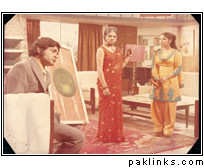
A momentous day in her life would be when her son played by an aging Mohammed Ali, Nadeem or Waheed Murad, would dash into the room announcing “Maa, mein paas hogaya, maa”. In the worst case scenario, her coughing would progress into full-fledged tuberculosis and she would die way before intermission.
The Wheelchair-bound Wheeler Dealer: Best played by Sabiha Khanum, Meena Dawood and Nayyar Sultana, this was the authoritarian mother who couldn’t stand on her own two feet (literally speaking) but managed the wealth, land and haveli, stuck to the values and virtues of her feudal khandan, izzat and abroo! On slight suspicion of her son drinking, he would receive a deserving slap across the face (the thunderous sound of the palm of her hand meeting his cheek would put to shame even that of Hurricane Katrina), and before one could say the word ‘booze’, her decision would change everyone’s destiny in the film.
(Nayyar Sultana)
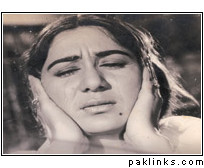
She would sit holding the wheels of her wheelchair, refusing to compromise with her rebellious son or daughter, would shoo away the domestic servants or the munshiji who had served this woman and her megalomaniac family for donkey’s years. Of course, when left absolutely alone, she would swing her wheelchair to face the garlanded picture of her dead husband and vociferously share her tearful, personal turmoil that she suffers in her gallant efforts to protect the khadani waqar and zeenat.
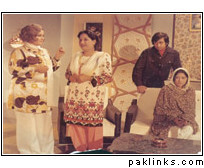
The Kalub Queen: The most entertaining after the Head Banger, this one wore saris, fashionable glasses, elaborate hairpieces and loads of jewellery. Representing the Lollywood version of an elite socialite, this ‘mummy’ was best played by Atiya Sharf holding a long cigarette holder to her pursed mouth, and much later by Zeba Shahnaz who flew around in a helicopter in the less dazzling era of Lollywood. These women were the epitome of the modern (read modren) society, hence encouraged their spoilt bratty daughters Husna, Mumtaz or Sangeeta to go to the kalub, get up late, throw themselves on the bed in a wild tantrum and wine, dine and dance with sleazy-looking men and immoral women. An offshoot of this role was played by Sabiha Khanum in Ek Gunnah Aur Sahi, where she won an award at the Tashkent Film Festival.
Indian character actress Shashikala was a delight to watch in this genre. It was also fun to watch the holier-than-thou bahu played by either Shabnam or Zeba enter the scene and help the wicked modern mother and daughter out of the mess they usually got themselves into.
***The Devil wields a Gun(dasa): She was in a class of her won — the epitome of martriachal power in the rural Punjab setup. Her sons worship her, her bahus love her. The lacha-clad, gun/gundasa toting bebe of Punjabi cinema was and still is best played by Bahar Begum. She is a totally neurotic case who is out to take revenge from the killers of her husband through her bloodthirsty son — either the late heavy-duty Sultan Rahi or Shan sporting a handlebar moustache. Flanked by her buxom bahu played by Anjuman (now Saima), she has absolutely no fears. She can face Mustafa Qureshi, Shujaat Hashmi or Shafqat Cheema and their army of goons, rave and rant about how Gujjars take revenge. Finally, the emotional tongue-lashing, including half-obscene references to having breastfed her son and some badly edited rifle stunts, brings about a predictable end to the tumultuous storyline, but only after a climax oozing with blood and gore.