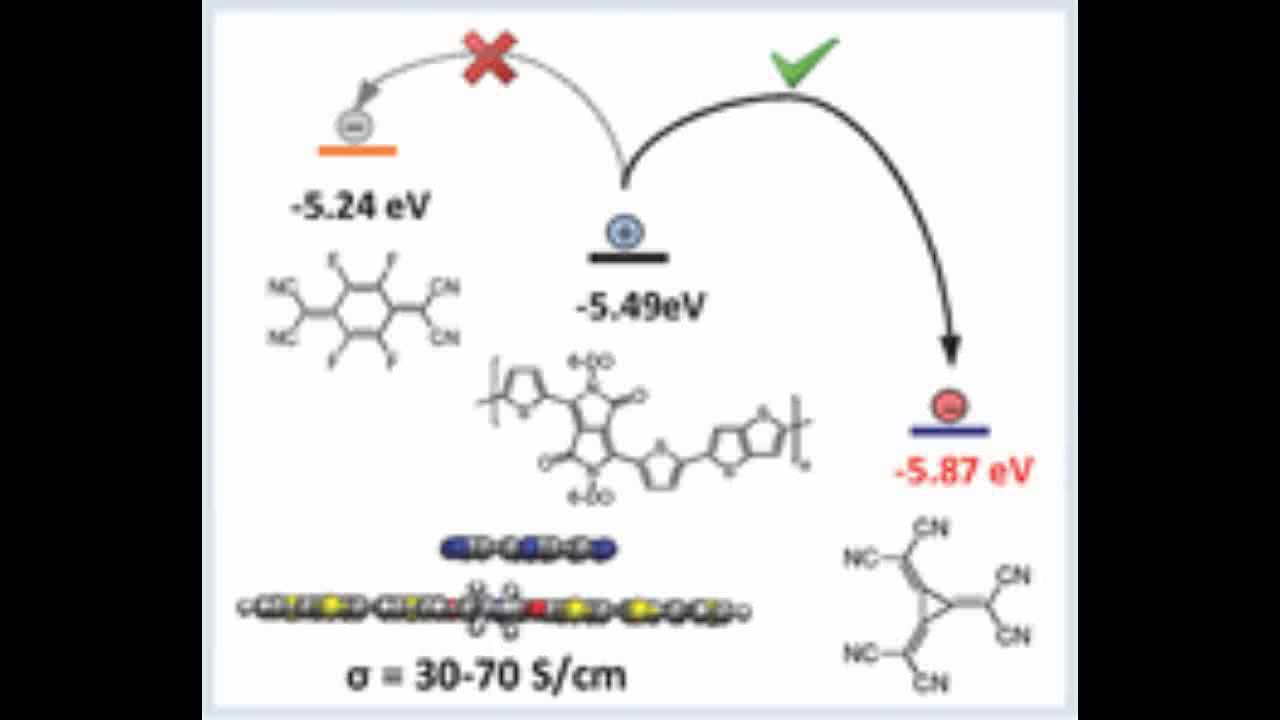
Scientists from the Moscow State University together with colleagues from Germany have found that a derivative of [3]-radialene, a molecule known to the science for nearly 30 years, can be used to create organic semiconductors.
The researchers believe that the achievement will greatly contribute to the development of organic electronics and, in particular, to fabrication of organic light emitting diodes and new classes of organic solar cells.
Organic or “plastic” electronics is a relatively young scientific field, which came to life about 15-20 years ago. Its purpose is the development of electronic devices based on organic materials. This type of devices is yet inferior to the standard silicon-based electronics in terms of performance, and also less durable. But it also has advantages – lightness, thinness, flexibility, transparency, and most importantly – plastic electronics is much cheaper than silicon. The main applications of organic electronics include solar cells, which will be much cheaper than the silicon-based modules. Also, organic electronics can be used to design organic light emitting devices and field-effect transistors.