**Creeping Militarization of the Society
**With Musharraf perhaps on the verge of announcing a decision to retire from the Army, I went looking for some articles that best sum up his legacy. To me, it is a legacy of creeping militarization, destruction of institutions and insurgencies in FATA and Balochistan. On the economic front, there is a relatively robust GDP growth but its affects on the poor have been minimal. How do u think history will remember his era?
Musharraf’s Military Reaches Deep Into Pakistani Society****
By Griff Witte
Washington Post Foreign Service
Wednesday, June 27, 2007; Page A12
DAULAT NAGAR, Pakistan – Nusrat Riaz, a doctor for 17 years, has spent the past three directing a clinic that provides care to thousands of poor patients in this remote, wheat-farming village on the plains of Punjab.
So Riaz was surprised this spring when he learned the government had appointed a monitor to look over his shoulder as he worked. He was even more surprised when he learned the man had no medical background, had no experience supervising doctors and was functionally illiterate.
But when Riaz learned the monitor was a retired Pakistani army officer, it all made sense. “This is part of the militarization of the entire country,” said Riaz, 46. “It is very insulting, and it is happening because of the man sitting at the top.”
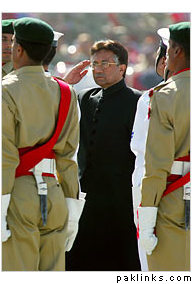
That man, Gen. Pervez Musharraf, the president, has been Pakistan’s leader for almost eight years. In that time, the nuclear-armed military has quietly exerted its influence over nearly every segment of Pakistani society.
Active-duty or retired officers now occupy most key government jobs, including posts in education, agriculture and medicine that have little to do with defense. The military also dominates the corporate world; it reportedly runs a $20 billion portfolio of businesses from banks to real estate developers to bakeries. And everywhere lurks the hand of the feared military-led intelligence services.
Yet in a country where the military has long been immune from criticism, its extraordinary power is now drawing open contempt from civilians. A campaign against Musharraf that began three months ago, following his suspension of the chief justice, has exploded into a full-fledged movement to oust the armed services from civilian life and send the generals back to their barracks.
They are not expected to go easily, and the wealth and influence they have attained during the Musharraf era helps explain why.
“If the generals don’t recede, I fear a civil-military conflict,” said Zafarullah Khan, a leading Pakistani lawyer and opposition figure. “Ultimately the question is: Who gets to rule? Sixteen generals or 160 million people? Sooner or later we have to decide that once and for all.”
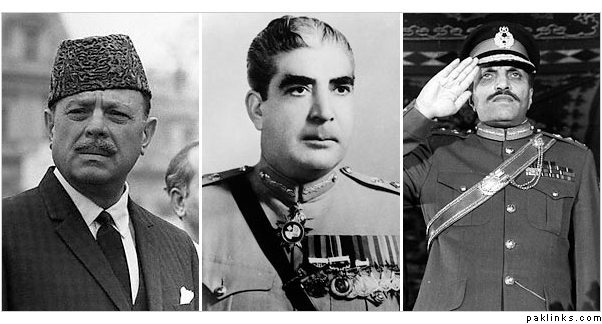
History in Pakistan is on the generals’ side. They have ruled the country for more than half of the 60 years since independence. Even when civilians have ostensibly been in charge, they have had to bow to the military just to keep their jobs. Of the nation’s past three civilian leaders, two are in exile and one was hanged.
Musharraf’s brand of military rule has been different from most. Since coming to power in a bloodless coup in 1999, he has not declared martial law. As army chief, he still wears his uniform, but just as often opts for a business suit or traditional shalwar kameez. For the most part, he eschews grand, strutting military parades. Soldiers are a rare sight on the nation’s streets.
Yet the military’s imprint is everywhere.
It’s by the side of the road, where men in orange jumpsuits labor for a military-run foundation that controls a huge share of the nation’s construction industry. It’s also present up and down the ranks of the civilian bureaucracy, where government workers answer to retired military men and complain that loyalty is consistently rewarded over hard work or competence. And it’s in Riaz’s health clinic, where his doctors say they take heat from army inspectors if they spend more than 10 minutes with a patient.
](http://www.dailytimes.com.pk/default.asp?page=2007\06\29\story_29-6-2007_pg7_9)****Ex-army officers train bureaucrats
By Azaz Syed
ISLAMABAD: Top training institutions for bureaucrats are headed by retired military officers, Daily Times has learnt.
A report has been submitted to the National Assembly Secretariat in reply to a question raised by MNA Dr Farid Ahmed Piracha. It has disclosed that Maj Gen (r) Sikandar Shami is the director general of the Civil Services Academy (SCA), Lahore. The SCA is a unique academy where all newly selected bureaucrats are trained.
National Institute of Public Administration (NIPA), where officers get training before being promoted from grade 18 to 19, is run by retired army officers, says the report.
Maj Gen (r) Khalid Naeem is the director general of NIPA Karachi, Air Commodore (r) Shaukat Haider director general of NIPA Quetta and Maj Gen (r) Akbar Saeed Awan is the director general of NIPA Peshawar.
Federal Public Service Commission (FPSC) has also been run by retired military generals over the years. Currently, Lt Gen (r) Shahid Hamid is its chairman. The retired military officer is also the chairman of the Central Selection Board (CSB), which selects the officers of grade 19, 20 and 21 and recommends the promotion into grade 22.
Pakistan Administrative Staff College, Lahore, is the top training institute for the officers waiting for promotion from grade 21 to grade 22. This institution is headed by Lt Gen (r) Javed Hassan according to the report.